Cisco certification · Exam 350-501

350-501 Mock Exam Page 17

Implementing and Operating Cisco Service Provider Network Core Technologies (350-501 SPCOR)

Free 350-501 mock exam questions 161–164, each with the answer and an explanation.

20 questions · 27 minutes · free, no sign-up

Free 350-501 questions

161–164 of 164 free
Question 161 Choose 2
Which two actions describe ISP delegation to PCE servers? (Choose two)
Show answerHide answer

Correct answer: A, B adding a new PCE server with lower precedence than the primary PCE changing the precedence of any of the PCE servers

Explanation

Explanation

In Cisco MPLS TE with Path Computation Element (PCE) delegation, the headend router delegates path computation to one or more PCE servers. The precedence of a PCE server determines its priority in the delegation list: a lower precedence value means higher priority. To influence which PCE server is used, the operator can either add a new PCE server with lower precedence than the primary PCE (making it the new preferred PCE) or change the precedence of any of the existing PCE servers (reordering the delegation priority). Both actions directly describe how ISP delegation to PCE servers is managed. This makes options A and B the correct answers.

Why the other options are incorrect:

C. Removing TE re-optimization timer timeouts
Re-optimization timers control how often TE tunnels attempt to re-optimize their paths. Removing these timers does not describe PCE server delegation and does not change which PCE server is used.

D. Entering the `mpls traffic-eng reoptimize` command
This command manually triggers TE tunnel re-optimization. It is not a delegation action to a PCE server and does not affect PCE precedence or selection.

E. Adding a new PCE server with higher precedence than the primary PCE
In Cisco IOS XR, a lower precedence value indicates higher priority. Adding a server with "higher precedence" in terms of priority would mean a lower numerical value, but the wording of this option is ambiguous and conflicts with the standard terminology. The two clear delegation actions are adding a PCE with lower precedence and changing the precedence of existing PCE servers.

Reference:
RFC 4655 – A Path Computation Element (PCE)-Based Architecture; RFC 5440 – Path Computation Element (PCE) Communication Protocol (PCEP); Cisco IOS XR MPLS Configuration Guide – Configuring MPLS TE with PCE; Cisco 350-501 SPCOR Official Cert Guide, MPLS Traffic Engineering chapter.
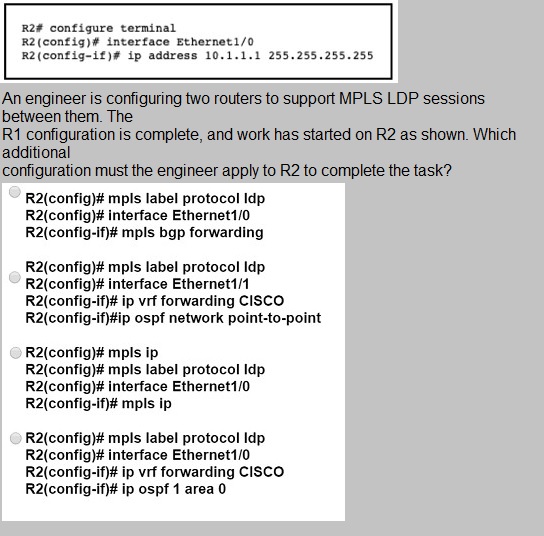
Question 162 Choose 1
Refer to the exhibit.
Show answerHide answer

Correct answer: C Option C

Explanation

Explanation

The exhibit shows R2 with `interface Ethernet1/0` configured with `ip address 10.1.1.1 255.255.255.255`. To support MPLS LDP sessions, LDP must be enabled globally with `mpls label protocol ldp` (or `mpls ip`, which enables LDP by default) and then enabled on the interface with `mpls ip`. Option C provides exactly this: it configures `mpls ip` globally, `mpls label protocol ldp` globally, and then `mpls ip` on interface Ethernet1/0. This enables LDP on the interface so that it can form LDP sessions and exchange label bindings with R1. This makes option C the correct answer.

Why the other options are incorrect:

A. Option A
It enables `mpls label protocol ldp` globally and `mpls bgp forwarding` on the interface, but `mpls bgp forwarding` is used for BGP labeled unicast, not for LDP. It does not enable LDP on the interface.

B. Option B
It enables `mpls label protocol ldp` globally but then applies VRF forwarding and OSPF point-to-point on Ethernet1/1, which is not the interface shown in the exhibit and does not enable LDP on the correct interface.

D. Option D
It enables `mpls label protocol ldp` globally but then configures VRF forwarding and OSPF on the interface instead of enabling MPLS LDP with `mpls ip`. This does not enable LDP on the interface.

Reference:
Cisco IOS XR MPLS Configuration Guide – Implementing LDP: Enabling LDP on Interfaces; RFC 5036 – LDP Specification; Cisco 350-501 SPCOR Official Cert Guide, MPLS chapter.
Question 163 Choose 3
A router is configured to perform MPLS LDP graceful restart. Which three steps are included when the RP sends an LDP initialization to a neighbor to establish an LDP session? (Choose three)
Show answerHide answer

Correct answer: A, C, D Reconnect Timeout field Graceful restart capability in OPEN message Recovery Time field

Explanation

Explanation

When an LDP router with graceful restart enabled sends an LDP Initialization message to a neighbor, it includes the Graceful Restart Capability TLV, which carries the Reconnect Timeout field and the Recovery Time field. The Graceful Restart Capability TLV is sent during session initialization to indicate that the router supports graceful restart and to specify the reconnect and recovery timers. The Learn from Neighbor (N) flag is part of the FT Reconnect TLV used during the recovery phase, not during the initial session establishment. The Learn from Network (L) flag is also not part of the initialization message. Type-9 LSA is an OSPF construct unrelated to LDP. This makes options A, C, and D the correct answers.

Why the other options are incorrect:

B. Learn from Neighbor (N) flag, set to 1
The N flag is part of the FT Reconnect TLV used during the recovery phase, not during the initial LDP session establishment. It indicates whether the restarting router should learn the FT state from the neighbor.

E. Learn from Network (L) flag, set to 1
The L flag is also part of the FT Reconnect TLV and is used during recovery, not during initialization.

F. Type-9 LSA
Type-9 LSA is an OSPFv3 link-local LSA and has no role in LDP graceful restart initialization.

Reference:
RFC 3478 – Graceful Restart Mechanism for Label Distribution Protocol (LDP); RFC 5036 – LDP Specification; Cisco IOS XR MPLS Configuration Guide – Implementing LDP: Graceful Restart; Cisco 350-501 SPCOR Official Cert Guide, MPLS chapter.
Question 164 Choose 2
Which two tasks must you perform when you implement LDP NSF on your network? (Choose two.)
Show answerHide answer

Correct answer: B, D Enable NSF for EIGRP Implement direct connections for LDP peers

Explanation

Explanation

To implement LDP NSF (Non-Stop Forwarding) on a network, the two required tasks are to enable NSF for the link-state routing protocol in use (OSPF or IS-IS) and to implement direct connections for LDP peers. LDP NSF depends on the IGP NSF to preserve the routing and forwarding state during a control-plane restart, so the IGP NSF must be enabled. Additionally, LDP NSF requires that LDP peers be directly connected, because the NSF procedures rely on the LDP session being re-established quickly and the label bindings being preserved between directly connected neighbors. This makes options B and D the correct answers.

Why the other options are incorrect:

A. Enable NSF for EIGRP
EIGRP is not a link-state protocol and is not used with LDP NSF in service provider MPLS networks. LDP NSF works with OSPF or IS-IS.

C. Disable Cisco Express Forwarding
CEF must remain enabled for MPLS LDP forwarding. Disabling CEF would break MPLS forwarding and is not part of LDP NSF implementation.

E. Enable NSF for BGP
BGP NSF is a separate feature for BGP graceful restart. While it can be used in the same network, it is not a requirement for LDP NSF.

Reference:
RFC 3478 – Graceful Restart Mechanism for Label Distribution Protocol (LDP); RFC 3623 – Graceful OSPF Restart; RFC 5306 – Restart Signaling for IS-IS; Cisco IOS XR MPLS Configuration Guide – Implementing LDP: Non-Stop Forwarding; Cisco 350-501 SPCOR Official Cert Guide, MPLS and Network Assurance sections.

That's the last free question

You've seen the free 30% (164 of 547 questions). Full access unlocks every question and full-length 350-501 mock exams (90 questions, 120 minutes), a different mock on every attempt.

Unlock full mock exam
Full mock exam

Sit the 350-501 exam before exam day

Full-length mocks with the same number of questions and the same time limit as the real 350-501 exam. Every attempt draws a new set of questions from the full bank, so you can keep going until you pass comfortably.

Get full 350-501 mock exam
  • 90questions per mock
  • 120 mintime limit
  • 547questions in the bank
  • Newmock on every attempt