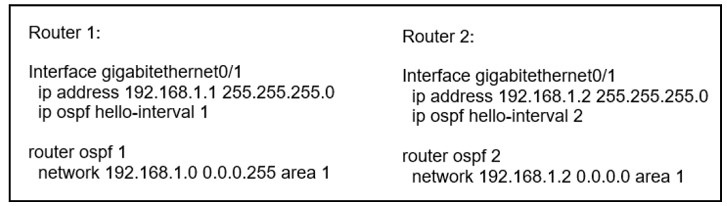
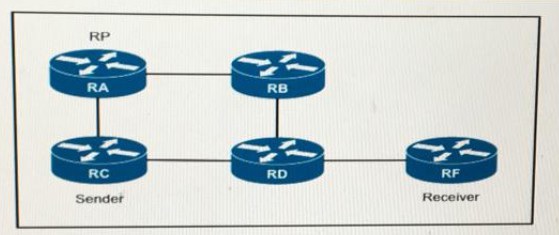
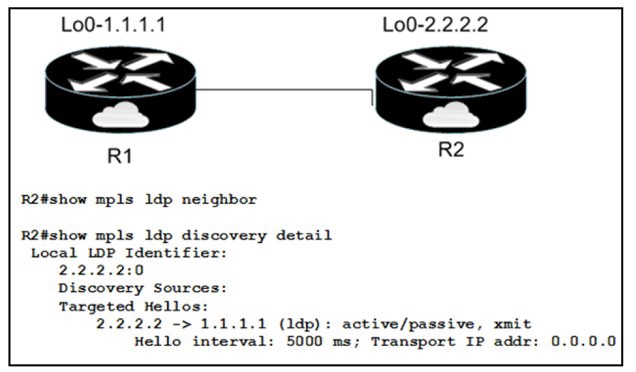
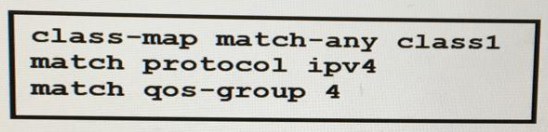
Refer to the exhibit:

Which statement supports QPPB implementation?
Which statement supports QPPB implementation?
Show answerHide answer
Correct answer: C QoS policies use BGP to gain full coverage on the network.
Explanation
ExplanationQoS Policy Propagation Through BGP (QPPB) uses BGP attributes such as AS_PATH to classify traffic and assign a QoS group, which is then used to apply QoS policies. The exhibit shows a route-policy that matches specific AS_PATH values and sets a QoS group of 10, applied to the BGP table via `table-policy`. By leveraging BGP, QPPB can classify traffic based on prefix or AS_PATH information and propagate those classifications across the network without needing to manually define QoS policies on every router. This allows QoS policies to gain full coverage on the network using BGP as the classification and propagation mechanism. This makes option C the correct answer.
Why the other options are incorrect:
A. QoS policies are identified in the MPLS forwarding table – QPPB classification is derived from BGP attributes and applied to the RIB/FIB, not specifically from the MPLS forwarding table. While QPPB can be used in MPLS networks, the identification of QoS policies is based on BGP path attributes, not the MPLS forwarding table entries.
B. QoS policies rely exclusively on BGP attributes to manipulate traffic – QPPB uses BGP attributes to classify traffic and set QoS groups, but the actual QoS treatment is carried out by QoS policies such as policing, marking, and queuing. Saying policies rely exclusively on BGP attributes is inaccurate because the enforcement is done by QoS mechanisms.
D. QPPB policies affect only egress traffic – QPPB can affect both ingress and egress traffic. QoS groups set through QPPB can be used to apply input and output policies on interfaces. Restricting QPPB to egress only is incorrect.
Reference:
Cisco IOS XR Routing Configuration Guide – Implementing BGP: QoS Policy Propagation Through BGP (QPPB); Cisco 350-501 SPCOR Official Cert Guide, BGP and QoS sections.