Cisco certification · Exam 300-710

300-710 Mock Exam Page 11

Securing Networks with Cisco Firepower (300-710 SNCF)

Free 300-710 questions on Topic 1: Deployment, each with the answer and an explanation.

20 questions · 33 minutes · free, no sign-up

Topic 1: Deployment questions

101–108 of 108 free
Question 101 Choose 1
What is an advantage of adding multiple inline interface pairs to the same inline interface set when deploying an asynchronous routing configuration?
Show answerHide answer

Correct answer: A Allows the IPS to identify inbound and outbound traffic as part of the same traffic flow.

Explanation

Explanation

In an asynchronous routing scenario (where the return path of the traffic goes through a different device or interface than the forward path), traffic might be split across multiple physical links. By adding multiple inline interface pairs to the same inline interface set, the Cisco FTD (or IPS) treats all the pairs within that set as part of a single logical traffic flow.

This is crucial because it allows the Snort engine to correlate the inbound and outbound packets (or bidirectional flows) correctly, even if they arrive on different physical interfaces. Without grouping them into the same inline set, the device would treat the traffic as separate, disconnected flows, which would break stateful inspection, TCP stream reassembly, and proper intrusion detection.

Why the Other Options Are Incorrect

B. The interfaces disable autonegotiation and interface speed is hard coded set to 1000 Mbps: This is not an advantage of grouping interfaces into an inline set; interface speed and duplex are independent configuration settings.

C. Allows traffic inspection to continue without interruption during the Snort process restart: Snort restarts (e.g., during policy deployment or MTU changes) interrupt inspection temporarily regardless of inline set configuration. This is not an advantage of multiple inline pairs.

D. The interfaces are automatically configured as a media-independent interface crossover: Auto-MDIX is a physical layer feature that handles cable pinouts. It is not related to inline set grouping.

Reference

Cisco Documentation: "Cisco Firepower Management Center Configuration Guide" – Section on Inline Sets, which explains that multiple inline pairs in the same set allow the device to treat traffic as a single flow for stateful inspection and asynchronous routing.
Question 102 Choose 1

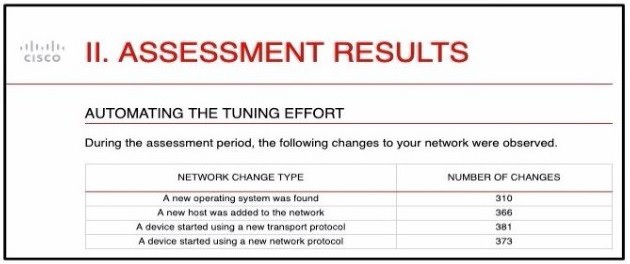
Refer to the exhibit.

And engineer is analyzing the Attacks Risk Report and finds that there are over 300
instances of new operating systems being seen on the network How is the Firepower
configuration updated to protect these new operating systems?

Show answerHide answer

Correct answer: B

The administrator requests a Remediation Recommendation Report from Cisco
Firepower

Explanation

Explanation

Exhibit mein "Automating the Tuning Effort" ke under network changes dikhaye gaye hain, jaise ke 310 naye operating systems detect hue hain. Jab Cisco Firepower ko naye operating systems ya vulnerabilities network par milte hain, to administrator ko manually policies dhoondhne ki zaroorat nahi hoti.

Firepower Management Center (FMC) mein Remediation Recommendation Report generate karne ka feature hota hai. Ye report analyze karti hai ke newly discovered hosts/operating systems ke liye kaun se intrusion rules enable karne chahiye taake unhe protect kiya ja sake. Ye report administrator ko recommendations deti hai, jisse woh efficiently apni policies update kar sakta hai aur naye threats se network ko bacha sakta hai.

Why the Other Options Are Incorrect

A. Cisco Firepower automatically updates the policies: Firepower automatic tuning nahi karta. Usse explicitly report request karni padti hai taake recommendations mil sakein aur policies apply ki ja sakein.

C. Cisco Firepower gives recommendations to update the policies: Ye option B ke qareeb hai lekin sahi procedure ye hai ke administrator ko Remediation Recommendation Report request karni hoti hai. Sirf "gives recommendations" kehna poora process explain nahi karta.

D. The administrator manually updates the policies: Naye operating systems ke liye saare rules manually dhoondhna bahut mushkil aur time-consuming hoga. Firepower ka Remediation Recommendation Report feature is manual effort ko automate karta hai.

Reference

Cisco Documentation: "Cisco Firepower Management Center Configuration Guide" – Section on Remediation Recommendations, which explains how to generate a report to identify and enable the appropriate intrusion rules for newly discovered hosts and operating systems.
Question 103 Choose 1
An engineer has been tasked with providing disaster recovery for an organization's primary Cisco FMC. What must be done on the primary and secondary Cisco FMCs to ensure that a copy of the original corporate policy is available if the primary Cisco FMC fails?
Show answerHide answer

Correct answer: A Restore the primary Cisco FMC backup configuration to the secondary Cisco FMC device when the primary device fails.

Explanation

Explanation

To provide disaster recovery (DR) for a primary Cisco Firepower Management Center (FMC), the most reliable and automated method is to configure FMC High Availability (HA). By pairing a primary (active) FMC with a secondary (standby) FMC, the system continuously synchronizes the configuration, including all policies (Access Control, Intrusion, NAT, VPN, etc.), event data, and system settings. If the primary FMC fails, the secondary FMC automatically takes over the management of the managed devices, ensuring that the organization's policies remain available and enforced with minimal downtime.

Why the Other Options Are Incorrect

A. Restore the primary Cisco FMC backup configuration to the secondary Cisco FMC device when the primary device fails: While restoring a backup is a valid disaster recovery method, it requires manual intervention and takes time. The requirement is to ensure the policy is available if the primary fails; configuring HA provides automatic, near-instant failover without the need for manual restoration.

C. Connect the primary and secondary Cisco FMC devices with Category 6 cables of not more than 10 meters in length: Physical cabling length is not the determining factor for disaster recovery. HA can be configured across different locations (as long as latency requirements are met). The key requirement is the HA configuration itself, not the cable length.

D. Place the active Cisco FMC device on the same trusted management network as the standby device: While network connectivity between the FMCs is required for HA synchronization, simply placing them on the same network does not configure the HA relationship or provide the automatic failover and policy synchronization needed for disaster recovery.

Reference

Cisco Documentation: "Cisco Firepower Management Center High Availability Configuration Guide" – Section on FMC High Availability, which explains how HA provides automatic failover and continuous synchronization of policies for disaster recovery.
Question 104 Choose 2
Which two routing options are valid with Cisco FTD? (Choose Two)
Show answerHide answer

Correct answer: A, C BGPv6ECMP with up to three equal cost paths across a single interface

Explanation

Explanation

Cisco Firepower Threat Defense (FTD) supports multiple routing protocols and load-balancing mechanisms, but with specific platform limitations.

A. BGPv6: FTD supports BGP for both IPv4 and IPv6 address families. You can configure BGP IPv6 peers and exchange IPv6 routes, making this a valid routing option.

C. ECMP with up to three equal cost paths across a single interface: FTD supports Equal-Cost Multi-Path (ECMP) routing and allows up to 8 equal-cost paths. However, a valid ECMP configuration can consist of up to three equal-cost paths pointing to different next-hop gateways out of a single interface. This is a supported scenario for load balancing traffic.

Why the Other Options Are Incorrect

B. ECMP with up to three equal cost paths across multiple interfaces: While FTD does support ECMP across multiple interfaces, the limit is 8 interfaces/paths per ECMP zone, not three. The specific limit of "three" makes this option inaccurate.

D. BGPv4 in transparent firewall mode: Cisco documentation explicitly states that BGP is not supported in transparent firewall mode. Dynamic routing (BGP) is only supported in routed mode.

E. BGPv4 with nonstop forwarding: While FTD supports BGP Graceful Restart (a form of nonstop forwarding), the exact phrase "BGPv4 with nonstop forwarding" as a distinct, standard routing capability is not the primary valid option highlighted in the standard configuration guides compared to BGPv6 and ECMP. (Additionally, older ASA/FTD platforms had specific limitations, and this option is a distractor).

Reference

Cisco Documentation: "Cisco Firepower Management Center Configuration Guide" – Section on Routing, confirming BGP IPv6 support and ECMP capabilities (up to 8 paths).
Question 105 Choose 1
A network administrator needs to create a policy on Cisco Firepower to fast-path traffic to avoid Layer 7 inspection. The rate at which traffic is inspected must be optimized. What must be done to achieve this goal?
Show answerHide answer

Correct answer: B Configure a prefilter policy

Explanation

Explanation

In Cisco Firepower (FMC/FTD), a Prefilter Policy is used to process traffic before it reaches the main Access Control Policy and the deep inspection engines (like Snort). By configuring Fastpath rules within a prefilter policy, the administrator can quickly match specific traffic (based on Layer 3/4 criteria or specific applications) and explicitly allow it to bypass Layer 7 (Snort) inspection. This "fast-paths" the traffic, significantly optimizing the inspection rate and reducing the load on the device's CPU, which is exactly what the scenario requires.

Why the Other Options Are Incorrect

A. Enable the FXOS for multi-instance: Multi-instance is used to create separate virtual FTD devices on a single hardware appliance for tenant segmentation. It does not provide a mechanism to fast-path specific traffic around Layer 7 inspection.

C. Configure modular policy framework: MPF (Modular Policy Framework) is a Cisco ASA configuration concept. While FTD is built on some ASA foundations, the modern, GUI-driven way to achieve early traffic classification and bypass is through Prefilter policies.

D. Disable TCP inspection: Disabling TCP inspection is a dangerous practice that would break stateful tracking and security, and it is not the correct method for selectively optimizing traffic inspection rates.

Reference

Cisco Documentation: "Cisco Firepower Management Center Configuration Guide" – Section on Prefilter Policies, which explains how Fastpath rules can be used to bypass Snort inspection and optimize performance.
Question 106 Choose 1
A security engineer must configure a Cisco FTD appliance to inspect traffic coming from the internet. The Internet traffic will be mirrored from the Cisco Catalyst 9300 Switch. Which configuration accomplishes the task?
Show answerHide answer

Correct answer: D Set interface configuration mode to passive

Explanation

Explanation

When traffic is mirrored (SPAN/RSPAN) from a switch (like the Cisco Catalyst 9300) to a Cisco FTD appliance for inspection, the FTD is not physically inline with the traffic flow. It is only receiving a copy of the packets.

To configure the FTD to receive and analyze this mirrored traffic without attempting to forward it (since it's not in the actual path), the interface must be set to Passive mode. In passive mode (often used in IPS-only deployments), the interface receives traffic unconditionally for analysis by the Snort engine, but it does not transmit the traffic back out.

Why the Other Options Are Incorrect

A. Set interface configuration mode to none: "None" is not a valid interface mode for receiving and inspecting traffic in FTD.

B. Set the firewall mode to transparent: Transparent mode means the FTD acts as a Layer 2 bridge (bump-in-the-wire) and is physically inline with the traffic. If the traffic is mirrored, the FTD isn't inline, so transparent mode is not the correct deployment method.

C. Set the firewall mode to routed: Routed mode requires the FTD to act as a Layer 3 gateway with IP addresses on its interfaces. Mirrored traffic has no return path through the FTD, making routed mode inappropriate for this scenario.

Reference

Cisco Documentation: "Cisco Firepower Management Center Configuration Guide" – Section on Passive Interfaces, which explains how to configure an interface to receive mirrored/SPAN traffic for intrusion detection without disrupting the network.
Question 107 Choose 1
What is the role of the casebook feature in Cisco Threat Response?
Show answerHide answer

Correct answer: A sharing threat analysts

Explanation

Explanation

The Casebook feature in Cisco Threat Response is a collaborative workspace designed for threat investigations. Its primary role is to allow security analysts to record, organize, and share sets of observables (such as IP addresses, domains, file hashes) and investigation notes. When multiple analysts are working on an incident, the Casebook provides a centralized place to save their findings and share them with other team members, enabling efficient collaboration during threat analysis.

Why the Other Options Are Incorrect

B. Pulling data via the browser extension: While a browser extension exists that can interact with Threat Response and Casebooks, the Casebook itself is a cloud-based investigation tool. Its role is not limited to data extraction via a browser extension.

C. Triage automation with alerting: Casebooks are used for manual investigation and documentation. They do not automatically triage alerts. Automation and orchestration in Threat Response are handled through other features like Workflows.

D. Alert prioritization: Alert prioritization is typically a function of the incident management or alerting system. The Casebook is focused on documenting and sharing the investigation of observables, not on prioritizing the initial alerts.

Reference

Cisco Documentation: "Integrating with Cisco Threat Response" – States that the Casebook is used to "record, organize, and share sets of observables of interest primarily during an investigation and threat analysis."
Question 108 Choose 1
An engineer is working on a LAN switch and has noticed that its network connection to the mime Cisco IPS has gone down Upon troubleshooting it is determined that the switch is working as expected What must have been implemented for this failure to occur?
Show answerHide answer

Correct answer: B Link-state propagation is enabled

Explanation

Explanation

Inline Link-State Propagation is a feature designed to maintain network integrity in inline deployments. When a Cisco IPS/FTD is placed inline (as a bump in the wire), if one side of the inline pair loses its link (e.g., the connection to the LAN switch goes down), the device will automatically bring down the link on the other side of the pair as well.

In this scenario, the switch's network connection to the IPS has gone down. If link-state propagation is enabled, the IPS will propagate this link failure to the switch on the other side, effectively bringing down that switch's connection too. This prevents traffic from being black-holed (where the upstream router still sends traffic to the IPS, but the IPS has no path to forward it). The fact that the switch's connection went down while the switch itself is working perfectly indicates that the IPS intentionally brought the link down to propagate the failure.

Why the Other Options Are Incorrect

A. The upstream router has a misconfigured routing protocol: A routing protocol issue on the upstream router would not cause the direct physical link between the switch and the IPS to go down.

C. The Cisco IPS has been configured to be in fail-open mode: Fail-open mode means that if the IPS fails or loses power, it physically bridges the traffic so the network keeps running. It does not intentionally bring down the switch's link.

D. The Cisco IPS is configured in detection mode: In detection mode (passive/IDS), the IPS does not sit inline and drop the link; it only monitors a copy of the traffic. If it were in detection mode, the link would not go down due to the IPS.

Reference

Cisco Documentation: "Cisco Firepower Management Center Configuration Guide" – Section on Inline Sets and Link-State Propagation, which explains how link-state propagation brings down the paired interface to prevent traffic black-holing during a link failure.

That's the last free question in Topic 1: Deployment

You've seen the free 30% (108 of 362 questions). Full access unlocks every question and full-length 300-710 mock exams (55 questions, 90 minutes), a different mock on every attempt.

Unlock full mock exam
Full mock exam

Sit the 300-710 exam before exam day

Full-length mocks with the same number of questions and the same time limit as the real 300-710 exam. Every attempt draws a new set of questions from the full bank, so you can keep going until you pass comfortably.

Get full 300-710 mock exam
  • 55questions per mock
  • 90 mintime limit
  • 420questions in the bank
  • Newmock on every attempt