Amazon Web Services certification · Exam SCS-C02

SCS-C02 Mock Exam Page 8

AWS Certified Security - Specialty

Free SCS-C02 mock exam questions 71–80, each with the answer and an explanation.

20 questions · 33 minutes · free, no sign-up

Free SCS-C02 questions

71–80 of 110 free
Question 71 Choose 1

You have an S3 bucket defined in IAM. You want to ensure that you encrypt the data before sending it across the wire. What is the best way to achieve this. Please select:

Show answerHide answer

Correct answer: B

Use the IAM Encryption CLI to encrypt the data first

Explanation

Explanation: One can use the IAM Encryption CLI to encrypt the data before sending it across to the S3 bucket. Options A and C are invalid because this would still mean that data is transferred in plain text Option D is invalid because you cannot just enable client side encryption for the S3 bucket For more information on Encrypting and Decrypting data, please visit the below URL:

https://IAM.amazonxom/blogs/securirv/how4o-encrvpt-and-decrypt-your-data-with-the-IAMencryption-cl

The correct answer is: Use the IAM Encryption CLI to encrypt the data first Submit your Feedback/Queries to our Experts

Question 72 Choose 3

A company is undergoing a layer 3 and layer 4 DDoS attack on its web servers running on IAM. Which combination of IAM services and features will provide protection in this scenario? (Select THREE).

Show answerHide answer

Correct answer: D, E, F

IAM Shield

Elastic Load Balancer

Amazon GuardDuty

Question 73 Choose 1

A company's security engineer wants to receive an email alert whenever Amazon GuardDuty, AWS Identity and Access Management Access Analyzer, or Amazon Made generate a high-severity security finding. The company uses AWS Control Tower to govern all of its accounts. The company also uses AWS Security Hub with all of the AWS service integrations turned on. Which solution will meet these requirements with the LEAST operational overhead?

Show answerHide answer

Correct answer: B

Create an Amazon EventBridge rule with a pattern that matches Security Hub findings events with high severity. Configure the rule to send the findings to a target Amazon Simple Notification Service (Amazon SNS) topic. Subscribe the desired email addresses to the SNS topic.

Explanation

Explanation: The AWS documentation states that you can create an Amazon EventBridge rule with a pattern that matches Security Hub findings events with high severity. You can then configure the rule to send the findings to a target Amazon Simple Notification Service (Amazon SNS) topic. You can subscribe the desired email addresses to the SNS topic. This method is the least operational overhead way to meet the requirements.
References: : AWS Security Hub User Guide

Question 74 Choose 1

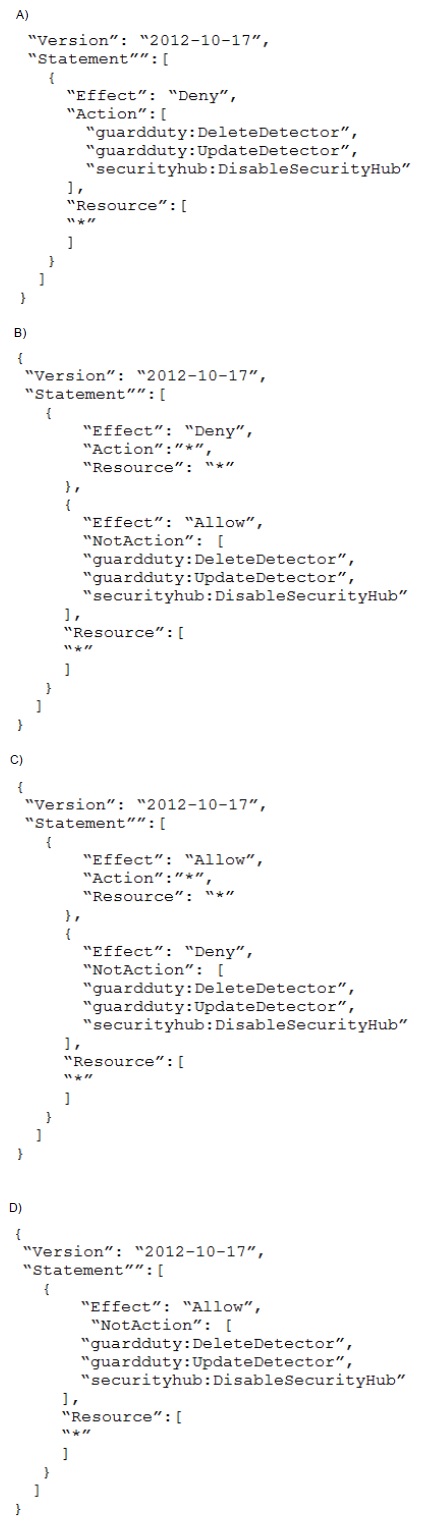
A company deploys a set of standard IAM roles in AWS accounts. The IAM roles are based on job functions within the company. To balance operational efficiency and security, a security engineer implemented AWS Organizations SCPs to restrict access to critical security services in all company accounts. All of the company's accounts and OUs within AWS Organizations have a default FullAWSAccess SCP that is attached. The security engineer needs to ensure that no one can disable Amazon GuardDuty and AWS Security Hub. The security engineer also must not override other permissions that are granted by IAM policies that are defined in the accounts.

Which SCP should the security engineer attach to the root of the organization to meet these requirements?

Show answerHide answer

Correct answer: A

Option A

Question 75 Choose 2

A company’s public Application Load Balancer (ALB) recently experienced a DDoS attack. To mitigate this issue. the company deployed Amazon CloudFront in front of the ALB so that users would not directly access the Amazon EC2 instances behind the ALB. The company discovers that some traffic is still coming directly into the ALB and is still being handled by the EC2 instances. Which combination of steps should the company take to ensure that the EC2 instances will receive traffic only from CloudFront? (Choose two.)

Show answerHide answer

Correct answer: B, C

Configure CloudFront to add a custom: HTTP header to requests that CloudFront sends to the ALB.

Configure the ALB to forward only requests that contain the custom HTTP header.

Explanation

Explanation:
To prevent users from directly accessing an Application Load Balancer and allow access only through CloudFront, complete these high-level steps: Configure CloudFront to add a custom HTTP header to requests that it sends to the Application Load Balancer. Configure the Application Load Balancer to only forward requests that contain the custom HTTP header. (Optional) Require HTTPS to improve the security of this solution.
https://docs.aws.amazon.com/AmazonCloudFront/latest/DeveloperGuide/restrict-accessto-load-balancer.html

Question 76 Choose 1

A security engineer is designing an IAM policy for a script that will use the AWS CLI. The script currently assumes an IAM role that is attached to three AWS managed IAM policies: AmazonEC2FullAccess, AmazonDynamoDBFullAccess, and Ama-zonVPCFullAccess. The security engineer needs to construct a least privilege IAM policy that will replace the AWS managed IAM policies that are attached to this role. Which solution will meet these requirements in the MOST operationally efficient way?

Show answerHide answer

Correct answer: A

In AWS CloudTrail, create a trail for management events. Run the script with the existing AWS managed IAM policies. Use IAM Access Analyzer to generate a new IAM policy that is based on access activity in the trail. Replace the existing AWS managed IAM policies with the generated IAM poli-cy for the role.

Question 77 Choose 1

A company is using Amazon Elastic Container Service (Amazon ECS) to run its containerbased application on AWS. The company needs to ensure that the container images contain no severe vulnerabilities. The company also must ensure that only specific IAM roles and specific AWS accounts can access the container images. Which solution will meet these requirements with the LEAST management overhead?

Show answerHide answer

Correct answer: C

Pull images from the public container registry. Publish the images to Amazon Elastic Container Registry (Amazon ECR) repositories with scan on push configured in a centralized AWS account. Use a CI/CD pipeline to deploy the images to different AWS accounts. Use repository policies and identity-based policies to restrict access to which IAM principals and accounts can access the images.

Explanation

Explanation:
The correct answer is C. Pull images from the public container registry. Publish the images to Amazon Elastic Container Registry (Amazon ECR) repositories with scan on push configured in a centralized AWS account. Use a CI/CD pipeline to deploy the images to different AWS accounts. Use repository policies and identity-based policies to restrict access to which IAM principals and accounts can access the images.

This solution meets the requirements because:
Amazon ECR is a fully managed container registry service that supports Docker and OCI images and artifacts1. It integrates with Amazon ECS and other AWS services to simplify the development and deployment of container-based applications.

Amazon ECR provides image scanning on push, which uses the Common Vulnerabilities and Exposures (CVEs) database from the open-source Clair project to detect software vulnerabilities in container images2. The scan results are available in the AWS Management Console, AWS CLI, or AWS SDKs2.

Amazon ECR supports cross-account access to repositories, which allows sharing images across multiple AWS accounts3. This can be achieved by using repository policies, which are resource-based policies that specify which IAM principals and accounts can access the repositories and what actions they can perform4. Additionally, identity-based policies can be used to control which IAM roles in eachaccount can access the repositories5.

The other options are incorrect because:
A. This option does not use repository policies to restrict cross-account access to the images, which is a requirement. Identity-based policies alone are not sufficient to control access to Amazon ECR repositories5.

B. This option does not use Amazon ECR, which is a fully managed service that provides image scanning and cross-account access features. Hosting a private container registry on EC2 instances would require more management overhead and additional security measures.

D. This option uses AWS CodeArtifact, which is a fully managed artifact repository service that supports Maven, npm, NuGet, PyPI, and generic package formats6. However, AWS CodeArtifact does not support Docker or OCI container images, which are required for Amazon ECS applications.
Question 78 Choose 2

A company has launched an Amazon EC2 instance with an Amazon Elastic Block Store (Amazon EBS) volume in the us-east-1 Region The volume is encrypted with an AWS Key Management Service (AWS KMS) customer managed key that the company's security team created The security team has created an 1AM key policy and has assigned the policy to the key The security team has also created an 1AM instance profile and has assigned the profile to the instance The EC2 instance will not start and transitions from the pending state to the shutting-down state to the terminated state Which combination of steps should a security engineer take to troubleshoot this issue? (Select TWO )

Show answerHide answer

Correct answer: C, D

Verify that the KMS key that is associated with the EBS volume is in the Enabled state

Verify that the EC2 role that is associated with the instance profile has the correct 1AM instance policy to launch an EC2 instance with the EBS volume

Explanation

Explanation: To troubleshoot the issue of an EC2 instance failing to start and transitioning to a terminated state when it has an EBS volume encrypted with an AWS KMS customer managed key, a security engineer should take the following steps:

C. Verify that the KMS key that is associated with the EBS volume is in the Enabled state. If the key is not enabled, it will not function properly and could cause the EC2 instance to fail.

D. Verify that the EC2 role that is associated with the instance profile has the correct IAM instance policy to launch an EC2 instance with the EBS volume. If the instance does not have the necessary permissions, it may not be able to mount the volume and could cause the instance to fail.

Therefore, options C and D are the correct answers. 
Reference: For more information, please see the Amazon AWS Certified Security - Specialty Exam Guide, p. 47-48. Also, refer to [1] "Amazon EBS encryption uses AWS KMS keys when creating encrypted volumes ...".

Question 79 Choose 2

A company uses Amazon RDS for MySQL as a database engine for its applications. A recent security audit revealed an RDS instance that is not compliant with company policy for encrypting data at rest. A security engineer at the company needs to ensure that all existing RDS databases are encrypted using server-side encryption and that any future deviations from the policy are detected. Which combination of steps should the security engineer take to accomplish this? (Select TWO.)

Show answerHide answer

Correct answer: A, D

Create an IAM Config rule to detect the creation of unencrypted RDS databases. Create an Amazon EventBridge (Amazon CloudWatch Events) rule to trigger on the IAM Config rules compliance state change and use Amazon Simple Notification Service (Amazon SNS) to notify the security operations team.

Take a snapshot of the unencrypted RDS database. Copy the snapshot and enable snapshot encryption in the process. Restore the database instance from the newly created encrypted snapshot. Terminate the unencrypted database instance.

Question 80 Choose 1

A company developed an application by using AWS Lambda, Amazon S3, Amazon Simple Notification Service (Amazon SNS), and Amazon DynamoDB. An external application puts objects into the company's S3 bucket and tags the objects with date and time. A Lambda function periodically pulls data from the company's S3 bucket based on date and time tags and inserts specific values into a DynamoDB table for further processing. The data includes personally identifiable information (Pll). The company must remove data that is older than 30 days from the S3 bucket and the DynamoDB table. Which solution will meet this requirement with the MOST operational efficiency?

Show answerHide answer

Correct answer: B

Create an S3 Lifecycle policy to expire objects that are older than 30 days. Update the Lambda function to add the TTL attribute in the DynamoDB table. Enable TTL on the DynamoDB table to expire entires that are older than 30 days based on the TTL attribute.

Full mock exam

Sit the SCS-C02 exam before exam day

Full-length mocks with the same number of questions and the same time limit as the real SCS-C02 exam. Every attempt draws a new set of questions from the full bank, so you can keep going until you pass comfortably.

Get full SCS-C02 mock exam
  • 65questions per mock
  • 105 mintime limit
  • 367questions in the bank
  • Newmock on every attempt