Amazon Web Services certification · Exam SCS-C02

SCS-C02 Mock Exam Page 6

AWS Certified Security - Specialty

Free SCS-C02 mock exam questions 51–60, each with the answer and an explanation.

20 questions · 33 minutes · free, no sign-up

Free SCS-C02 questions

51–60 of 110 free
Question 51 Choose 1

A company is expanding its group of stores. On the day that each new store opens, the company wants to launch a customized web application for that store. Each store's application will have a non-production environment and a production environment. Each environment will be deployed in a separate AWS account. The company uses AWS Organizations and has an OU that is used only for these accounts.

The company distributes most of the development work to third-party development teams. A security engineer needs to ensure that each team follows the company's deployment plan for AWS resources. The security engineer also must limit access to the deployment plan to only the developers who need access. The security engineer already has created an AWS CloudFormation template that implements the deployment plan.

What should the security engineer do next to meet the requirements in the MOST secure way?

Show answerHide answer

Correct answer: A

Create an AWS Service Catalog portfolio in the organization's management account. Upload the CloudFormation template. Add the template to the portfolio's product list. Share the portfolio with the OIJ.

Explanation

Explanation:
The correct answer is A. Create an AWS Service Catalog portfolio in the organization’s management account. Upload the CloudFormation template. Add the template to the portfolio’s product list. Share the portfolio with the OU.

According to the AWS documentation, AWS Service Catalog is a service that allows you to create and manage catalogs of IT services that are approved for use on AWS. You can use Service Catalog to centrally manage commonly deployed IT services and help achieve consistent governance and compliance requirements, while enabling users to quickly deploy only the approved IT services they need.

To use Service Catalog with multiple AWS accounts, you need to enable AWS Organizations with all features enabled. This allows you to centrally manage your accounts and apply policies across your organization. You can also use Service Catalog as a service principal for AWS Organizations, which lets you share your portfolios with organizational units (OUs) or accounts in your organization.

To create a Service Catalog portfolio, you need to use an administrator account, such as the organization’s management account. You can upload your CloudFormation template as a product in your portfolio, and define constraints and tags for it. You can then share your portfolio with the OU that contains the accounts for the web applications. This will allow the developers in those accounts to launch products from the shared portfolio using the Service Catalog end user console.

Option B is incorrect because CloudFormation modules are reusable components that encapsulate one or more resources and their configurations. They are not meant to be used as templates for deploying entire stacks of resources. Moreover, sharing a module with an OU does not grant access to launch stacks from it.

Option C is incorrect because creating an IAM role that has a trust policy that allows crossaccount access to the portfolio is not secure. It would allow any user in the OU accounts to assume the role and access the portfolio, regardless of their job function or access requirements.

Option D is incorrect because sharing a module with an OU does not grant access to launch stacks from it. It also does not limit access to the deployment plan to only the developers who need access.
Question 52 Choose 1

A company wants to configure DNS Security Extensions (DNSSEC) for the company's primary domain. The company registers the domain with Amazon Route 53. The company hosts the domain on Amazon EC2 instances by using BIND. What is the MOST operationally efficient solution that meets this requirement?

Show answerHide answer

Correct answer: D

Migrate the zone to Route 53 with DNSSEC signing enabled. Create a key-signing key (KSK) that is based on an AWS Key Management Service (AWS KMS) customer managed key. Add a delegation signer (DS) record to the parent zone.

Explanation

Explanation: To configure DNSSEC for a domain registered with Route 53, the most operationally efficient solution is to migrate the zone to Route 53 with DNSSEC signing enabled, create a key-signing key (KSK) that is based on an AWS Key Management Service (AWS KMS) customer managed key, and add a delegation signer (DS) record to the parent zone. This way, Route 53 handles the zone-signing key (ZSK) and the signing of the records in the hosted zone, and the customer only needs to manage the KSK in AWS KMS and provide the DS record to the domain registrar. Option A is incorrect because it does not involve migrating the zone to Route 53, which would simplify the DNSSEC configuration. Option B is incorrect because it creates both a ZSK and a KSK based on AWS KMS customer managed keys, which is unnecessary and less efficient than letting Route 53 manage the ZSK. Option C is incorrect because it does not involve migrating the zone to Route 53, and it requires running the dnssec-signzone command manually, which is less efficient than letting Route 53 sign the zone automatically. 

Verified References:
https://docs.aws.amazon.com/Route53/latest/DeveloperGuide/domain-configurednssec.html
https://aws.amazon.com/about-aws/whats-new/2020/12/announcing-amazonroute-53-support-dnssec/

Question 53 Choose 1

A company is deploying an Amazon EC2-based application. The application will include a custom health-checking component that produces health status data in JSON format. A Security Engineer must implement a secure solution to monitor application availability in near-real time by analyzing the hearth status data.
Which approach should the Security Engineer use?

Show answerHide answer

Correct answer: A

Use Amazon CloudWatch monitoring to capture Amazon EC2 and networking metrics Visualize metrics using Amazon CloudWatch dashboards.

Explanation

Explanation:
Amazon CloudWatch monitoring is a service that collects and tracks metrics from AWS resources and applications, and provides visualization tools and alarms to monitor performance and availability1. The health status data in JSON format can be sent to CloudWatch as custom metrics2, and then displayed in CloudWatch dashboards3. The other options are either inefficient or insecure for monitoring application availability in nearreal time.

Question 54 Choose 1

A company has deployed Amazon GuardDuty and now wants to implement automation for potential threats. The company has decided to start with RDP brute force attacks that come from Amazon EC2 instances in the company’s AWS environment. A security engineer needs to implement a solution that blocks the detected communication from a suspicious instance until investigation and potential remediation can occur. Which solution will meet these requirements?

Show answerHide answer

Correct answer: C

Enable AWS Security Hub to ingest GuardDuty findings and send the event to Amazon EventBridge (Amazon CloudWatch Events). Deploy AWS Network Firewall. Process the event with an AWS Lambda function that adds a rule to a Network Firewall firewall policy to block traffic to and from the suspicious instance.

Question 55 Choose 1

A company has an AWS Key Management Service (AWS KMS) customer managed key with imported key material Company policy requires all encryption keys to be rotated every year. What should a security engineer do to meet this requirement for this customer managed key?

Show answerHide answer

Correct answer: A

Enable automatic key rotation annually for the existing customer managed key

Explanation

Explanation: To meet the requirement of rotating the AWS KMS customer managed key every year, the most appropriate solution would be to enable automatic key rotation annually for the existing customer managed key. This will ensure that AWS KMS generates new cryptographic material for the CMK every year. AWS KMS also saves the CMK’s older cryptographic material in perpetuity so it can be used to decrypt data that it encrypted. AWS KMS does not delete any rotated key material until you delete the CMK. 

References: : Key Rotation Enabled | Trend Micro : Rotating AWS KMS keys - AWS Key Management Service

Question 56 Choose 1

An organization must establish the ability to delete an IAM KMS Customer Master Key (CMK) within a 24-hour timeframe to keep it from being used for encrypt or decrypt operations Which of tne following actions will address this requirement?

Show answerHide answer

Correct answer: C

Use the schedule key deletion function within KMS to specify the minimum wait period for deletion

Explanation

Explanation: the schedule key deletion function within KMS allows you to specify a waiting period before deleting a customer master key (CMK)4. The minimum waiting period is 7 days and the maximum is 30 days5. This function prevents the CMK from being used for encryption or decryption operations during the waiting period4. The other options are either invalid or ineffective for deleting a CMK within a 24-hour timeframe.

Question 57 Choose 1

A company is running an Amazon RDS for MySQL DB instance in a VPC. The VPC must not send or receive network traffic through the internet.
A security engineer wants to use AWS Secrets Manager to rotate the DB instance credentials automatically. Because of a security policy, the security engineer cannot use the standard AWS Lambda function that Secrets Manager provides to rotate the credentials.
The security engineer deploys a custom Lambda function in the VPC. The custom Lambda function will be responsible for rotating the secret in Secrets Manager. The security engineer edits the DB instance's security group to allow connections from this function. When the function is invoked, the function cannot communicate with Secrets Manager to rotate the secret properly. What should the security engineer do so that the function can rotate the secret?

Show answerHide answer

Correct answer: D

Configure a Secrets Manager interface VPC endpoint. Include the Lambda function's private subnet during the configuration process.

Explanation

Explanation: You can establish a private connection between your VPC and Secrets Manager by creating an interface VPC endpoint. Interface endpoints are powered by AWS PrivateLink, a technology that enables you to privately access Secrets Manager APIs without an internet gateway, NAT device, VPN connection, or AWS Direct Connect connection.

Reference:
https://docs.aws.amazon.com/secretsmanager/latest/userguide/vpc-endpoint-overview.html

The correct answer is D. Configure a Secrets Manager interface VPC endpoint. Include the Lambda function’s private subnet during the configuration process.

A Secrets Manager interface VPC endpoint is a private connection between the VPC and Secrets Manager that does not require an internet gateway, NAT device, VPN connection, or AWS Direct Connect connection1. By configuring a Secrets Manager interface VPC endpoint, the security engineer can enable the custom Lambda function to communicate with Secrets Manager without sending or receiving network traffic through the internet. The security engineer must include the Lambda function’s private subnet during the configuration process to allow the function to use the endpoint2.

The other options are incorrect for the following reasons:
A. An egress-only internet gateway is a VPC component that allows outbound communication over IPv6 from instances in the VPC to the internet, and prevents the internet from initiating an IPv6 connection with the instances3. However, this option does not meet the requirement that the VPC must not send or receive network traffic through the internet. Moreover, an egress-only internet gateway is for use with IPv6 traffic only, and Secrets Manager does not support IPv6 addresses2.

B. A NAT gateway is a VPC component that enables instances in a private subnet to connect to the internet or other AWS services, but prevents the internet from initiating connections with those instances4. However, this option does not meet the requirement that the VPC must not send or receive network traffic through the internet. Additionally, a NAT gateway requires an elastic IP address, which is a public IPv4 address4.

C. A VPC peering connection is a networking connection between two VPCs that enables you to route traffic between them using private IPv4 addresses or IPv6 addresses5. However, this option does not work because Secrets Manager does not have a default VPC that can be peered with. Furthermore, a VPC peering connection does not provide a private connection to Secrets Manager APIs without an internet gateway or other devices2.

Question 58 Choose 1

A security engineer wants to forward custom application-security logs from an Amazon EC2 instance to Amazon CloudWatch. The security engineer installs the CloudWatch agent on the EC2 instance and adds the path of the logs to the CloudWatch configuration file.
However, CloudWatch does not receive the logs. The security engineer verifies that the awslogs service is running on the EC2 instance. What should the security engineer do next to resolve the issue?

Show answerHide answer

Correct answer: D

Attach the CloudWatchAgentServerPolicy AWS managed policy to the EC2 instance role.

Explanation

Explanation:
The correct answer is D. Attach the CloudWatchAgentServerPolicy AWS managed policy to the EC2 instance role.

According to the AWS documentation1, the CloudWatch agent is a software agent that you can install on your EC2 instances to collect system-level metrics and logs. To use the CloudWatch agent, you need to attach an IAM role or user to the EC2 instance that grants Permissions for the agent to perform actions on your behalf. The CloudWatchAgentServerPolicy is an AWS managed policy that provides the necessary permissions for the agent to write metrics and logs to CloudWatch2. By attaching this policy to the EC2 instance role, the security engineer can resolve the issue of CloudWatch not receiving the custom application-security logs.

The other options are incorrect for the following reasons:
A. Adding AWS CloudTrail to the trust policy of the EC2 instance is not relevant, because CloudTrail is a service that records API activity in your AWS account, not custom application logs3. Sending the custom logs to CloudTrail instead of CloudWatch would not meet the requirement of forwarding them to CloudWatch.

B. Adding Amazon S3 to the trust policy of the EC2 instance is not necessary, because S3 is a storage service that does not require any trust relationship with
EC2 instances4. Configuring the application to write the custom logs to an S3 bucket that CloudWatch can use to ingest the logs would be an alternative solution, but it would be more complex and costly than using the CloudWatch agent directly.

C. Adding Amazon Inspector to the trust policy of the EC2 instance is not helpful, because Inspector is a service that scans EC2 instances for software vulnerabilities and unintended network exposure, not custom application logs5. Using Amazon Inspector instead of the CloudWatch agent would not meet the requirement of forwarding them to CloudWatch.

References:
1: Collect metrics, logs, and traces with the CloudWatch agent - Amazon CloudWatch
2:CloudWatchAgentServerPolicy - AWS Managed Policy
3: What Is AWS CloudTrail? - AWS CloudTrail
4: Amazon S3 FAQs - Amazon Web Services
5: Automated Software Vulnerability Management - Amazon Inspector - AWS

Question 59 Choose 1

A company is running workloads in a single IAM account on Amazon EC2 instances and Amazon EMR clusters a recent security audit revealed that multiple Amazon Elastic Block Store (Amazon EBS) volumes and snapshots are not encrypted The company's security engineer is working on a solution that will allow users to deploy EC2 Instances and EMR clusters while ensuring that all new EBS volumes and EBS snapshots are encrypted at rest. The solution must also minimize operational overhead Which steps should the security engineer take to meet these requirements?

Show answerHide answer

Correct answer: D

Use the IAM Management Console or IAM CLi to enable encryption by default for EBS volumes in each IAM Region where the company operates.

Explanation

Explanation:
To ensure that all new EBS volumes and EBS snapshots are encrypted at rest and minimize operational overhead, the security engineer should do the following:
Use the AWS Management Console or AWS CLI to enable encryption by default for EBS volumes in each AWS Region where the company operates. This allows the security engineer to automatically encrypt any new EBS volumes and snapshots created from those volumes, without requiring any additional actions from users.

Question 60 Choose 1

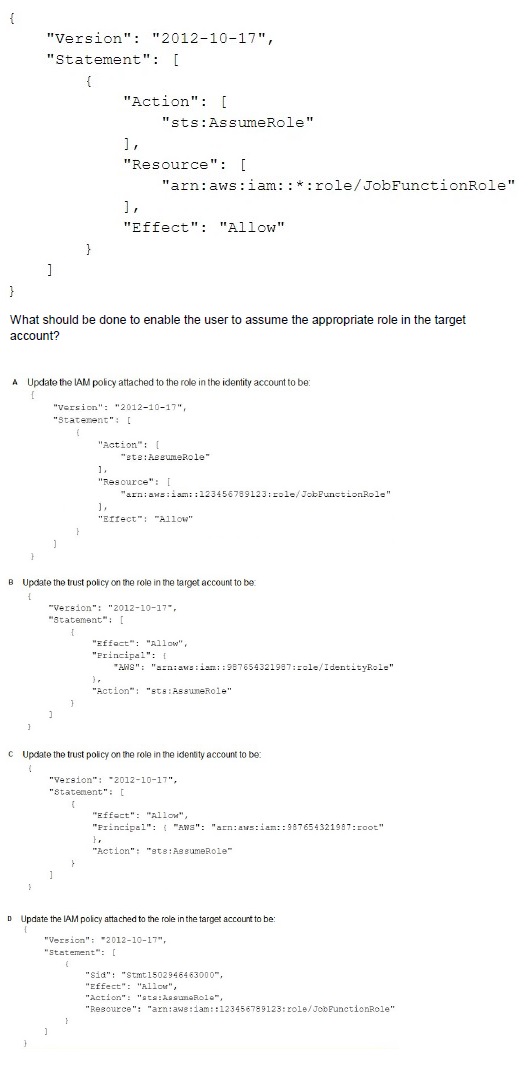
A company uses identity federation to authenticate users into an identity account (987654321987) where the users assume an IAM role named IdentityRole. The users then assume an IAM role named JobFunctionRole in the target IAM account (123456789123) to perform their job functions.
A user is unable to assume the IAM role in the target account. The policy attached to the role in the identity account is:

Show answerHide answer

Correct answer: B

Option B

Full mock exam

Sit the SCS-C02 exam before exam day

Full-length mocks with the same number of questions and the same time limit as the real SCS-C02 exam. Every attempt draws a new set of questions from the full bank, so you can keep going until you pass comfortably.

Get full SCS-C02 mock exam
  • 65questions per mock
  • 105 mintime limit
  • 367questions in the bank
  • Newmock on every attempt