Amazon Web Services certification · Exam SCS-C02

SCS-C02 Mock Exam Page 5

AWS Certified Security - Specialty

Free SCS-C02 mock exam questions 41–50, each with the answer and an explanation.

20 questions · 33 minutes · free, no sign-up

Free SCS-C02 questions

41–50 of 110 free
Question 41 Choose 1

A company's application team needs to host a MySQL database on IAM. According to the company's security policy, all data that is stored on IAM must be encrypted at rest. In addition, all cryptographic material must be compliant with FIPS 140-2 Level 3 validation.

The application team needs a solution that satisfies the company's security requirements and minimizes operational overhead. Which solution will meet these requirements?

Show answerHide answer

Correct answer: B

Host the database on Amazon RDS. Use Amazon Elastic Block Store (Amazon EBS) for encryption. Use an IAM managed CMK in IAM Key Management Service (IAM KMS) for key management.

Question 42 Choose 1

A company has implemented IAM WAF and Amazon CloudFront for an application. The application runs on Amazon EC2 instances that are part of an Auto Scaling group. The Auto Scaling group is behind an Application Load Balancer (ALB).
The IAM WAF web ACL uses an IAM Managed Rules rule group and is associated with the CloudFront distribution. CloudFront receives the request from IAM WAF and then uses the ALB as the distribution's origin.
During a security review, a security engineer discovers that the infrastructure is susceptible to a large, layer 7 DDoS attack.
How can the security engineer improve the security at the edge of the solution to defend against this type of attack?

Show answerHide answer

Correct answer: C

Configure IAM WAF with a rate-based rule that imposes a rate limit that automatically blocks requests when the rate limit is exceeded.

Explanation

Explanation:
To improve the security at the edge of the solution to defend against a large, layer 7 DDoS attack, the security engineer should do the following:
Configure AWS WAF with a rate-based rule that imposes a rate limit that automatically blocks requests when the rate limit is exceeded. This allows the security engineer to use a rule that tracks the number of requests from a single IP address and blocks subsequent requests if they exceed a specified threshold within a specified time period.

Question 43 Choose 1

A company hosts a web application on an Apache web server. The application runs on Amazon EC2 instances that are in an Auto Scaling group. The company configured the EC2 instances to send the Apache web server logs to an Amazon CloudWatch Logs group that the company has configured to expire after 1 year. Recently, the company discovered in the Apache web server logs that a specific IP address is sending suspicious requests to the web application. A security engineer wants to analyze the past week of Apache web server logs to determine how many requests that the IP address sent and the corresponding URLs that the IP address requested. What should the security engineer do to meet these requirements with the LEAST effort?

Show answerHide answer

Correct answer: C

Use CloudWatch Logs Insights and a custom query syntax to analyze the CloudWatch logs for the specific IP address and the requested URLs.

Question 44 Choose 3

A company is operating a website using Amazon CloudFornt. CloudFront servers some content from Amazon S3 and other from web servers running EC2 instances behind an Application. Load Balancer (ALB). Amazon DynamoDB is used as the data store. The company already uses IAM Certificate Manager (ACM) to store a public TLS certificate that can optionally secure connections between the website users and CloudFront. The company has a new requirement to enforce end-to-end encryption in transit. Which combination of steps should the company take to meet this requirement? (Select THREE.)

Show answerHide answer

Correct answer: B, C, E

Update the web application configuration on the web servers to use HTTPS instead of HTTP when connecting to DynamoDB

Update the CloudFront distribution to redirect HTTP corrections to HTTPS

Update the ALB listen to listen using HTTPS using the public ACM TLS certificate. Update the CloudFront distribution to connect to the HTTPS listener.

Explanation

Explanation:
To enforce end-to-end encryption in transit, the company should do the following:
Update the web application configuration on the web servers to use HTTPS instead of HTTP when connecting to DynamoDB. This ensures that the data is encrypted when it travels from the web servers to the data store.
Update the CloudFront distribution to redirect HTTP requests to HTTPS. This ensures that the viewers always use HTTPS when they access the website
through CloudFront.
Update the ALB to listen using HTTPS using the public ACM TLS certificate.
Update the CloudFront distribution to connect to the HTTPS listener. This ensures that the data is encrypted when it travels from CloudFront to the ALB and from the ALB to the web servers.

Question 45 Choose 1

A security engineer needs to run an AWS CloudFormation script. The CloudFormation script builds AWS infrastructure to support a stack that includes web servers and a MySQL database. The stack has been deployed in pre-production environments and is ready for production. The production script must comply with the principle of least privilege. Additionally, separation of duties must exist between the security engineer's IAM account and CloudFormation. Which solution will meet these requirements?

Show answerHide answer

Correct answer: A

Use IAM Access Analyzer policy generation to generate a policy that allows the
CloudFormation script to run and manage the stack. Attach the policy to a new IAM role. Modify the security engineer's IAM permissions to be able to pass the new role to CloudFormation.

Explanation

Explanation:
The correct answer is A. Use IAM Access Analyzer policy generation to generate a policy that allows the CloudFormation script to run and manage the stack. Attach the policy to a new IAM role. Modify the security engineer’s IAM permissions to be able to pass the new role to CloudFormation.

According to the AWS documentation, IAM Access Analyzer is a service that helps you identify the resources in your organization and accounts, such as Amazon S3 buckets or IAM roles, that are shared with an external entity. You can also use IAM Access Analyzer to generate fine-grained policies that grant least privilege access based on access activity and access attempts.

To use IAM Access Analyzer policy generation, you need to enable IAM Access Analyzer in your account or organization. You can then use the IAM console or the AWS CLI to generate a policy for a resource based on its access activity or access attempts. You can review and edit the generated policy before applying it to the resource.

To use IAM Access Analyzer policy generation with CloudFormation, you can follow these steps:

Run the CloudFormation script in a pre-production environment and monitor its access activity or access attempts using IAM Access Analyzer.
Use IAM Access Analyzer policy generation to generate a policy that allows the CloudFormation script to run and manage the stack. The policy will include only
the permissions that are necessary for the script to function. Attach the policy to a new IAM role that has a trust relationship with CloudFormation. This will allow CloudFormation to assume the role and execute the script.

Modify the security engineer’s IAM permissions to be able to pass the new role to CloudFormation. This will allow the security engineer to launch the stack using the role.

Run the CloudFormation script in the production environment using the new role. This solution will meet the requirements of least privilege and separation of duties, as it will limit the permissions of both CloudFormation and the security engineer to only what is needed for running and managing the stack.

Option B is incorrect because creating an IAM policy that allows ec2:* and rds:*
permissions is not following the principle of least privilege, as it will grant more permissions than necessary for running and managing the stack. Moreover, modifying the security engineer’s IAM permissions to be able to assume the new role is not ensuring separation of duties, as it will allow the security engineer to bypass CloudFormation and directly access the resources.

Option C is incorrect because modifying the security engineer’s IAM permissions to be able to run the CloudFormation script is not ensuring separation of duties, as it will allow the security engineer to execute the script without using CloudFormation.
Option D is incorrect because creating an IAM policy that allows ec2:* and rds:*
permissions is not following the principle of least privilege, as it will grant more permissions than necessary for running and managing the stack. Using the IAM policy simulator to confirm that the policy allows the AWS API calls that are necessary to build the stack is not sufficient, as it will not generate a fine-grained policy based on access activity or access attempts.
Question 46 Choose 1

A company plans to use AWS Key Management Service (AWS KMS) to implement an encryption strategy to protect data at rest. The company requires client-side encryption for company projects. The company is currently conducting multiple projects to test the company's use of AWS KMS. These tests have led to a sudden increase in the company's AWS resource consumption. The test projects include applications that issue multiple requests each second to KMS endpoints for encryption activities.
The company needs to develop a solution that does not throttle the company's ability to use AWS KMS. The solution must improve key usage for client-side encryption and must be cost optimized.
Which solution will meet these requirements?

Show answerHide answer

Correct answer: B

Use data key caching. Use the local cache that the AWS Encryption SDK provides with a caching cryptographic materials manager.

Explanation

Explanation:
The correct answer is B. Use data key caching. Use the local cache that the AWS Encryption SDK provides with a caching cryptographic materials manager.

This answer is correct because data key caching can improve performance, reduce cost, and help the company stay within the service limits of AWS KMS. Data key caching stores data keys and related cryptographic material in a cache, and reuses them for encryption and decryption operations. This reduces the number of requests to AWS KMS endpoints and avoids throttling. The AWS Encryption SDK provides a local cache and a caching cryptographic materials manager (caching CMM) that interacts with the cache and enforces security thresholds that the company can set1.

The other options are incorrect because:
A. Using keyrings with the AWS Encryption SDK does not address the problem of throttling or cost optimization. Keyrings are used to generate, encrypt, and decrypt data keys, but they do not cache or reuse them. Using each keyring individually or combining them into a multi-keyring does not reduce the number of requests to AWS KMS endpoints2.

C. Using KMS key rotation does not address the problem of throttling or cost optimization. Key rotation is a security practice that creates new cryptographic material for a KMS key every year, but it does not affect the data that the KMS key protects. Key rotation does not reduce the number of requests to AWS KMS endpoints, and it might incur additional costs for storing multiple versions of key material3.

D. Using keyrings with the AWS Encryption SDK does not address the problem of throttling or cost optimization, as explained in option A. Moreover, using any of the wrapping keys in the multi-keyring to decrypt the data is not a valid option, because only one of the wrapping keys can decrypt a given data key. The wrapping key that encrypts a data key is stored in the encrypted data key structure, and only that wrapping key can decrypt it4. 

References:
1: Data key caching - AWS Encryption SDK 2: Using keyrings - AWS Encryption SDK 3:
Rotating AWS KMS keys - AWS Key Management Service 4: How keyrings work - AWS Encryption SDK

Question 47 Choose 1

A company uses Amazon EC2 Linux instances in the AWS Cloud. A member of the company's security team recently received a report about common vulnerability identifiers on the instances.

A security engineer needs to verify patching and perform remediation if the instances do not have the correct patches installed. The security engineer must determine which EC2 instances are at risk and must implement a solution to automatically update those instances with the applicable patches. What should the security engineer do to meet these requirements?

Show answerHide answer

Correct answer: A

Use AWS Systems Manager Patch Manager to view vulnerability identifiers for missing patches on the instances. Use Patch Manager also to automate the patching process.

Explanation

Explanation: https://aws.amazon.com/about-aws/whats-new/2020/10/now-use-awssystems-manager-to-view-vulnerability-identifiers-for-missing-patches-on-your-linuxinstances/

Question 48 Choose 2

A company uses AWS Organizations to manage a multi-accountAWS environment in a single AWS Region. The organization's management account is named management-01. The company has turned on AWS Config in all accounts in the organization. The company has designated an account named security-01 as the delegated administra-tor for AWS Config.

All accounts report the compliance status of each account's rules to the AWS Config delegated administrator account by using an AWS Config aggregator. Each account administrator can configure and manage the account's own AWS Config rules to handle each account's unique compliance requirements.

A security engineer needs to implement a solution to automatically deploy a set of 10 AWS Config rules to all existing and future AWS accounts in the organiza-tion. The solution must turn on AWS Config automatically during account crea-tion. Which combination of steps will meet these requirements? (Select TWO.)

Show answerHide answer

Correct answer: B, E

Create a conformance pack that contains the 10 required AWS Config rules. Deploy the conformance pack from the security-01 account.

Create an AWS CloudFormation template that will activate AWS Config. De-ploy the template by using CloudFormation StackSets in the management-01 account.

Question 49 Choose 1

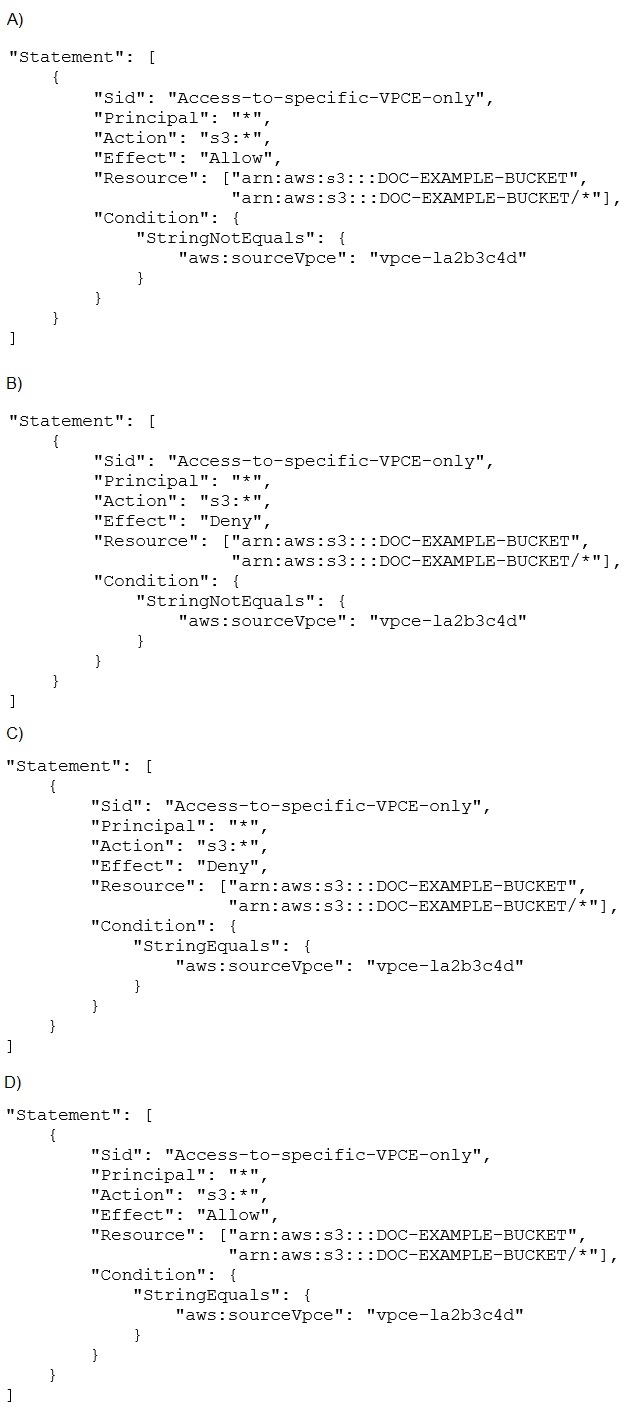
A security engineer needs to configure an Amazon S3 bucket policy to restrict access to an S3 bucket that is named DOC-EXAMPLE-BUCKET. The policy must allow access to only DOC-EXAMPLE-BUCKET from only the following endpoint: vpce-1a2b3c4d. The policy must deny all access to DOC-EXAMPLE-BUCKET if the specified endpoint is not used. Which bucket policy statement meets these requirements?

Show answerHide answer

Correct answer: B

Option B

Question 50 Choose 1

An IAM user receives an Access Denied message when the user attempts to access objects in an Amazon S3 bucket. The user and the S3 bucket are in the same AWS account. The S3 bucket is configured to use server-side encryption with AWS KMS keys (SSE-KMS) to encrypt all of its objects at rest by using a customer managed key from the same AWS account. The S3 bucket has no bucket policy defined. The IAM user has been granted permissions through an IAM policy that allows the kms:Decrypt permission to the customer managed key. The IAM policy also allows the s3:List* and s3:Get* permissions for the S3 bucket and its objects.
Which of the following is a possible reason that the IAM user cannot access the objects in the S3 bucket?

Show answerHide answer

Correct answer: D

The KMS key policy has been edited to remove the ability for the AWS account to have full access to the key.

Explanation

Explanation:
The possible reason that the IAM user cannot access the objects in the S3 bucket is D. The KMS key policy has been edited to remove the ability for the AWS account to have full access to the key.

This answer is correct because the KMS key policy is the primary way to control access to the KMS key, and it must explicitly allow the AWS account to have full access to the key. If the KMS key policy has been edited to remove this permission, then the IAM policy that grants kms:Decrypt permission to the IAM user has no effect, and the IAM user cannot decrypt the objects in the S3 bucket12. The other options are incorrect because:

A. The IAM policy does not need to allow the kms:DescribeKey permission, because this permission is not required for decrypting objects in S3 using SSEKMS.
The kms:DescribeKey permission allows getting information about a KMS key, such as its creation date, description, and key state3.

B. The S3 bucket has not been changed to use the AWS managed key to encrypt objects at rest, because this would not cause an Access Denied message for the IAM user. The AWS managed key is a default KMS key that is created and managed by AWS for each AWS account and Region. The IAM user does not need any permissions on this key to use it for SSE-KMS4.

C. An S3 bucket policy does not need to be added to allow the IAM user to access the objects, because the IAM user already has s3:List* and s3:Get* permissions for the S3 bucket and its objects through an IAM policy. An S3 bucket policy is an optional way to grant cross-account access or public access to an S3 bucket5.

References:
1: Key policies in AWS KMS 2: Using server-side encryption with AWS KMS keys (SSEKMS)
3: AWS KMS API Permissions Reference 4: Using server-side encryption with Amazon S3 managed keys (SSE-S3) 5: Bucket policy examples

Full mock exam

Sit the SCS-C02 exam before exam day

Full-length mocks with the same number of questions and the same time limit as the real SCS-C02 exam. Every attempt draws a new set of questions from the full bank, so you can keep going until you pass comfortably.

Get full SCS-C02 mock exam
  • 65questions per mock
  • 105 mintime limit
  • 367questions in the bank
  • Newmock on every attempt