Fortinet certification · Exam NSE7_SSE_AR-26

NSE7_SSE_AR-26 Mock Exam Page 2

Fortinet NSE 7 - FortiSASE 26 Architect

Free NSE7_SSE_AR-26 mock exam questions 11–20, each with the answer and an explanation.

20 questions · 30 minutes · free, no sign-up

Free NSE7_SSE_AR-26 questions

11–20 of 31 free
Question 11 Choose 3
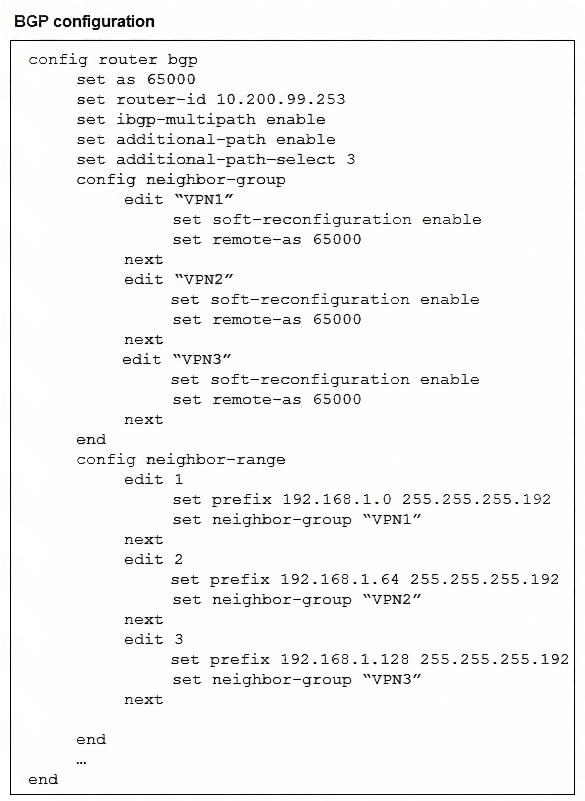
Refer to the exhibit. The exhibit shows the BGP configuration on the hub in a hub-and-spoke topology. The administrator wants BGP to advertise prefixes from spokes to other spokes over the IPsec overlays, including additional paths. However, when looking at the spoke routing table, the administrator does not see the prefixes from other spokes and the additional paths Which three settings must the administrator configure inside each BGP neighbor group so spokes can learn the prefixes of other spokes and their additional paths? (Choose three.)
Show answerHide answer

Correct answer: C, D, E Enable route-reflector-server Enable route-reflector-client. Set adv-additional-path to the number of additional paths to advertise.

Explanation

Explanation

This scenario describes a standard ADVPN (Auto-Discovery VPN) BGP configuration challenge. In a hub-and-spoke SD-WAN topology, spokes establish BGP peering only with the hub, not directly with each other.

By default, iBGP (Internal BGP) has a split-horizon rule: a route learned from an iBGP peer is never advertised to another iBGP peer. Because the hub learns spoke prefixes via iBGP, it will not advertise Spoke A's prefix to Spoke B unless it acts as a Route Reflector. Furthermore, to send multiple paths (additional paths) to the spokes, BGP Additional Paths must be configured correctly on the hub.

Option C is correct:

The hub must be configured as a route reflector server (`set route-reflector-server enable` or `config neighbor-group > set route-reflector-server enable`). This allows the hub to break the iBGP split-horizon rule and reflect routes learned from one spoke to other spokes.

Option D is correct:

The spoke neighbor groups on the hub must be configured as route reflector clients (`set route-reflector-client enable`). This designates the spokes as clients of the hub's route reflection, allowing the hub to reflect routes between them.

Option E is correct:

While the global BGP configuration (shown at the top of the exhibit) has `set additional-path enable` and `set additional-path-select 3`, this only tells the hub to receive and select additional paths. To actually advertise those additional paths to the spokes, the administrator must configure `set adv-additional-path <number>` (e.g., `set adv-additional-path 3`) inside the neighbor groups. Without this, the hub will only advertise its best path.

Why the other options are incorrect:

A (Set additional-path to send): In FortiOS BGP configuration, there is no `set additional-path send` option under the neighbor-group. The global command is `set additional-path enable`, and the advertisement is controlled by `adv-additional-path`.

B (Set additional-path to forward): "Forward" is not a valid BGP additional-path configuration keyword in FortiOS.

References:

Fortinet Document Library: FortiOS Administration Guide — "BGP" > "Route Reflection" and "BGP Additional Paths".
Question 12 Choose 1
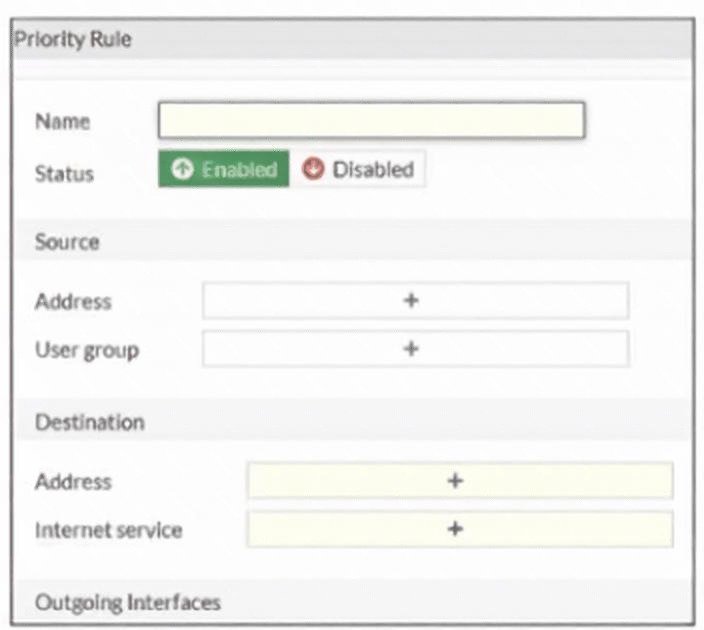
Refer to the exhibit. An administrator configures SD-WAN rules for a DIA setup using the FortiGate GUI. The page to configure the source and destination part of the rule looks as shown in the exhibit. The GUI page shows no option to configure an application as the destination of the SD-WAN rule Why?
Show answerHide answer

Correct answer: D You must enable the feature first using the GUI menu System > Feature Visibility.

Explanation

Explanation

In FortiOS, certain advanced or specific features are hidden from the GUI by default to keep the interface clean. If you are configuring an SD-WAN rule and want to use Application Control categories or specific applications as the match criteria for steering traffic, this feature must be enabled in the GUI.

To do this, you navigate to System > Feature Visibility and enable Application Control (and often SD-WAN if it's a newer FortiOS version where it's split). Once Application Control is enabled in Feature Visibility, the SD-WAN rule configuration page will display the "Application" option under the Destination section, allowing you to select application categories or individual applications (like Facebook, Office 365, etc.) to steer traffic.

Why the other options are incorrect:

A (You cannot use applications as the destination when FortiGate is used for a DIA setup): This is false. Using applications to steer traffic to the internet (DIA) is a primary use case for SD-WAN. For example, you might want to route Office 365 traffic through a specific ISP.

B (FortiGate allows the configuration of applications as the destination of SD-WAN rules only on the CLI): This is false. While you can configure it via CLI, the GUI fully supports it once the feature is made visible.

C (You must enable the feature on the CLI): While it is true that you can enable feature visibility via CLI (config system settings > set gui-application-control enable), the primary and intended way to do this from the GUI perspective (which the question is based on) is through the Feature Visibility menu. Option D is the most accurate and direct GUI-based answer.

References:

Fortinet Document Library: FortiOS Administration Guide — "System" > "Feature Visibility" (Enabling Application Control in the GUI).

Question 13 Choose 2
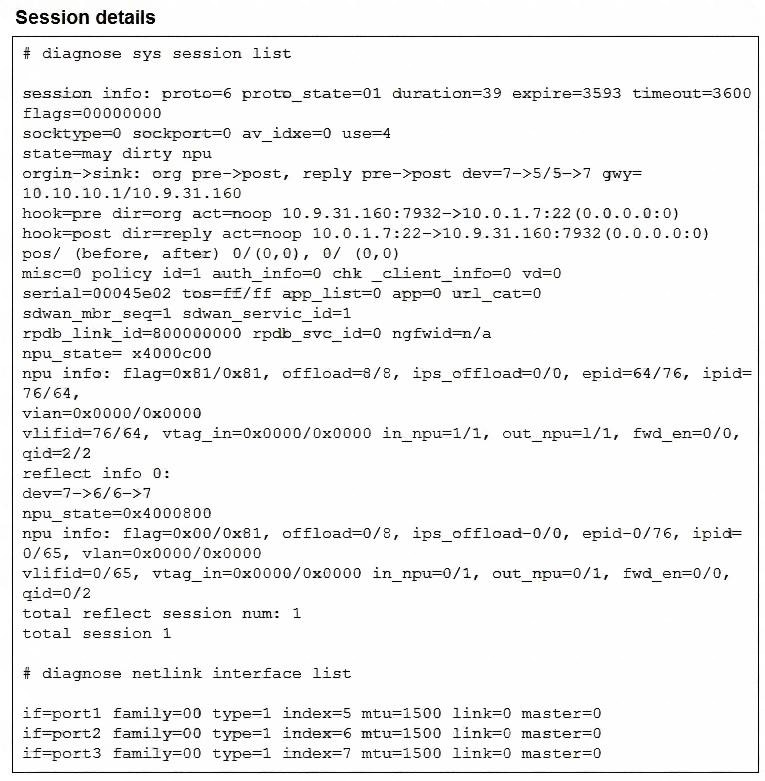
Refer to the exhibit. The exhibit shows the details of a session and the index numbers of some relevant interfaces on a FortiGate device that supports hardware offloading. Based on the information shown in the exhibits, which two conclusions can you draw? (Choose two.)
Show answerHide answer

Correct answer: C, D The reply direction of the asymmetric traffic flows from port2 to port3.The auxiliary session can be offloaded to hardware.

Explanation

Explanation

First, map the interface indexes from diagnose netlink interface list: index 5 = port1, index 6 = port2, index 7 = port3.

The session output has two parts:

1. Main session: dev=7->5 / 5->7 means port3 → port1 in the original direction, and port1 → port3 in the reply direction.

2. Reflect info (auxiliary session): dev=7->6 / 6->7 means port3 → port2 in the original direction, and port2 → port3 in the reply direction.

The reflect section is what FortiGate creates when it handles asymmetric traffic, where the reply does not come back on the same path as the original. The main session is dev=7->5, and the auxiliary session records the second path involving port2.

C is correct. The reflect session’s reply direction is 6->7, which is port2 → port3. The traffic is asymmetric, and this is the reply direction on the asymmetric leg.

D is correct. The reflect session’s NPU info shows offload=0/8 and flag=0x00/0x81, and total reflect session num: 1 confirms it exists. The 8 indicates that direction is offloaded to the NPU, so the auxiliary session is hardware-offloaded.

Why the other options are wrong

A: Offloading asymmetric flows is not a default behavior. FortiGate handles asymmetric offload through auxiliary sessions, which are controlled by a separate setting (auxiliary-session) and are not enabled by default. The fact that one exists here only shows it has been enabled.

B: The original direction of the main (symmetric) flow is port3 → port1 (7->5), not port3 → port2. Port3 → port2 belongs to the reflect session.


References

FortiOS Administration Guide: Hardware acceleration > NP6/NP7 session offloading (diagnose sys session list, npu info, offload flags)

FortiOS Administration Guide: Asymmetric routing and auxiliary-session (reflect sessions)

Question 14 Choose 2
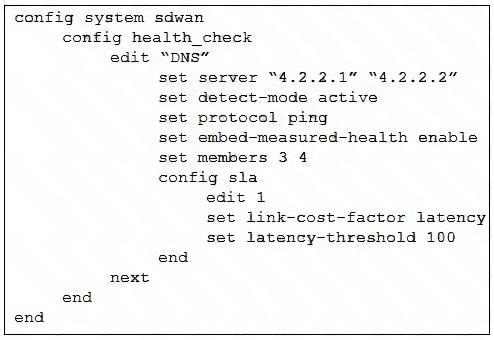
Refer to the exhibit. The exhibit shows the health-check configuration on a FortiGate device used as a spoke. You notice that the hub FortiGate doesn’t prioritize the traffic as expected. Which two configuration elements should you check on the hub? (Choose two.)
Show answerHide answer

Correct answer: B, C This performance SLA uses the same members. The performance SLA uses the same criteria.

Explanation

Explanation

The exhibit shows an SD-WAN performance SLA named "DNS" configured on a spoke FortiGate. It uses Active probing (detect-mode active) to 4.2.2.1 and 4.2.2.2 via Ping (protocol ping), and importantly, it has set embed-measured-health enable.

When embed-measured-health is enabled, the spoke embeds its own locally measured SLA performance metrics into the ADVPN/BGP packets sent to the hub. The hub can then read these embedded metrics to make intelligent, topology-aware routing decisions (so it doesn't have to independently probe the remote spokes).

For the hub to process and prioritize traffic based on these embedded health metrics, the SLA configuration on the hub must match the spoke's SLA configuration exactly. Specifically:

Option B is correct (Same members):
The hub's corresponding performance SLA must monitor the exact same SD-WAN members (interfaces/tunnels) that are used on the spoke. If the hub's SLA is checking different members or doesn't include the spoke's tunnel as a member, it won't map the embedded metrics to the correct routing path.

Option C is correct (Same criteria):
The hub must use the same SLA criteria (latency, jitter, packet loss thresholds, and probe settings). If the hub has a different latency threshold or a different probe configuration for that SLA, the embedded metrics from the spoke will be evaluated against mismatched criteria, causing the hub to prioritize traffic incorrectly.

Why the other options are incorrect:

A (The performance SLA has the parameter priority-out-sla configured): There is no such parameter as priority-out-sla in FortiOS SD-WAN configuration.

D (The performance SLA is configured with set embedded-measure accept): While the hub does need to accept the embedded measurements, the specific CLI command is set embed-measured-health enable (the same as on the spoke), not set embedded-measure accept. Furthermore, just enabling acceptance isn't enough if the members and criteria don't match.

References:

Fortinet Document Library: FortiOS Administration Guide — "SD-WAN" > "Overlay Orchestrator" and "ADVPN" (Using embedded health checks to share SLA metrics between spokes and hubs).

Fortinet Knowledge Base: Technical Tip — How set embed-measured-health enable works and the requirement for matching SLA configurations across the topology.

Question 15 Choose 1
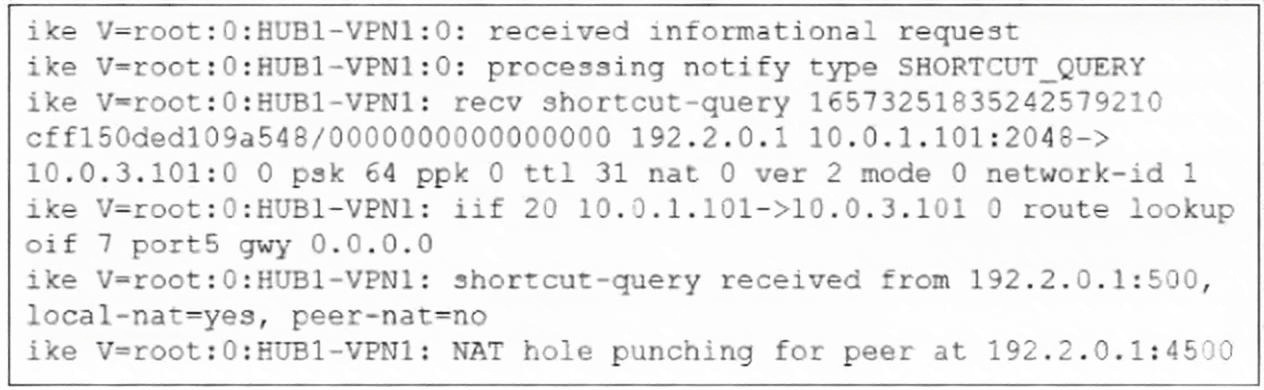
Refer to the exhibit.
Which statement correctly describes the role of the ADVPN device in handling traffic?
Show answerHide answer

Correct answer: D This device is a spoke that has received a shortcut query from a remote hub.

Explanation

Explanation

The key lines are:

processing notify type SHORTCUT_QUERY and recv shortcut-query ... 10.0.1.101:2048 -> 10.0.3.101: this device received an ADVPN shortcut query for traffic from 10.0.1.101 to 10.0.3.101.

route lookup oif 7 port5 gwy 0.0.0.0: the route lookup for the destination 10.0.3.101 resolves to a directly connected interface (port5) with no gateway. The destination is local to this device, so this FortiGate is the spoke that owns the 10.0.3.0/24 subnet.

The query arrives through the overlay tunnel HUB1-VPN1. In ADVPN, a spoke sends the first packet through the hub, the hub detects the spoke-to-spoke traffic, and the hub sends a shortcut query to the destination spoke. So the query reaches this device from the hub, not directly from the originating spoke.

local-nat=yes, peer-nat=no and NAT hole punching for peer at 192.2.0.1:4500: this spoke is behind NAT, so it uses NAT traversal (UDP 4500) as part of the shortcut negotiation.

Why the other options are wrong

A: Spokes don’t send shortcut queries directly to each other. Before a shortcut exists, the query is relayed by the hub.

B: A hub forwarding a query would look up the destination via the tunnel toward another spoke, not via a locally connected interface with gwy 0.0.0.0.

C: This device is not a hub, and the log shows a shortcut query being received, not two spokes having already established a shortcut.

References

FortiOS Administration Guide: IPsec VPN > ADVPN (shortcut query, shortcut reply, auto-discovery-sender / auto-discovery-receiver)

FortiOS Administration Guide: Troubleshooting ADVPN (diagnose debug application ike)

Question 16 Choose 1
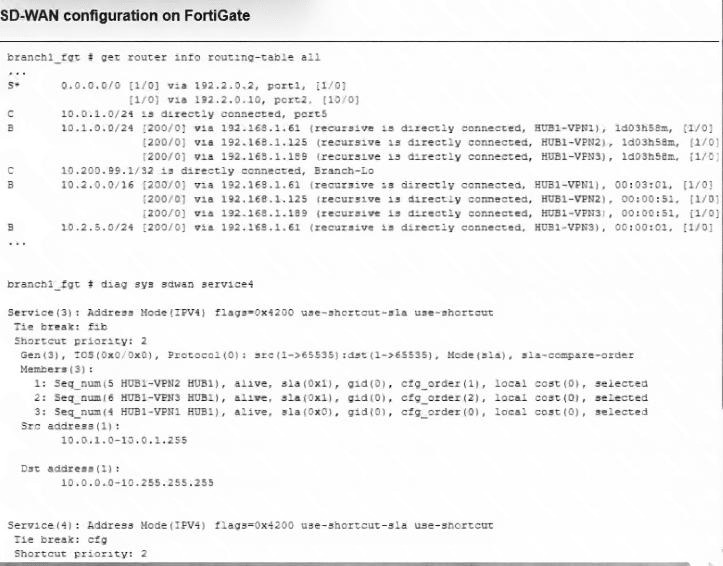
Refer to the exhibit. Which SD-WAN rule and interface uses FortiGate to steer the traffic from the LAN subnet 10.0.1.0/24 to the corporate server 10.2.5.254?
Show answerHide answer

Correct answer: A SD-WAN service rule 3 and interface HUB1-VPN3.

Explanation

Explanation

To determine how FortiGate steers the traffic, we need to analyze two things: the routing table (to see how the destination is reached) and the SD-WAN service output (to see how the SD-WAN rule matches the traffic and selects the member).

1. Routing Table Analysis (get router info routing-table all):

Look for the destination 10.2.5.254. The routing table shows the subnet B 10.2.5.0/24 (which includes 10.2.5.254).

The route points to: [200/0] via 192.168.1.61 (recursive is directly connected, HUB1-VPN3).

This means to reach the corporate server, the traffic must exit through the HUB1-VPN3 overlay tunnel.

2. SD-WAN Service Output (diag sys sdwan service4):

Service(3) matches the Source Address 10.0.1.0-10.0.1.255 (which includes the LAN subnet 10.0.1.0/24) and Destination 10.0.0.0-10.255.255.255 (which includes 10.2.5.254).

Look at the Members listed for Service(3):

1: Seq_num(5 HUB1-VPN2 HUB1) ... selected

2: Seq_num(6 HUB1-VPN3 HUB1) ... selected

3: Seq_num(4 HUB1-VPN1 HUB1) ... selected

Because it is an SLA-based rule (Mode(sla)), FortiGate will look at the SLA health of these members. However, because the routing table specifically dictates that the route to 10.2.5.0/24 is learned via HUB1-VPN3, FortiGate will use that specific member to route the traffic.

Why the other options are incorrect:

B (SD-WAN service rule 3 and interface HUB1-VPN2): While service rule 3 includes HUB1-VPN2 as a member, the routing table shows the specific route for the destination (10.2.5.0/24) is learned through HUB1-VPN3. Therefore, it will not use VPN2 for this specific destination.

C (SD-WAN service rule 4 and interface port2): Service rule 4 does not match the source subnet 10.0.1.0/24 based on the output (it is a different rule, likely for a different purpose or default traffic). Additionally, the route to 10.2.5.0/24 does not point to port2.

D (SD-WAN service rule 4 and port1 or port2): Same reasoning as C; rule 4 is incorrect, and the routing table does not point to port1 or port2 for this destination.

References:

Fortinet Document Library: FortiOS Administration Guide — "SD-WAN" > "SD-WAN Rules" and "Troubleshooting" (Understanding how routing table entries and SD-WAN member selection interact).

Question 17 Choose 2
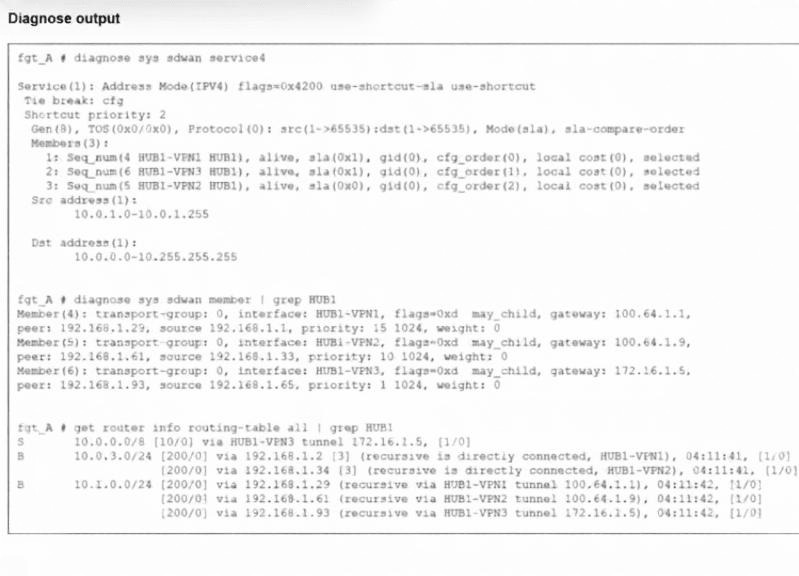
Refer to the exhibit. An administrator is troubleshooting SD-WAN on FortiGate. A device behind branch1_fgt generates traffic to the 10.0.0.0/8 network. The administrator expects the traffic to match SD-WAN rule ID 1 and be routed over HUB1-VPN1. However, the traffic is routed over HUB1-VPN3. Based on the output shown in the exhibit, which two reasons, individually or together, could explain the observed behavior? (Choose two.)
Show answerHide answer

Correct answer: B, D The traffic matches a regular policy route configured with HUB1-VPN3 as the outgoing device HUB1-VPN3 has a lower route priority value (higher priority) than HUB1-VPN1.

Explanation

Explanation

To understand why the traffic is routed over HUB1-VPN3 instead of the expected HUB1-VPN1, we must analyze the routing and SD-WAN processing order:

1. Option B is correct: In FortiOS, routing decisions follow a specific order: Policy Routes > SD-WAN Rules > Routing Table. If a standard (non-SD-WAN) policy route is configured on the FortiGate that matches the source and destination and points explicitly to HUB1-VPN3, it will be evaluated before the SD-WAN rule. If it matches, it will force the traffic out of HUB1-VPN3, bypassing the SD-WAN rule entirely.

2. Option D is correct: If the SD-WAN rule does evaluate, and all members are healthy (SLA is met), FortiGate uses the route table to determine which member is selected. Look at the routing table in the exhibit for the 10.0.0.0/8 network (which encompasses the destination).

The route via HUB1-VPN1 has an administrative distance (AD) and metric of [10/10].

The route via HUB1-VPN3 has an AD and metric of [1/0].

Because a lower value is preferred in routing, the route via HUB1-VPN3 (Priority 1) is preferred over HUB1-VPN1 (Priority 10). Even if the SD-WAN rule selects multiple members (as seen in the service4 output where both HUB1-VPN1 and HUB1-VPN3 are selected), the active route in the routing table dictates the forwarding path. HUB1-VPN3 wins because it has the better route priority/metric.

Why the other options are incorrect:

A (HUB1-VPN3 has a higher member configuration priority than HUB1-VPN1): The diagnose sys sdwan member output shows the member priority for both HUB1-VPN1 and HUB1-VPN3 is 1024. They have equal member configuration priority, so this cannot be the reason.

C (HUB1-VPN1 does not have a valid route to the destination): The routing table output clearly shows that HUB1-VPN1 does have a valid route to the 10.0.0.0/8 network (B 10.0.0.0/8 [200/0] via 192.168.1.2 (recursive is directly connected, HUB1-VPN1)). It is just not the preferred route because HUB1-VPN3 has a better priority.

References:

Fortinet Document Library: FortiOS Administration Guide — "Routing" > "Policy Routes" (Evaluation order of policy routes vs. SD-WAN rules).

Question 18 Choose 2
An administrator configures the performance service-level agreement (SLA) with the probe mode, Prefer Passive. What are two observable impacts of this configuration? (Choose two.)
Show answerHide answer

Correct answer: B, E FortiGate passively monitors the member if TCP traffic is passing through the member. During passive monitoring, the SLA performance rule cannot detect dead members.

Explanation

Explanation

In Prefer Passive probe mode, FortiGate measures link quality (latency, jitter, packet loss) from live user traffic instead of sending its own probes, and falls back to active probes when there isn’t enough traffic to measure.

B is correct. Passive measurement works from TCP sessions. FortiGate derives the metrics from the TCP flow (for example, from TCP handshake and acknowledgment timing). Other traffic, such as ICMP, isn’t used for passive measurement.

E is correct. While the rule is in passive mode, FortiGate only observes whatever traffic happens to be flowing. It sends no probes, so it has no reliable way to tell that a member is dead. Dead-member detection depends on active probes, which is why Prefer Passive switches to active mode when traffic is absent.

Why the other options are wrong

A: Passive monitoring does not use ICMP traffic. It relies on TCP sessions (see B).

C: This describes a fallback timer that I can’t confirm. Prefer Passive is described as switching to active probing when there is no suitable traffic and returning to passive when traffic is seen again. I’m not aware of a fixed 3-minute rule, so I’d treat this option as a distractor.

D: Passive measurement needs the traffic to be inspected by the CPU, so sessions subject to passive monitoring cannot be offloaded to the NPU. The documented setup requires disabling ASIC offload (auto-asic-offload disable) on the relevant firewall policy. This option states the opposite.

Confidence note: B and D/E are the points I’m most sure about (D being false is well-documented). E is the best fit for the second answer, but the exact wording of the fallback behavior (option C) varies by FortiOS version. If your answer key differs, check the “Passive WAN health measurement” section for your exam version.

References

FortiOS Administration Guide: SD-WAN > Performance SLA > Passive WAN health measurement (probe-mode prefer-passive)

FortiOS CLI Reference: config system sdwan > config health-check > set probe-mode

Question 19 Choose 1


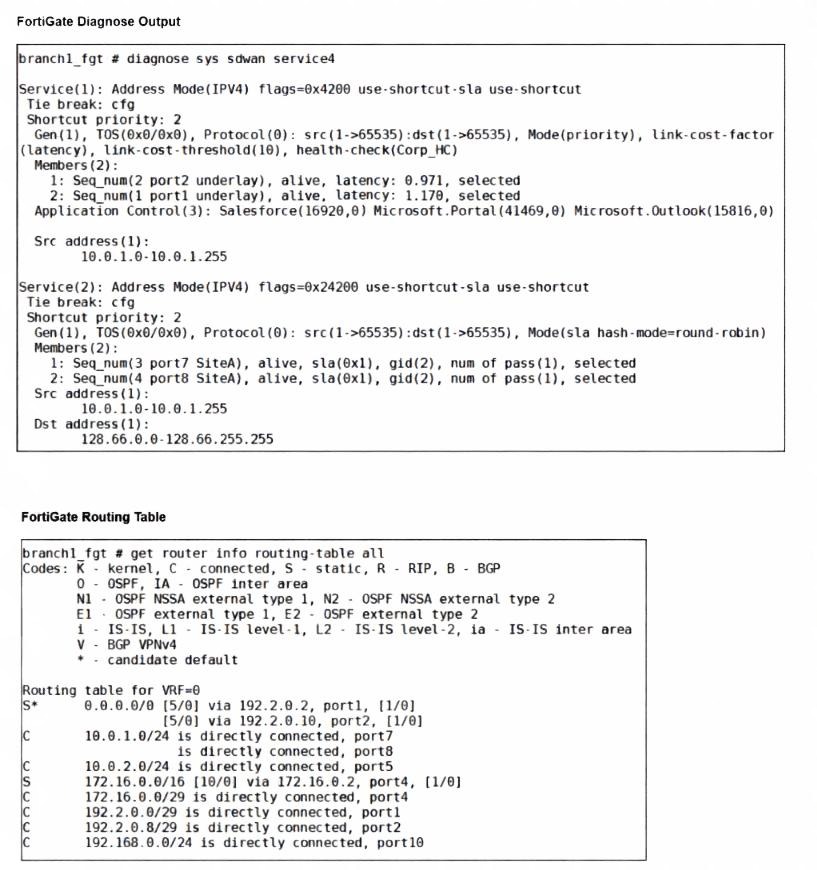
How does FortiGate handle the ICMP traffic with the source IP address 10.0.1.125 and the destination IP address 128.66.0.125?
Show answerHide answer

Correct answer: D FortiGate routes the traffic flow according to the forwarding information base (FIB).

Explanation

Explanation

To determine how FortiGate handles the specific traffic flow (Source: 10.0.1.125, Destination: 128.66.0.125, Protocol: ICMP), we must evaluate the SD-WAN service output and the routing table.

1. Rule 1 Evaluation:

Source matches: 10.0.1.0-10.0.1.255 (includes 10.0.1.125).

Application Control matches: Salesforce, Microsoft.Portal, Microsoft.Outlook.

Result: The traffic is ICMP. ICMP does not match these specific web applications. Therefore, it bypasses Rule 1.

2. Rule 2 Evaluation:

Source matches: 10.0.1.0-10.0.1.255.

Destination matches: 128.66.0.0-128.66.0.255 (includes 128.66.0.125).

Protocol/Criteria matches: None specified (matches any).

Result: The traffic matches the destination of Rule 2. However, look at the Mode for Rule 2: Mode(sla hash-mode=round-robin).

3. Why it bypasses SD-WAN load balancing:

Even though the traffic matches Rule 2, SD-WAN rules with load-balancing modes (like round-robin or source-ip-based) typically rely on session creation to assign a flow to a member.

More importantly, FortiOS SD-WAN load balancing is designed for session-based traffic (TCP/UDP). ICMP does not establish sessions in the same way.

When a matching SD-WAN rule cannot properly assign the flow (or if the SD-WAN feature is bypassed for that specific protocol), FortiGate falls back to standard routing. The traffic will be routed based on the FIB (Forwarding Information Base) for the destination 128.66.0.0/24.

Since the routing table does not show a specific route for 128.66.0.0/24, it would follow the default route (S* 0.0.0.0/0 via 192.2.0.2 port1 or port2), but the action is governed by standard FIB lookups.

Why the other options are incorrect:

A (FortiGate drops the traffic flow): There is no implicit deny rule or explicit drop action shown in the output for this traffic. FortiGate will route it.

B (FortiGate load balances the traffic flow through port7 and port8): While Rule 2 matches the destination, SD-WAN load balancing (round-robin) applies to sessions. Furthermore, the specific ICMP flow is not evaluated as an application session for load balancing in this context. Standard routing takes precedence for non-session traffic when SD-WAN doesn't explicitly capture it.

C (FortiGate steers the traffic flow through port2): While the default route points to port2, standard ICMP traffic matching a destination-only rule without application control will fall back to the FIB routing decision, which is the most accurate description of the mechanism.

References:

Fortinet Document Library: FortiOS Administration Guide — "SD-WAN" > "SD-WAN Rules" (Understanding how load balancing modes apply to sessions and the fallback to routing).

Question 20 Choose 1
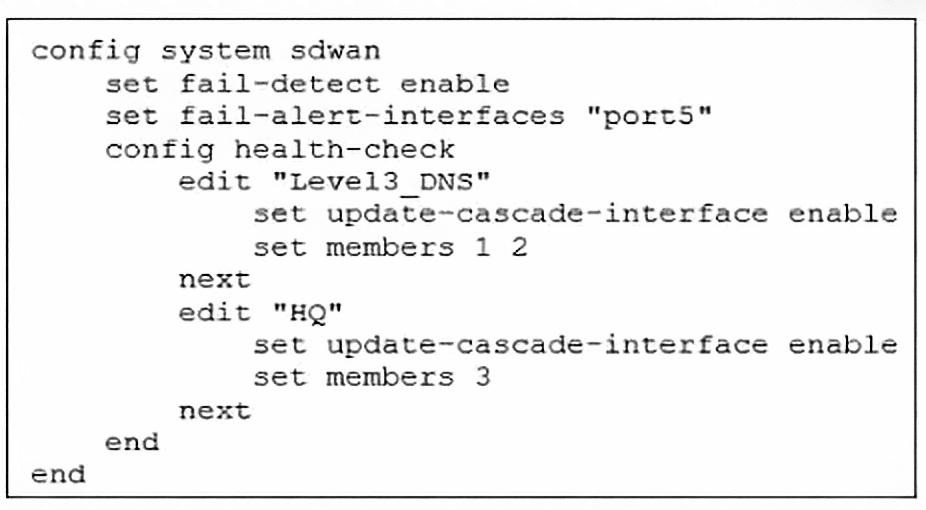
Refer to the exhibit. Which action will FortiGate take if it detects SD-WAN members as dead?
Show answerHide answer

Correct answer: A FortiGate sends alert messages through port5 when it detects any SD-WAN member as dead.

Explanation

Explanation

Let's look at the specific CLI commands configured in the exhibit:

1. set fail-detect enable: This enables the SD-WAN failure detection mechanism.

2. set fail-alert-interfaces "port5": This is the crucial command. In FortiOS, when fail-detect is enabled, the fail-alert-interfaces command specifies which interface(s) FortiGate will use to send alert messages (such as SNMP traps or log messages) when an SD-WAN health check fails and a member is marked as dead. It does not bring the interface up or down.

Why the other options are incorrect:

B & C (FortiGate brings up port5...): The fail-alert-interfaces command is strictly for sending notifications/alerts. To bring an interface up or down based on SD-WAN health, you would use SD-WAN member actions (config system sdwan > config members > edit X > set status enable/disable) or link-monitor actions, which are not present in this configuration.

D (...when it detects all SD-WAN members as dead): The fail-detect and fail-alert-interfaces feature is designed to trigger an alert whenever a health check fails (i.e., any monitored member is detected as dead), not just when all of them fail.

References:

Fortinet Document Library: FortiOS Administration Guide — "SD-WAN" > "Configuring SD-WAN health checks" and "Fail-detect and fail-alert-interfaces" (Explains how to configure the FortiGate to send alerts through specific interfaces when SD-WAN members go down).

Full mock exam

Sit the NSE7_SSE_AR-26 exam before exam day

Full-length mocks with the same number of questions and the same time limit as the real NSE7_SSE_AR-26 exam. Every attempt draws a new set of questions from the full bank, so you can keep going until you pass comfortably.

Get full NSE7_SSE_AR-26 mock exam
  • 50questions per mock
  • 75 mintime limit
  • 110questions in the bank
  • Newmock on every attempt