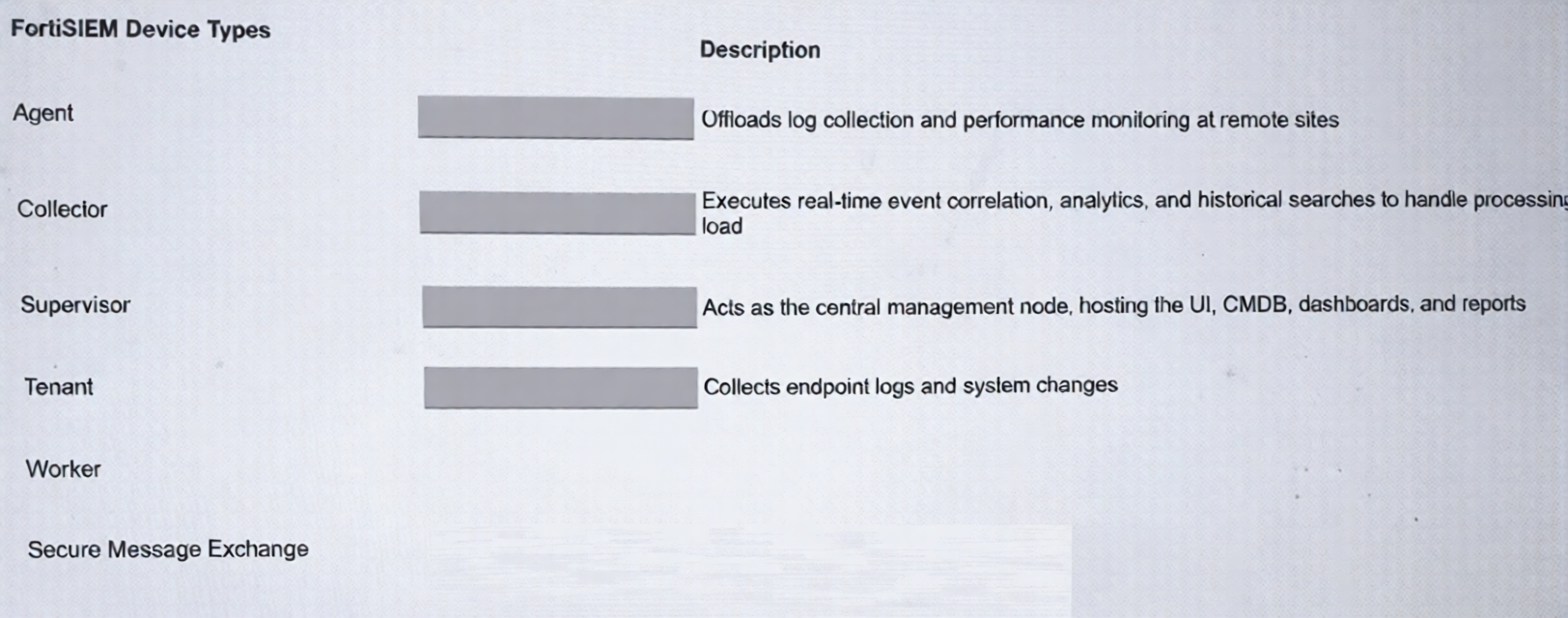
Match the FortiSIEM device type to its description. Select each FortiSIEM device type in the left column,
hold and drag it to the blank space next to its corresponding description in the column on the right.
Show answerHide answer
Explanation
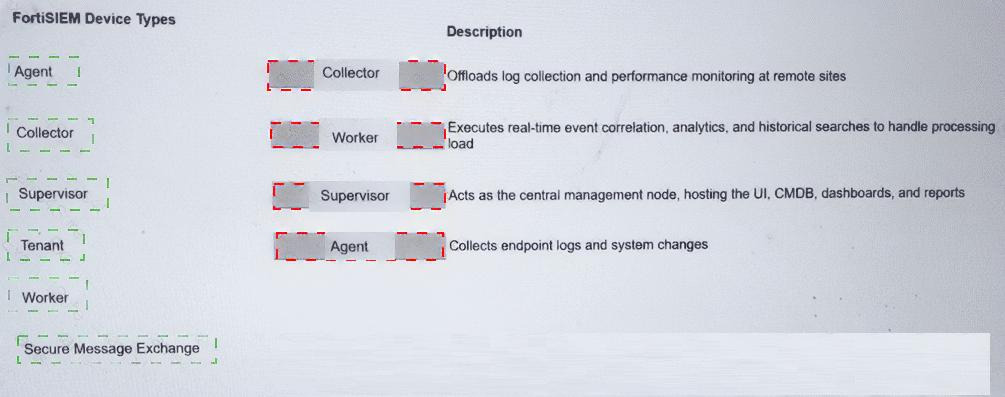
Explanation:
This question tests your knowledge of FortiSIEM component roles in a distributed deployment. Each device type has a distinct function: lightweight collection, centralized management, distributed processing, or log forwarding.
✔️ Correct Options:
Agent:
Deployed at remote sites without a local Collector. It forwards logs and performance data efficiently over WAN to reduce bandwidth usage.
Worker:
Handles heavy processing like correlation and historical searches. Multiple Workers can be added to scale performance horizontally.
Supervisor:
Provides the single pane of glass for administration. It maintains the CMDB, serves the web UI, and manages report scheduling.
Collector:
Typically installed on-premises near log sources. It receives raw logs, parses them, and sends normalized events to Supervisor/Worker.
❌ Incorrect options:
Tenant:
This is a logical isolation unit in multi‑tenant deployments, not a physical device type with the described roles.
Secure Message Exchange:
This is a communication protocol or component for secure event transmission, not a FortiSIEM device type.
🔧 Reference:
→ Fortinet Official Documentation: FortiSIEM Architecture
Confirms the roles of Agent, Collector, Supervisor, and Worker in the FortiSIEM component model.