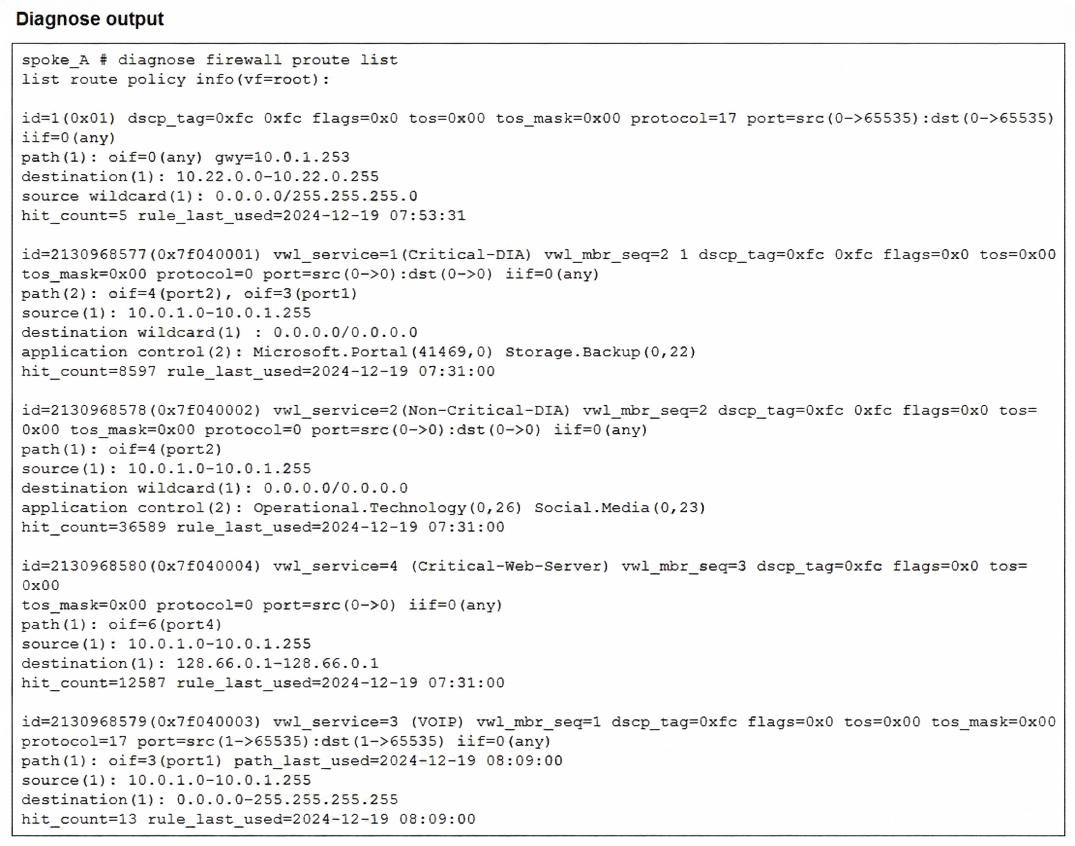
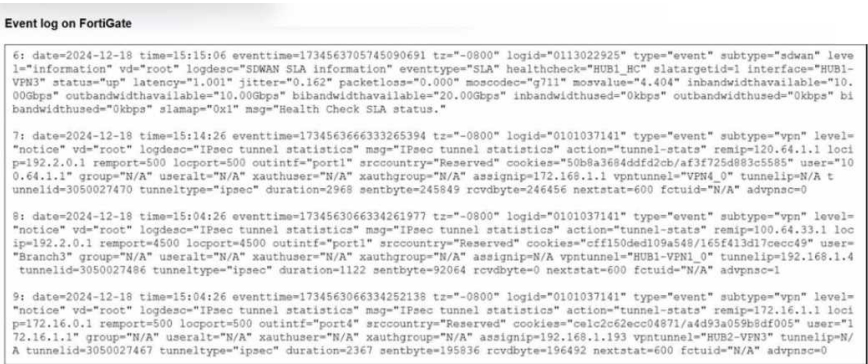
Refer to the exhibit.
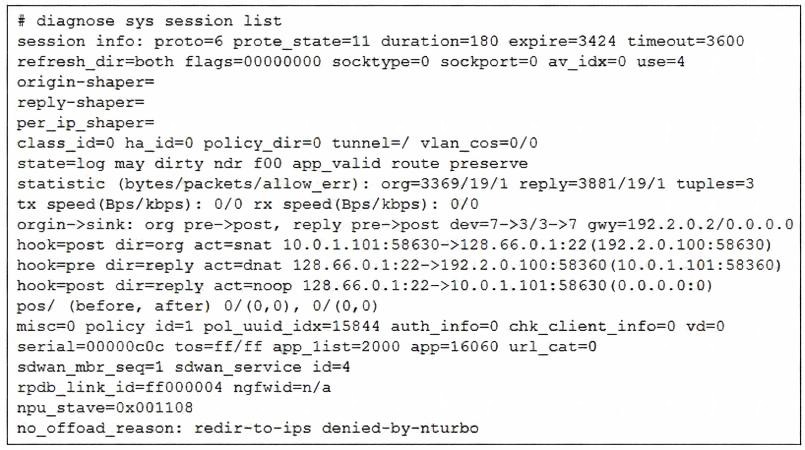
The administrator configured the SD-WAN rule ID 4 with two members (port1 and port2) and strategy lowest cost (SLA). What are the two characteristics of the session shown in the exhibit? (Choose two.)
The administrator configured the SD-WAN rule ID 4 with two members (port1 and port2) and strategy lowest cost (SLA). What are the two characteristics of the session shown in the exhibit? (Choose two.)
Show answerHide answer
Correct answer: A, D FortiGate steered this flow according to an SD-WAN rule 4. FortiGate will re-evaluate this session if the outgoing interface goes down.
Explanation
Explanation:Evidence from the session output
Two key lines in the output are:
sdwan_service_id=4
sdwan_mbr_seq=1 (and the session flags include may_dirty)
✅ A. FortiGate steered this flow according to an SD-WAN rule 4. — Correct
Why:
sdwan_service_id=4 explicitly shows that SD-WAN rule (service) ID 4 selected the egress for this session.
This is the clearest indicator in diagnose sys session list that SD-WAN steering was applied.
✅ D. FortiGate will re-evaluate this session if the outgoing interface goes down. — Correct
Why:
The session includes the flag may_dirty, which indicates the session is eligible to be marked “dirty” and re-evaluated when underlying conditions change (for example, SD-WAN member failure, link down, or SLA state change).
Also, because the SD-WAN strategy is lowest cost (SLA), if the currently used member fails, FortiGate will re-run the SD-WAN rule decision and move the session to the next best available member when re-evaluation is enabled (which is the typical/default behavior in SD-WAN rules unless explicitly disabled).
Why the other options are wrong
❌ B. FortiGate will never re-evaluate this session. — Incorrect
Contradicted by the presence of may_dirty and SD-WAN service steering metadata (sdwan_service_id).
❌ C. FortiGate steered this flow according to the application detected and the outgoing interface is port3. — Incorrect
While the session shows app_valid / app=16060 (application was identified), the output’s steering attribution is to SD-WAN rule ID 4, not application-based steering, and the option’s outgoing interface is port3 is not supported by the rule description (members are port1 and port2, not port3).