Fortinet certification · Exam NSE6_FNC_AD-7.6

NSE6_FNC_AD-7.6 Mock Exam

Fortinet NSE 6 - FortiNAC-F 7.6 Administrator

Find out if you're ready for NSE6_FNC_AD-7.6. Take the free timed mock exam and get your score in minutes, or study the free NSE6_FNC_AD-7.6 questions below with answers and explanations.

16 questions · 24 minutes · free, no sign-up

Free NSE6_FNC_AD-7.6 questions

1–10 of 16 free
Question 1 Choose 1
An administrator wants to create a conference manager administrator account but would like to limit the number of conference accounts that can be generated to 30. Which statement about conference accounts is true?
Show answerHide answer

Correct answer: D Conference account limits are defined in the conference guest and contractor template.

Explanation

Explanation:

In FortiNAC-F 7.6, the maximum number of conference accounts is configured in the Guest/Contractor template when the Visitor Type is set to Conference.

The template includes a setting called Max Number Of Accounts. When enabled, the administrator can enter the maximum total number of conference accounts that can be created using that template. Therefore, if the requirement is to allow only 30 conference accounts, the administrator can configure the conference template with a maximum of 30 accounts.

Why the other options are incorrect:
A. Incorrect. FortiNAC-F does not require conference-account limits to be configured in multiples of 25. A specific maximum such as 30 can be entered in the template.

B. Incorrect. An administrator profile controls what a conference manager or sponsor is permitted to do and which guest/contractor templates they can use. It does not directly define the maximum number of conference accounts.

C. Incorrect. The onboarding conference portal is not where the maximum account limit is configured.

D. Correct. The Guest/Contractor template contains the Max Number Of Accounts setting specifically for the Conference visitor type.

Fortinet Reference:
Fortinet FortiNAC-F 7.6.0 Documentation → Create templates → Max Number Of Accounts. Fortinet states that this setting is available when the Visitor Type is Conference and limits the total number of accounts that can be created with that template.
Question 2 Choose 1
Refer to the exhibit.

Given this topology, and a layer 3 registration network configuration, which IP address would be designated in the DHCP relay configuration for the registration network?
Show answerHide answer

Correct answer: D 192.168.200.10

Explanation

Explanation:

In a Layer 3 FortiNAC-F registration network, DHCP broadcasts from endpoints in the Registration VLAN cannot directly reach FortiNAC-F because the endpoints and FortiNAC service interface are on different Layer 3 networks. A DHCP relay/helper is therefore configured on the registration network to forward the DHCP requests to the FortiNAC-F Service Interface (port2).

Fortinet specifically states that, in a Layer 3 implementation, DHCP relays must be configured on each isolation network and point back to the FortiNAC isolation/service interface. FortiNAC-F uses port2 to provide services such as DHCP, DNS, and the captive portal to isolated endpoints.

From the exhibit:
Registration VLAN: 192.168.10.x/24
Registration VLAN gateway: 192.168.10.254
Corporate DHCP: 192.168.100.75
FortiNAC-F port1: 192.168.100.20
FortiNAC-F port2: 192.168.200.10

Therefore, the DHCP relay for the Registration VLAN must forward DHCP requests to 192.168.200.10.

Why the Other Options Are Incorrect:
A. 192.168.10.254 – Incorrect
This is the default gateway of the Registration VLAN. The DHCP relay would typically be configured on this routing device/interface, but this address is not the DHCP relay destination.

B. 192.168.100.75 – Incorrect
This is the corporate DHCP server. For FortiNAC-F Layer 3 isolation/registration, FortiNAC provides DHCP addressing to isolated endpoints through its service interface rather than directing these registration clients to the normal corporate DHCP server. Fortinet requires at least one FortiNAC DHCP scope for an isolation VLAN.

C. 192.168.100.20 – Incorrect
This is FortiNAC-F port1, which is the production/management-facing interface. Layer 3 isolation services use port2, the FortiNAC Service Interface.

D. 192.168.200.10 – Correct
This is the FortiNAC-F port2/service interface. The DHCP relay for the Registration VLAN should point to this address.

Reference:
Fortinet FortiNAC-F 7.6 Deployment Guide → Determine FortiNAC Service Configuration (Network Type): for Layer 3 implementations, DHCP relays on isolation networks point back to the FortiNAC isolation interface.
Question 3 Choose 1
An administrator wants FortiNAC-F to return a group of user-defined RADIUS attributes in RADIUS responses. Which condition must be true to achieve this?
Show answerHide answer

Correct answer: B Inbound RADIUS requests must contain the Calling-Station-ID attribute.

Explanation

Explanation:

FortiNAC-F can use RADIUS Attribute Groups to return a collection of standard, vendor-specific, or user-defined/custom RADIUS attributes in RADIUS responses such as Access-Accept.

For FortiNAC-F to process and return these attribute groups, the incoming RADIUS request must include the Calling-Station-Id attribute. Fortinet specifically states that if Calling-Station-Id is missing, RADIUS attributes will not be returned.

Why the Other Options Are Incorrect

A. The requesting device must support RFC 5176. — Incorrect
RFC 5176 relates to Dynamic Authorization, including Change of Authorization (CoA) and Disconnect-Request messages. It is not required simply for FortiNAC-F to return attribute groups in an Access-Accept response.

B. Inbound RADIUS requests must contain the Calling-Station-ID attribute. — Correct
This is an explicit Fortinet requirement. The Calling-Station-Id identifies the endpoint and allows FortiNAC-F to properly process logical-network information and determine which RADIUS attribute groups should be returned.

C. The device models in the inventory view must be configured for proxy-based authentication. — Incorrect
Fortinet states that devices using RADIUS Attribute Groups must be configured for Local RADIUS Authentication, not proxy-based authentication.

D. RADIUS accounting must be enabled on the FortiNAC-F RADIUS server configuration. — Incorrect
Accounting is important for some functions, particularly CoA-related functionality, but it is not the prerequisite for returning RADIUS Attribute Groups in normal authentication responses.

Reference
Fortinet FortiNAC-F 7.6 Administration Guide → RADIUS > Attribute Groups states two key requirements:
Device models must use Local RADIUS Authentication.
The inbound RADIUS request must contain Calling-Station-Id; otherwise, the configured RADIUS attributes are not returned.
Question 4 Choose 1
What must an administrator configure to allow FortiNAC-F to process incoming syslog messages that are not supported by default?
Show answerHide answer

Correct answer: C A Security Event Parser

Explanation

Explanation:

FortiNAC-F has built-in support for parsing syslog messages from a wide range of common vendors (e.g., Cisco, Aruba, Palo Alto, Fortinet). However, when an administrator needs to ingest and process syslog messages from a custom application or a vendor whose syslog format is not natively recognized by FortiNAC, they must configure a Security Event Parser.

The Security Event Parser allows the administrator to define custom regular expressions (regex) to extract specific values (e.g., source IP, destination IP, username, threat level) from the raw syslog payload.

Once the parser extracts these fields, FortiNAC can map them to internal fields and use them to trigger Security Actions (like quarantining a device) based on the parsed event data.

Without a custom parser, FortiNAC will receive the syslog messages but will not understand the structure, so it will ignore or drop the events for policy enforcement purposes.

Why the other options are incorrect:

A. A Syslog Service Connector:
This is not a standard FortiNAC term. FortiNAC uses Log Receivers to accept syslog, not "Service Connectors." Connectors typically refer to integrations with third-party systems like ticketing systems, SIEMs, or MDM (e.g., ServiceNow Connector). This option is a distractor.

B. A Security Action:
A Security Action defines what FortiNAC should do in response to an event (e.g., isolate the device, send an email, disable a port). It does not define how to interpret the incoming syslog message. You must have a parser to interpret the event before you can apply an action to it.

D. A Log Receiver:
A Log Receiver is the configuration that tells FortiNAC where and how to listen for syslog messages (e.g., which UDP/TCP port and IP address to bind to). It is responsible for the transport layer, but it does not process or parse the content of the messages. You need a Log Receiver to get the data in, and a Security Event Parser to make sense of it.

Reference:
FortiNAC 7.6 Administration Guide > Security Events > "Configuring Security Event Parsers" – Explicitly states that custom parsers are required to process syslog formats not supported by default.
FortiNAC 7.6 Administration Guide > Log Receivers > "Syslog Receivers" – Differentiates between the receiver (transport) and the parser (content interpretation).
FortiNAC 7.6 Online Help > "Creating a Custom Parser" – Details the use of regular expressions to extract fields from raw syslog data.
Question 5 Choose 1
When managing multiple FortiNAC-F CAs with a FortiNAC-F Manager, how is endpoint information updated in the FortiNAC-F Manager database?
Show answerHide answer

Correct answer: A Endpoint information is pulled from the managed CAs by the FortiNAC-F Manager at a set interval.

Explanation

Explanation:

In FortiNAC-F 7.6, the FortiNAC Manager maintains local endpoint information by actively pulling endpoint data from each managed CA.

Fortinet's documentation states that the Manager actively pulls endpoint information (users, hosts, and adapters) from each managed CA every 5 minutes, incrementally, and saves the information locally.

Important Exam Points
Direction: CA → FortiNAC Manager
Method: Manager actively pulls the information
Frequency: Every 5 minutes
Type: Incremental synchronization
Stored: The information is saved in the Manager's local database.

Why the Other Options Are Incorrect

❌ B. Endpoint information is updated in real time when a host status changes.
The endpoint database synchronization is not described as real-time. FortiNAC Manager polls/pulls endpoint information at the documented 5-minute interval.

❌ C. Endpoint information is updated when an administrator synchronizes with each CA.
Administrators can manually synchronize global configuration objects, but endpoint information is handled through the Manager's automatic endpoint synchronization mechanism. Fortinet distinguishes manual CA synchronization from endpoint synchronization.

❌ D. Endpoint information is pushed to the FortiNAC-F Manager based on an administratively configured scheduled task.
The direction is reversed. The Manager pulls endpoint information from the managed CAs; it isn't pushed by a user-configured scheduled task.

Exam Takeaway
Remember:
FortiNAC Manager → pulls → endpoint information → every 5 minutes → incrementally
This is different from Global Synchronization, which concerns global configuration information and has its own synchronization behavior. Fortinet's 7.6 documentation lists Global Synchronization separately from endpoint synchronization.
Question 6 Choose 1
As part of a FortiNAC-F integration with FortiGate for management of VPN users, what must be configured on FortiGate to keep FortiNAC-F up to date with VPN session information?
Show answerHide answer

Correct answer: D Syslog messages

Explanation

Explanation:

For the FortiNAC-F integration with FortiGate VPN users, FortiGate must be configured to send the relevant VPN syslog messages to FortiNAC-F.

When a user successfully connects through an SSL VPN or IPsec VPN, FortiGate creates the VPN session and sends FortiNAC-F a syslog message containing information such as the user ID, remote IP address, and session details. FortiNAC-F uses this information to keep its view of active VPN sessions current.

For FortiNAC-F 7.6, Fortinet documents the relevant VPN log IDs, including:

SSL VPN: 0101039947, 0101039948
IPsec VPN: 0101037129, 0101037134
IPsec VPN for FortiNAC-F 7.6+: 0101037139 is also supported and recommended for more efficient phase2-up/phase2-down processing.

Why the Other Options Are Incorrect

A. SNMP traps — Incorrect
SNMP can be used for device discovery and management information, but it is not the mechanism FortiNAC-F relies on to receive current FortiGate VPN session events.

B. RADIUS accounting — Incorrect
RADIUS accounting is important in other FortiNAC authentication integrations, but the documented FortiGate VPN integration uses VPN syslog events and API information to track the VPN session.

C. Security Fabric integration — Incorrect
Security Fabric connectivity can be part of the broader FortiGate/FortiNAC integration, but it is not what keeps FortiNAC-F updated with VPN login/logout session information.

D. Syslog messages — Correct
Fortinet explicitly requires VPN activity syslog messages to be sent from FortiGate to FortiNAC-F. FortiNAC-F listens for these messages and uses them to identify and maintain VPN session information.

Fortinet Reference

Fortinet FortiNAC-F 7.6 → FortiGate VPN Integration → Syslog Settings / How It Works. The documentation states that after a successful VPN connection, FortiGate sends a syslog message to FortiNAC containing the user's IP and other session information.
Question 7 Choose 2
Which two statements are true about integrating a third-party device using SNMP traps from that device as input to generate an event? (Choose two.)
Show answerHide answer

Correct answer: A, C The sending device must be modeled in the inventory topology.set allowaccess snmp must be configured using the CLI on the FortiNAC-F receiving interface.

Explanation

Explanations:

A. The sending device must be modeled in the inventory topology:
For FortiNAC to properly map, parse, and associate an incoming SNMP trap payload to a recognized network asset or source, the third-party hardware component must first be added and modeled within the Network Inventory topology.

C. set allowaccess snmp must be configured using the CLI on the FortiNAC-F receiving interface:
The system interface on the FortiNAC-F appliance that intercepts trap messages must be administratively configured to allow SNMP service (set allowaccess snmp), ensuring the firewall policy permits incoming UDP port 162 traffic to reach the management engine.

B. SNMPv3 requirement — Incorrect:
FortiNAC does not exclusively require SNMPv3. Third-party devices can also send traps using SNMPv1 or SNMPv2c.

D. Specific IP and MAC address OIDs — Incorrect:
Configuring specific IP and MAC address OIDs is not a blanket requirement for all trap MIB file implementations to generate events.
Question 8 Choose 1
Refer to the exhibit.

After a successful layer 2 poll, two hosts were learned on the same port The port is a member of the Role- Based Access and Forced Registration groups. The switch has been configured to leverage a single isolation VLAN. How will FortiNAC-F manage this port?
Show answerHide answer

Correct answer: A The port will be provisioned to the isolation network

Explanation

Explanation:

FortiNAC-F performs VLAN enforcement at the switch-port level in this scenario. When multiple hosts are learned on the same physical access port, they cannot independently be placed into different VLANs through ordinary port-based VLAN switching.

Because the port belongs to the Forced Registration group, an unregistered/rogue host connected to that port triggers registration enforcement. Fortinet states that ports in this group place unregistered devices into the Registration/Isolation VLAN until they are registered.

Since the switch is configured to use a single isolation VLAN, the port itself is moved to that isolation network. Consequently, both hosts behind that physical port are affected by the VLAN assignment.

Why the Other Options Are Incorrect

B. The port will be provisioned for the normal state host, but the second host will have access to only the isolation portal page — Incorrect
With ordinary port-based VLAN enforcement, FortiNAC-F cannot assign one host on the physical port to the production VLAN while keeping another host on that same port in the isolation VLAN. The VLAN change applies to the port.

C. The port will be provisioned as an uplink to a hub or unmanaged switch — Incorrect
Learning two MAC addresses on a port does not automatically cause FortiNAC-F to convert that port into an uplink. FortiNAC-F can recognize multiple hosts on one port, but that condition by itself does not make it an infrastructure uplink.

D. The port will be added to the Access Point Management group — Incorrect
Access Point Management relates to recognized wireless access-point infrastructure. Simply discovering multiple hosts on a wired switch port does not cause the port to be placed in that group.

Reference
Fortinet FortiNAC-F documentation states that:
Forced Registration causes unregistered hosts on participating ports to be placed into the Registration VLAN.
FortiNAC-F can use a single isolation VLAN for restricted states such as unknown/unregistered hosts.
Question 9 Choose 1
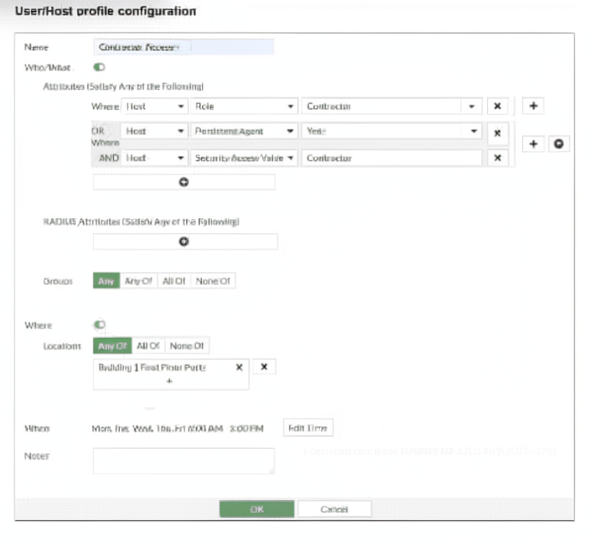
Refer to the exhibit.

If a host is connected to a port in the Building 1 First Floor Ports group, what must also be true to match this user/host profile?
Show answerHide answer

Correct answer: D The host must have a role value of contractor or an installed persistent agent and a security access value of contractor, and be connected between 6 AM and 5 PM.

Explanation

Explanation:

The Attributes section shows this logic structure:

Where: Host Role = Contractor
OR Where: Host Persistent Agent = Yes
AND Where: Host Security Access Value = Contractor

This groups as: (Role = Contractor OR Persistent Agent = Yes) AND (Security Access Value = Contractor)
The Where (time) field shows: Mon, Tue, Wed, Thu, Fri, 6:00 AM – 5:00 PM.
So the full matching condition is: the host must have a role of contractor or an installed persistent agent, and regardless of which of those is true, it must also have a security access value of contractor — and the connection must occur between 6 AM and 5 PM.

This matches Option D exactly: "The host must have a role value of contractor or an installed persistent agent and a security access value of contractor, and be connected between 6 AM and 5 PM."

Why Not the Others:

A — Incorrect:
Incorrectly implies the security access value is inside the OR group. It is actually ANDed separately, as indicated by the "AND Where" row.

B — Incorrect:
Incorrectly states the time window as 9 AM–5 PM instead of 6 AM–5 PM.

C — Incorrect:
Incorrectly ORs all three conditions together, ignoring the "AND" that ties in the Security Access Value condition.
Question 10 Choose 1
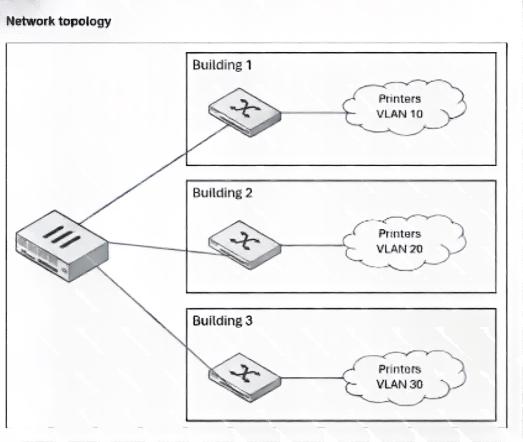
Refer to the exhibit.

An administrator wants to use FortiNAC-F to automatically provision printers throughout their organization. Each building uses its own local VLAN for printers. Which FortiNAC-F feature would allow this to be accomplished with a single network access policy?
Show answerHide answer

Correct answer: B Logical networks

Explanation

Explanation:

Logical networks allow the administrator to create a single Network Access Policy while dynamically mapping printers to the appropriate building-specific VLAN.

The key idea is that a logical network provides an abstraction over the actual physical VLANs. The same policy can assign the appropriate logical network, while FortiNAC-F determines the corresponding local VLAN for the printer based on the network configuration at that location.

Why the Other Options Are Incorrect

A. Dynamic host groups — Incorrect:
These dynamically group hosts based on criteria, but they don't provide the VLAN abstraction needed to use different local VLANs with one policy.

B. Logical networks — Correct:
They allow different physical VLANs to be represented through a common logical network, making a single policy possible.

C. Device profiling rules — Incorrect:
Profiling rules identify and classify devices such as printers; they don't by themselves handle the per-building VLAN mapping.

D. Preferred VLAN designations — Incorrect:
Preferred VLANs can influence VLAN selection, but they don't provide the centralized logical-to-physical network abstraction described in the question.

Exam Tip

When you see “different VLANs at different locations/buildings + one Network Access Policy,” think Logical Networks.
Full mock exam

Sit the NSE6_FNC_AD-7.6 exam before exam day

Full-length mocks with the same number of questions and the same time limit as the real NSE6_FNC_AD-7.6 exam. Every attempt draws a new set of questions from the full bank, so you can keep going until you pass comfortably.

Get full NSE6_FNC_AD-7.6 mock exam
  • —questions per mock
  • —time limit
  • 59questions in the bank
  • Newmock on every attempt