Juniper certification · Exam JN0-664

JN0-664 Mock Exam Page 3

Service Provider Professional (JNCIP-SP)

Free JN0-664 mock exam questions 21–28, each with the answer and an explanation.

20 questions · 28 minutes · free, no sign-up

Free JN0-664 questions

21–28 of 28 free
Question 21 Choose 1
Exhibit


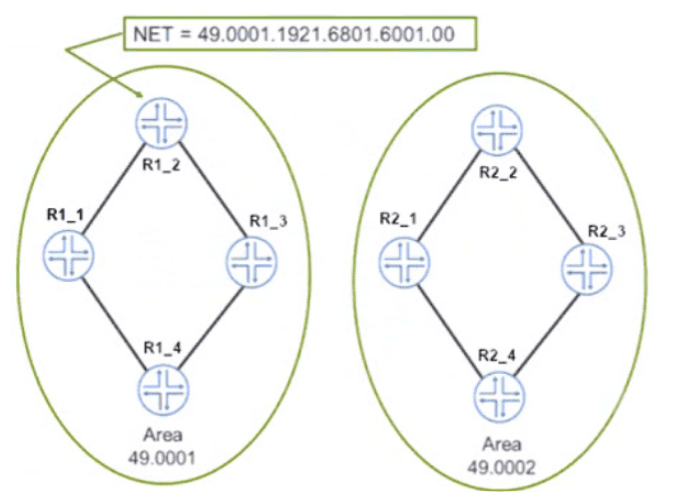
The network shown in the exhibit is based on IS-IS
Which statement is correct in this scenario?
Show answerHide answer

Correct answer: A The NSEL byte for Area 0001 is 00.

Explanation

Explanation:

The exhibit shows an IS-IS network with two areas: 49.0001 and 49.0002. The NET (Network Entity Title) for one router is given as: 49.0001.1921.6801.6001.00

A. The NSEL byte for Area 0001 is 00.

Correct. The NSEL (N‑SEL) or SEL (NSAP Selector) is the last byte (two hex digits) of the NET. In IS-IS, the SEL is always 00 for routing purposes. In the given NET 49.0001.1921.6801.6001.00, the final 00 is the NSEL. This identifies the NET as an IS‑IS routing entity rather than a transport layer endpoint. Therefore, the NSEL for Area 0001 (or any area) is indeed 00.

Why other options are incorrect

B. The area address is two bytes.
Incorrect. The area address is variable length. Here, 49.0001 — 49 is the AFI (1 byte), and 0001 is the area ID (2 bytes). Total area address length is 3 bytes, not 2 bytes.

C. The routers are using unnumbered interfaces.
Incorrect. There is no information in the exhibit about interface addressing. IS-IS can run on numbered or unnumbered interfaces, but the exhibit does not indicate either. The NET shows the system ID derived from an IP address (1921.6801.6001 = 192.168.1.1 format), suggesting numbered interfaces exist, but unnumbered is not stated or implied.

D. The system ID of R1_2 is 192.168.16.1.
Incorrect. The system ID in the NET is 1921.6801.6001, which converts to 1921.6801.6001 (hex) → 192.168.1.1 in dotted decimal, not 192.168.16.1. The conversion: 1921=192.1? Actually, standard mapping: 1921 hex = 192.1? Let's clarify: 192.168.1.1 in hex is c0.a8.01.01, not 1921.6801. Wait — the given 1921.6801.6001 is likely a 6‑byte system ID written as 3 groups of 4 hex digits: 1921 6801 6001. This does not directly map to a simple dotted decimal IP. It is not 192.168.16.1. The system ID format is 6 bytes of hex, not directly an IP address. Thus D is false.

References:

ISO 10589: IS-IS NET format — AFI + Area ID + System ID (6 bytes) + SEL (00 for routing). SEL byte is always 00 for IS‑IS routing entities. Junos IS-IS Configuration Guide.
Question 22 Choose 1
What is the correct order of packet flow through configurable components in the Junos OS CoS features?
Show answerHide answer

Correct answer: B Behavior Aggregate Classifier -> Multifield Classifier -> Input Policer -> Forwarding Policy Options -> Fabric Scheduler -> Output Policer -> Scheduler/Shaper/RED -> Rewrite Marker

Explanation

Explanation:

Junos CoS processes packets in a specific ordered sequence from ingress to egress. Understanding this order is critical for proper CoS configuration.

Correct order breakdown:

Behavior Aggregate (BA) Classifier – First at ingress. Examines a single field (DSCP, EXP, 802.1p) to assign forwarding class and loss priority. Fast hardware operation.

Multifield (MF) Classifier – Second. Firewall filter examining multiple fields (IP, port, etc.). Can override BA classification results.

Input Policer – Applies rate limiting on ingress. Can discard packets that exceed configured rates. Operates after classification so policer can act on forwarding class.

Forwarding Policy Options – Controls which next-hop or output interface is selected based on forwarding class.

Fabric Scheduler – Manages packet queuing across the switch fabric in modular platforms. Occurs before egress queuing.

Output Policer – Applies rate limiting on egress before final queuing. Can police after fabric but before scheduler.

Scheduler/Shaper/RED – Egress queuing mechanism. Schedulers transmit packets, shapers rate‑limit, RED manages congestion.

Rewrite Marker – Last step. Rewrites packet headers (DSCP, EXP, 802.1p) for outgoing packets so downstream routers can classify them correctly.

Why other options are incorrect

A.Places MF before BA (wrong order) and Rewrite Marker before Scheduler (rewrite must be last).

C.Places Input Policer before MF classifier — policer should operate after classification.

D.Places Scheduler before Output Policer — output policer typically precedes scheduler in Junos on many platforms.

References

Junos Class of Service Configuration Guide: “CoS Packet Flow Sequence” – BA → MF → Policers → Forwarding Policy → Fabric Scheduler → Output Policer → Scheduler → Rewrite Marker. JNCIP‑SP Study Guide: CoS processing order.
Question 23 Choose 2
Exhibit


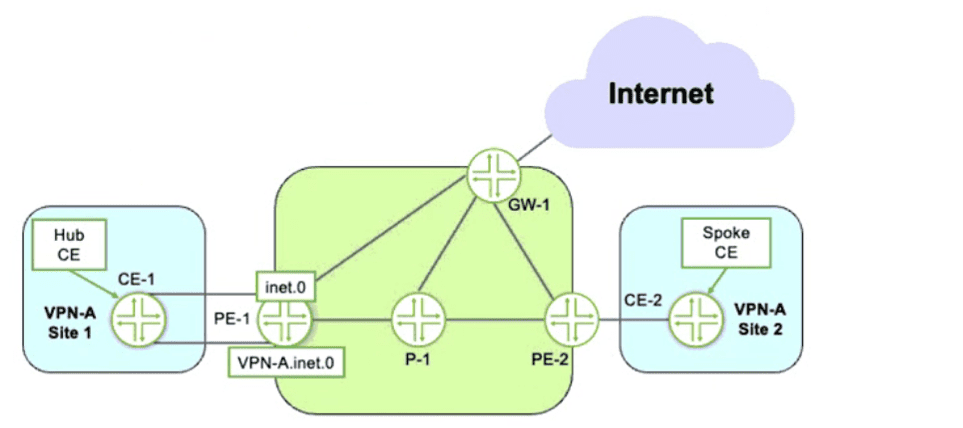
Referring to the exhibit, you must provide Internet access for VPN-A using CE-1 as the hub CE.

Which two statements are correct in this situation? (Choose two.)
Show answerHide answer

Correct answer: A, D You must use RIB groups to leak routes between the inet. o and vpn-a. inet. o tables.Internet traffic from Site 2 takes the path of PE-2 -> PE-1 -> CE-1 -> PE-1 -> GW-1.

Explanation

Explanation:

The exhibit shows a hub-and-spoke VPN topology where CE-1 (hub CE) provides Internet access for VPN-A. Site 2 (spoke CE) connects to PE-2, and the Internet gateway (GW-1) connects to PE-1. However, the requirement states Internet access must use CE-1 as the hub CE, meaning all Internet-bound traffic must go through CE-1.

A. You must use RIB groups to leak routes between the inet.0 and VPN-A.inet.0 tables.
Correct. To allow VPN-A sites to reach the Internet, the default route (or specific Internet routes) from the global routing table (inet.0) must be imported into the VRF table (VPN-A.inet.0). This is achieved using a RIB group (e.g., import-rib [ inet.0 VPN-A.inet.0 ]). Without this, the VRF has no knowledge of Internet destinations.

D. Internet traffic from Site 2 takes the path of PE-2 → PE-1 → CE-1 → PE-1 → GW-1.
Correct. In a hub-and-spoke design with CE-1 as the hub, all traffic between spokes (or from a spoke to the Internet via the hub) must traverse the hub CE. Therefore, traffic from Site 2 (CE-2) goes:
CE-2 → PE-2 → (MPLS VPN) → PE-1 → CE-1 (hub) → back to PE-1 → GW-1 → Internet. The return path follows the reverse. CE-1 acts as the central routing point.

Why other options are incorrect

B. RIB groups are not needed
Incorrect. RIB groups (or similar route leaking) are essential to bring Internet routes into the VRF. Without them, no Internet access is possible.

C. Internet traffic from Site 2 takes PE-2 → PE-1 → GW-1
Incorrect. This path bypasses the hub CE (CE-1), violating the design requirement. The hub CE must be used.

References:

Junos VPNs Configuration Guide: RIB groups for VRF Internet access. Hub-and-spoke VPN design requires all inter-spoke traffic (including Internet) to traverse the hub CE. JNCIP‑SP Study Guide: Layer 3 VPNs — Internet access using hub CE.
Question 24 Choose 1
Exhibit


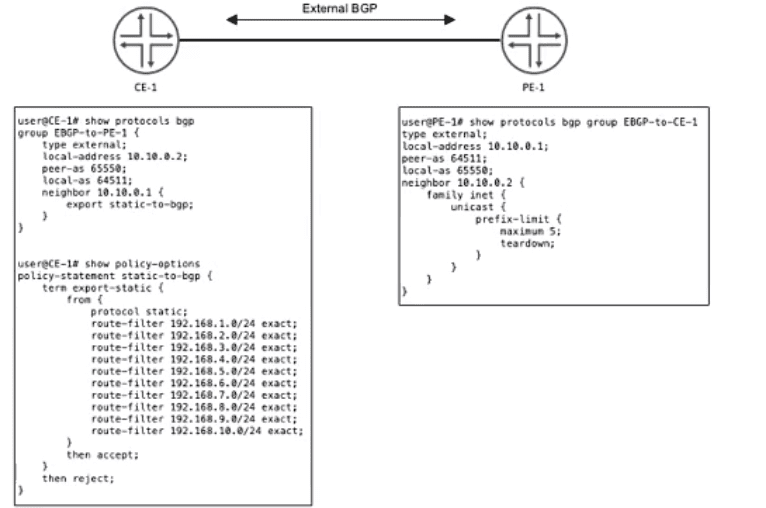
CE-1 must advertise ten subnets to PE-1 using BGP Once CE-1 starts advertising the subnets to PE-1, the BGP peering state changes to Active.

Referring to the CLI output shown in the exhibit, which statement is correct?
Show answerHide answer

Correct answer: C The prefix limit has been reached on PE-1

Explanation

Explanation:

The exhibit shows CE-1 attempting to advertise ten subnets (192.168.1.0/24 through 192.168.10.0/24) to PE-1 using an export policy static-to-bgp.

Why other options are incorrect

A. CE-1 is advertising its entire routing table
Incorrect. CE-1 is advertising exactly ten static routes via the export policy, not its entire routing table.

B. CE-1 is configured with an incorrect peer AS
Incorrect. CE-1 uses peer-as 65550 and local-as 64511; PE-1 uses peer-as 64511 and local-as 65550. The AS numbers match correctly.

D. CE-1 is unreachable
Incorrect. The BGP session initially establishes (pre‑limit) and only fails after prefix limit is exceeded. Reachability is not the issue.

References:

Junos BGP Configuration Guide: prefix-limit — maximum prefixes allowed from a neighbor. teardown terminates BGP session when limit exceeded. JNCIP‑SP Study Guide: BGP — Prefix limiting and session behavior.
Question 25 Choose 2
Exhibit


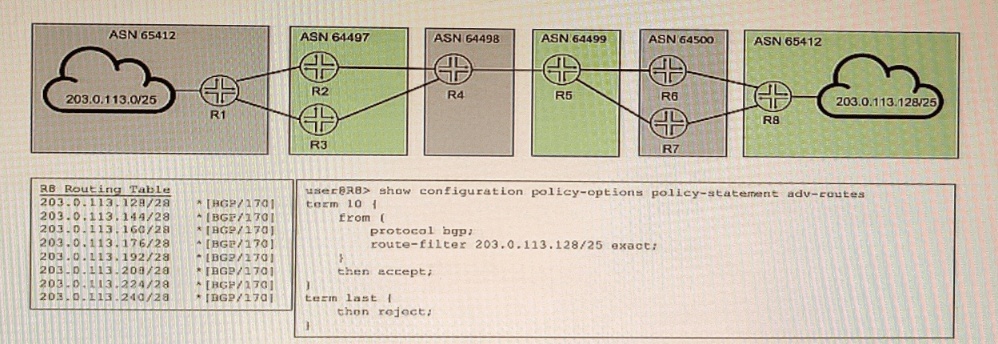
You are attempting to summarize routes from the 203.0.113.128/25 IP block on R8 to AS 64500. You implement the export policy shown in the exhibit and all routes from the routing table stop being advertised.

In this scenario, which two steps would you take to summarize the route in BGP? (Choose two.)
Show answerHide answer

Correct answer: A, D Remove the from protocol bgp command from the export policyReplace exact in the export policy with orlonger.

Explanation

Explanation:

The exhibit shows R8 attempting to advertise a summary route 203.0.113.128/25 toward AS 64500. However, the export policy adv-routes contains:

from protocol bgp
route-filter 203.0.113.128/25 exact

After applying this policy, all routes stop being advertised because the policy matches nothing and the final reject blocks everything.

A. Remove the from protocol bgp command from the export policy.
R8 likely does not have a BGP route for 203.0.113.128/25 exactly. The route may be an aggregate, static, or directly connected route. By specifying protocol bgp, the policy matches only BGP-learned routes, excluding other route sources. Removing this allows the policy to match the summary route regardless of its protocol origin (e.g., aggregate or static discard).

D. Replace exact in the export policy with orlonger.
If R8 has only more‑specific routes (e.g., /26, /27, etc.) and no exact /25 route, the exact match fails. Changing to orlonger matches the prefix 203.0.113.128/25 and any more-specific routes. However, for proper summarization, you typically need an aggregate route or static discard route for the /25 itself. The orlonger alone is insufficient without a summary route in the table. But in combination with removing protocol bgp, R8 can generate the summary via an aggregate route. The question asks for two steps to summarize the route — A and D are the correct pair from the options given.

Why other options are incorrect

B. Add add-path command
add-path allows advertising multiple BGP paths for the same prefix. It does not help with route summarization or fix the “no routes advertised” problem.

C. Add static route 203.0.113.123/25 discard
The prefix is incorrect — should be 203.0.113.128/25, not .123/25. Even if corrected, a static discard route alone does not fix the policy match issue without also adjusting the policy.

References:

Junos BGP Configuration Guide:BGP export policies for route summarization. Aggregate routes require orlonger or separate aggregate term. Removing protocol restriction allows non‑BGP routes to be advertised. JNCIP‑SP Study Guide: BGP — Prefix aggregation.
Question 26 Choose 2
Which two statements are correct about the customer interface in an LDP-signaled pseudowire? (Choose two)
Show answerHide answer

Correct answer: C, D When the encapsulation is vLan-ccc or extended-vlan-ccc, the configured VLAN tag is included in the control plane LDP advertisementWhen the encapsulation is ethemet-ccc, tagged and untagged frames are both accepted in the data plane.

Explanation

Explanation:

LDP-signaled pseudowires (Layer 2 circuits) use specific encapsulation types to determine how the PE handles Ethernet frames and how it communicates requirements to the remote peer via LDP.

VLAN-CCC / Extended-VLAN-CCC (Option C):
These encapsulations are "VLAN-aware." When the PE signals the pseudowire to its peer, it includes the specific VLAN ID in the LDP Label Mapping message (specifically within the Interface Parameters TLV). This ensures both sides agree on the VLAN tag being transported. If the tags do not match and "ignore-encapsulation-mismatch" is not set, the pseudowire will stay down.

Ethernet-CCC (Option D):
This is often referred to as "Port Mode" or "Raw Mode." In this mode, the PE treats the physical interface (or unit 0) as a transparent pipe. It does not look at the internal VLAN tags of the incoming frames; it simply takes the entire Ethernet frame (regardless of whether it is tagged, untagged, or Q-in-Q) and wraps it in an MPLS label for transport.

Why Other Options Are Incorrect

Option A:This is incorrect because the VLAN ID is a fundamental part of the LDP control plane signaling for VLAN-based circuits to ensure service consistency between PEs.

Option B: This is incorrect because ethernet-ccc is specifically designed for transparency. Restricting it to untagged frames only would defeat its purpose as a port-to-port tunneling mechanism; it is the most permissive encapsulation type.

References:

Junos OS VPNs User Guide: "Layer 2 Circuit Encapsulation Types" – Section detailing Ethernet-CCC vs. VLAN-CCC.

JNCIP-SP Certification Objectives: "Layer 2 VPNs" – Understanding LDP signaling and/ seudowire encapsulation.
Question 27 Choose 2
You are a network architect for a service provider and want to offer Layer 2 services to your customers You want to use EVPN for Layer 2 services in your existing MPLS network.

Which two statements are correct in this scenario? (Choose two.)
Show answerHide answer

Correct answer: C, D EVPN uses Type 2 routes to advertise MAC address and IP address pairs learned using ARP snoopingEVPN uses Type 3 routes to join a multicast tree to flood traffic.

Explanation

Explanation:

EVPN (Ethernet VPN) uses a BGP-based control plane to distribute reachability information. In an MPLS network, it relies on several specific BGP route types to handle different traffic scenarios:

MAC/IP Advertisement (Type 2):
Unlike traditional VPLS which relies on data plane learning, EVPN uses BGP Type 2 routes to distribute learned MAC addresses. If ARP snooping is enabled, the PE can also learn the associated IP address and advertise the MAC/IP pair together. This helps reduce network-wide ARP flooding by allowing the egress PE to respond to ARP requests locally (ARP suppression).

Inclusive Multicast Ethernet Tag Route (Type 3):
EVPN uses Type 3 routes for the "ingress replication" or multicast signaling. These routes are used to announce a PE's interest in receiving Broadcast, Unknown Unicast, and Multicast (BUM) traffic for a specific EVPN instance (EVI). They allow the PEs to build a flood tree to ensure BUM traffic is correctly replicated to all participating sites.

Why Other Options Are Incorrect

A. Segment Routing:
While EVPN can run over a Segment Routing (SR) transport, it is not a requirement. EVPN is transport-agnostic and functions perfectly over traditional LDP or RSVP-TE signaled LSPs.

B. VXLAN:
VXLAN is an alternative data plane encapsulation often used in data centers. However, since the scenario explicitly mentions an existing MPLS network, you would typically use EVPN-MPLS (where BGP labels are used for the service) rather than VXLAN.

References

Junos OS VPNs User Guide: "EVPN Overview" and "Understanding EVPN Route Types."

JNCIP-SP Certification Objectives: Under "Edge-routed Bridging (ERB) and EVPN-MPLS Operations."

RFC 7432: BGP MPLS-Based Ethernet VPN" – Section detailing the function of Route Types 2 and 3.
Question 28 Choose 1
You are asked to protect your company's customers from amplification attacks. In this scenario, what is Juniper's recommended protection method
Show answerHide answer

Correct answer: B BGP FlowSpec

Explanation

Explanation:

Amplification attacks are a type of volumetric DDoS where an attacker sends small requests with a spoofed source IP (the victim) to publicly accessible services, which then send much larger responses to the victim.

BGP FlowSpec: Unlike traditional routing, which only looks at the destination IP, FlowSpec allows the propagation of traffic filtering rules via BGP. It can match traffic based on source, destination, protocol, and port, and then take action—such as rate-limiting or discarding—directly at the network edge. This is the recommended approach for amplification attacks because it allows the provider to drop only the malicious traffic (e.g., NTP traffic from specific sources) while keeping legitimate traffic flowing to the customer.

Why Other Options Are Incorrect

A. ASN Prepending:
This is a traffic engineering technique used to influence inbound path selection by making an AS Path look longer and less desirable. It provides no protection against the volume or nature of a DDoS attack.

C. Destination-based RTBH:
While effective at stopping an attack from reaching the customer, RTBH is a "sledgehammer" approach. It drops all traffic destined for the victim's IP address. For an amplification attack, this means the attacker succeeds in their goal of taking the customer offline.

D. unicast Reverse Path Forwarding (uRPF):
uRPF is used to prevent spoofing at the source. While it helps stop your own network from being an origin of spoofed traffic, it does not protect your customers from an external amplification attack already directed at them from the Internet.

References

Junos OS Routing Protocols User Guide: Section on "BGP Flow Specification (FlowSpec) Overview."

JNCIP-SP Certification Objectives: "High Availability and Network Security" – Implementation of BGP FlowSpec for DDoS mitigation.

That's the last free question

You've seen the free 30% (28 of 96 questions). Full access unlocks every question and full-length JN0-664 mock exams (65 questions, 90 minutes), a different mock on every attempt.

Unlock full mock exam
Full mock exam

Sit the JN0-664 exam before exam day

Full-length mocks with the same number of questions and the same time limit as the real JN0-664 exam. Every attempt draws a new set of questions from the full bank, so you can keep going until you pass comfortably.

Get full JN0-664 mock exam
  • 65questions per mock
  • 90 mintime limit
  • 96questions in the bank
  • Newmock on every attempt