Exhibit
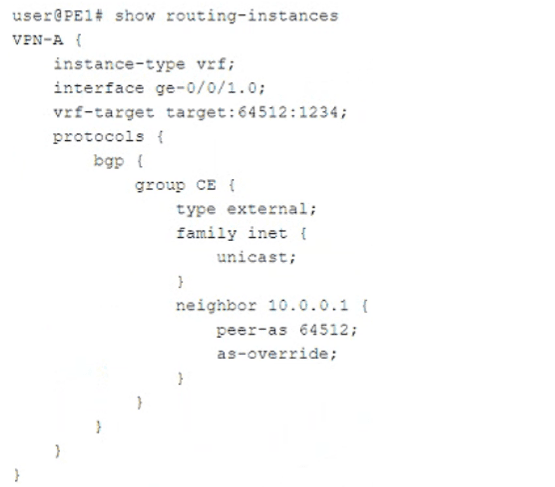
Which two statements about the configuration shown in the exhibit are correct? (Choose two.)
Which two statements about the configuration shown in the exhibit are correct? (Choose two.)
Show answerHide answer
Correct answer: B, D This VPN connects customer sites that use the same AS numberA Layer 3 VPN is configured.
Explanation
Explanation:The exhibit shows a VRF (routing instance) configuration with:
instance-type vrf → Layer 3 VPN (not Layer 2)
vrf-target target:64512:1234 → exports/imports routes using route target community
BGP configured between PE and CE (neighbor 10.0.0.1, peer-as 64512)
as-override configured under the BGP group
D. A Layer 3 VPN is configured.
Correct. instance-type vrf plus vrf-target and BGP peering with a CE indicates a BGP/MPLS Layer 3 VPN (RFC 4364). The PE exchanges IP routes (family inet unicast) with the CE.
B. This VPN connects customer sites that use the same AS number.
Correct. The as-override statement is used when multiple customer sites share the same AS number. Without as-override, the PE would receive routes from CE1 with AS 64512, then advertise them to CE2 (also AS 64512). CE2 would see its own AS in the AS path and reject the routes. as-override replaces CE2's AS (64512) with the PE's AS before sending to CE2, preventing loop detection. This proves the customer uses the same AS at multiple sites.
Why other options are incorrect
A. This VPN connects customer sites that use different AS numbers.
Incorrect. If sites used different AS numbers, as-override would not be needed. The as-override command explicitly solves the "same AS across sites" problem.
C. A Layer 2 VPN is configured.
Incorrect. instance-type vrf and BGP family inet unicast indicate a Layer 3 VPN. Layer 2 VPNs use instance-type l2vpn or evpn.
References
RFC 4364: BGP/MPLS IP Virtual Private Networks (VPNs)
Junos VPNs Configuration Guide: "as-override for BGP/MPLS Layer 3 VPNs"
JNCIP‑SP Study Guide: Layer 3 VPNs — CE‑PE routing with same AS