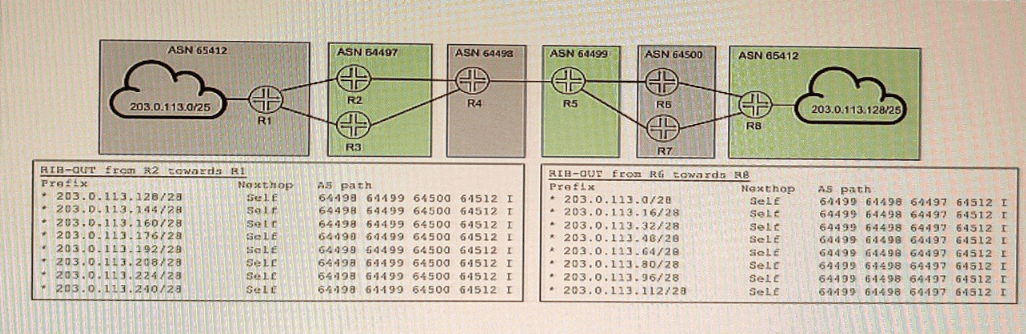
R1 and R8 are not receiving each other's routes
Referring to the exhibit, what are three configuration commands that would solve this problem? (Choose three.)
Show answerHide answer
Correct answer: A, B, C Configure remove-private on advertisements from AS 64497 toward AS 64498.Configure as-override on advertisement from AS 64500 toward AS 64512.Configure remove-private on advertisements from AS 64500 toward AS 64499.
Explanation
Explanation:The problem illustrated in image_c38646.jpg is a classic BGP loop prevention scenario. Both R1 and R8 reside in AS 65412. When R1 advertises a route, the AS Path attribute is prepended with 65412. As this update traverses the provider networks and reaches R6/R7 to be sent to R8, the AS Path still contains 65412. Upon receipt, R8 detects its own AS number in the path and discards the prefix to prevent a potential routing loop.
To resolve this without using non-standard workarounds, the provider must hide or replace the customer's AS number:
Option B (as-override):
This is the primary solution for Provider Edge (PE) routers. By configuring as-override on the neighbor statement toward R8, the PE router replaces the occurrence of 65412 in the AS Path with its own AS (64500). R8 then receives an update that appears to originate from the provider, bypassing the loop check.
Options A & C (remove-private):
The intermediate ASNs (64497 through 64500) are within the private AS range. In many service provider designs, especially when spanning multiple sub-segments or organizations, remove-private is used to strip these ASNs before the update is passed to another peer. This shortens the AS Path and ensures that private AS numbers do not leak into different routing domains, which helps maintain clean path information between the two customer sites.
Why Other Options Are Incorrect
Options D & E (loops and advertise-peer-as):
These commands are "Customer Edge" (CE) side fixes rather than "Provider" side fixes. While configuring loops allows a router to accept a path containing its own AS, it is generally discouraged in professional ISP environments as it weakens loop prevention. advertise-peer-as is typically used in specific complex hub-and-spoke topologies and is not the standard or most efficient method for the linear provider transit shown in the exhibit.
References
Juniper Networks Technical Publication: Junos OS Routing Protocols User Guide – Section on "BGP AS-Override and Loop Prevention."
JNCIP-SP Certification Objectives: Service Provider Routing Policy – Specifically covering BGP path attribute manipulation and scaling techniques.