Finnco, a subsidiary of a certification body, provided ISMS consultancy services to an
organization. Considering this scenario, when can the certification body certify the
organization?
Show answerHide answer
Correct answer: BAt no time, since it presents a conflict of interest
Question 62Choose 1
Which is an example of a qualitative evidence?
Show answerHide answer
Correct answer: CAn interview with the information security personnel to validate if the information security
process complies with the standard requirements
Question 63Choose 1
What is the objective of penetration testing in the risk assessment process?
Show answerHide answer
Correct answer: BTo identify potential failures in the ICT protection schemes
Question 64Choose 1
Select the option which best describes how Information Security Management System
audits should be conducted:
Show answerHide answer
Correct answer: DAudit methods should be used to assess objective evidence in order to generate audit
findings. Then, the audit conclusion should be created and presented to the auditee at the
closing meeting.
Question 65Choose 1
Scenario 3: Rebuildy is a construction company located in Bangkok.. Thailand, that
specializes in designing, building, and maintaining residential buildings. To ensure
the security of sensitive project data and client information, Rebuildy decided to
implement an ISMS based on ISO/IEC 27001. This included a comprehensive
understanding of information security risks, a defined continual improvement
approach, and robust business solutions.
The ISMS implementation outcomes are presented below
•Information security is achieved by applying a set of security controls and
establishing policies, processes, and procedures.
•Security controls are implemented based on risk assessment and aim to eliminate
or reduce risks to an acceptable level.
•All processes ensure the continual improvement of the ISMS based on the plan-docheck-
act (PDCA) model.
•The information security policy is part of a security manual drafted based on best
security practices Therefore, it is not a stand-alone document.
•Information security roles and responsibilities have been clearly stated in every
employees job description
•Management reviews of the ISMS are conducted at planned intervals.
Rebuildy applied for certification after two midterm management reviews and one
annual internal audit Before the certification audit one of Rebuildy’s former employees approached one of the audit team members to tell them that Rebuildy has
several security problems that the company is trying to conceal. The former
employee presented the documented evidence to the audit team member Electra, a
key client of Rebuildy, also submitted evidence on the same issues, and the auditor
determined to retain this evidence instead of the former employee's. The audit team
member remained in contact with Electra until the audit was completed, discussing
the nonconformities found during the audit. Electra provided additional evidence to
support these findings.
At the beginning of the audit, the audit team interviewed the company’s top
management They discussed, among other things, the top management's
commitment to the ISMS implementation. The evidence obtained from these
discussions was documented in written confirmation, which was used to determine
Rebuildy’s conformity to several clauses of ISO/IEC 27001
The documented evidence obtained from Electra was attached to the audit report,
along with the nonconformities report. Among others, the following nonconformities
were detected:
•An instance of improper user access control settings was detected within the
company's financial reporting system.
•A stand-alone information security policy has not been established. Instead, the
company uses a security manual drafted based on best security practices.
After receiving these documents from the audit team, the team leader met Rebuildy’s
top management to present the audit findings. The audit team reported the findings
related to the financial reporting system and the lack of a stand-alone information
security policy. The top management expressed dissatisfaction with the findings and
suggested that the audit team leader's conduct was unprofessional, implying they
might request a replacement. Under pressure, the audit team leader decided to
cooperate with top management to downplay the significance of the detected
nonconformities. Consequently, the audit team leader adjusted the report to present
a more favorable view, thus misrepresenting the true extent of Rebuildy's
compliance issues.
Based on the scenario above, answer the following question:
Question:
Based on Scenario 3, the audit team used information obtained from interviews with top
management to determine Rebuildy’s conformity to several ISO/IEC 27001 clauses. Is
this acceptable?
Show answerHide answer
Correct answer: BYes, the audit team obtained verbal evidence by written confirmations from the top management, which can be used to determine conformity to the standard
Question 66
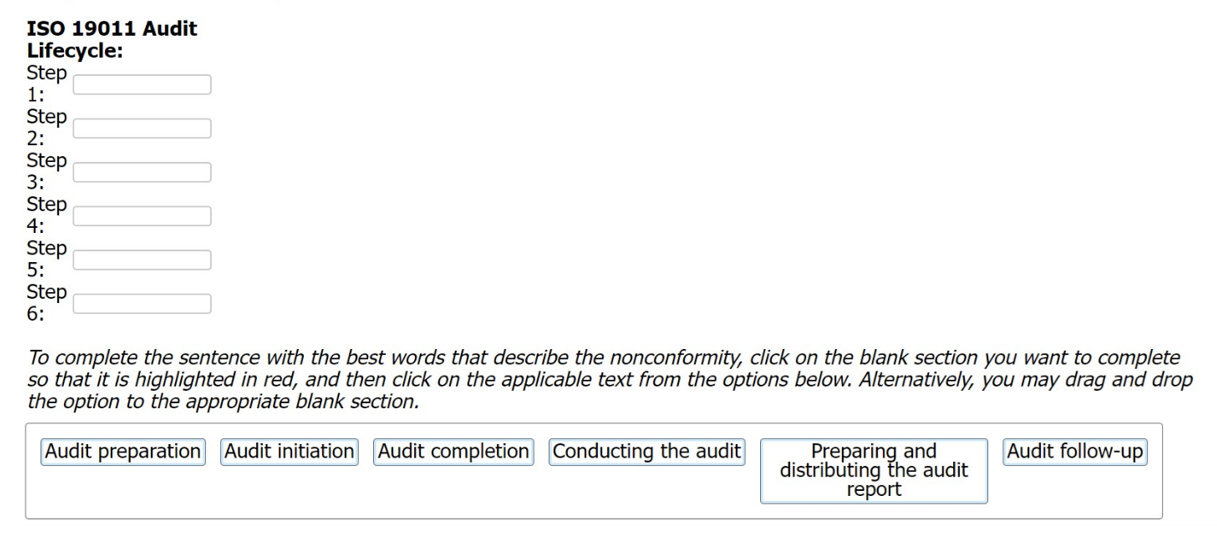
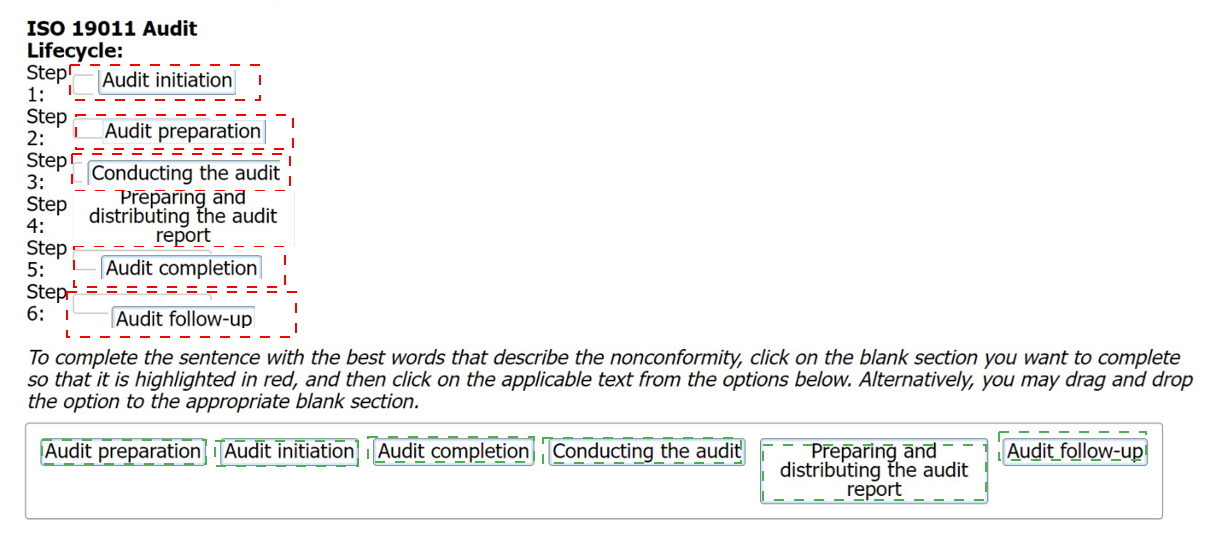
The audit lifecycle describes the ISO 19011 process for conducting an individual audit.
Drag and drop the steps of the audit lifecycle into the correct sequence.
Show answerHide answer
Explanation
Question 67Choose 1
Which one of the following options best describes the purpose of a Stage 2 audit?
Show answerHide answer
Correct answer: CTo evaluate the implementation of the management system
Question 68Choose 1
Why should materiality be considered during the initial contact?
Show answerHide answer
Correct answer: CTo set the audit objectives
Question 69Choose 1
Scenario 6: Sinvestment is an insurance company that offers home, commercial, and life
insurance. The company was founded in North Carolina, but have recently expanded in
other locations, including Europe and Africa.
Sinvestment is committed to complying with laws and regulations applicable to their
industry and preventing any information security incident. They have implemented an ISMS
based on ISO/IEC 27001 and have applied for ISO/IEC 27001 certification.
Two auditors were assigned by the certification body to conduct the audit. After signing a
confidentiality agreement with Sinvestment. they started the audit activities. First, they
reviewed the documentation required by the standard, including the declaration of the
ISMS scope, information security policies, and internal audits reports. The review process
was not easy because, although Sinvestment stated that they had a documentation
procedure in place, not all documents had the same format.
Then, the audit team conducted several interviews with Sinvestment's top management to
understand their role in the ISMS implementation. All activities of the stage 1 audit were
performed remotely, except the review of documented information, which took place onsite,
as requested by Sinvestment.
During this stage, the auditors found out that there was no documentation related to
information security training and awareness program. When asked, Sinvestment's
representatives stated that the company has provided information security training
sessions to all employees. Stage 1 audit gave the audit team a general understanding of
Sinvestment's operations and ISMS.
The stage 2 audit was conducted three weeks after stage 1 audit. The audit team observed
that the marketing department (which was not included in the audit scope) had no
procedures in place to control employees’ access rights. Since controlling employees'
access rights is one of the ISO/IEC 27001 requirements and was included in the
information security policy of the company, the issue was included in the audit report. In
addition, during stage 2 audit, the audit team observed that Sinvestment did not record logs
of user activities. The procedures of the company stated that "Logs recording user activities
should be retained and regularly reviewed," yet the company did not present any evidence
of the implementation of such procedure.
During all audit activities, the auditors used observation, interviews, documented information review, analysis, and technical verification to collect information and evidence.
All the audit findings during stages 1 and 2 were analyzed and the audit team decided to
issue a positive recommendation for certification.
According to scenario 6, the marketing department employees were not following the
access control policy. Which option is correct in this case?
Show answerHide answer
Correct answer: BThe employees' access right control is included in Sinvestment’s information security
policy, so the issue must be communicated to Sinvestment's representatives and included
in the audit report
Question 70Choose 4
You are an ISMS audit team leader tasked with conducting a follow-up audit at a client's
data centre. Following two days on-site you conclude that of the original 12 minor and 1 major nonconformities that prompted the follow-up audit, only 1 minor nonconformity still
remains outstanding.
Select four options for the actions you could take.
Show answerHide answer
Correct answer: A, C, F, GAgree with the auditee/audit client how the remaining nonconformity will be cleared, by
when, and how its clearance will be verified
Close the follow-up audit as the organisation has demonstrated it is committed to
clearing the nonconformities raised
Note the progress made but hold the audit open until all corrective action has been
cleared
Advise the individual managing the audit programme of any decision taken regarding
the outstanding nonconformity
Full mock exam
Sit the ISO-IEC-27001-Lead-Auditor exam before exam day
Full-length mocks with the same number of questions and the same time limit as the real ISO-IEC-27001-Lead-Auditor exam. Every attempt draws a new set of questions from the full bank, so you can keep going until you pass comfortably.