OrgXY is an ISO/IEC 27001-certified software development company. A year after being
certified, OrgXY's top management informed the certification body that the company was
not ready for conducting the surveillance audit. What happens in this case?
Show answerHide answer
Correct answer: AThe certification is suspended
Question 92Choose 3
You are conducting a third-party surveillance audit when another member of the audit team approaches you seeking clarification. They have been asked to assess the organisation's application of control 5.7 - Threat Intelligence. They are aware that this is one of the new controls introduced in the 2022 edition of ISO/IEC 27001, and they want to make sure they audit the control correctly.
They have prepared a checklist to assist them with their audit and want you to confirm that their planned activities are aligned with the control's requirements.
Which three of the following options represent valid audit trails?
Show answerHide answer
Correct answer: D, F, GI will ensure that appropriate measures have been introduced to inform top management as to the effectiveness of current threat intelligence arrangementsI will check that threat intelligence is actively used to protect the confidentiality, integrity and availability of the organisation's information assetsI will review how information relating to information security threats is collected and evaluated to produce threat intelligence
Question 93Choose 1
Which one of the following options best describes the main purpose of a Stage 2 third-party
audit?
Show answerHide answer
Correct answer: CTo identify nonconformances against a standard
Question 94Choose 1
Scenario 6: Cyber ACrypt is a cybersecurity company that provides endpoint
protection by offering anti-malware and device security, asset life cycle
management, and device encryption. To validate its ISMS against ISO/IEC 27001 and
demonstrate its commitment to cybersecurity excellence, the company underwent a
meticulous audit process led by John, the appointed audit team leader.
Upon accepting the audit mandate, John promptly organized a meeting to outline the
audit plan and team roles This phase was crucial for aligning the team with the
audit's objectives and scope However, the initial presentation to Cyber ACrypt’s staff
revealed a significant gap in understanding the audit's scope and objectives,
indicating potential readiness challenges within the company
As the stage 1 audit commenced, the team prepared for on-site activities. They
reviewed Cyber ACrypt's documented information, including the information
security policy and operational procedures ensuring each piece conformed to and
was standardized in format with author identification, production date, version
number, and approval date Additionally, the audit team ensured that each document
contained the information required by the respective clause of the standard This
phase revealed that a detailed audit of the documentation describing task execution
was unnecessary, streamlining the process and focusing the team's efforts on
critical areas During the phase of conducting on-site activities, the team evaluated
management responsibility for the Cyber Acrypt's policies This thorough
examination aimed to ascertain continual improvement and adherence to ISMS
requirements Subsequently, in the document, the stage 1 audit outputs phase, the
audit team meticulously documented their findings, underscoring their conclusions
regarding the fulfillment of the stage 1 objectives. This documentation was vital for
the audit team and Cyber ACrypt to understand the preliminary audit outcomes and
areas requiring attention.
The audit team also decided to conduct interviews with key interested parties. This
decision was motivated by the objective of collecting robust audit evidence to
validate the management system’s compliance with ISO/IEC 27001 requirements.
Engaging with interested parties across various levels of Cyber ACrypt provided the
audit team with invaluable perspectives and an understanding of the ISMS's
implementation and effectiveness.
The stage 1 audit report unveiled critical areas of concern. The Statement of
Applicability (SoA) and the ISMS policy were found to be lacking in several respects,
including insufficient risk assessment, inadequate access controls, and lack of
regular policy reviews. This prompted Cyber ACrypt to take immediate action to
address these shortcomings. Their prompt response and modifications to the
strategic documents reflected a strong commitment to achieving compliance.
The technical expertise introduced to bridge the audit team's cybersecurity
knowledge gap played a pivotal role in identifying shortcomings in the risk
assessment methodology and reviewing network architecture. This included
evaluating firewalls, intrusion detection and prevention systems, and other network
security measures, as well as assessing how Cyber ACrypt detects, responds to,
and recovers from external and internal threats. Under John's supervision, the
technical expert communicated the audit findings to the representatives of Cyber
ACrypt. However, the audit team observed that the expert s objectivity might have
been compromised due to receiving consultancy fees from the auditee. Considering
the behavior of the technical expert during the audit, the audit team leader decided
to discuss this concern with the certification body.
Based on the scenario above, answer the following question:
Question:
Based on Scenario 6, was the objective of the interviews during the Stage 1 audit
accordingly set by the audit team?
Show answerHide answer
Correct answer: AYes, the objective of the interviews is to collect audit evidence to validate the
management system’s compliance with ISO/IEC 27001 requirements
Question 95Choose 1
Scenario 7: Webvue. headquartered in Japan, is a technology company specializing
in the development, support, and maintenance of computer software. Webvue
provides solutions across various technology fields and business sectors. Its
flagship service is CloudWebvue, a comprehensive cloud computing platform
offering storage, networking, and virtual computing services. Designed for both
businesses and individual users. CloudWebvue is known for its flexibility,
scalability, and reliability.
Webvue has decided to only include CloudWebvue in its ISO/IEC 27001 certification
scope. Thus, the stage 1 and 2 audits were performed simultaneously Webvue takes
pride in its strictness regarding asset confidentiality They protect the information
stored in CloudWebvue by using appropriate cryptographic controls. Every piece of
information of any classification level, whether for internal use. restricted, or
confidential, is first encrypted with a unique corresponding hash and then stored in
the cloud.
The audit team comprised five persons Keith. Sean. Layla, Sam. and Tina. Keith, the
most experienced auditor on the IT and information security auditing team, was the
audit team leader. His responsibilities included planning the audit and managing the
audit team. Sean and Layla were experienced in project planning, business analysis,
and IT systems (hardware and application) Their tasks included audit planning
according to Webvue’s internal systems and processes Sam and Tina, on the other
hand, who had recently completed their education, were responsible for completing
the day-to-day tasks while developing their audit skills.
While verifying conformity to control 8.24 Use of cryptography of ISO/IEC 27001
Annex A through interviews with the relevant staff, the audit team found out that the
cryptographic keys have been initially generated based on random bit generator
(RBG) and other best practices for the generation of the cryptographic keys. After
checking Webvue's cryptography policy, they concluded that the information
obtained by the interviews was true. However, the cryptographic keys are still in use
because the policy does not address the use and lifetime of cryptographic keys.
As later agreed upon between Webvue and the certification body, the audit team
opted to conduct a virtual audit specifically focused on verifying conformity to
control 8.11 Data Masking of ISO/IEC 27001 within Webvue, aligning with the
certification scope and audit objectives. They examined the processes involved in
protecting data within CloudWebvue. focusing on how the company adhered to its
policies and regulatory standards. As part of this process. Keith, the audit team
leader, took screenshot copies of relevant documents and cryptographic key management procedures to document and analyze the effectiveness of Webvue's
practices.
Webvue uses generated test data for testing purposes. However, as determined by
both the interview with the manager of the QA Department and the procedures used
by this department, sometimes live system data are used. In such scenarios, large
amounts of data are generated while producing more accurate results. The test data
is protected and controlled, as verified by the simulation of the encryption process
performed by Webvue's personnel during the audit.
While interviewing the manager of the QA Department, Keith observed that
employees in the Security Training Department were not following proper
procedures, even though this department fell outside the audit scope. Despite the
exclusion in the audit scope, the non conformity in the Security Training Department
has potential implications for the processes within the audit scope, specifically
impacting data security and cryptographic practices in CloudWebvue. Therefore,
Keith incorporated this finding into the audit report and accordingly informed the
auditee.
Based on the scenario above, answer the following question:
Question:
To verify conformity to the protection of test data control, Webvue’s personnel
simulated the encryption process. Is this acceptable?
Show answerHide answer
Correct answer: CYes, simulation of a process to verify conformity to a control can be done with the
assistance of the auditee’s personnel
Question 96Choose 1
How does predictive analytics help auditors in identifying potential risks?
Show answerHide answer
Correct answer: BBy predicting future outcomes based on trends
Question 97Choose 2
Which two of the following options do not participate in a second-party audit to ISO/IEC
27001?
Show answerHide answer
Correct answer: D, EAn auditor from an accreditation bodyAn auditor trained in the CQI and IRCA scheme
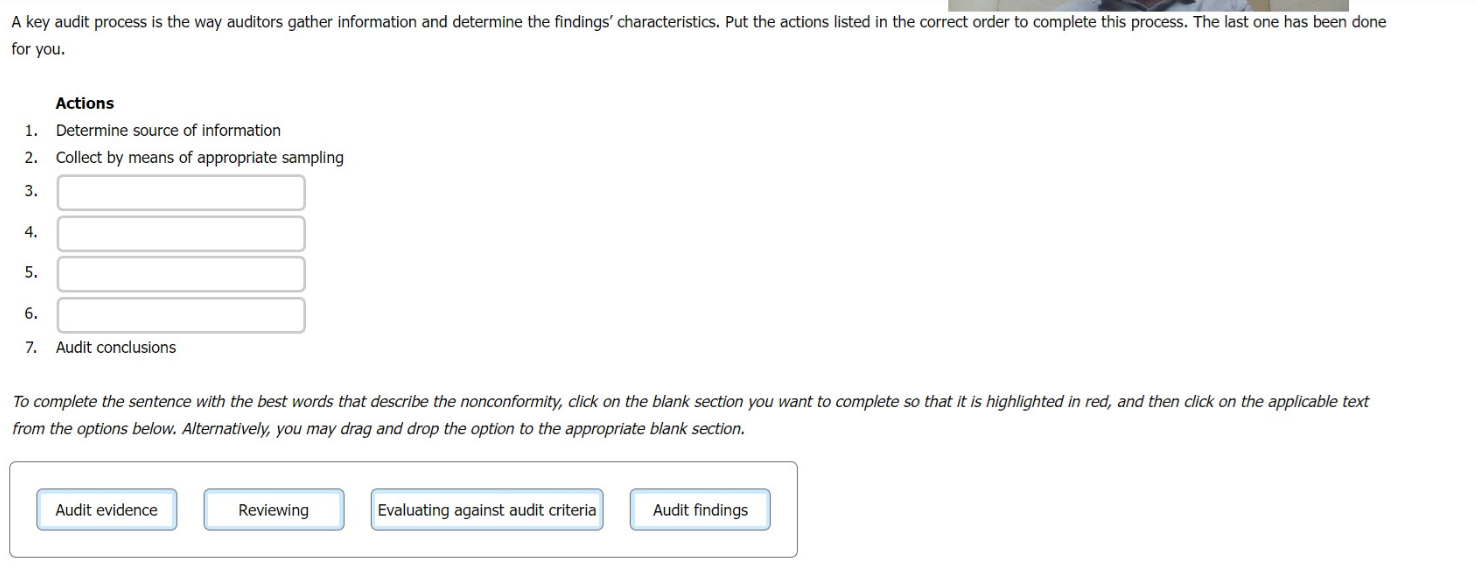
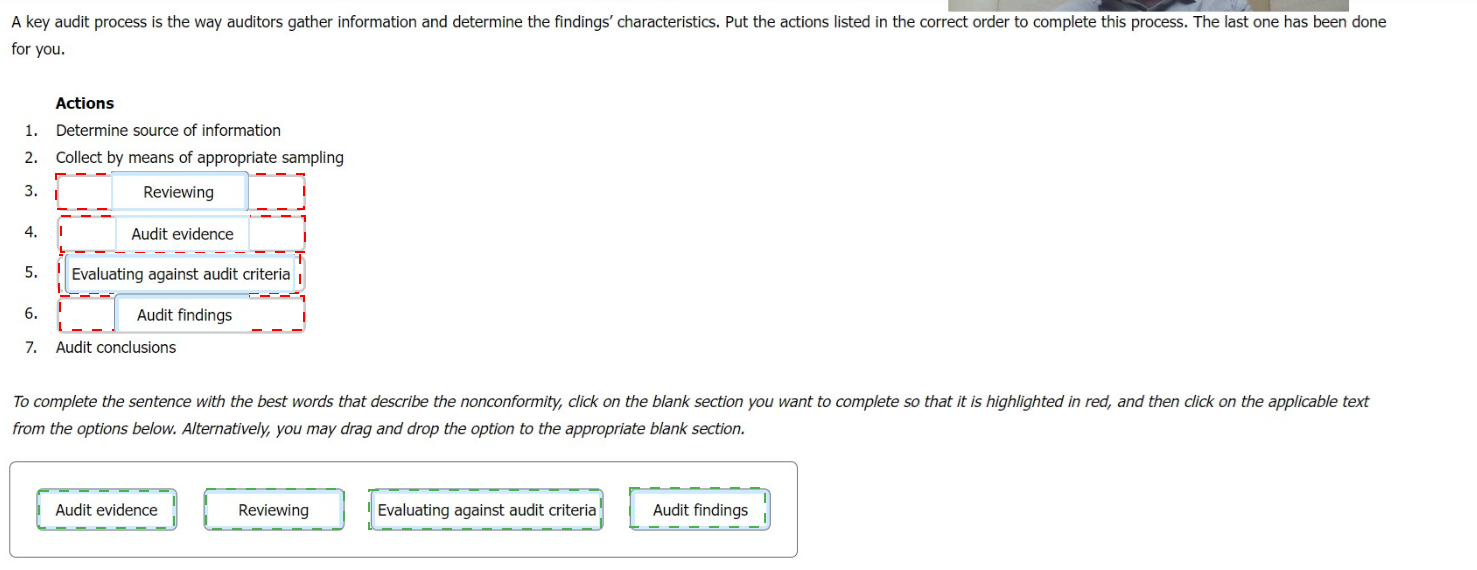
A key audit process is the way auditors gather information and determine the findings'
characteristics. Put the actions listed in the correct order to complete this process. The last
one has been done for you.
Show answerHide answer
Explanation
Question 100
Select the words that best complete the sentence:
"The purpose of maintaining regulatory compliance in a management system is to
To complete the sentence with the best word(s), click on the blank section you want to
complete so that it is highlighted in red,
and then click on the applicable text from the options below. Alternatively, you may drag
and drop the option to the appropriate blank section.
Show answerHide answer
Explanation
Full mock exam
Sit the ISO-IEC-27001-Lead-Auditor exam before exam day
Full-length mocks with the same number of questions and the same time limit as the real ISO-IEC-27001-Lead-Auditor exam. Every attempt draws a new set of questions from the full bank, so you can keep going until you pass comfortably.