What type of fund offers the highest expected risk and the highest expected return in terms
of the risk-return trade-off between different types of mutual funds?
Show answerHide answer
Correct answer: CSpecialty fund
Explanation
Explanation:
A specialty fund generally carries the highest expected risk and highest expected return among the fund types listed because it concentrates its investments in a specific industry, sector, geographic area, or theme.
This concentration reduces diversification. If the targeted sector performs very well, returns can be substantial; however, if that sector performs poorly, the fund can experience significant losses.
This illustrates the risk-return trade-off:
Higher potential return → Higher potential risk
Why the other answers are incorrect
A. Mortgage fund: Generally has lower risk and more predictable income because it invests primarily in mortgages.
B. Canadian Equity fund: Invests in Canadian stocks and can have significant volatility, but is generally more diversified than a specialty fund.
C. Specialty fund: ✅ Correct. Concentration in a specific sector or theme creates higher risk and therefore higher expected return.
D. Real estate fund: Can have relatively high risk because of property-market fluctuations, but is generally not as concentrated as a specialty fund.
Question 52Choose 1
Sheldon is a 25 year old graphic designer. He has just started working and saves regularly.
Apart from his regular salary he also earns extra money from freelancing after office hours
and during weekends. His earnings from his freelance work are sufficient for meeting his
living expenses. He saves the entire amount of his salary. He has heard about lifecycle
funds but has come to you for additional information.
Which of the following statement about lifecycle funds is TRUE?
Show answerHide answer
Correct answer: AAs Sheldon gets older, the life cycle asset allocation changes from more risky to less
risky.
Explanation
Explanation:
Lifecycle funds (also called target-date or target-maturity funds) are designed with a predetermined “glide path.”
They begin with a higher allocation to equities (higher risk/return potential) when the investor is younger and farther from the target date. As the investor ages and the target date approaches, the fund automatically rebalances toward a more conservative mix (more fixed-income and cash, less equity).
This automatic shift from more risky to less risky is the core feature of lifecycle funds and is covered in the IFC curriculum under mutual fund products and portfolio construction.
Why the other options are incorrect
B: Lifecycle funds do not start with equal allocations to cash, fixed income, and equities. They typically begin with a heavy equity weighting that gradually declines.
C: The asset allocation does not remain fixed. It changes over time according to the fund’s glide path. It is also not based on the current age demographic of unitholders in a static way.
D: Changes in asset allocation are driven by the passage of time (proximity to the target date), not by the investor’s income.
Key IFC takeaway: Lifecycle funds provide a hands-off way for investors (especially younger ones like Sheldon) to maintain an age-appropriate asset mix that automatically becomes more conservative as they approach their goal (e.g., retirement).
Question 53Choose 1
Four fund managers are comparing their quartile rankings over the past four years:
Which fund manager would likely be most satisfied with their fund's performance history?
Show answerHide answer
Correct answer: CManager A
Explanation
Explanation:
Quartile Rankings Concept: In mutual fund performance evaluation (covered in the IFC curriculum), a peer group universe is divided into four equal groups (or quartiles):
1st Quartile: Represents the top 25% of performers (the best-performing funds in the category). 2nd Quartile: Represents performance from 25% to 50%. 3rd Quartile: Represents performance from 50% to 75%. 4th Quartile: Represents the bottom 25% of performers (the worst-performing funds).
Why Manager A is Correct: A fund manager (and their investors) would be most satisfied maintaining consistent rankings in the 1st quartile over a multi-year evaluation period, as it proves superior, market-leading performance relative to competing funds in the same category. (Note: If your specific question variant included a table of year-by-year rankings, look for the manager who consistently scored in the 1st quartile or showed the strongest upward consistency).
Why the Other Options are Incorrect: Managers positioned in the 2nd, 3rd, or 4th quartiles show average to below-average relative performance, meaning their funds lagged behind a significant portion of their peers.
Official Reference: Investment Funds in Canada (IFC) Course, Chapter: Understanding Mutual Fund Performance (Module covering peer group comparison universes and quartile rankings).
Question 54Choose 1
What type of mutual fund seeks to provide a positive real rate of return, through both
income and capital appreciation, by investing in a diversified portfolio of fixed income
securities, as well as Canadian and foreign equity securities?
Show answerHide answer
Correct answer: BBalanced
Explanation
Explanation:
A balanced fund is designed to provide both income (from fixed-income securities such as bonds) and capital appreciation (from equity investments). It invests in a diversified portfolio that typically includes Canadian and foreign equities along with fixed-income securities. The goal is to achieve a positive real rate of return while managing risk through diversification across asset classes.
Reference: CSI Investment Funds in Canada (IFC), Chapter 10 “The Modern Mutual Fund” — balanced funds combine fixed income and equity securities to provide growth and income, aiming for a positive real return.
❌ Why the Other Options Are Incorrect
A. Dividend Fund
Focuses primarily on equities that pay dividends. It emphasizes income but does not necessarily balance with fixed-income securities for diversification.
C. Blue Chip Fund
Invests in large, established companies with strong track records. These funds emphasize stability and growth but do not include fixed-income securities as part of their mandate.
D. Mortgage Fund
Invests mainly in mortgages or mortgage-backed securities, focusing on income. It does not provide the equity exposure needed for capital appreciation.
📘 References Balanced Funds — diversified mix of equities and fixed income Dividend Funds — equity focus with dividend income
Question 55Choose 1
Vickie recently added the ABC Investco EV Fund to her portfolio. This fund invests in global
companies involved in the electric vehicles sector. What type of mutual fund is this
classified as?
Show answerHide answer
Correct answer: DSpecialty
Explanation
Explanation:
D. Specialty (Correct) Why it's right: A specialty fund (sometimes called a sector, thematic, or industry fund) invests in a narrow, specific segment of the economy—such as a single industry, theme, or technology trend like electric vehicles, biotechnology, or artificial intelligence. Because the ABC Investco EV Fund concentrates exclusively on the electric vehicles sector rather than broad market indexes, it is classified under the specialty fund category.
A. Standard (Incorrect) Why it's wrong: "Standard" is not a formal mutual fund classification type in the IFC curriculum; conventional broad categories typically include money market, fixed-income (bond), balanced, and equity funds.
B. Growth (Incorrect) Why it's wrong: Growth is an investment style focused on companies expected to grow at an above-average rate compared to the rest of the market, rather than a specific fund asset or sector category like electric vehicles.
C. Resource (Incorrect) Why it's wrong: A resource fund specifically targets natural resource sectors such as mining, oil, gas, and forestry, rather than specialized technology or manufacturing themes like electric vehicles.
Reference: Investment Funds in Canada (IFC) Course, Chapter: Mutual Fund Products / Specialized Mutual Funds and Sector/Specialty Funds.
Question 56Choose 1
Which drawback of the comparison universe method makes average fund managers look
more like underperformers as the comparison period lengthens?
Show answerHide answer
Correct answer: A Survivorship bias
Explanation
Explanation
Why A is correct:
The comparison universe method tracks a group of funds with similar mandates over time. However, it suffers from a significant flaw called survivorship bias, where poorly performing funds are closed or merged out of existence and are subsequently dropped from the universe rankings.
As the comparison period lengthens, more and more of these "defunct" funds are excluded, meaning the universe becomes a "universe of survivors". The remaining pool contains only the funds that were strong (or lucky) enough to persist. This constantly removes the "losers" from the historical data, causing the average performance benchmark to be artificially inflated. Therefore, an average fund manager who is still in existence and simply maintaining a middle-of-the-road performance will increasingly look like an underperformer compared to this upwardly biased peer group.
Research demonstrates that this effect compounds over time. One study found that the annual survivorship bias in average fund performance increases from just 0.07% for one-year samples to a significantly larger 1% per year for samples longer than fifteen years. This distortion makes it appear that a stable, average manager is losing ground relative to peers, when in reality the "peers" have simply been weeded out.
Why the other options are wrong:
B. Definition of universes – While defining the peer group (e.g., large-cap value vs. large-cap growth) is crucial for a fair comparison, misclassification is a problem of style drift or miscategorization. It does not inherently worsen or become more problematic specifically as the comparison period lengthens.
C. Matching of risk profiles – Similar to definition, this is a challenge of ensuring an "apples-to-apples" comparison. However, the effect of risk mismatching does not have a mechanical relationship to the length of the time horizon. It is a constant qualitative issue, whereas survivorship bias is a quantitative flaw that grows with time.
D. Universe size – A universe that is too small can make statistical comparisons less meaningful, but the size of the universe (number of funds) does not directly cause an average-performing manager to look worse over a longer horizon. It is the composition of that universe (specifically, the elimination of poor performers) that creates this specific drawback as time passes.
Question 57Choose 1
What best describes why mortgage funds generally have less sensitivity to changes in
interest rates than bond funds?
Show answerHide answer
Correct answer: BInterest on mortgages is usually paid monthly, while interest on bonds is typically paid
semi-annually
Question 58Choose 1
The ZZZ Money Market Fund has a 7-day yield of 0.05%. What is the current yield for the
fund? Round your answer to two decimal places.
Show answerHide answer
Correct answer: D2.61%
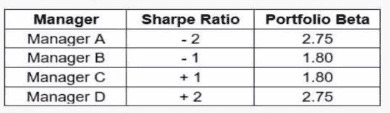
Question 59Choose 1
The following chart outlines data for various fund managers:
Which manager likely has the highest return for a given level of risk?
Show answerHide answer
Correct answer: CManager D.
Question 60Choose 1
An investor, whose marginal tax rate is 29%, owns non-registered units of a fund that have
a beginning and ending NAVPS of $21.50 and $25.50, respectively. The inflation rate is
2%. Assuming dividends are reinvested and ignoring additions or withdrawals, what is the
before-tax, one-year rate of return?
Show answerHide answer
Correct answer: B18.60%
Full mock exam
Sit the IFC exam before exam day
Full-length mocks with the same number of questions and the same time limit as the real IFC exam. Every attempt draws a new set of questions from the full bank, so you can keep going until you pass comfortably.