How does the life-cycle hypothesis assist an advisor while interacting with clients?
Show answerHide answer
Correct answer: CIt provides general assumptions regarding investment objectives based on a client's life
stage
Question 42Choose 1
What type of benefit plan has a final benefit that is dependent on the investment returns
within the plan?
Show answerHide answer
Correct answer: BDefined contribution plan
Question 43Choose 1
Saheed is a retiree who is considering splitting his pension income with his wife, Minu.
Which of the following outcomes may occur if he shares his pension benefits?
Show answerHide answer
Correct answer: AWhether the couple saves on income tax will be dependent on Minu's marginal tax rate
Question 44Choose 1
Which statement about unused registered retirement savings plan (RRSP) contribution
room is CORRECT?
Show answerHide answer
Correct answer: BIt can be carried forward to future years
Question 45Choose 1
Your clients, Philip and Helen, have a disabled son, Alex, age 22. They want to set up a
registered disability savings plan (RDSP) for Alex and have asked you for some
information.
Which statement is TRUE?
Show answerHide answer
Correct answer: CAlex must quality for the disability tax credit
Question 46Choose 1
One of your clients, Sheldon, is 65 years old. He has $30,000 to invest. He has a low risk
profile, and an investment objective of receiving regular income. He has a time horizon of 5
years.
Based on Sheldon's risk profile and investment objective, which of the following investment
recommendations is MOST appropriate for Sheldon?
Show answerHide answer
Correct answer: B3% Government of Canada Bonds at par, which have a maturity that coincides with
Sheldon's time horizon.
What is the level of risk associated with a mortgage fund compared to other types of
funds?
Show answerHide answer
Correct answer: BMore risk than a money market fund, but less risk than a bond fund
Explanation
Explanation:
A mortgage fund primarily invests in residential and commercial mortgages and other mortgage-related fixed-income securities. In the IFC framework, mortgage funds fall between money market funds and bond funds on the risk spectrum.
The typical order is:
Money Market Fund → Mortgage Fund → Bond Fund
Mortgage funds are riskier than money market funds because mortgages have longer maturities and expose the fund to greater interest-rate risk and default/credit risk. Money market funds invest mainly in short-term, high-quality debt instruments and are generally among the lowest-risk mutual funds. CIRO likewise describes money market mutual funds as relatively safe investments with very low risk of losing the initial investment.
However, mortgage funds generally have less risk than bond funds. Mortgage rates tend to change less frequently than market bond yields, and mortgages typically have shorter effective terms than many bonds. As a result, mortgage funds are generally less sensitive to changing interest rates and historically exhibit less volatility than bond funds. IFC educational material specifically places mortgage funds above money market funds but below bond funds in terms of both default and interest-rate risk.
Why the other options are incorrect A. More risk than a precious metals fund, but less risk than a specialty fund – Incorrect. Precious metals and specialty funds are generally much more volatile than conservative mortgage funds.
C. More risk than a balanced fund, but less risk than a real estate fund – Incorrect. Mortgage funds are generally considered more conservative than balanced funds.
D. More risk than a dividend fund, but less risk than an equity fund – Incorrect. This does not reflect the IFC's comparative risk classification for mortgage funds. The relevant comparison is with money market and bond funds.
IFC Exam Tip
Remember the conservative fixed-income risk progression:
Money Market → Mortgage → Bond
As you move to the right, interest-rate sensitivity and overall volatility generally increase.
Answer: B. More risk than a money market fund, but less risk than a bond fund.
Question 48Choose 1
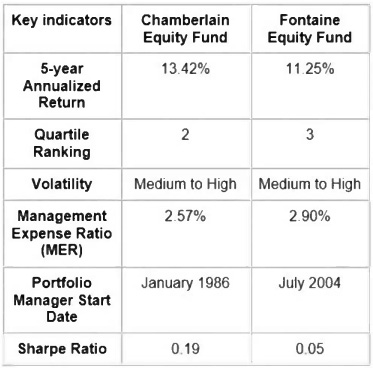
You have been researching Canadian equity mutual funds for a new client. You come
across the following information.
What can you conclude from this information?
Show answerHide answer
Correct answer: DFontaine Equity Fund's higher MER contributes to its lower 5-year annualized return.
Explanation
Explanation
Why D is correct:
The Management Expense Ratio (MER) is the annual fee charged to unitholders to cover management, administrative, and operating costs. It is directly deducted from the fund's net asset value (NAV) before returns are reported. Therefore, a higher MER will reduce the net return delivered to investors. Since all other factors being equal, a fund with a higher MER will have a lower net return than a comparable fund with a lower MER. In the data provided, Fontaine Equity Fund has a lower 5-year return (11.25%) than Chamberlain (13.42%), and a higher MER is a plausible and correct contributing factor to that underperformance. The IFC curriculum explicitly teaches that MER is a key determinant of net fund performance.
Why the other options are wrong:
A. "Chamberlain Equity Fund has lower volatility since its 5-year annualized return is higher."
Wrong. Return and volatility are not directly correlated in this manner. A higher return does not imply lower volatility—in fact, higher returns often come with higher volatility. The table explicitly shows both funds have "Medium to High" volatility, so no conclusion about lower volatility can be drawn from return data alone. You need standard deviation or beta to assess volatility.
B. "Fontaine Equity Fund is a better fund because it has a higher quartile ranking."
Wrong. A lower quartile ranking number is better (Quartile 1 = top 25%, Quartile 4 = bottom 25%). Fontaine has a Quartile Ranking of 3, which is worse than Chamberlain's 2. A higher number means worse relative performance within its peer group. This option incorrectly interprets the quartile ranking.
C. "Fontaine Equity Fund has a lower risk level since its Sharpe Ratio is lower."
Wrong. The Sharpe Ratio measures risk-adjusted return—it is calculated as (Fund Return − Risk-Free Rate) ÷ Standard Deviation. A higher Sharpe Ratio indicates better risk-adjusted performance (more return per unit of risk). Chamberlain's Sharpe Ratio (0.19) is higher than Fontaine's (0.05), meaning Chamberlain delivers superior return for the risk taken. A lower Sharpe Ratio does not mean lower risk—it means worse risk-adjusted return, which could be due to lower returns, higher volatility, or both.
Question 49Choose 1
Which exemplifies the tendency of mutual fund companies to shut down poor performing
funds?
Show answerHide answer
Correct answer: BSurvivorship bias
Explanation
Explanation:
Survivorship bias occurs when mutual fund companies close or merge poorly performing funds. As a result, only the stronger-performing funds remain in the historical performance data.
This makes the published average returns of a fund category or peer group look better than the true overall experience of investors (because the underperforming funds have been removed from the statistics).
This concept is covered in the IFC curriculum under mutual fund performance evaluation and analysis (Evaluating and Selecting Mutual Funds / Analysis of Mutual Funds).
Why the other options are incorrect
A. Standby underwriting: A type of underwriting commitment in which the underwriter agrees to purchase any unsold securities in a new issue. It is unrelated to fund performance or fund closures.
C. Short selling: The practice of selling borrowed securities in the expectation that their price will fall. It has no connection to the closure of underperforming mutual funds.
D. Standard lot: Refers to a normal trading unit size for securities (e.g., 100 shares for most stocks). It is a market microstructure term and is irrelevant here.
Key IFC takeaway: When reviewing mutual fund performance data, be aware of survivorship bias — past category averages can be inflated because weak funds have been eliminated from the record.
Question 50Choose 1
Recently interest rates have gone up. Your customer, Mr. Corelli, has asked you how this
will affect the value of his mortgage fund. What is the best response to give to Mr. Corelli?
Show answerHide answer
Correct answer: BThe value of the mortgage fund will go down because new mortgages will pay higher
interest than those in the fund
Explanation
Explanation:
Mortgage funds are affected by changes in interest rates, much like other fixed-income investments.
When market interest rates rise, newly issued mortgages generally offer higher rates than mortgages already held by the fund. That makes the fund’s existing lower-rate mortgages less attractive to investors.
As a result, the market value of the existing mortgages declines, which can cause the net asset value (NAV) of the mortgage fund to fall.
For example, suppose a mortgage fund holds mortgages yielding 4%. If new comparable mortgages are now being issued at 6%, investors would prefer the newer mortgages unless the older 4% mortgages are priced lower. This downward price adjustment can reduce the value of the fund.
Why the Other Options Are Incorrect
A. The mortgage fund will not be affected because the rise in interest rates will affect only new mortgages: Incorrect. Existing mortgages are affected because their relative attractiveness changes when new mortgages offer higher rates.
C. The mortgage fund will not be affected because mortgages do not react to changes in interest rates the way bonds do: Incorrect. Mortgage investments do have interest-rate risk, although their sensitivity may differ from that of conventional bonds.
D. The value of the mortgage fund should go up because mortgages will now be earning higher interest: Incorrect. The fund’s existing mortgages do not immediately reset to the higher market rate. In the short term, their lower rates can reduce their market value.
IFC Exam Tip
Remember the basic fixed-income relationship:
Interest rates rise → existing fixed-income values fall
Interest rates fall → existing fixed-income values rise
This relationship applies to mortgage funds as well as bond funds.
Full mock exam
Sit the IFC exam before exam day
Full-length mocks with the same number of questions and the same time limit as the real IFC exam. Every attempt draws a new set of questions from the full bank, so you can keep going until you pass comfortably.