What is the level of risk associated with a mortgage fund compared to other types of
funds?
Show answerHide answer
Correct answer: BMore risk than a money market fund, but less risk than a bond fund
Explanation
Explanation:
A mortgage fund primarily invests in residential and commercial mortgages and other mortgage-related fixed-income securities. In the IFC framework, mortgage funds fall between money market funds and bond funds on the risk spectrum.
The typical order is:
Money Market Fund → Mortgage Fund → Bond Fund
Mortgage funds are riskier than money market funds because mortgages have longer maturities and expose the fund to greater interest-rate risk and default/credit risk. Money market funds invest mainly in short-term, high-quality debt instruments and are generally among the lowest-risk mutual funds. CIRO likewise describes money market mutual funds as relatively safe investments with very low risk of losing the initial investment.
However, mortgage funds generally have less risk than bond funds. Mortgage rates tend to change less frequently than market bond yields, and mortgages typically have shorter effective terms than many bonds. As a result, mortgage funds are generally less sensitive to changing interest rates and historically exhibit less volatility than bond funds. IFC educational material specifically places mortgage funds above money market funds but below bond funds in terms of both default and interest-rate risk.
Why the other options are incorrect A. More risk than a precious metals fund, but less risk than a specialty fund – Incorrect. Precious metals and specialty funds are generally much more volatile than conservative mortgage funds.
C. More risk than a balanced fund, but less risk than a real estate fund – Incorrect. Mortgage funds are generally considered more conservative than balanced funds.
D. More risk than a dividend fund, but less risk than an equity fund – Incorrect. This does not reflect the IFC's comparative risk classification for mortgage funds. The relevant comparison is with money market and bond funds.
IFC Exam Tip
Remember the conservative fixed-income risk progression:
Money Market → Mortgage → Bond
As you move to the right, interest-rate sensitivity and overall volatility generally increase.
Answer: B. More risk than a money market fund, but less risk than a bond fund.
Question 2Choose 1
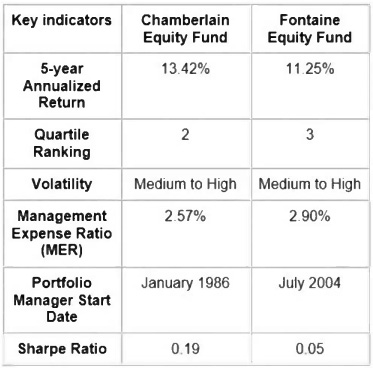
You have been researching Canadian equity mutual funds for a new client. You come
across the following information.
What can you conclude from this information?
Show answerHide answer
Correct answer: DFontaine Equity Fund's higher MER contributes to its lower 5-year annualized return.
Explanation
Explanation
Why D is correct:
The Management Expense Ratio (MER) is the annual fee charged to unitholders to cover management, administrative, and operating costs. It is directly deducted from the fund's net asset value (NAV) before returns are reported. Therefore, a higher MER will reduce the net return delivered to investors. Since all other factors being equal, a fund with a higher MER will have a lower net return than a comparable fund with a lower MER. In the data provided, Fontaine Equity Fund has a lower 5-year return (11.25%) than Chamberlain (13.42%), and a higher MER is a plausible and correct contributing factor to that underperformance. The IFC curriculum explicitly teaches that MER is a key determinant of net fund performance.
Why the other options are wrong:
A. "Chamberlain Equity Fund has lower volatility since its 5-year annualized return is higher."
Wrong. Return and volatility are not directly correlated in this manner. A higher return does not imply lower volatility—in fact, higher returns often come with higher volatility. The table explicitly shows both funds have "Medium to High" volatility, so no conclusion about lower volatility can be drawn from return data alone. You need standard deviation or beta to assess volatility.
B. "Fontaine Equity Fund is a better fund because it has a higher quartile ranking."
Wrong. A lower quartile ranking number is better (Quartile 1 = top 25%, Quartile 4 = bottom 25%). Fontaine has a Quartile Ranking of 3, which is worse than Chamberlain's 2. A higher number means worse relative performance within its peer group. This option incorrectly interprets the quartile ranking.
C. "Fontaine Equity Fund has a lower risk level since its Sharpe Ratio is lower."
Wrong. The Sharpe Ratio measures risk-adjusted return—it is calculated as (Fund Return − Risk-Free Rate) ÷ Standard Deviation. A higher Sharpe Ratio indicates better risk-adjusted performance (more return per unit of risk). Chamberlain's Sharpe Ratio (0.19) is higher than Fontaine's (0.05), meaning Chamberlain delivers superior return for the risk taken. A lower Sharpe Ratio does not mean lower risk—it means worse risk-adjusted return, which could be due to lower returns, higher volatility, or both.
Question 3Choose 1
Which exemplifies the tendency of mutual fund companies to shut down poor performing
funds?
Show answerHide answer
Correct answer: BSurvivorship bias
Explanation
Explanation:
Survivorship bias occurs when mutual fund companies close or merge poorly performing funds. As a result, only the stronger-performing funds remain in the historical performance data.
This makes the published average returns of a fund category or peer group look better than the true overall experience of investors (because the underperforming funds have been removed from the statistics).
This concept is covered in the IFC curriculum under mutual fund performance evaluation and analysis (Evaluating and Selecting Mutual Funds / Analysis of Mutual Funds).
Why the other options are incorrect
A. Standby underwriting: A type of underwriting commitment in which the underwriter agrees to purchase any unsold securities in a new issue. It is unrelated to fund performance or fund closures.
C. Short selling: The practice of selling borrowed securities in the expectation that their price will fall. It has no connection to the closure of underperforming mutual funds.
D. Standard lot: Refers to a normal trading unit size for securities (e.g., 100 shares for most stocks). It is a market microstructure term and is irrelevant here.
Key IFC takeaway: When reviewing mutual fund performance data, be aware of survivorship bias — past category averages can be inflated because weak funds have been eliminated from the record.
Question 4Choose 1
Recently interest rates have gone up. Your customer, Mr. Corelli, has asked you how this
will affect the value of his mortgage fund. What is the best response to give to Mr. Corelli?
Show answerHide answer
Correct answer: BThe value of the mortgage fund will go down because new mortgages will pay higher
interest than those in the fund
Explanation
Explanation:
Mortgage funds are affected by changes in interest rates, much like other fixed-income investments.
When market interest rates rise, newly issued mortgages generally offer higher rates than mortgages already held by the fund. That makes the fund’s existing lower-rate mortgages less attractive to investors.
As a result, the market value of the existing mortgages declines, which can cause the net asset value (NAV) of the mortgage fund to fall.
For example, suppose a mortgage fund holds mortgages yielding 4%. If new comparable mortgages are now being issued at 6%, investors would prefer the newer mortgages unless the older 4% mortgages are priced lower. This downward price adjustment can reduce the value of the fund.
Why the Other Options Are Incorrect
A. The mortgage fund will not be affected because the rise in interest rates will affect only new mortgages: Incorrect. Existing mortgages are affected because their relative attractiveness changes when new mortgages offer higher rates.
C. The mortgage fund will not be affected because mortgages do not react to changes in interest rates the way bonds do: Incorrect. Mortgage investments do have interest-rate risk, although their sensitivity may differ from that of conventional bonds.
D. The value of the mortgage fund should go up because mortgages will now be earning higher interest: Incorrect. The fund’s existing mortgages do not immediately reset to the higher market rate. In the short term, their lower rates can reduce their market value.
IFC Exam Tip
Remember the basic fixed-income relationship:
Interest rates rise → existing fixed-income values fall
Interest rates fall → existing fixed-income values rise
This relationship applies to mortgage funds as well as bond funds.
Question 5Choose 1
What type of fund offers the highest expected risk and the highest expected return in terms
of the risk-return trade-off between different types of mutual funds?
Show answerHide answer
Correct answer: CSpecialty fund
Explanation
Explanation:
A specialty fund generally carries the highest expected risk and highest expected return among the fund types listed because it concentrates its investments in a specific industry, sector, geographic area, or theme.
This concentration reduces diversification. If the targeted sector performs very well, returns can be substantial; however, if that sector performs poorly, the fund can experience significant losses.
This illustrates the risk-return trade-off:
Higher potential return → Higher potential risk
Why the other answers are incorrect
A. Mortgage fund: Generally has lower risk and more predictable income because it invests primarily in mortgages.
B. Canadian Equity fund: Invests in Canadian stocks and can have significant volatility, but is generally more diversified than a specialty fund.
C. Specialty fund: ✅ Correct. Concentration in a specific sector or theme creates higher risk and therefore higher expected return.
D. Real estate fund: Can have relatively high risk because of property-market fluctuations, but is generally not as concentrated as a specialty fund.
Question 6Choose 1
Sheldon is a 25 year old graphic designer. He has just started working and saves regularly.
Apart from his regular salary he also earns extra money from freelancing after office hours
and during weekends. His earnings from his freelance work are sufficient for meeting his
living expenses. He saves the entire amount of his salary. He has heard about lifecycle
funds but has come to you for additional information.
Which of the following statement about lifecycle funds is TRUE?
Show answerHide answer
Correct answer: AAs Sheldon gets older, the life cycle asset allocation changes from more risky to less
risky.
Explanation
Explanation:
Lifecycle funds (also called target-date or target-maturity funds) are designed with a predetermined “glide path.”
They begin with a higher allocation to equities (higher risk/return potential) when the investor is younger and farther from the target date. As the investor ages and the target date approaches, the fund automatically rebalances toward a more conservative mix (more fixed-income and cash, less equity).
This automatic shift from more risky to less risky is the core feature of lifecycle funds and is covered in the IFC curriculum under mutual fund products and portfolio construction.
Why the other options are incorrect
B: Lifecycle funds do not start with equal allocations to cash, fixed income, and equities. They typically begin with a heavy equity weighting that gradually declines.
C: The asset allocation does not remain fixed. It changes over time according to the fund’s glide path. It is also not based on the current age demographic of unitholders in a static way.
D: Changes in asset allocation are driven by the passage of time (proximity to the target date), not by the investor’s income.
Key IFC takeaway: Lifecycle funds provide a hands-off way for investors (especially younger ones like Sheldon) to maintain an age-appropriate asset mix that automatically becomes more conservative as they approach their goal (e.g., retirement).
Question 7Choose 1
Four fund managers are comparing their quartile rankings over the past four years:
Which fund manager would likely be most satisfied with their fund's performance history?
Show answerHide answer
Correct answer: CManager A
Explanation
Explanation:
Quartile Rankings Concept: In mutual fund performance evaluation (covered in the IFC curriculum), a peer group universe is divided into four equal groups (or quartiles):
1st Quartile: Represents the top 25% of performers (the best-performing funds in the category). 2nd Quartile: Represents performance from 25% to 50%. 3rd Quartile: Represents performance from 50% to 75%. 4th Quartile: Represents the bottom 25% of performers (the worst-performing funds).
Why Manager A is Correct: A fund manager (and their investors) would be most satisfied maintaining consistent rankings in the 1st quartile over a multi-year evaluation period, as it proves superior, market-leading performance relative to competing funds in the same category. (Note: If your specific question variant included a table of year-by-year rankings, look for the manager who consistently scored in the 1st quartile or showed the strongest upward consistency).
Why the Other Options are Incorrect: Managers positioned in the 2nd, 3rd, or 4th quartiles show average to below-average relative performance, meaning their funds lagged behind a significant portion of their peers.
Official Reference: Investment Funds in Canada (IFC) Course, Chapter: Understanding Mutual Fund Performance (Module covering peer group comparison universes and quartile rankings).
Question 8Choose 1
What type of mutual fund seeks to provide a positive real rate of return, through both
income and capital appreciation, by investing in a diversified portfolio of fixed income
securities, as well as Canadian and foreign equity securities?
Show answerHide answer
Correct answer: BBalanced
Explanation
Explanation:
A balanced fund is designed to provide both income (from fixed-income securities such as bonds) and capital appreciation (from equity investments). It invests in a diversified portfolio that typically includes Canadian and foreign equities along with fixed-income securities. The goal is to achieve a positive real rate of return while managing risk through diversification across asset classes.
Reference: CSI Investment Funds in Canada (IFC), Chapter 10 “The Modern Mutual Fund” — balanced funds combine fixed income and equity securities to provide growth and income, aiming for a positive real return.
❌ Why the Other Options Are Incorrect
A. Dividend Fund
Focuses primarily on equities that pay dividends. It emphasizes income but does not necessarily balance with fixed-income securities for diversification.
C. Blue Chip Fund
Invests in large, established companies with strong track records. These funds emphasize stability and growth but do not include fixed-income securities as part of their mandate.
D. Mortgage Fund
Invests mainly in mortgages or mortgage-backed securities, focusing on income. It does not provide the equity exposure needed for capital appreciation.
📘 References Balanced Funds — diversified mix of equities and fixed income Dividend Funds — equity focus with dividend income
Question 9Choose 1
Vickie recently added the ABC Investco EV Fund to her portfolio. This fund invests in global
companies involved in the electric vehicles sector. What type of mutual fund is this
classified as?
Show answerHide answer
Correct answer: DSpecialty
Explanation
Explanation:
D. Specialty (Correct) Why it's right: A specialty fund (sometimes called a sector, thematic, or industry fund) invests in a narrow, specific segment of the economy—such as a single industry, theme, or technology trend like electric vehicles, biotechnology, or artificial intelligence. Because the ABC Investco EV Fund concentrates exclusively on the electric vehicles sector rather than broad market indexes, it is classified under the specialty fund category.
A. Standard (Incorrect) Why it's wrong: "Standard" is not a formal mutual fund classification type in the IFC curriculum; conventional broad categories typically include money market, fixed-income (bond), balanced, and equity funds.
B. Growth (Incorrect) Why it's wrong: Growth is an investment style focused on companies expected to grow at an above-average rate compared to the rest of the market, rather than a specific fund asset or sector category like electric vehicles.
C. Resource (Incorrect) Why it's wrong: A resource fund specifically targets natural resource sectors such as mining, oil, gas, and forestry, rather than specialized technology or manufacturing themes like electric vehicles.
Reference: Investment Funds in Canada (IFC) Course, Chapter: Mutual Fund Products / Specialized Mutual Funds and Sector/Specialty Funds.
Question 10Choose 1
Which drawback of the comparison universe method makes average fund managers look
more like underperformers as the comparison period lengthens?
Show answerHide answer
Correct answer: A Survivorship bias
Explanation
Explanation
Why A is correct:
The comparison universe method tracks a group of funds with similar mandates over time. However, it suffers from a significant flaw called survivorship bias, where poorly performing funds are closed or merged out of existence and are subsequently dropped from the universe rankings.
As the comparison period lengthens, more and more of these "defunct" funds are excluded, meaning the universe becomes a "universe of survivors". The remaining pool contains only the funds that were strong (or lucky) enough to persist. This constantly removes the "losers" from the historical data, causing the average performance benchmark to be artificially inflated. Therefore, an average fund manager who is still in existence and simply maintaining a middle-of-the-road performance will increasingly look like an underperformer compared to this upwardly biased peer group.
Research demonstrates that this effect compounds over time. One study found that the annual survivorship bias in average fund performance increases from just 0.07% for one-year samples to a significantly larger 1% per year for samples longer than fifteen years. This distortion makes it appear that a stable, average manager is losing ground relative to peers, when in reality the "peers" have simply been weeded out.
Why the other options are wrong:
B. Definition of universes – While defining the peer group (e.g., large-cap value vs. large-cap growth) is crucial for a fair comparison, misclassification is a problem of style drift or miscategorization. It does not inherently worsen or become more problematic specifically as the comparison period lengthens.
C. Matching of risk profiles – Similar to definition, this is a challenge of ensuring an "apples-to-apples" comparison. However, the effect of risk mismatching does not have a mechanical relationship to the length of the time horizon. It is a constant qualitative issue, whereas survivorship bias is a quantitative flaw that grows with time.
D. Universe size – A universe that is too small can make statistical comparisons less meaningful, but the size of the universe (number of funds) does not directly cause an average-performing manager to look worse over a longer horizon. It is the composition of that universe (specifically, the elimination of poor performers) that creates this specific drawback as time passes.
Full mock exam
Sit the IFC exam before exam day
Full-length mocks with the same number of questions and the same time limit as the real IFC exam. Every attempt draws a new set of questions from the full bank, so you can keep going until you pass comfortably.