Fortinet certification · Exam FCSS_EFW_AD-7.6

FCSS_EFW_AD-7.6 Mock Exam Page 4

FCSS - Enterprise Firewall 7.6 Administrator

Free FCSS_EFW_AD-7.6 mock exam questions 31–33, each with the answer and an explanation.

20 questions · 39 minutes · free, no sign-up

Free FCSS_EFW_AD-7.6 questions

31–33 of 33 free
Question 31 Choose 2
Why does the ISDB block layers 3 and 4 of the OSI model when applying content filtering? (Choose two.)
Show answerHide answer

Correct answer: A, B A. FortiGate has a predefined list of all IPs and ports for specific applications downloaded from FortiGuard.The ISDB blocks the IP addresses and ports of an application predefined by FortiGuard.

Explanation

Explanation:
The Internet Service Database (ISDB) is a dynamic, FortiGuard-maintained list of well-known public applications and services (e.g., Microsoft 365, Zoom, Google Cloud). It operates primarily at Layer 3 (IP addresses) and Layer 4 (Protocol/Ports).

A. This is correct.
The ISDB is a predefined database downloaded from FortiGuard. It contains the current IP address ranges and port numbers associated with specific internet services.

B. This is correct.
When you create a firewall rule using an Internet Service object, the FortiGate blocks or allows traffic based on the destination IP addresses and ports listed for that service in the database. This is a Layer 3/4 operation.

Why other options are incorrect:

C. This is incorrect.
The ISDB itself does not "work in proxy mode." It is a matching database used in policies. The policy's inspection mode (proxy or flow) is separate. ISDB matching happens before deep content inspection.

D. This is incorrect.
Blocking by URL and domain is a function of DNS Filtering or Web Filtering operating at Layer 7 (Application layer), not the primary function of the ISDB at Layers 3/4.

Reference:

Fortinet Documentation:
FortiOS Administration Guide - Internet Services. It states: "Internet Services are based on IP addresses and ports, and are provided by FortiGuard." This confirms the ISDB uses predefined Layer 3 (IP) and Layer 4 (port) information for filtering.
Question 32 Choose 2
A FortiGate device with UTM profiles is reaching the resource limits, and the administrator expects the traffic in the enterprise network to increase.
The administrator has received an additional FortiGate of the same model.
Which two protocols should the administrator use to integrate the additional FortiGate device into this enterprise network? (Choose two.)
Show answerHide answer

Correct answer: A, B FGSP with external load balancersFGCP in active-active mode and with switches

Explanation

Explanation:

The goal is to increase capacity to handle growing traffic by integrating a second identical FortiGate. The solution must allow both devices to actively process traffic (load sharing), not just provide redundancy.

B. FGCP in active-active mode and with switches:
This is the primary solution. FortiGate Clustering Protocol (FGCP) in active-active (A-A) mode allows both units to form a cluster and actively process traffic. Using switches with a Transparent Mode HA setup or a Virtual Cluster (where each unit uses its own IPs) enables true load distribution. It shares sessions and synchronizes UTM caches, making both units work as one logical device with increased throughput.

A. FGSP with external load balancers:
FortiGate Session Life Support Protocol (FGSP) is designed for standalone (not traditional HA) clustering, often used over longer distances. It synchronizes sessions but does not share a virtual IP. To load balance traffic across both units, an external load balancer (physical or logical) is required to distribute connections to each FortiGate's individual IPs. This also achieves active-active throughput scaling.

Why the other options are incorrect:

C. FGCP in active-passive mode:
This only provides failover redundancy. The passive unit does not process traffic, so it does not increase capacity or solve the "reaching resource limits" problem.

D. VRRP with switches:
VRRP is a standard redundancy protocol for default gateways. It is inherently active-passive; only the master forwards traffic. Like option C, it does not scale performance.

Reference:

Fortinet Documentation:
FortiOS HA Guide – "Active-active HA" explains how FGCP A-A distributes traffic using equal-cost multi-path (ECMP) routing or a virtual cluster.
FortiOS HA Guide – "FGSP (standalone cluster)" explains that FGSP requires external load balancing for traffic distribution. Both methods enable horizontal scaling to increase total UTM throughput.
Question 33 Choose 1
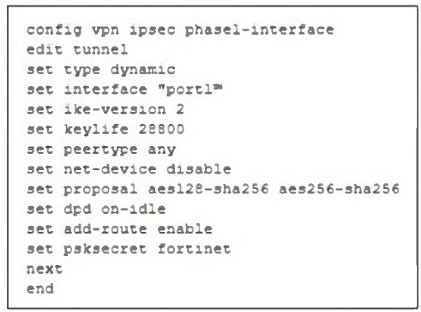
Refer to the exhibit, which contains a partial VPN configuration.

What can you conclude from this VPN IPsec phase 1 configuration?
Show answerHide answer

Correct answer: A This configuration is the best for networks with regular traffic intervals, providing a balance between connectivity assurance and resource utilization.

Explanation

Explanation:

The key to this question is recognizing the specific VPN settings in the configuration snippet. The most relevant setting is:

set keepalive 60 auto-negotiate
This command configures Dead Peer Detection (DPD) to send keepalive packets every 60 seconds and to automatically renegotiate if the peer is unresponsive. This is crucial for "networks with regular traffic intervals" because:
Balance: It ensures the tunnel stays alive even during idle periods (connectivity assurance) without the overhead of constant, aggressive rekeying (resource utilization).
Optimal Use: For scenarios where traffic is intermittent, this setup maintains tunnel readiness while efficiently managing FortiGate CPU and bandwidth resources used for DPD.

Why other options are incorrect:

B. Peer IDs are unencrypted and exposed, creating a security risk.
Incorrect. Peer IDs are exchanged during Phase 1 negotiation, which is encrypted. The configuration does not expose them in plaintext.

C. FortiGate will not add a route to its routing or forwarding information base...
Incorrect. This describes the add-route disable option, which is not shown or implied in this configuration snippet.

D. A separate interface is created for each dial-up tunnel...
Incorrect. This describes a behavior of Dial-Up IPsec configurations (using mode-cfg and client addressing). The provided configuration does not indicate dial-up settings (set type is not shown as dynamic), making this conclusion invalid.

Reference:

Fortinet Documentation:
FortiOS IPsec VPN Guide - Configuring Phase 1 Settings. The section on Dead Peer Detection (DPD) explains that the keepalive and auto-negotiate settings are used to maintain connectivity for on-demand tunnels, balancing availability with resource efficiency.

That's the last free question

You've seen the free 30% (33 of 112 questions). Full access unlocks every question and full-length FCSS_EFW_AD-7.6 mock exams (36 questions, 70 minutes), a different mock on every attempt.

Unlock full mock exam
Full mock exam

Sit the FCSS_EFW_AD-7.6 exam before exam day

Full-length mocks with the same number of questions and the same time limit as the real FCSS_EFW_AD-7.6 exam. Every attempt draws a new set of questions from the full bank, so you can keep going until you pass comfortably.

Get full FCSS_EFW_AD-7.6 mock exam
  • 36questions per mock
  • 70 mintime limit
  • 112questions in the bank
  • Newmock on every attempt