ISC certification · Exam CSSLP

CSSLP Mock Exam Page 3

Certified Secure Software Lifecycle Professional

Free CSSLP questions on Topic 3: Volume C, each with the answer and an explanation.

20 questions · 33 minutes · free, no sign-up

Topic 3: Volume C questions

21–30 of 46 free
Question 21

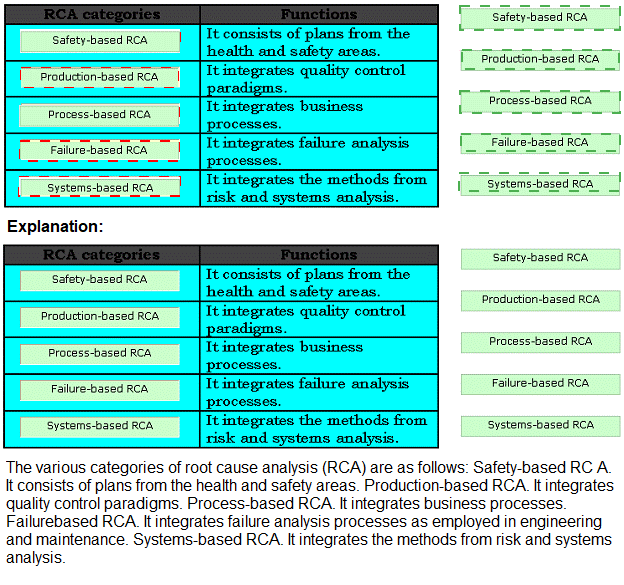
RCA (root cause analysis) is an iterative and reactive method that identifies the root cause of various incidents, and the actions required to prevent these incidents from reoccurring. RCA is classified in various categories. Choose appropriate categories and drop them in front of their respective functions.

Show answerHide answer

Explanation
Question 22 Choose 3

Which of the following are the responsibilities of the owner with regard to data in an information classification program? Each correct answer represents a complete solution. Choose three.

Show answerHide answer

Correct answer: A, C, D

Reviewing the classification assignments at regular time intervals and making changes as the business needs change.

Delegating the responsibility of the data protection duties to a custodian.

Determining what level of classification the information requires.

Explanation

Explanation: The following are the responsibilities of the owner with regard to data in an information classification program: Determining what level of classification the information requires. Reviewing the classification assignments at regular time intervals and making changes as the business needs change. Delegating the responsibility of the data protection duties to a custodian. An information owner can be an executive or a manager of an organization. He will be responsible for the asset of information that must be protected.

Answer: B is incorrect. Running regular backups and routinely testing the validity of the backup data is the responsibility of a custodian.

Question 23 Choose 1

John works as a security manager for SoftTech Inc. He is working with his team on the disaster recovery management plan. One of his team members has a doubt related to the most cost effective DRP testing plan. According to you, which of the following disaster recovery testing plans is the most cost-effective and efficient way to identify areas of overlap in the plan before conducting more demanding training exercises?

Show answerHide answer

Correct answer: C

Structured walk-through test

Explanation

Explanation: The structured walk-through test is also known as the table-top exercise. In structured walk-through test, the team members walkthrough the plan to identify and correct weaknesses and how they will respond to the emergency scenarios by stepping in the course of the plan. It is the most effective and competent way to identify the areas of overlap in the plan before conducting more challenging training exercises. Answer: A is incorrect. In full-scale exercise, the critical systems run at an alternate site. Answer: B is incorrect. The emergency management group and response teams actually perform their emergency response functions by walking through the test, without actually initiating recovery procedures. But it is not much cost effective. Answer: D is incorrect. It is a test performed when personnel walks through the evacuation route to a designated area where procedures for accounting for the personnel are tested.

Question 24 Choose 3

Which of the following are Service Level Agreement (SLA) structures as defined by ITIL? Each correct answer represents a complete solution. Choose all that apply.

Show answerHide answer

Correct answer: B, D, E

Service Based

Customer Based

Multi-Level

Explanation

Explanation: ITIL defines 3 types of Service Level Agreement (SLA) structures, which are as follows:

1.Customer Based: It covers all services used by an individual customer group.

2.Service Based: It is one service for all customers.

3.Multi-Level: Some examples of Multi- Level SLA are 3 Tier SLA encompassing Corporate and Customer & Service Layers.

Answer: C and A are incorrect. There are no such SLA structures as Segment Based and Component Based.

Question 25 Choose 1

Which of the following terms refers to the protection of data against unauthorized access?

Show answerHide answer

Correct answer: D

Confidentiality

Explanation

Explanation: Confidentiality is a term that refers to the protection of data against unauthorized access. Administrators can provide confidentiality by encrypting data. Symmetric encryption is a relatively fast encryption method. Hence, this method of encryption is best suited for encrypting large amounts of data such as files on a computer. Answer: A is incorrect. Integrity ensures that no intentional or unintentional unauthorized modification is made to data. Answer: C is incorrect. Auditing is used to track user accounts for file and object access, logon attempts, system shutdown etc. This enhances the security of the network. Before enabling auditing, the type of event to be audited should be specified in the Audit Policy in User Manager for Domains.

Question 26 Choose 1

Rob is the project manager of the IDLK Project for his company. This project has a budget of $5,600,000 and is expected to last 18 months. Rob has learned that a new law may affect how the project is allowed to proceed - even though the organization has already invested over $750,000 in the project. What risk response is the most appropriate for this instance?

Show answerHide answer

Correct answer: D

Acceptance

Explanation

Explanation: At this point all that Rob can likely do is accepting the risk event. Because this is an external risk, there is little that Rob can do other than document the risk and share the new with management and the project stakeholders. If the law is passed then Rob can choose the most appropriate way for the project to continue. Acceptance response is a part of Risk Response planning process. Acceptance response delineates that the project plan will not be changed to deal with the risk. Management may develop a contingency plan if the risk does occur. Acceptance response to a risk event is a strategy that can be used for risks that pose either threats or opportunities. Acceptance response can be of two types: Passive acceptance: It is a strategy in which no plans are made to try or avoid or mitigate the risk. Active acceptance: Such responses include developing contingency reserves to deal with risks, in case they occur. Acceptance is the only response for both threats and opportunities. Answer: B is incorrect. Mitigation aims to lower the probability and/or impact of the risk event. Answer: C is incorrect. Transference transfers the ownership of the risk event to a third party, usually through a contractual agreement. Answer: D is incorrect. Enhance is a risk response that tries to increase the probability and/or impact of the positive risk event.

Question 27 Choose 1

In which of the following phases of the SDLC does the software and other components of the system faithfully incorporate the design specifications and provide proper documentation and training?

Show answerHide answer

Correct answer: C

Programming and training

Explanation

Explanation: In the programming and training phase of the SDLC, the software and other components of the system faithfully incorporate the design specifications, and proper documentation and training are provided. Answer: D is incorrect. During the initiation phase, the need for a system is expressed and the purpose of the system is documented. Answer: A is incorrect. During the design phase, systems requirements are incorporated into design. This phase specifies to include controls that support the auditing of the system. Answer: B is incorrect. During the evaluation and acceptance phase, the system and data are validated, all the control requirements and the user requirements are met by the system.

Question 28 Choose 1

You work as a CSO (Chief Security Officer) for Tech Perfect Inc. You have a disaster scenario and you want to discuss it with your team members for getting appropriate responses of the disaster. In which of the following disaster recovery tests can this task be performed?

Show answerHide answer

Correct answer: D

Simulation test

Explanation

Explanation: A simulation test is a method used to test the disaster recovery plans. It operates just like a structured walk-through test. In the simulation test, the members of a disaster recovery team present with a disaster scenario and then, discuss on appropriate responses. These suggested responses are measured and some of them are taken by the team. The range of the simulation test should be defined carefully for avoiding excessive disruption of normal business activities. Answer: A is incorrect. The structured walk-through test is also known as the table-top exercise. In structured walk-through test, the team members walkthrough the plan to identify and correct weaknesses and how they will respond to the emergency scenarios by stepping in the course of the plan. It is the most effective and competent way to identify the areas of overlap in the plan before conducting more challenging training exercises. Answer: B is incorrect. A full-interruption test includes the operations that shut down at the primary site and are shifted to the recovery site according to the disaster recovery plan. It operates just like a parallel test. The full- interruption test is very expensive and difficult to arrange. Sometimes, it causes a major disruption of operations if the test fails. Answer: C is incorrect. A parallel test includes the next level in the testing procedure, and relocates the employees to an alternate recovery site and implements site activation procedures. These employees present with their disaster recovery responsibilities as they would for an actual disaster. The disaster recovery sites have full responsibilities to conduct the day-to-day organization's business.

Question 29 Choose 1

Certification and Accreditation (C&A or CnA) is a process for implementing information security. Which of the following is the correct order of C&A phases in a DITSCAP assessment?

Show answerHide answer

Correct answer: C

Definition, Verification, Validation, and Post Accreditation

Explanation

Explanation: C&A consists of four phases in a DITSCAP assessment. These phases are the same as NIACAP phases. The order of these phases is as follows: 1.Definition: The definition phase is focused on understanding the IS business case, the mission, environment, and architecture. This phase determines the security requirements and level of effort necessary to achieve Certification & Accreditation (C&A). 2.Verification: The second phase confirms the evolving or modified system's compliance with the information. The verification phase ensures that the fully integrated system will be ready for certification testing. 3.Validation: The third phase confirms abidance of the fully integrated system with the security policy. This phase follows the requirements slated in the SSAA. The objective of the validation phase is to show the required evidence to support the DAA in accreditation process. 4.Post Accreditation: The Post Accreditation is the final phase of DITSCAP assessment and it starts after the system has been certified and accredited for operations. This phase ensures secure system management, operation, and maintenance to save an acceptable level of residual risk.

Question 30 Choose 1

Which of the following allows multiple operating systems (guests) to run concurrently on a host computer?

Show answerHide answer

Correct answer: B

Hypervisor

Explanation

Explanation: A hypervisor is a virtualization technique that allows multiple operating systems (guests) to run concurrently on a host computer. It is also called the virtual machine monitor (VMM). The hypervisor provides a virtual operating platform to the guest operating systems and checks their execution process. It provides isolation to the host's resources. The hypervisor is installed on server hardware. Answer: A is incorrect. Emulator duplicates the functions of one system using a different system, so that the second system behaves like the first system. Answer: D is incorrect. CP/CMS is a time-sharing operating system of the late 60s and early 70s, and it is known for its excellent performance and advanced features. Answer: C is incorrect. Grid computing refers to the combination of computer resources from multiple administrative domains to achieve a common goal.

Full mock exam

Sit the CSSLP exam before exam day

Full-length mocks with the same number of questions and the same time limit as the real CSSLP exam. Every attempt draws a new set of questions from the full bank, so you can keep going until you pass comfortably.

Get full CSSLP mock exam
  • 65questions per mock
  • 105 mintime limit
  • 348questions in the bank
  • Newmock on every attempt