ISC certification · Exam CSSLP

CSSLP Mock Exam Page 2

Certified Secure Software Lifecycle Professional

Free CSSLP questions on Topic 3: Volume C, each with the answer and an explanation.

20 questions · 33 minutes · free, no sign-up

Topic 3: Volume C questions

11–20 of 46 free
Question 11 Choose 3

Which of the following can be used to accomplish authentication? Each correct answer represents a complete solution. Choose all that apply.

Show answerHide answer

Correct answer: B, C, D

Biometrics

Token

Password

Explanation

Explanation: The following can be used to accomplish authentication: 1.Password 2.Biometrics 3.Token A password is a secret word or string of characters that is used for authentication, to prove identity, or gain access to a resource.

Question 12 Choose 1

Which of the following is a chronological record of system activities to enable the reconstruction and examination of the sequence of events and/or changes in an event?

Show answerHide answer

Correct answer: B

Audit trail

Explanation

Explanation: Audit trail or audit log is a chronological sequence of audit records, each of which contains evidence directly pertaining to and resulting from the execution of a business process or system function. Audit records typically result from activities such as transactions or communications by individual people, systems, accounts, or other entities. The process that creates audit trail should always run in a privileged mode, so it could access and supervise all actions from all users, and normal user could not stop/change it. Furthermore, for the same reason, trail file or database table with a trail should not be 

accessible to normal users. Answer: C is incorrect. A computer security audit is a manual or systematic measurable technical assessment of a system or application. Manual assessments include interviewing staff, performing security vulnerability scans, reviewing application and operating system access controls, and analyzing physical access to the systems. Automated assessments, or CAAT's, include system generated audit reports or using software to monitor and report changes to files and settings on a system. Systems can include personal computers, servers, mainframes, network routers, and switches.

Answer: D is incorrect. Detective controls are the audit controls that are not needed to be restricted. Any control that performs a monitoring activity can likely be defined as a Detective Control. For example, it is possible that mistakes, either intentional or unintentional, can be made. Therefore, an additional Protective control is that these companies must have their financial results audited by an independent Certified Public Accountant. The role of this accountant is to act as an auditor. In fact, any auditor acts as a Detective control. If the organization in question has not properly followed the rules, a diligent auditor should be able to detect the deficiency which indicates that some control somewhere has failed. Answer: A is incorrect. Reactive or corrective controls typically work in response to a detective control, responding in such a way as to alert or otherwise correct an unacceptable condition. Using the example of account rules, either the internal Audit Committee or the SEC itself, based on the report generated by the external auditor, will take some corrective action. In this way, they are acting as a Corrective or Reactive control.
Question 13 Choose 1

Which of the following fields of management focuses on establishing and maintaining consistency of a system's or product's performance and its functional and physical attributes with its requirements, design, and operational information throughout its life?

Show answerHide answer

Correct answer: A

Configuration management

Explanation

Explanation: Configuration management is a field of management that focuses on establishing and maintaining consistency of a system's or product's performance and its functional and physical attributes with its requirements, design, and operational information 

throughout its life. Configuration Management System is a subsystem of the overall project management system. It is a collection of formal documented procedures used to identify and document the functional and physical characteristics of a product, result, service, or component of the project. It also controls any changes to such characteristics, and records and reports each change and its implementation status. It includes the documentation, tracking systems, and defined approval levels necessary for authorizing and controlling changes. Audits are performed as part of configuration management to determine if the requirements have been met. Answer: D is incorrect. The procurement management plan defines more than just the procurement of team members, if needed. It defines how procurements will be planned and executed, and how the organization and the vendor will fulfill the terms of the contract. Answer: B is incorrect. Risk Management is used to identify, assess, and control risks. It includes analyzing the value of assets to the business, identifying threats to those assets, and evaluating how vulnerable each asset is to those threats. Answer: C is incorrect. Change Management is used to ensure that standardized methods and procedures are used for efficient handling of all changes.

Question 14 Choose 3

Which of the following characteristics are described by the DIAP Information Readiness Assessment function? Each correct answer represents a complete solution. Choose all that apply.

Show answerHide answer

Correct answer: B, C, D

It performs vulnerability/threat analysis assessment.

It provides data needed to accurately assess IA readiness.

It identifies and generates IA requirements.

Explanation

Explanation: The characteristics of the DIAP Information Readiness Assessment function are as follows: It provides data needed to accurately assess IA readiness. It identifies and generates IA requirements. It performs vulnerability/threat analysis assessment. Answer: A is incorrect. It is a function performed by the ASSET system.

Question 15 Choose 1

You work as a project manager for BlueWell Inc. You are preparing to plan risk responses for your project with your team. How many risk response types are available for a negative risk event in the project?

Show answerHide answer

Correct answer: D

Four

Explanation

Explanation: There are four risk responses available for a negative risk event. The risk response strategies for negative risks are: Avoid: It involves altering the project management plan to remove the threats completely. Transfer: It requires shifting some or all of the negative effects of a threat including the ownership of response, to a third party. Mitigate: It implies a drop in the probability and impact of an unfavorable risk event to be within suitable threshold limits. Accept: It delineates that the project plan will not be changed to deal with the risk. Management may develop a contingency plan if the risk occurs. It is used for both negative and positive risks. Answer: C is incorrect. There are four responses for negative risk events. Answer: A is incorrect. There are four, not three, responses for negative risk events. Do not forget that acceptance can be used for negative risk events. Answer: B is incorrect. There are seven total risk responses, four of which can be used for negative risk events.

Question 16 Choose 5

Which of the following security related areas are used to protect the confidentiality, integrity, and availability of federal information systems and information processed by those systems?

Show answerHide answer

Correct answer: A, B, C, D, E

Personnel security

Access control

Configuration management

Media protection

Risk assessment

Explanation

Explanation: The minimum security requirements cover seventeen security related areas to protect the confidentiality, integrity, and availability of federal information systems and information processed by those systems. They are as follows: Access control Awareness and training Audit and accountability Certification, accreditation, and security assessment Configuration management Contingency planning Identification and authentication Incident response Maintenance Media protection Physical and environmental protection Planning Personnel security Risk assessment Systems and services acquisition System and communications protection System and information integrity.

Question 17

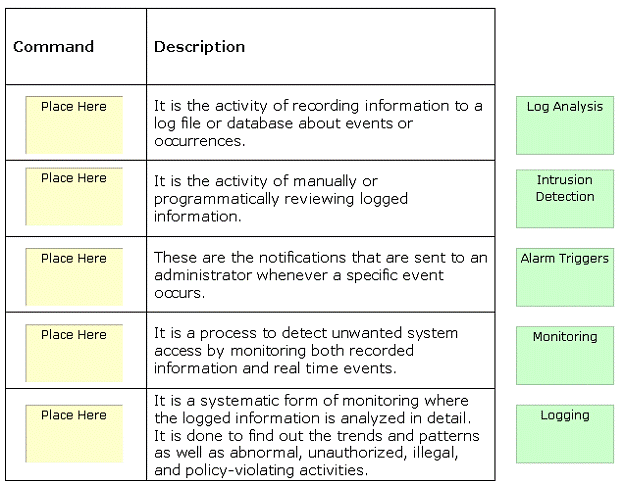
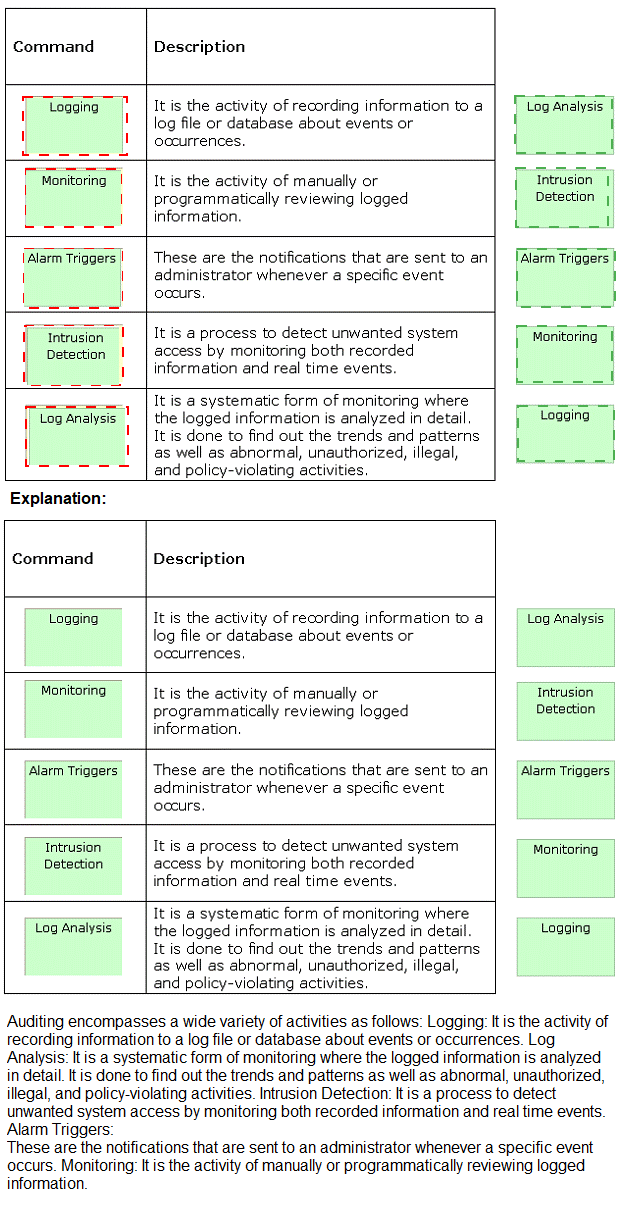
Auditing is used to track user accounts for file and object access, logon attempts, system shutdown, and many more vulnerabilities to enhance the security of the network. It encompasses a wide variety of activities. Place the different auditing activities in front of their descriptions.

Show answerHide answer

Explanation

Question 18

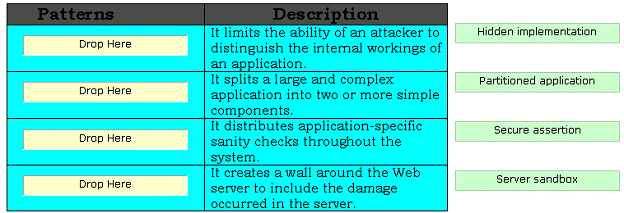
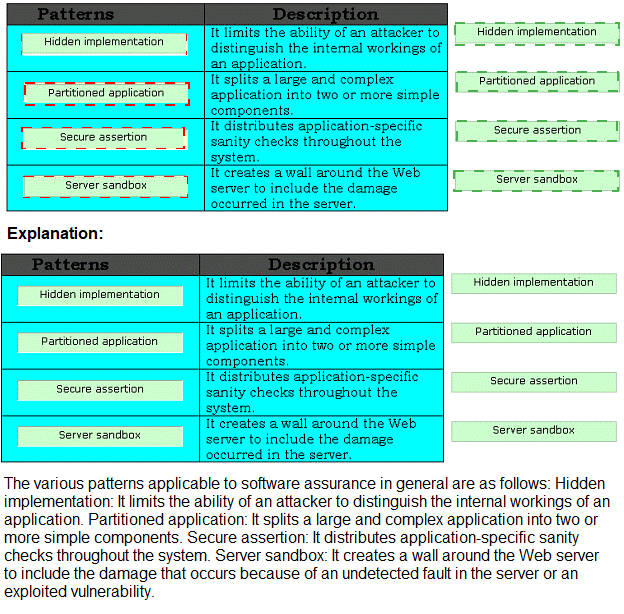
A number of security design patterns are developed for software assurance in general. Drag and drop the appropriate security design patterns in front of their respective descriptions.

Show answerHide answer

Explanation

Question 19 Choose 1

Henry is the project manager of the QBG Project for his company. This project has a budget of $4,576,900 and is expected to last 18 months to complete. The CIO, a stakeholder in the project, has introduced a scope change request for additional deliverables as part of the project work. What component of the change control system would review the proposed changes' impact on the features and functions of the project's product?

Show answerHide answer

Correct answer: A

Configuration management system

Explanation

Explanation: The configuration management system ensures that proposed changes to the project's scope are reviewed and evaluated for their affect on the project's product. Configuration Management System is a subsystem of the overall project management system. It is a collection of formal documented procedures used to identify and document the functional and physical characteristics of a product, result, service, or component of the project. It also controls any changes to such characteristics, and records and reports each change and its implementation status. It includes the documentation, tracking systems, and defined approval levels necessary for authorizing and controlling changes. Audits are performed as part of configuration management to determine if the requirements have been met. Answer: B is incorrect. The scope change control system focuses on reviewing the actual changes to the project scope. When a change to the project's scope is proposed, the configuration management system is also invoked. Answer: C is incorrect. The cost change control system is responsible for reviewing and controlling changes to the project costs. Answer: D is incorrect. Integrated change control examines the affect of a proposed change on the project as a whole.

Question 20 Choose 2

Which of the following are the benefits of information classification for an organization? Each correct answer represents a complete solution. Choose two.

Show answerHide answer

Correct answer: B, C

It helps identify which protections apply to which information.

It helps identify which information is the most sensitive or vital to an organization.

Explanation

Explanation: Following are the benefits of information classification for an organization: It helps identify which protections apply to which information. It helps identify which information is the most sensitive or vital to an organization. It supports the tenets of confidentiality, integrity, and availability as it pertains to data.

Answer: D is incorrect. The concept of integrity ensures that modifications are not made to data by unauthorized personnel or processes. It also ensures that unauthorized modifications are not made to data by authorized personnel or processes. Answer: A is incorrect. Information classification cannot reduce the Total Cost of Ownership (TCO).

Full mock exam

Sit the CSSLP exam before exam day

Full-length mocks with the same number of questions and the same time limit as the real CSSLP exam. Every attempt draws a new set of questions from the full bank, so you can keep going until you pass comfortably.

Get full CSSLP mock exam
  • 65questions per mock
  • 105 mintime limit
  • 348questions in the bank
  • Newmock on every attempt