ISC certification · Exam CSSLP

CSSLP Mock Exam

Certified Secure Software Lifecycle Professional

Free CSSLP questions on Topic 3: Volume C, each with the answer and an explanation.

20 questions · 33 minutes · free, no sign-up

Topic 3: Volume C questions

1–10 of 46 free
Question 1 Choose 1

Which of the following processes identifies the threats that can impact the business continuity of operations?

Show answerHide answer

Correct answer: C

Business impact analysis

Explanation

Explanation: A business impact analysis (BIA) is a crisis management and business impact analysis technique that identifies those threats that can impact the business continuity of operations. Such threats can be either natural or man-made. The BIA team should have a clear understanding of the organization, key business processes, and IT resources for assessing the risks associated with continuity. In the BIA team, there should be senior management, IT personnel, and end users to identify all resources that are to be used during normal operations. Answer: B is incorrect. Risk analysis is the science of risks and their probability and evaluation in a business or a process. It is an important factor in security enhancement and prevention in a system. Risk analysis should be performed as part of the risk management process for each project. The outcome of the risk analysis would be the creation or review of the risk register to identify and quantify risk elements to
the project and their potential impact. Answer: A is incorrect. The functional analysis process is used for converting system requirements into a comprehensive function standard. Verification is the result of the functional analysis process, in which the fundamentals of a system level functional architecture are defined adequately to allow for synthesis in the design phase. The functional analysis breaks down the higher-level functions into the lower level functions. Answer: D is incorrect. Requirements analysis encompasses the tasks that go into determining the needs or conditions to meet for a new or altered product, taking account of the possibly conflicting requirements of the various stakeholders.
Question 2 Choose 1

Which of the following is the most secure method of authentication?

Show answerHide answer

Correct answer: A

Biometrics

Explanation

Explanation: Biometrics is a method of authentication that uses physical characteristics, such as fingerprints, scars, retinal patterns, and other forms of biophysical qualities to identify a user. Nowadays, the usage of biometric devices such as hand scanners and retinal scanners is becoming more common in the business environment. It is the most secure method of authentication. Answer: B is incorrect. Username and password is the least secure method of authentication in comparison of smart card and biometrics authentication. Username and password can be intercepted. Answer: D is incorrect. Smart card authentication is not as reliable as biometrics authentication. Answer: C is incorrect. Anonymous authentication does not provide security as a user can log on to the system anonymously and he is not prompted for credentials.

Question 3 Choose 3

Which of the following statements reflect the 'Code of Ethics Canons' in the '(ISC)2 Code of Ethics'? Each correct answer represents a complete solution. Choose all that apply.


Show answerHide answer

Correct answer: A, C, D

Act honorably, honestly, justly, responsibly, and legally.

Provide diligent and competent service to principals.

Protect society, the commonwealth, and the infrastructure.

Explanation

Explanation: The Code of Ethics Canons in (ISC)2 code of ethics are as follows: Protect society, the commonwealth, and the infrastructure. Act honorably, honestly, justly, responsibly, and legally. Provide diligent and competent service to principals. Advance and protect the profession.

Question 4 Choose 1

Which of the following plans is documented and organized for emergency response, backup operations, and recovery maintained by an activity as part of its security program that will ensure the availability of critical resources and facilitates the continuity of operations in an emergency situation?

Show answerHide answer

Correct answer: C

Contingency Plan

Explanation

Explanation: Contingency plan is prepared and documented for emergency response, backup operations, and recovery maintained by an activity as the element of its security program that will ensure the availability of critical resources and facilitates the continuity of operations in an emergency situation. A contingency plan is a plan devised for a specific situation when things could go wrong. Contingency plans are often devised by governments or businesses who want to be prepared for anything that could happen.

Contingency plans include specific strategies and actions to deal with specific variances to assumptions resulting in a particular problem, emergency, or state of affairs. They also include a monitoring process and "triggers" for initiating planned actions. They are required to help governments, businesses, or individuals to recover from serious incidents in the minimum time with minimum cost and disruption.

Answer: D is incorrect. A disaster recovery plan should contain data, hardware, and software that can be critical for a business. It should also include the plan for sudden loss such as hard disc crash. The business should use backup and data recovery utilities to limit the loss of data. Answer: A is incorrect. The Continuity Of Operation Plan (COOP) refers to the preparations and institutions maintained by the United States government, providing survival of federal government operations in the case of catastrophic events. It provides procedures and capabilities to sustain an organization's essential. COOP is the procedure documented to ensure persistent critical operations throughout any period where normal operations are unattainable. Answer: B is incorrect. Business Continuity Planning (BCP) is the creation and validation of a practiced logistical plan for how an organization will recover and restore partially or completely interrupted critical (urgent) functions within a predetermined time after a disaster or extended disruption. The logistical plan is called a business continuity plan.

Question 5 Choose 1

Mark works as a Network Administrator for NetTech Inc. He wants users to access only those resources that are required for them. Which of the following access control models will he use?

Show answerHide answer

Correct answer: D

Role-Based Access Control

Explanation

Explanation: Role-based access control (RBAC) is an access control model. In this model, a user can access resources according to his role in the organization. For example, a backup administrator is responsible for taking backups of important data. Therefore, he is only authorized to access this data for backing it up. However, sometimes users with different roles need to access the same resources. This situation can also be handled using the RBAC model. Answer: B is incorrect. Mandatory Access Control (MAC) is a model that uses a predefined set of access privileges for an object of the system. Access to an object is restricted on the basis of the sensitivity of the object and granted through authorization. Sensitivity of an object is defined by the label assigned to it. For example, if a user receives a copy of an object that is marked as "secret", he cannot grant permission to other users to see this object unless they have the appropriate permission. Answer: A is incorrect. DAC is an access control model. In this model, the data owner has the right to decide who can access the data. This model is commonly used in PC environment. The basis of this model is the use of Access Control List (ACL). Answer: C is incorrect. There is no such access control model as Policy Access Control.

Question 6

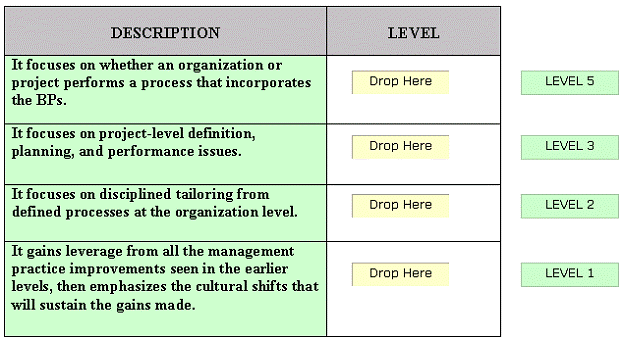
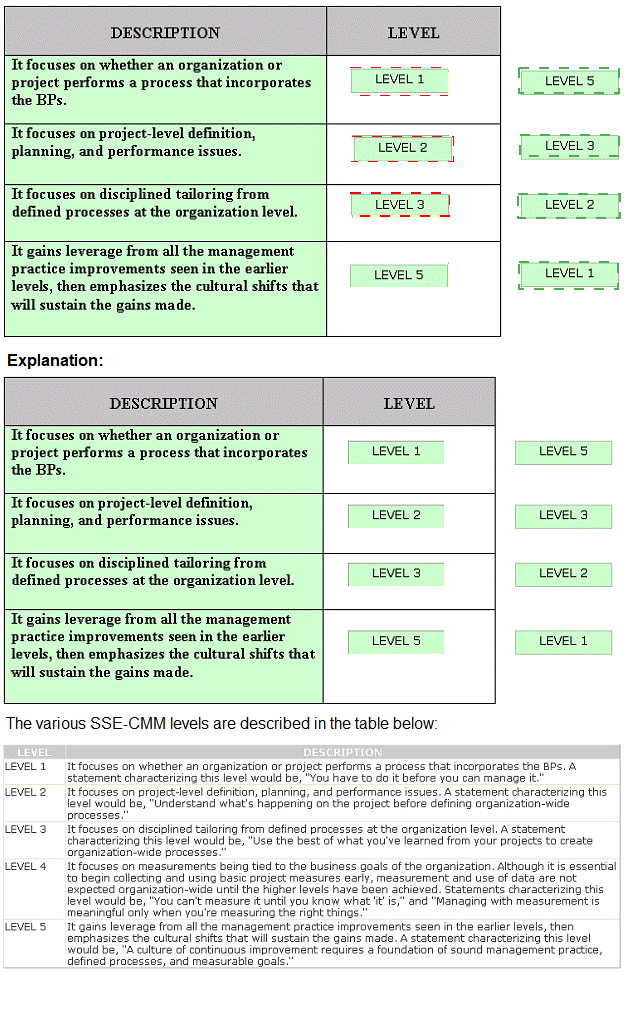
Drag and drop the various SSE-CMM levels at the appropriate places.

Show answerHide answer

Explanation

Question 7 Choose 1

John works as a professional Ethical Hacker. He has been assigned the project of testing the security of www.we-are-secure.com. He has successfully performed the following steps of the pre-attack phase to check the security of the We-are-secure network: Gathering information Determining the network range Identifying active systems Now, he wants to find the open ports and applications running on the network. Which of the following tools will he use to accomplish his task?

Show answerHide answer

Correct answer: D

SuperScan

Explanation

In such a situation, John will use the SuperScan tool to find the open ports and applications 

on the We-are-secure network. SuperScan is a TCP/UDP port scanner. It also works as a ping sweeper and hostname resolver. It can ping a given range of IP addresses and resolve the host name of the remote system. The features of SuperScan are as follows: It scans any port range from a built-in list or any given range. It performs ping scans and port scans using any IP range. It modifies the port list and port descriptions using the built in editor. It connects to any discovered open port using user-specified "helper" applications. It has the transmission speed control utility. Answer: C, A, and B are incorrect. RIPE, ARIN, and APNIC are the Regional Internet Registries (RIR) that manage, distribute, and register public IP addresses within their respective regions. These can be used as passive tools by an attacker to determine the network range.

Question 8 Choose 4

The Phase 2 of DITSCAP C&A is known as Verification. The goal of this phase is to obtain a fully integrated system for certification testing and accreditation. What are the process activities of this phase? Each correct answer represents a complete solution. Choose all that apply.

Show answerHide answer

Correct answer: A, B, C, D

Certification analysis

Assessment of the Analysis Results

Configuring refinement of the SSAA

System development

Explanation

Explanation: The Phase 2 of DITSCAP C&A is known as Verification. The goal of this phase is to obtain a fully integrated system for certification testing and accreditation. This phase takes place between the signing of the initial version of the SSAA and the formal accreditation of the system. This phase verifies security requirements during system development. The process activities of this phase are as follows: Configuring refinement of the SSAA System development Certification analysis Assessment of the Analysis Results Answer: E is incorrect. Registration is a Phase 1 activity.

Question 9 Choose 2

What are the differences between managed and unmanaged code technologies? Each correct answer represents a complete solution. Choose two.

Show answerHide answer

Correct answer: C, D

Managed code executes under management of a runtime environment, whereas unmanaged code is executed by the CPU of a computer system.

Managed code executes under management of a runtime environment, whereas unmanaged code is executed by the CPU of a computer system.

Explanation

Explanation: Programming languages are categorized into two technologies:

  1. Managed code: This computer program code is compiled into an intermediate code format. Managed code is referred to as byte code. It executes under the management of a runtime environment. Java EE and Microsoft.NET are the examples of managed code.
  2. Unmanaged code: This computer code is compiled into machine Unmanaged code is executed by the CPU of a computer system. C and C++ are the examples of unmanaged code. Answer: A is incorrect. Managed code is referred to as byte code. Answer: B is incorrect. C and C++ are the examples of unmanaged code, whereas Java EE and Microsoft.NET are the examples of managed code.
Question 10 Choose 1

In which of the following levels of exception safety are operations succeeded with full guarantee and fulfill all needs in the presence of exceptional situations?

Show answerHide answer

Correct answer: C

Failure transparency

Explanation

Explanation: Failure transparency is the best level of exception safety. In this level, operations are succeeded with full guarantee and fulfill all needs in the presence of exceptional situations. Failure transparency does not throw the exception further up even when an exception occurs. This level is also known as no throw guarantee.

Full mock exam

Sit the CSSLP exam before exam day

Full-length mocks with the same number of questions and the same time limit as the real CSSLP exam. Every attempt draws a new set of questions from the full bank, so you can keep going until you pass comfortably.

Get full CSSLP mock exam
  • 65questions per mock
  • 105 mintime limit
  • 348questions in the bank
  • Newmock on every attempt