ISC certification · Exam CSSLP

CSSLP Mock Exam Page 3

Certified Secure Software Lifecycle Professional

Free CSSLP questions on Topic 2: Volume B, each with the answer and an explanation.

20 questions · 33 minutes · free, no sign-up

Topic 2: Volume B questions

21–29 of 29 free
Question 21 Choose 1

In which of the following phases of the DITSCAP process does Security Test and Evaluation (ST&E) occur?

Show answerHide answer

Correct answer: C

Phase 3

Explanation

Explanation: Security Test and Evaluation (ST&E) occurs in Phase 3 of the DITSCAP C&A process. Answer: D is incorrect. The Phase 1 of DITSCAP C&A is known as Definition Phase. The goal of this phase is to define the C&A level of effort, identify the main C&A roles and responsibilities, and create an agreement on the method for implementing the security requirements. The Phase 1 starts with the input of the mission need. This phase comprises three process activities: Document mission need Registration Negotiation Answer: A is incorrect. The Phase 2 of DITSCAP C&A is known as Verification. The goal of this phase is to obtain a fully integrated system for certification testing and accreditation. This phase takes place between the signing of the initial version of the SSAA and the formal accreditation of the system. This phase verifies security requirements during system development. The process activities of this phase are as follows: Configuring refinement of the SSAA System development Certification analysis Assessment of the Analysis Results Answer: B is incorrect. The Phase 4 of DITSCAP C&A is known as Post Accreditation. This phase starts after the system has been accredited in the Phase 3. The goal of this phase is to continue to operate and manage the system and to ensure that it will maintain an acceptable level of residual risk. The process activities of this phase are as follows: System operations Security operations Maintenance of the SSAA Change management Compliance validation
Question 22 Choose 3

Which of the following sections come under the ISO/IEC 27002 standard?

Show answerHide answer

Correct answer: A, B, D

Security policy 

Asset management

Risk assessment 

Explanation

Explanation: ISO/IEC 27002 is an information security standard published by the International Organization for Standardization (ISO) and by the International Electrotechnical Commission (IEC) as ISO/IEC 17799:2005. This standard contains the following twelve main sections: 1.Risk assessment: It refers to assessment of risk. 2.Security policy: It deals with the security management. 3.Organization of information security: It deals with governance of information security. 4.Asset management: It refers to inventory and classification of information assets. 5.Human resources security: It deals with security aspects for employees joining, moving and leaving an organization. 6.Physical and environmental security: It is related to protection of the computer facilities. 7.Communications and operations management: It is the management of technical security controls in systems and networks. 8.Access control: It deals with the restriction of access rights to networks, systems, applications, functions and data. 9.Information systems acquisition, development and maintenance: It refers to build security into applications. 10.Information security incident management: It refers to anticipate and respond appropriately to information security breaches. 11.Business continuity management: It deals with protecting, maintaining and recovering business-critical processes and systems. 12.Compliance: It is used for ensuring conformance with information security policies, standards, laws and regulations. Answer: C is incorrect. Financial assessment does not come under the ISO/IEC 27002 standard.

Question 23 Choose 1

Which of the following vulnerabilities occurs when an application directly uses or concatenates potentially hostile input with data file or stream functions?

Show answerHide answer

Correct answer: B

Malicious file execution

Explanation

Explanation: Malicious file execution is a vulnerability that occurs when an application directly uses or concatenates potentially hostile input with data file or stream functions. This leads to arbitrary remote and hostile data being included, processed, and invoked by the Web server. Malicious file execution can be prevented by using an indirect object reference map, input validation, or explicit taint checking mechanism. Answer: D is incorrect. Injection flaw occurs when data is sent to an interpreter as a part of command or query. Answer: A is incorrect. Insecure cryptographic storage occurs when applications have failed to encrypt data. Answer: C is incorrect. Insecure communication occurs when applications have failed to encrypt network traffic. 

Question 24 Choose 1

Which of the following provides an easy way to programmers for writing lower-risk applications and retrofitting security into an existing application?

Show answerHide answer

Correct answer: D

ESAPI 

Explanation

Explanation: ESAPI (Enterprise Security API) is a group of classes that encapsulate the key security operations, needed by most of the applications. It is a free, open source, Web application security control library. ESAPI provides an easy way to programmers for writing lower-risk applications and retrofitting security into an existing application. It offers a solid foundation for new development. Answer: C is incorrect. An encryption wrapper is a device that encrypts and decrypts the critical or all software codes at runtime. Answer: B is incorrect. Code obfuscation transforms the code so that it is less intelligible for a person. Answer: A is incorrect. Watermarking is the irreversible process of embedding information into a digital media. The purpose of digital watermarks is to provide copyright protection for intellectual property that is in digital form.

Question 25 Choose 3

What are the security advantages of virtualization, as described in the NIST Information Security and Privacy Advisory Board (ISPAB) paper "Perspectives on Cloud Computing and Standards"? Each correct answer represents a complete solution. Choose three. 

Show answerHide answer

Correct answer: A, B, C

It increases capabilities for fault tolerant computing. 

It adds a layer of security for defense-in-depth.

It decreases exposure of weak software.

Explanation

Explanation: The security advantages of virtualization are as follows: It adds a layer of security for defense-in-depth. It provides strong encapsulation of errors. It increases intrusion detection through introspection. It decreases exposure of weak software. It increases the flexibility for discovery. It increases capabilities for fault tolerant computing using rollback and snapshot features. Answer: D is incorrect. Virtualization increases configuration effort because of complexity of the virtualization layer and composite system.

Question 26 Choose 1

Mark works as a Network Administrator for NetTech Inc. The company has a Windows 2000 domain-based network. Users report that they are unable to log on to the network. Mark finds that accounts are locked out due to multiple incorrect log on attempts. What is the most likely cause of the account lockouts? 

Show answerHide answer

Correct answer: B

Brute force attack

Explanation

Explanation: Brute force attack is the most likely cause of the account lockouts. In a brute force attack, unauthorized users attempt to log on to a network or a computer by using multiple possible user names and passwords. Windows 2000 and other network operating systems have a security feature that locks a user account if the number of failed logon attempts occur within a specified period of time, based on the security policy lockout settings. Answer: A is incorrect. Spoofing is a technique that makes a transmission appear to have come from an authentic source by forging the IP address, email address, caller ID, etc. In IP spoofing, a hacker modifies packet headers by using someone else's IP address to hide his identity. However, spoofing cannot be used while surfing the Internet, chatting on-line, etc. because forging the source IP address causes the responses to be misdirected. Answer: C is incorrect. A SYN attack affects computers running on the TCP/IP protocol. It is a protocol-level attack that can render a computer's network services unavailable. A SYN attack is also known as SYN flooding. Answer: D is incorrect. When a computer repeatedly sends ICMP echo requests to another computer, it is known as a PING attack.

Question 27

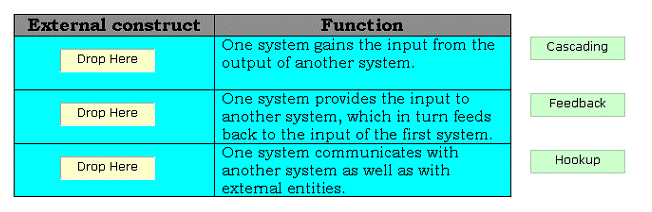
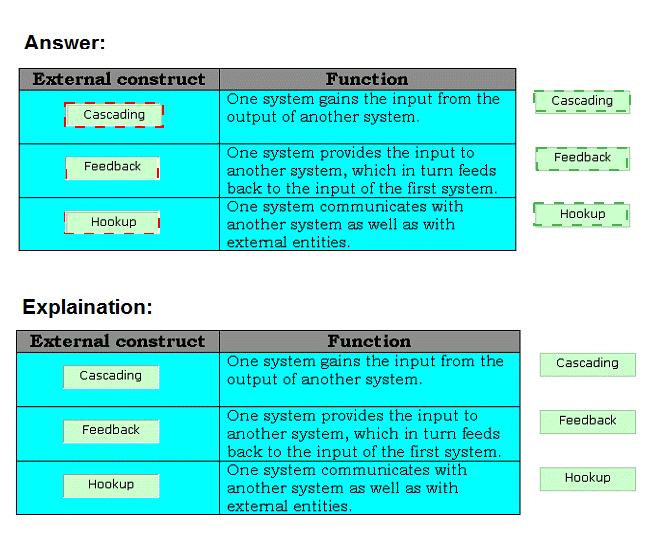
Drag and drop the appropriate external constructs in front of their respective functions.

Show answerHide answer

Explanation

There are two types of compositional constructs: 1.External constructs: The various types of external constructs are as follows: Cascading: In this type of external construct, one system gains the input from the output of another system. Feedback: In this type of external construct, one system provides the input to another system, which in turn feeds back to the input of the first system. Hookup: In this type of external construct, one system communicates with another system as well as with external entities. 2.Internal constructs: The internal constructs include intersection, union, and difference.


Question 28 Choose 1

Which of the following plans is designed to protect critical business processes from natural or man-made failures or disasters and the resultant loss of capital due to the unavailability of normal business processes?

Show answerHide answer

Correct answer: B

Business continuity plan

Explanation

Explanation: The business continuity plan is designed to protect critical business processes from natural or man-made failures or disasters and the resultant loss of capital due to the unavailability of normal business processes. Business Continuity Planning (BCP) is the creation and validation of a practiced logistical plan for how an organization will recover and restore partially or completely interrupted critical (urgent) functions within a predetermined time after a disaster or extended disruption. The logistical plan is called a business continuity plan. Answer: C is incorrect. The crisis communication plan can be broadly defined as the plan for the exchange of information before, during, or after a crisis event. It is considered as a sub-specialty of the public relations profession that is designed to protect and defend an individual, company, or organization facing a public challenge to its reputation. The aim of crisis communication plan is to assist organizations to achieve continuity of critical business processes and information flows under crisis, disaster or event driven circumstances. Answer: A is incorrect. A contingency plan is a plan devised for a specific situation when things could go wrong. Contingency plans are often devised by governments or businesses who want to be prepared for anything that could happen. Contingency plans include specific strategies and actions to deal with specific variances to assumptions resulting in a particular problem, emergency, or state of affairs. They also include a monitoring process and "triggers" for initiating planned actions. They are required to help governments, businesses, or individuals to recover from serious incidents in the minimum time with minimum cost and disruption. Answer: D is incorrect. A disaster recovery plan should contain data, hardware, and software that can be critical for a business. It should also include the plan for sudden loss such as hard disc crash. The business should use backup and data recovery utilities to limit the loss of data

Question 29 Choose 1

Which of the following processes provides a standard set of activities, general tasks, and a management structure to certify and accredit systems, which maintain the information assurance and the security posture of a system or site? 

Show answerHide answer

Correct answer: B

NIACAP 

Explanation

Explanation: NIACAP is a process, which provides a standard set of activities, general tasks, and a management structure to certify and accredit systems that maintain the information assurance and the security posture of a system or site. Answer: D is incorrect. DITSCAP is a process, which establishes a standard process, a set of activities, general task descriptions, and a management structure to certify and accredit the IT systems that will maintain the required security posture. Answer: A is incorrect. The NSA-IAM evaluates information systems at a high level and uses a subset of the SSE-CMM process areas to measure the implementation of information security on these systems. Answer: C is incorrect. ASSET is a tool developed by NIST to automate the process of self-assessment through the use of the questionnaire in NIST. 

That's the last free question in Topic 2: Volume B

You've seen the free 30% (29 of 98 questions). Full access unlocks every question and full-length CSSLP mock exams (65 questions, 105 minutes), a different mock on every attempt.

Unlock full mock exam
Full mock exam

Sit the CSSLP exam before exam day

Full-length mocks with the same number of questions and the same time limit as the real CSSLP exam. Every attempt draws a new set of questions from the full bank, so you can keep going until you pass comfortably.

Get full CSSLP mock exam
  • 65questions per mock
  • 105 mintime limit
  • 348questions in the bank
  • Newmock on every attempt