ISC certification · Exam CSSLP

CSSLP Mock Exam Page 2

Certified Secure Software Lifecycle Professional

Free CSSLP questions on Topic 2: Volume B, each with the answer and an explanation.

20 questions · 33 minutes · free, no sign-up

Topic 2: Volume B questions

11–20 of 29 free
Question 11 Choose 1

Which of the following tiers addresses risks from an information system perspective?

Show answerHide answer

Correct answer: B

Tier 3  

Explanation

Explanation: The information system level is the tier 3. It addresses risks from an information system perspective, and is guided by the risk decisions at tiers 1 and 2. Risk decisions at tiers 1 and 2 impact the ultimate selection and deployment of requisite safeguards. This also has an impact on the countermeasures at the information system level. The RMF primarily operates at tier3 but it can also have interactions at tiers 1 and 2. Answer: A is incorrect. It is an invalid Tier description. Answer: D is incorrect. The Organization Level is the Tier 1, and it addresses risks from an organizational perspective. Answer: C is incorrect. The mission and business process level is the Tier 2, and it addresses risks from the mission and business process perspective. 

Question 12 Choose 1

Which of the following security models characterizes the rights of each subject with respect to every object in the computer system?

Show answerHide answer

Correct answer: D

Access matrix 

Explanation

Explanation: The access matrix or access control matrix is an abstract, formal security model of protection state in computer systems that characterizes the rights of each subject with respect to every object in the system. It was first introduced by Butler W. Lampson in 1971. According to the access matrix model, the protection state of a computer system can be abstracted as a set of objects 'O', that is the set of entities that needs to be protected (e.g. processes, files, memory pages) and a set of subjects 'S' that consists of all active entities (e.g. users, processes). Further there exists a set of rights 'R' of the form r(s,o), where s S, o O and r(s,o) R. A right thereby specifies the kind of access a subject is allowed to process with regard to an object. Answer: B is incorrect. The Bell-La Padula Model is a state machine model used for enforcing access control in government and military applications. The model is a formal state transition model of computer security policy that describes a set of access control rules which use security labels on objects and clearances for subjects. Security labels range from the most sensitive (e.g.,"Top Secret"), down to the least sensitive (e.g., "Unclassified" or "Public"). The Bell-La Padula model focuses on data confidentiality and controlled access to classified information, in contrast to the Biba Integrity Model which describes rules for the protection of data integrity. Answer: A is incorrect. The Clark-Wilson model provides a foundation for specifying and analyzing an integrity policy for a computing system. The model is primarily concerned with formalizing the notion of information integrity. Information integrity is maintained by preventing corruption of data items in a system due to either error or malicious intent. The model's enforcement and certification rules define data items and processes that provide the basis for an integrity policy. The core of the model is based on the notion of a transaction. Answer: C is incorrect. The Biba model is a formal state transition system of computer security policy that describes a set of access control rules designed to ensure data integrity. Data and subjects are grouped into ordered levels of integrity. The model is designed so that subjects may not corrupt data in a level ranked higher than the subject, or be corrupted by data from a lower level than the subject. 
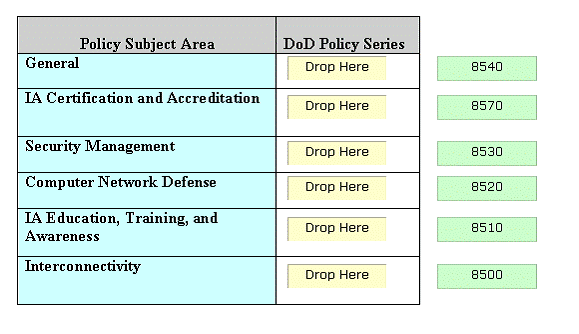
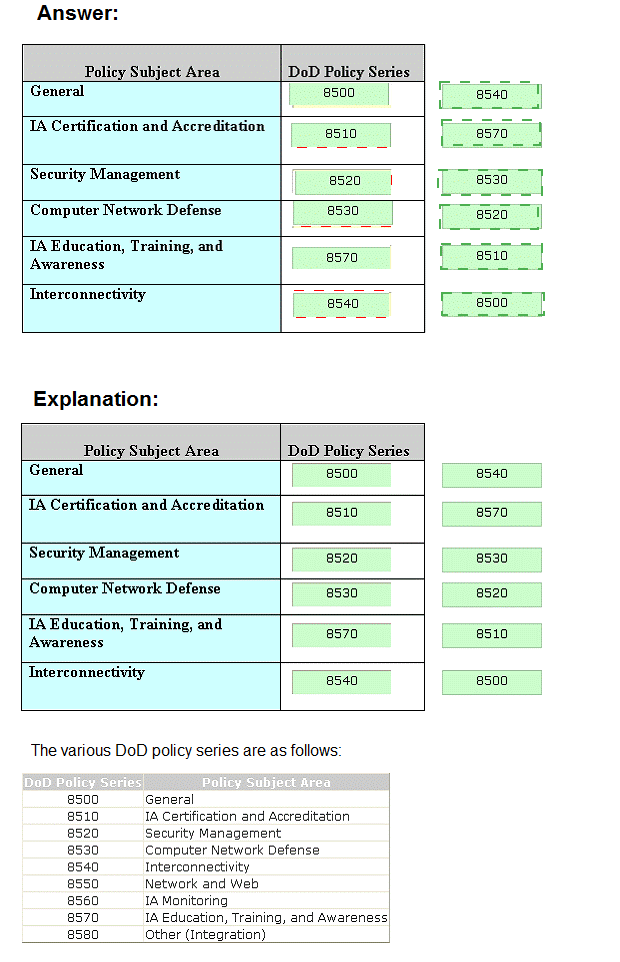
Question 13

Drag and drop the correct DoD Policy Series at their appropriate places.

Show answerHide answer

Explanation

Question 14 Choose 3

The Project Risk Management knowledge area focuses on which of the following processes? Each correct answer represents a complete solution. Choose all that apply. 

Show answerHide answer

Correct answer: A, B, C

Risk Monitoring and Control 

Risk Management Planning

Quantitative Risk Analysis

Explanation

Explanation: The Project Risk Management knowledge area focuses on the following processes: Risk Management Planning Risk Identification Qualitative Risk Analysis Quantitative Risk Analysis Risk Response Planning Risk Monitoring and Control Answer: D is incorrect. There is no such process in the Project Risk Management knowledge area.

Question 15 Choose 3

What are the subordinate tasks of the Implement and Validate Assigned IA Control phase in the DIACAP process? Each correct answer represents a complete solution. Choose all that apply.

Show answerHide answer

Correct answer: A, B, C

Conduct validation activities.

Execute and update IA implementation plan. 

Combine validation results in DIACAP scorecard. 

Explanation

Explanation: The Department of Defense Information Assurance Certification and Accreditation Process (DIACAP) is a process defined by the United States Department of Defense (DoD) for managing risk. The subordinate tasks of the Implement and Validate Assigned IA Control phase in the DIACAP process are as follows: Execute and update IA implementation plan. Conduct validation activities. Combine validation results in the DIACAP scorecard. Answer: D is incorrect. The activities related to the disposition of the system data and objects are conducted in the fifth phase of the DIACAP process. The fifth phase of the DIACAP process is known as Decommission System. 

Question 16 Choose 4

The Software Configuration Management (SCM) process defines the need to trace changes, and the ability to verify that the final delivered software has all of the planned enhancements that are supposed to be included in the release. What are the procedures that must be defined for each software project to ensure that a sound SCM process is implemented? Each correct answer represents a complete solution. Choose all that apply.

Show answerHide answer

Correct answer: A, B, C, D

Configuration status accounting

Configuration change control

Configuration identification

Configuration audits 

Explanation

Explanation: The SCM process defines the need to trace changes, and the ability to verify that the final delivered software has all of the planned enhancements that are supposed to be included in the release. It identifies four procedures that must be defined for each software project to ensure that a sound SCM process is implemented. They are as follows: 1.Configuration identification: Configuration identification is the process of identifying the attributes that define every aspect of a configuration item. A configuration item is a product (hardware and/or software) that has an end-user purpose. These attributes are recorded in configuration documentation and baselined. 2.Configuration change control: Configuration change control is a set of processes and approval stages required to change a configuration item's attributes and to re-baseline them. 3.Configuration status accounting: Configuration status accounting is the ability to record and report on the configuration baselines associated with each configuration item at any moment of time. 4.Configuration audits: Configuration audits are broken into functional and physical configuration audits. They occur either at delivery or at the moment of effecting the change. A functional configuration audit ensures that functional and performance attributes of a configuration item are achieved, while a physical configuration audit ensures that a configuration item is installed in accordance with the requirements of its detailed design documentation.

Question 17 Choose 1

In which of the following deployment models of cloud is the cloud infrastructure operated exclusively for an organization? 

Show answerHide answer

Correct answer: C

Private cloud

Explanation

Explanation: In private cloud, the cloud infrastructure is operated exclusively for an organization. The private cloud infrastructure is administered by the organization or a third party, and exists on premise and off premise. 

Question 18 Choose 2

The Data and Analysis Center for Software (DACS) specifies three general principles for software assurance which work as a framework in order to categorize various secure design principles. Which of the following principles and practices does the General Principle 1 include? Each correct answer represents a complete solution. Choose two

Show answerHide answer

Correct answer: A, D

Principle of separation of privileges, duties, and roles

Principle of least privilege 

Explanation

Explanation: General Principle 1- Minimize the number of high-consequence targets includes the following principles and practices: Principle of least privilege Principle of separation of privileges, duties, and roles Principle of separation of domains Answer: B is incorrect. Assume environment data is not trustworthy principle is included in the General Principle 2. Answer: C is incorrect. Simplify the design principle is included in the General Principle 3.

Question 19 Choose 1

You work as a security manager for BlueWell Inc. You are going through the NIST SP 800- 37 C&A methodology, which is based on four well defined phases. In which of the following phases of NIST SP 800-37 C&A methodology does the security categorization occur?

Show answerHide answer

Correct answer: D

Initiation 

Explanation

Explanation: The various phases of NIST SP 800-37 C&A are as follows: Phase 1: Initiation- This phase includes preparation, notification and resource identification. It performs the security plan analysis, update, and acceptance. Phase 2: Security Certification- The Security certification phase evaluates the controls and documentation. Phase 3: Security Accreditation- The security accreditation phase examines the residual risk for acceptability, and prepares the final security accreditation package. Phase 4: Continuous Monitoring-This phase monitors the configuration management and control, ongoing security control verification, and status reporting and documentation. 

Question 20 Choose 1

Which of the following terms related to risk management represents the estimated frequency at which a threat is expected to occur?

Show answerHide answer

Correct answer: B

Annualized Rate of Occurrence (ARO) 

Explanation

Explanation: The Annualized Rate of Occurrence (ARO) is a number that represents the estimated frequency at which a threat is expected to occur. It is calculated based upon the probability of the event occurring and the number of employees that could make that event occur. Answer: D is incorrect. The Exposure Factor (EF) represents the % of assets loss caused by a threat. The EF is required to calculate the Single Loss Expectancy (SLE). Answer: A is incorrect. The Single Loss Expectancy (SLE) is the value in dollars that is assigned to a single event. SLE = Asset Value ($) X Exposure Factor (EF) Answer: C is incorrect. Safeguard acts as a countermeasure for reducing the risk associated with a specific threat or a group of threats

Full mock exam

Sit the CSSLP exam before exam day

Full-length mocks with the same number of questions and the same time limit as the real CSSLP exam. Every attempt draws a new set of questions from the full bank, so you can keep going until you pass comfortably.

Get full CSSLP mock exam
  • 65questions per mock
  • 105 mintime limit
  • 348questions in the bank
  • Newmock on every attempt