ISC certification · Exam CSSLP

CSSLP Mock Exam Page 7

Certified Secure Software Lifecycle Professional

Free CSSLP mock exam questions 61–70, each with the answer and an explanation.

20 questions · 33 minutes · free, no sign-up

Free CSSLP questions

61–70 of 103 free
Question 61 Choose 1

Which of the following plans is documented and organized for emergency response, backup operations, and recovery maintained by an activity as part of its security program that will ensure the availability of critical resources and facilitates the continuity of operations in an emergency situation?

Show answerHide answer

Correct answer: C

Contingency Plan

Explanation

Explanation: Contingency plan is prepared and documented for emergency response, backup operations, and recovery maintained by an activity as the element of its security program that will ensure the availability of critical resources and facilitates the continuity of operations in an emergency situation. A contingency plan is a plan devised for a specific situation when things could go wrong. Contingency plans are often devised by governments or businesses who want to be prepared for anything that could happen.

Contingency plans include specific strategies and actions to deal with specific variances to assumptions resulting in a particular problem, emergency, or state of affairs. They also include a monitoring process and "triggers" for initiating planned actions. They are required to help governments, businesses, or individuals to recover from serious incidents in the minimum time with minimum cost and disruption.

Answer: D is incorrect. A disaster recovery plan should contain data, hardware, and software that can be critical for a business. It should also include the plan for sudden loss such as hard disc crash. The business should use backup and data recovery utilities to limit the loss of data. Answer: A is incorrect. The Continuity Of Operation Plan (COOP) refers to the preparations and institutions maintained by the United States government, providing survival of federal government operations in the case of catastrophic events. It provides procedures and capabilities to sustain an organization's essential. COOP is the procedure documented to ensure persistent critical operations throughout any period where normal operations are unattainable. Answer: B is incorrect. Business Continuity Planning (BCP) is the creation and validation of a practiced logistical plan for how an organization will recover and restore partially or completely interrupted critical (urgent) functions within a predetermined time after a disaster or extended disruption. The logistical plan is called a business continuity plan.
Question 62 Choose 1

Mark works as a Network Administrator for NetTech Inc. He wants users to access only those resources that are required for them. Which of the following access control models will he use?

Show answerHide answer

Correct answer: D

Role-Based Access Control

Explanation

Explanation: Role-based access control (RBAC) is an access control model. In this model, a user can access resources according to his role in the organization. For example, a backup administrator is responsible for taking backups of important data. Therefore, he is only authorized to access this data for backing it up. However, sometimes users with different roles need to access the same resources. This situation can also be handled using the RBAC model. Answer: B is incorrect. Mandatory Access Control (MAC) is a model that uses a predefined set of access privileges for an object of the system. Access to an object is restricted on the basis of the sensitivity of the object and granted through authorization. Sensitivity of an object is defined by the label assigned to it. For example, if a user receives a copy of an object that is marked as "secret", he cannot grant permission to other users to see this object unless they have the appropriate permission. Answer: A is incorrect. DAC is an access control model. In this model, the data owner has the right to decide who can access the data. This model is commonly used in PC environment. The basis of this model is the use of Access Control List (ACL). Answer: C is incorrect. There is no such access control model as Policy Access Control.

Question 63

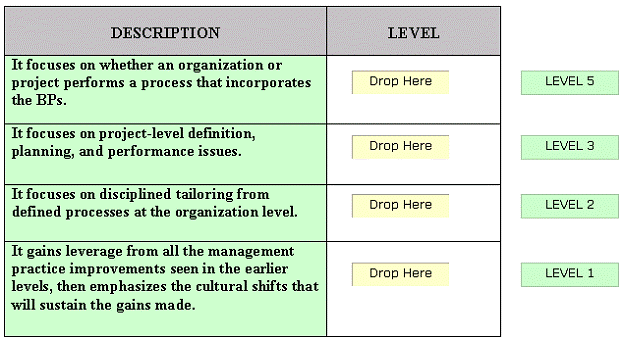
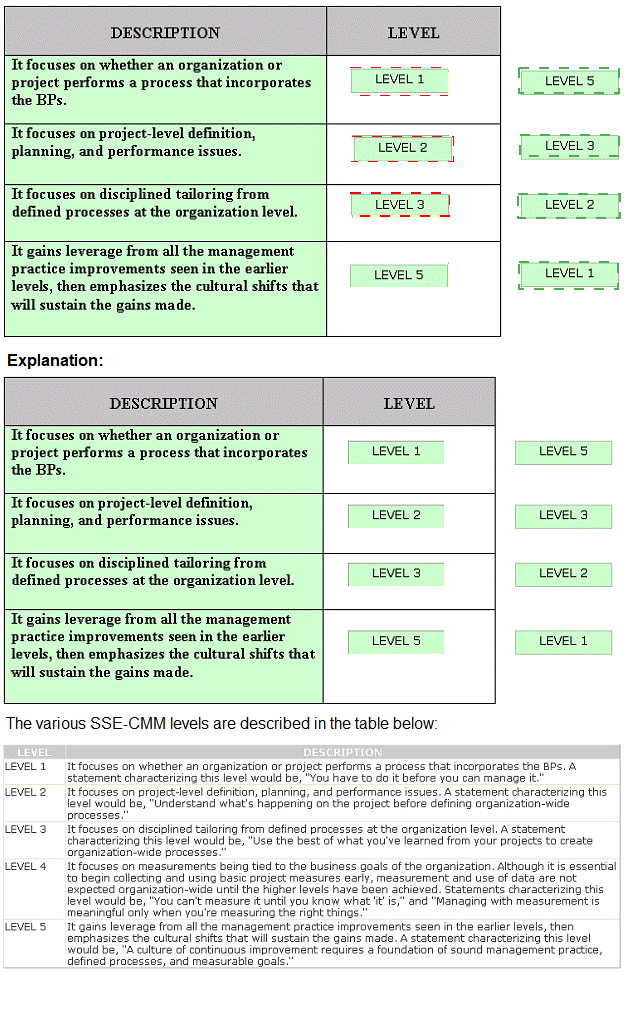
Drag and drop the various SSE-CMM levels at the appropriate places.

Show answerHide answer

Explanation

Question 64 Choose 1

John works as a professional Ethical Hacker. He has been assigned the project of testing the security of www.we-are-secure.com. He has successfully performed the following steps of the pre-attack phase to check the security of the We-are-secure network: Gathering information Determining the network range Identifying active systems Now, he wants to find the open ports and applications running on the network. Which of the following tools will he use to accomplish his task?

Show answerHide answer

Correct answer: D

SuperScan

Explanation

In such a situation, John will use the SuperScan tool to find the open ports and applications 

on the We-are-secure network. SuperScan is a TCP/UDP port scanner. It also works as a ping sweeper and hostname resolver. It can ping a given range of IP addresses and resolve the host name of the remote system. The features of SuperScan are as follows: It scans any port range from a built-in list or any given range. It performs ping scans and port scans using any IP range. It modifies the port list and port descriptions using the built in editor. It connects to any discovered open port using user-specified "helper" applications. It has the transmission speed control utility. Answer: C, A, and B are incorrect. RIPE, ARIN, and APNIC are the Regional Internet Registries (RIR) that manage, distribute, and register public IP addresses within their respective regions. These can be used as passive tools by an attacker to determine the network range.

Question 65 Choose 4

The Phase 2 of DITSCAP C&A is known as Verification. The goal of this phase is to obtain a fully integrated system for certification testing and accreditation. What are the process activities of this phase? Each correct answer represents a complete solution. Choose all that apply.

Show answerHide answer

Correct answer: A, B, C, D

Certification analysis

Assessment of the Analysis Results

Configuring refinement of the SSAA

System development

Explanation

Explanation: The Phase 2 of DITSCAP C&A is known as Verification. The goal of this phase is to obtain a fully integrated system for certification testing and accreditation. This phase takes place between the signing of the initial version of the SSAA and the formal accreditation of the system. This phase verifies security requirements during system development. The process activities of this phase are as follows: Configuring refinement of the SSAA System development Certification analysis Assessment of the Analysis Results Answer: E is incorrect. Registration is a Phase 1 activity.

Question 66 Choose 2

What are the differences between managed and unmanaged code technologies? Each correct answer represents a complete solution. Choose two.

Show answerHide answer

Correct answer: C, D

Managed code executes under management of a runtime environment, whereas unmanaged code is executed by the CPU of a computer system.

Managed code executes under management of a runtime environment, whereas unmanaged code is executed by the CPU of a computer system.

Explanation

Explanation: Programming languages are categorized into two technologies:

  1. Managed code: This computer program code is compiled into an intermediate code format. Managed code is referred to as byte code. It executes under the management of a runtime environment. Java EE and Microsoft.NET are the examples of managed code.
  2. Unmanaged code: This computer code is compiled into machine Unmanaged code is executed by the CPU of a computer system. C and C++ are the examples of unmanaged code. Answer: A is incorrect. Managed code is referred to as byte code. Answer: B is incorrect. C and C++ are the examples of unmanaged code, whereas Java EE and Microsoft.NET are the examples of managed code.
Question 67 Choose 1

In which of the following levels of exception safety are operations succeeded with full guarantee and fulfill all needs in the presence of exceptional situations?

Show answerHide answer

Correct answer: C

Failure transparency

Explanation

Explanation: Failure transparency is the best level of exception safety. In this level, operations are succeeded with full guarantee and fulfill all needs in the presence of exceptional situations. Failure transparency does not throw the exception further up even when an exception occurs. This level is also known as no throw guarantee.

Question 68 Choose 3

Which of the following can be used to accomplish authentication? Each correct answer represents a complete solution. Choose all that apply.

Show answerHide answer

Correct answer: B, C, D

Biometrics

Token

Password

Explanation

Explanation: The following can be used to accomplish authentication: 1.Password 2.Biometrics 3.Token A password is a secret word or string of characters that is used for authentication, to prove identity, or gain access to a resource.

Question 69 Choose 1

Which of the following is a chronological record of system activities to enable the reconstruction and examination of the sequence of events and/or changes in an event?

Show answerHide answer

Correct answer: B

Audit trail

Explanation

Explanation: Audit trail or audit log is a chronological sequence of audit records, each of which contains evidence directly pertaining to and resulting from the execution of a business process or system function. Audit records typically result from activities such as transactions or communications by individual people, systems, accounts, or other entities. The process that creates audit trail should always run in a privileged mode, so it could access and supervise all actions from all users, and normal user could not stop/change it. Furthermore, for the same reason, trail file or database table with a trail should not be 

accessible to normal users. Answer: C is incorrect. A computer security audit is a manual or systematic measurable technical assessment of a system or application. Manual assessments include interviewing staff, performing security vulnerability scans, reviewing application and operating system access controls, and analyzing physical access to the systems. Automated assessments, or CAAT's, include system generated audit reports or using software to monitor and report changes to files and settings on a system. Systems can include personal computers, servers, mainframes, network routers, and switches.

Answer: D is incorrect. Detective controls are the audit controls that are not needed to be restricted. Any control that performs a monitoring activity can likely be defined as a Detective Control. For example, it is possible that mistakes, either intentional or unintentional, can be made. Therefore, an additional Protective control is that these companies must have their financial results audited by an independent Certified Public Accountant. The role of this accountant is to act as an auditor. In fact, any auditor acts as a Detective control. If the organization in question has not properly followed the rules, a diligent auditor should be able to detect the deficiency which indicates that some control somewhere has failed. Answer: A is incorrect. Reactive or corrective controls typically work in response to a detective control, responding in such a way as to alert or otherwise correct an unacceptable condition. Using the example of account rules, either the internal Audit Committee or the SEC itself, based on the report generated by the external auditor, will take some corrective action. In this way, they are acting as a Corrective or Reactive control.

Question 70 Choose 1

Which of the following fields of management focuses on establishing and maintaining consistency of a system's or product's performance and its functional and physical attributes with its requirements, design, and operational information throughout its life?

Show answerHide answer

Correct answer: A

Configuration management

Explanation

Explanation: Configuration management is a field of management that focuses on establishing and maintaining consistency of a system's or product's performance and its functional and physical attributes with its requirements, design, and operational information 

throughout its life. Configuration Management System is a subsystem of the overall project management system. It is a collection of formal documented procedures used to identify and document the functional and physical characteristics of a product, result, service, or component of the project. It also controls any changes to such characteristics, and records and reports each change and its implementation status. It includes the documentation, tracking systems, and defined approval levels necessary for authorizing and controlling changes. Audits are performed as part of configuration management to determine if the requirements have been met. Answer: D is incorrect. The procurement management plan defines more than just the procurement of team members, if needed. It defines how procurements will be planned and executed, and how the organization and the vendor will fulfill the terms of the contract. Answer: B is incorrect. Risk Management is used to identify, assess, and control risks. It includes analyzing the value of assets to the business, identifying threats to those assets, and evaluating how vulnerable each asset is to those threats. Answer: C is incorrect. Change Management is used to ensure that standardized methods and procedures are used for efficient handling of all changes.

Full mock exam

Sit the CSSLP exam before exam day

Full-length mocks with the same number of questions and the same time limit as the real CSSLP exam. Every attempt draws a new set of questions from the full bank, so you can keep going until you pass comfortably.

Get full CSSLP mock exam
  • 65questions per mock
  • 105 mintime limit
  • 348questions in the bank
  • Newmock on every attempt