ISC certification · Exam CSSLP

CSSLP Mock Exam Page 6

Certified Secure Software Lifecycle Professional

Free CSSLP mock exam questions 51–60, each with the answer and an explanation.

20 questions · 33 minutes · free, no sign-up

Free CSSLP questions

51–60 of 103 free
Question 51 Choose 1

Which of the following vulnerabilities occurs when an application directly uses or concatenates potentially hostile input with data file or stream functions?

Show answerHide answer

Correct answer: B

Malicious file execution

Explanation

Explanation: Malicious file execution is a vulnerability that occurs when an application directly uses or concatenates potentially hostile input with data file or stream functions. This leads to arbitrary remote and hostile data being included, processed, and invoked by the Web server. Malicious file execution can be prevented by using an indirect object reference map, input validation, or explicit taint checking mechanism. Answer: D is incorrect. Injection flaw occurs when data is sent to an interpreter as a part of command or query. Answer: A is incorrect. Insecure cryptographic storage occurs when applications have failed to encrypt data. Answer: C is incorrect. Insecure communication occurs when applications have failed to encrypt network traffic. 
Question 52 Choose 1

Which of the following provides an easy way to programmers for writing lower-risk applications and retrofitting security into an existing application?

Show answerHide answer

Correct answer: D

ESAPI 

Explanation

Explanation: ESAPI (Enterprise Security API) is a group of classes that encapsulate the key security operations, needed by most of the applications. It is a free, open source, Web application security control library. ESAPI provides an easy way to programmers for writing lower-risk applications and retrofitting security into an existing application. It offers a solid foundation for new development. Answer: C is incorrect. An encryption wrapper is a device that encrypts and decrypts the critical or all software codes at runtime. Answer: B is incorrect. Code obfuscation transforms the code so that it is less intelligible for a person. Answer: A is incorrect. Watermarking is the irreversible process of embedding information into a digital media. The purpose of digital watermarks is to provide copyright protection for intellectual property that is in digital form.

Question 53 Choose 3

What are the security advantages of virtualization, as described in the NIST Information Security and Privacy Advisory Board (ISPAB) paper "Perspectives on Cloud Computing and Standards"? Each correct answer represents a complete solution. Choose three. 

Show answerHide answer

Correct answer: A, B, C

It increases capabilities for fault tolerant computing. 

It adds a layer of security for defense-in-depth.

It decreases exposure of weak software.

Explanation

Explanation: The security advantages of virtualization are as follows: It adds a layer of security for defense-in-depth. It provides strong encapsulation of errors. It increases intrusion detection through introspection. It decreases exposure of weak software. It increases the flexibility for discovery. It increases capabilities for fault tolerant computing using rollback and snapshot features. Answer: D is incorrect. Virtualization increases configuration effort because of complexity of the virtualization layer and composite system.

Question 54 Choose 1

Mark works as a Network Administrator for NetTech Inc. The company has a Windows 2000 domain-based network. Users report that they are unable to log on to the network. Mark finds that accounts are locked out due to multiple incorrect log on attempts. What is the most likely cause of the account lockouts? 

Show answerHide answer

Correct answer: B

Brute force attack

Explanation

Explanation: Brute force attack is the most likely cause of the account lockouts. In a brute force attack, unauthorized users attempt to log on to a network or a computer by using multiple possible user names and passwords. Windows 2000 and other network operating systems have a security feature that locks a user account if the number of failed logon attempts occur within a specified period of time, based on the security policy lockout settings. Answer: A is incorrect. Spoofing is a technique that makes a transmission appear to have come from an authentic source by forging the IP address, email address, caller ID, etc. In IP spoofing, a hacker modifies packet headers by using someone else's IP address to hide his identity. However, spoofing cannot be used while surfing the Internet, chatting on-line, etc. because forging the source IP address causes the responses to be misdirected. Answer: C is incorrect. A SYN attack affects computers running on the TCP/IP protocol. It is a protocol-level attack that can render a computer's network services unavailable. A SYN attack is also known as SYN flooding. Answer: D is incorrect. When a computer repeatedly sends ICMP echo requests to another computer, it is known as a PING attack.

Question 55

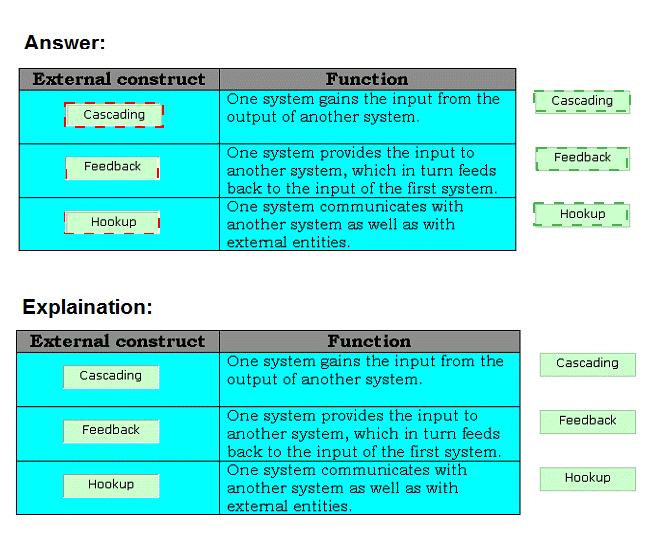
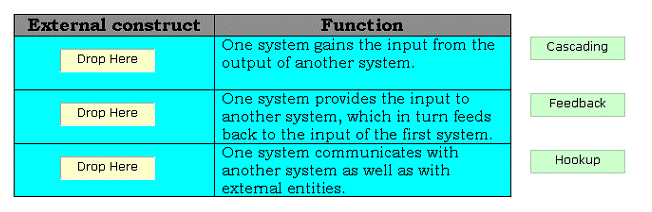
Drag and drop the appropriate external constructs in front of their respective functions.

Show answerHide answer

Explanation

There are two types of compositional constructs: 1.External constructs: The various types of external constructs are as follows: Cascading: In this type of external construct, one system gains the input from the output of another system. Feedback: In this type of external construct, one system provides the input to another system, which in turn feeds back to the input of the first system. Hookup: In this type of external construct, one system communicates with another system as well as with external entities. 2.Internal constructs: The internal constructs include intersection, union, and difference.


Question 56 Choose 1

Which of the following plans is designed to protect critical business processes from natural or man-made failures or disasters and the resultant loss of capital due to the unavailability of normal business processes?

Show answerHide answer

Correct answer: B

Business continuity plan

Explanation

Explanation: The business continuity plan is designed to protect critical business processes from natural or man-made failures or disasters and the resultant loss of capital due to the unavailability of normal business processes. Business Continuity Planning (BCP) is the creation and validation of a practiced logistical plan for how an organization will recover and restore partially or completely interrupted critical (urgent) functions within a predetermined time after a disaster or extended disruption. The logistical plan is called a business continuity plan. Answer: C is incorrect. The crisis communication plan can be broadly defined as the plan for the exchange of information before, during, or after a crisis event. It is considered as a sub-specialty of the public relations profession that is designed to protect and defend an individual, company, or organization facing a public challenge to its reputation. The aim of crisis communication plan is to assist organizations to achieve continuity of critical business processes and information flows under crisis, disaster or event driven circumstances. Answer: A is incorrect. A contingency plan is a plan devised for a specific situation when things could go wrong. Contingency plans are often devised by governments or businesses who want to be prepared for anything that could happen. Contingency plans include specific strategies and actions to deal with specific variances to assumptions resulting in a particular problem, emergency, or state of affairs. They also include a monitoring process and "triggers" for initiating planned actions. They are required to help governments, businesses, or individuals to recover from serious incidents in the minimum time with minimum cost and disruption. Answer: D is incorrect. A disaster recovery plan should contain data, hardware, and software that can be critical for a business. It should also include the plan for sudden loss such as hard disc crash. The business should use backup and data recovery utilities to limit the loss of data

Question 57 Choose 1

Which of the following processes provides a standard set of activities, general tasks, and a management structure to certify and accredit systems, which maintain the information assurance and the security posture of a system or site? 

Show answerHide answer

Correct answer: B

NIACAP 

Explanation

Explanation: NIACAP is a process, which provides a standard set of activities, general tasks, and a management structure to certify and accredit systems that maintain the information assurance and the security posture of a system or site. Answer: D is incorrect. DITSCAP is a process, which establishes a standard process, a set of activities, general task descriptions, and a management structure to certify and accredit the IT systems that will maintain the required security posture. Answer: A is incorrect. The NSA-IAM evaluates information systems at a high level and uses a subset of the SSE-CMM process areas to measure the implementation of information security on these systems. Answer: C is incorrect. ASSET is a tool developed by NIST to automate the process of self-assessment through the use of the questionnaire in NIST. 

Question 58 Choose 1

Which of the following processes identifies the threats that can impact the business continuity of operations?

Show answerHide answer

Correct answer: C

Business impact analysis

Explanation

Explanation: A business impact analysis (BIA) is a crisis management and business impact analysis technique that identifies those threats that can impact the business continuity of operations. Such threats can be either natural or man-made. The BIA team should have a clear understanding of the organization, key business processes, and IT resources for assessing the risks associated with continuity. In the BIA team, there should be senior management, IT personnel, and end users to identify all resources that are to be used during normal operations. Answer: B is incorrect. Risk analysis is the science of risks and their probability and evaluation in a business or a process. It is an important factor in security enhancement and prevention in a system. Risk analysis should be performed as part of the risk management process for each project. The outcome of the risk analysis would be the creation or review of the risk register to identify and quantify risk elements to
the project and their potential impact. Answer: A is incorrect. The functional analysis process is used for converting system requirements into a comprehensive function standard. Verification is the result of the functional analysis process, in which the fundamentals of a system level functional architecture are defined adequately to allow for synthesis in the design phase. The functional analysis breaks down the higher-level functions into the lower level functions. Answer: D is incorrect. Requirements analysis encompasses the tasks that go into determining the needs or conditions to meet for a new or altered product, taking account of the possibly conflicting requirements of the various stakeholders.

Question 59 Choose 1

Which of the following is the most secure method of authentication?

Show answerHide answer

Correct answer: A

Biometrics

Explanation

Explanation: Biometrics is a method of authentication that uses physical characteristics, such as fingerprints, scars, retinal patterns, and other forms of biophysical qualities to identify a user. Nowadays, the usage of biometric devices such as hand scanners and retinal scanners is becoming more common in the business environment. It is the most secure method of authentication. Answer: B is incorrect. Username and password is the least secure method of authentication in comparison of smart card and biometrics authentication. Username and password can be intercepted. Answer: D is incorrect. Smart card authentication is not as reliable as biometrics authentication. Answer: C is incorrect. Anonymous authentication does not provide security as a user can log on to the system anonymously and he is not prompted for credentials.

Question 60 Choose 3

Which of the following statements reflect the 'Code of Ethics Canons' in the '(ISC)2 Code of Ethics'? Each correct answer represents a complete solution. Choose all that apply.


Show answerHide answer

Correct answer: A, C, D

Act honorably, honestly, justly, responsibly, and legally.

Provide diligent and competent service to principals.

Protect society, the commonwealth, and the infrastructure.

Explanation

Explanation: The Code of Ethics Canons in (ISC)2 code of ethics are as follows: Protect society, the commonwealth, and the infrastructure. Act honorably, honestly, justly, responsibly, and legally. Provide diligent and competent service to principals. Advance and protect the profession.

Full mock exam

Sit the CSSLP exam before exam day

Full-length mocks with the same number of questions and the same time limit as the real CSSLP exam. Every attempt draws a new set of questions from the full bank, so you can keep going until you pass comfortably.

Get full CSSLP mock exam
  • 65questions per mock
  • 105 mintime limit
  • 348questions in the bank
  • Newmock on every attempt