CompTIA certification · Exam CS0-003

CS0-003 Mock Exam Page 7

CompTIA CySA+

Free CS0-003 mock exam questions 61–70, each with the answer and an explanation.

20 questions · 39 minutes · free, no sign-up

Free CS0-003 questions

61–70 of 151 free
Question 61 Choose 1
The SOC received a threat intelligence notification indicating that an employee's credentials were found on the dark web. The user's web and log-in activities were reviewed for malicious or anomalous connections, data uploads/downloads, and exploits. A review of the controls confirmed multifactor authentication was enabled. Which of the following should be done first to mitigate impact to the business networks and assets?
Show answerHide answer

Correct answer: A Perform a forced password reset.

Explanation

Explanation:

Since the employee’s credentials were found on the dark web, the immediate priority is to perform a forced password reset to prevent unauthorized access to business networks and assets. Even with multifactor authentication (MFA) enabled, compromised credentials pose a risk if MFA is bypassed or not applied universally. This action directly mitigates the threat of attackers using the credentials. Communicating to the user is important but secondary to securing the account. An ad hoc AV scan addresses potential malware, not credential misuse. Reviewing privileges is a good practice but less urgent than neutralizing the compromised credentials. Lowering SOC alert thresholds enhances monitoring but doesn’t directly address the immediate threat.

Reference:

CompTIA CySA+ Study Guide (CS0-003), Chapter 4: Incident Response

NIST SP 800-61 Rev. 2: Computer Security Incident Handling Guide (credential compromise response).
Question 62 Choose 1
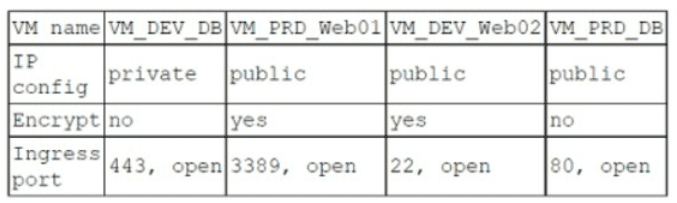
A company has the following security requirements: . No public IPs · All data secured at rest . No insecure ports/protocols After a cloud scan is completed, a security analyst receives reports that several misconfigurations are putting the company at risk. Given the following cloud scanner output:


Which of the following should the analyst recommend be updated first to meet the security requirements and reduce risks?
Show answerHide answer

Correct answer: D VM_PRD_Web01

Explanation

Explanation:

The company’s security requirements include no public IPs, all data secured at rest, and no insecure ports/protocols. VM_PRD_DB (a production database) should be prioritized for updates because misconfigurations in a production database are likely to involve critical issues, such as exposed public IPs, unencrypted data at rest, or insecure ports (e.g., unencrypted database protocols like MySQL on port 3306 or PostgreSQL on 5432). These pose a high risk to sensitive data in a production environment. VM_DEV_DB (development database) is lower priority due to its non-production status. VM_PRD_Web01 and VM_DEV_Web02 (web servers) may have issues, but databases typically store sensitive data, making VM_PRD_DB the most critical to address first.

Reference:

CompTIA CySA+ Study Guide (CS0-003), Chapter 3: Vulnerability Management

NIST SP 800-53: SC-28 (Protection of Data at Rest), AC-3 (Access Control)

OWASP Cloud Security: Misconfiguration Risks.
Question 63 Choose 1
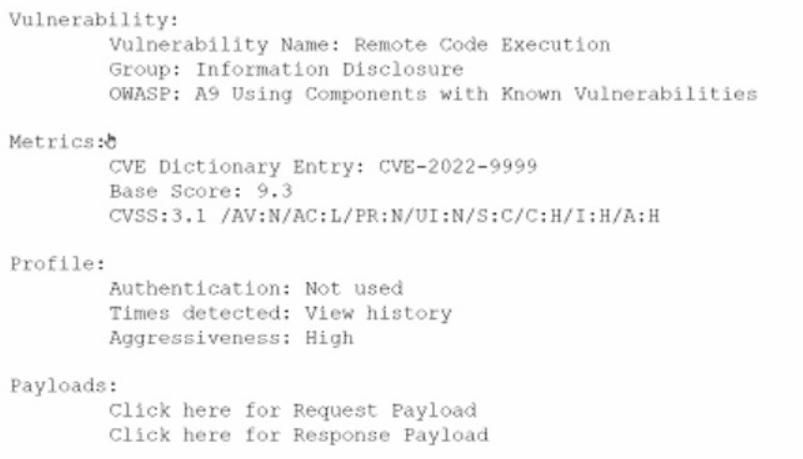
An analyst is evaluating the following vulnerability report:


Which of the following vulnerability report sections provides information about the level of impact on data confidentiality if a successful exploitation occurs?
Show answerHide answer

Correct answer: B Metrics

Explanation

Explanation:

In a vulnerability report, the Metrics section typically includes the CVSS (Common Vulnerability Scoring System) score, which quantifies the impact of a vulnerability on confidentiality, integrity, and availability. Specifically, the CVSS Confidentiality Impact (C) metric (e.g., C:H for High) indicates the level of impact on data confidentiality if the vulnerability is exploited. The Payloads section describes exploit code or methods, not impact. The Vulnerability section details the flaw itself. The Profile section may describe the system or environment, not the specific impact on confidentiality.

Reference:

CompTIA CySA+ Study Guide (CS0-003), Chapter 3: Vulnerability Management
Question 64 Choose 1
A penetration tester submitted data to a form in a web application, which enabled the penetration tester to retrieve user credentials. Which of the following should be recommended for remediation of this application vulnerability?
Show answerHide answer

Correct answer: C Performing input validation before allowing submission

Explanation

Explanation:

The vulnerability described suggests an input validation flaw, such as SQL injection or cross-site scripting (XSS), allowing the penetration tester to retrieve user credentials by submitting malicious data to a web form. Performing input validation (e.g., sanitizing and validating user inputs) prevents malicious data from being processed, directly addressing the root cause. Implementing multifactor authentication (MFA) on the server OS enhances authentication security but doesn’t fix the application’s input flaw. Hashing user passwords protects stored credentials but doesn’t prevent the exploit if credentials are extracted via the form. Segmenting the network improves security but doesn’t address the application vulnerability itself.

Reference:

CompTIA CySA+ Study Guide (CS0-003), Chapter 3: Vulnerability Management

OWASP Top Ten (2021): A03 – Injection (emphasizes input validation)

NIST SP 800-53: SI-10 (Input Validation)
Question 65 Choose 1
Which of the following best describes the goal of a disaster recovery exercise as preparation for possible incidents?
Show answerHide answer

Correct answer: A TO provide metrics and test continuity controls

Explanation

Explanation:

A disaster recovery (DR) exercise is primarily conducted to:

Test business continuity and recovery controls (e.g., backups, failovers, DR sites)

Measure recovery time objectives (RTO) and recovery point objectives (RPO)

Ensure systems can be restored within acceptable timeframes

This aligns directly with:

➡"To provide metrics and test continuity controls"

Reference:

CompTIA CySA+ CS0-003 Exam Objectives (Domain 3.5):

"Given a scenario, apply common prevention, detection, and recovery controls for organizational security." Let me know if you want a cheat sheet for DR testing types.
Question 66 Choose 1
A company is implementing a vulnerability management program and moving from an onpremises environment to a hybrid IaaS cloud environment. Which of the following implications should be considered on the new hybrid environment?
Show answerHide answer

Correct answer: B Cloud-specific misconfigurations may not be detected by the current scanners

Explanation

Explanation:

When moving to a hybrid IaaS cloud environment, it's crucial to understand that:

Traditional on-premises vulnerability scanners often do not detect cloud-specific risks, such as:

IAM misconfigurations

Insecure storage buckets

Excessive permissions

Publicly exposed services

These cloud misconfigurations are different from typical OS/app-level vulnerabilities.

Why the other options are incorrect:

The current scanners should be migrated to the cloud"

➤ Not necessarily; scanners can run on-prem and still reach cloud assets (depending on routing/security).

"Existing vulnerability scanners cannot scan IaaS systems"

➤ Not true. Most enterprise scanners can scan IaaS, but may miss configuration issues unless integrated with cloud-native APIs.

"Vulnerability scans on cloud environments should be performed from the cloud"

➤ It's ideal but not mandatory; scanning location depends on access, latency, and security design.

Reference:

CompTIA CySA+ CS0-003 Objective 3.3 – "Assess security implications of embedded and cloud-integrated systems."
Question 67 Choose 1
A security analyst has found the following suspicious DNS traffic while analyzing a packet capture:

• DNS traffic while a tunneling session is active.

• The mean time between queries is less than one second.

• The average query length exceeds 100 characters.

Which of the following attacks most likely occurred?
Show answerHide answer

Correct answer: A DNS exfiltration

Explanation

Explanation:

The key indicators mentioned in the packet capture point to DNS exfiltration, which is a form of data exfiltration using DNS queries. Here's why:

DNS traffic during a tunneling session → Suggests covert channels are in use.

Mean time between queries < 1 second → Indicates automated, high-frequency requests (unusual for normal DNS usage).

Average query length > 100 characters → Implies payloads or encoded data are being transmitted within DNS requests.

DNS exfiltration typically uses encoded or encrypted data inside DNS queries to bypass security controls and send data outside the network.

Why the other options are incorrect:

DNS spoofing: Involves forging DNS responses to redirect traffic—not related to the pattern of traffic shown.

DNS zone transfer: Attempts to pull an entire DNS zone file from a server; it’s a one-time large request, not many small ones.

DNS poisoning: Involves injecting false entries into a DNS cache—again, unrelated to query frequency or length.

Reference:

CompTIA CySA+ CS0-003 Exam Objective 2.2 – "Analyze potential indicators to determine the type of attack." Let me know if you'd like a diagram of how DNS exfiltration works.
Question 68 Choose 1
A Chief Information Security Officer has outlined several requirements for a new vulnerability scanning project:

. Must use minimal network bandwidth

. Must use minimal host resources

. Must provide accurate, near real-time updates

. Must not have any stored credentials in configuration on the scanner

Which of the following vulnerability scanning methods should be used to best meet these requirements?
Show answerHide answer

Correct answer: B Agent

Explanation

Why Agent Scanning Meets All Requirements:

Agent-based vulnerability scanning uses lightweight software installed directly on endpoints. It’s designed to: Minimize network bandwidth: Agents collect data locally and send only essential updates, reducing traffic across segments.

Use minimal host resources: Modern agents are optimized to run with low CPU and memory impact.

Provide near real-time updates: Agents can continuously monitor and report changes without waiting for scheduled scans.

Avoid stored credentials on the scanner: Since agents operate locally, they don’t require centralized credential storage, eliminating a major security concern.

This method is especially effective in segmented networks, remote environments, or systems with limited connectivity.

Why the Other Options Fall Short:

Internal:Too vague — could refer to any scanning done inside the network, including active or credentialed scans. Doesn’t guarantee low bandwidth or resource usage.

Active: Sends probes across the network, consuming bandwidth and potentially impacting host performance. Often requires stored credentials for deeper scans.

Uncredentialed: Avoids credential storage, but lacks depth and accuracy. Also relies on network probing, which increases bandwidth usage and may miss internal vulnerabilities.
Question 69 Choose 1
A security analyst needs to mitigate a known, exploited vulnerability related not tack vector that embeds software through the USB interface. Which of the following should the analyst do first?
Show answerHide answer

Correct answer: C Check configurations to determine whether USB ports are enabled on company assets.

Explanation

Why this is the correct first move:

When dealing with a known, exploited USB-based vulnerability, the most immediate and effective action is to assess the current exposure. That starts with checking whether USB ports are enabled and accessible on company devices. If they are, the organization may be vulnerable to:

Malicious USB devices (e.g., BadUSB, Rubber Ducky)

Firmware-level exploits that don’t require user interaction

Data exfiltration or remote code execution via USB interfaces

By identifying which systems have active USB ports, the analyst can:

Prioritize which assets need hardening

Disable or restrict USB access where feasible

Apply endpoint protection or device control policies

This step lays the groundwork for targeted mitigation and helps prevent further exploitation.

Why the other options come later:

Security awareness training:Important for long-term prevention, but it doesn’t address the immediate technical exposure.

Removable media policy:A strong policy is essential, but it’s a follow-up to understanding current configurations.

Review logs:Useful for incident response, but it doesn’t prevent future exploitation if USB ports remain active.
Question 70
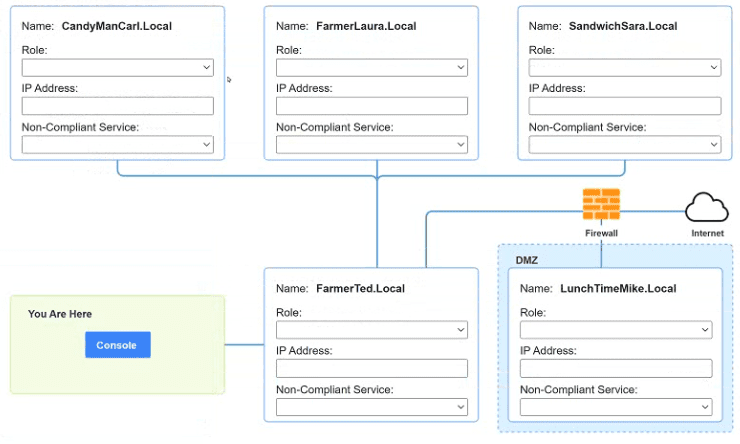
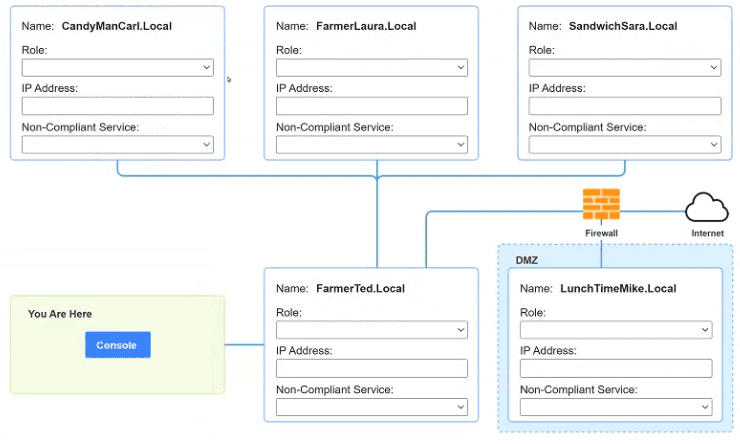
You are a penetration tester who is reviewing the system hardening guidelines for a company. Hardening guidelines indicate the following.

There must be one primary server or service per device.

Only default port should be used

Non- secure protocols should be disabled.

The corporate internet presence should be placed in a protected subnet

Instructions :

Using the available tools, discover devices on the corporate network and the services running on these devices.

You must determine

ip address of each device

The primary server or service each device

The protocols that should be disabled based on the hardening guidelines


Show answerHide answer

Explanation

1. Scan the Network for Devices

Use tools like:

Nmap: nmap -sP 192.168.1.0/24 to discover active hosts

Netdiscover or Advanced IP Scanner for quick device identification

This will help you identify:

IP addresses of devices

Hostnames (if available)

MAC addresses

2. Identify Services Running on Each Device

USE

nmap -sV to detect open ports and service versions

nmap -O to guess the operating system

This helps determine:

The primary server or service per device

Whether only default ports are used

3. Detect Non-Secure Protocols

Look for:

Telnet (port 23), FTP (port 21), HTTP (port 80), IMAP (port 143), etc.

These should be flagged for disabling in favor of secure alternatives like SSH, SFTP, HTTPS, and IMAPS

4. Check Network Segmentation

Use traceroute or firewall rules to verify:

Whether the corporate internet-facing services are placed in a DMZ or protected subnet
Full mock exam

Sit the CS0-003 exam before exam day

Full-length mocks with the same number of questions and the same time limit as the real CS0-003 exam. Every attempt draws a new set of questions from the full bank, so you can keep going until you pass comfortably.

Get full CS0-003 mock exam
  • 85questions per mock
  • 165 mintime limit
  • 506questions in the bank
  • Newmock on every attempt