CompTIA certification · Exam CS0-003

CS0-003 Mock Exam Page 6

CompTIA CySA+

Free CS0-003 mock exam questions 51–60, each with the answer and an explanation.

20 questions · 39 minutes · free, no sign-up

Free CS0-003 questions

51–60 of 151 free
Question 51 Choose 1
A zero-day command injection vulnerability was published. A security administrator is analyzing the following logs for evidence of adversaries attempting to exploit the vulnerability:
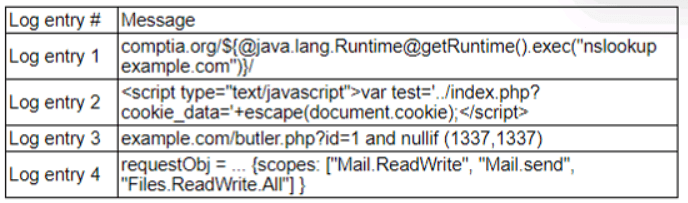


Which of the following log entries provides evidence of the attempted exploit?
Show answerHide answer

Correct answer: D Log entry 4

Explanation

Explanation:

A zero-day command injection vulnerability allows attackers to execute arbitrary system commands by injecting them into input fields (e.g., via web forms or APIs). To identify an exploit attempt, the security administrator should look for log entries showing suspicious commands, such as shell commands, file manipulation, or system reconnaissance attempts (e.g., cat /etc/passwd, curl, wget). Without specific log details for entries 1–4, the correct choice is the entry displaying such malicious patterns, indicating an attempt to exploit the vulnerability.

Reference:

CompTIA CySA+ Study Guide (CS0-003), Chapter 4: Incident Response

OWASP Top Ten (2021): A03 – Injection

NIST SP 800-61 Rev. 2: Computer Security Incident Handling Guide (log analysis)

CySA+ Objective: 2.1 – Analyze logs to identify indicators of compromise
Question 52 Choose 1
A recent penetration test discovered that several employees were enticed to assist attackers by visiting specific websites and running downloaded files when prompted by phone calls. Which of the following would best address this issue?
Show answerHide answer

Correct answer: A Increasing training and awareness for all staff

Explanation

Explanation:

The issue describes a social engineering attack (e.g., phishing combined with vishing), where employees were tricked into visiting malicious websites and running downloaded files. Increasing training and awareness educates staff to recognize and avoid such tactics, addressing the root cause—human error. Blocking malicious websites is helpful but insufficient, as attackers can use new or unknown sites. Blocking all scripts may disrupt legitimate operations and not prevent all malicious files. Disabling the ability to run downloaded applications is overly restrictive and impractical for most workflows

. Reference:

CompTIA CySA+ Study Guide (CS0-003), Chapter 2: Security Operations

NIST SP 800-53: AT-2 (Security Awareness Training)
Question 53 Choose 1
During security scanning, a security analyst regularly finds the same vulnerabilities in a critical application. Which of the following recommendations would best mitigate this problem if applied along the SDLC phase?
Show answerHide answer

Correct answer: C Use application security scanning as part of the pipeline for the CI/CDflow

Explanation

Explanation:

Regularly finding the same vulnerabilities in a critical application indicates a lack of early detection and remediation in the Software Development Life Cycle (SDLC). Integrating application security scanning into the CI/CD pipeline (e.g., Static Application Security Testing (SAST) or Dynamic Application Security Testing (DAST)) ensures vulnerabilities are identified and fixed during development, before deployment. This proactive approach reduces recurring issues. Red team exercises test production environments but don’t address development flaws. Checking coding libraries helps but is too narrow. Input validation mitigates specific vulnerabilities (e.g., injection) but isn’t comprehensive for all recurring issues.

Reference:

CompTIA CySA+ Study Guide (CS0-003), Chapter 3: Vulnerability Management

OWASP Secure Coding Practices: https://owasp.org/www-project-secure-coding-practices-quick-reference-guide/

NIST SP 800-53: SA-11 (Developer Security Testing and Evaluation)
Question 54 Choose 1
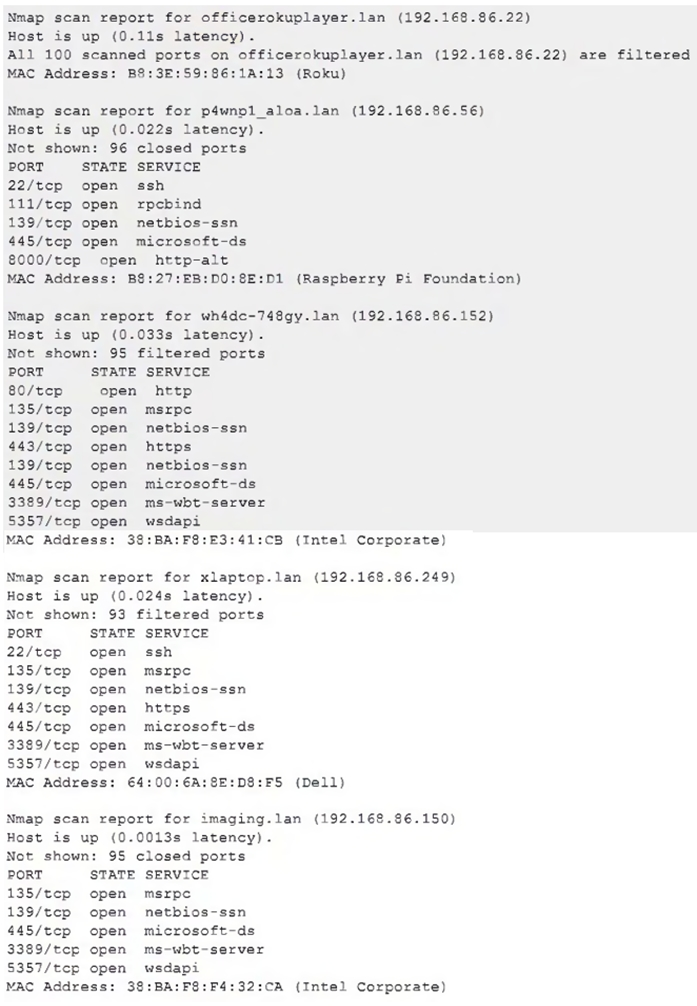
Due to reports of unauthorized activity that was occurring on the internal network, an analyst is performing a network discovery. The analyst runs an Nmap scan against a corporate network to evaluate which devices were operating in the environment. Given the following output:


Which of the following choices should the analyst look at first?
Show answerHide answer

Correct answer: E p4wnp1_aloa.lan (192.168.86.56)

Explanation

Explanation:

The device named p4wnp1_aloa.lan stands out as suspicious and should be investigated first. The name resembles P4wnP1 ALOHA, a known open-source tool used for penetration testing and malicious activities, often deployed as a rogue device or USB attack platform. Its presence on a corporate network, especially amid reports of unauthorized activity, suggests it could be an attacker’s device or compromised system. The other devices (wh4dc-748gy.lan, lan, imaging.lan, xlaptop.lan) have names typical of corporate assets (e.g., workstations, servers, or imaging systems) and are less likely to be the immediate source of unauthorized activity without further evidence.

Reference:

CompTIA CySA+ Study Guide (CS0-003), Chapter 2: Security Operations (Network Discovery and Threat Identification)

NIST SP 800-61 Rev. 2: Computer Security Incident Handling Guide (Identifying Rogue Devices)

P4wnP1 ALOHA Documentation: https://github.com/RoganDawes/P4wnP1_aloa (describes its use in penetration testing)
Question 55 Choose 1
Results of a SOC customer service evaluation indicate high levels of dissatisfaction with the inconsistent services provided after regular work hours. To address this, the SOC lead drafts a document establishing customer expectations regarding the SOC's performance and quality of services. Which of the following documents most likely fits this description?
Show answerHide answer

Correct answer: D Service-level agreement

Explanation

Explanation:

An SLA defines customer expectations for performance and quality of services, including availability, response times, and support consistency, especially for after-hours services. It directly addresses the SOC’s service delivery issues. A risk management plan focuses on identifying and mitigating risks, not service quality. A vendor agreement outlines terms with third-party providers, not SOC performance. An incident response plan details steps for handling security incidents, not customer service expectations.

Reference:

CompTIA CySA+ Study Guide (CS0-003), Chapter 5: Reporting and Communication

NIST SP 800-53: SA-9 (External System Services, covering SLAs)
Question 56 Choose 1
A technician identifies a vulnerability on a server and applies a software patch. Which of the following should be the next step in the remediation process?
Show answerHide answer

Correct answer: C Validation

Explanation

Explanation:

After applying a software patch to address a vulnerability, the next step in the remediation process is validation. This involves verifying that the patch successfully mitigated the vulnerability (e.g., by rescanning the server) and ensuring the system functions correctly without introducing new issues. Testing occurs before patching in a controlled environment. Implementation refers to applying the patch, which has already been done. Rollback is only needed if validation fails.

Reference:

CompTIA CySA+ Study Guide (CS0-003), Chapter 3: Vulnerability Management

NIST SP 800-40 Rev. 4: Guide to Enterprise Patch Management Planning
Question 57 Choose 1
An MSSP received several alerts from customer 1, which caused a missed incident response deadline for customer 2. Which of the following best describes the document that was violated?
Show answerHide answer

Correct answer: C SLA

Explanation

Explanation:

An SLA defines specific performance commitments, such as incident response deadlines, between a Managed Security Service Provider (MSSP) and its customers. Missing a deadline for Customer 2 due to prioritizing Customer 1’s alerts indicates a violation of the SLA with Customer 2. KPI (Key Performance Indicator) measures performance but isn’t a binding agreement. SLO (Service-level Objective) is a goal within an SLA, not the document itself. MOU (Memorandum of Understanding) outlines mutual agreements but lacks the enforceable specifics of an SLA.

Reference:

CompTIA CySA+ Study Guide (CS0-003), Chapter 5: Reporting and Communication

NIST SP 800-53: SA-9 (External System Services, covering SLAs)
Question 58 Choose 1
A Chief Information Security Officer wants to lock down the users' ability to change applications that are installed on their Windows systems. Which of the following is the best enterprise-level solution?
Show answerHide answer

Correct answer: B GPO

Explanation

Explanation:

GPO is the best enterprise-level solution to lock down users’ ability to change or install applications on Windows systems. Group Policy allows administrators to centrally configure and enforce security settings, such as restricting software installation via policies like “Restrict users from installing software” or “AppLocker” rules. HIPS (Host-based Intrusion Prevention System) detects and blocks malicious activities but doesn’t specifically manage application installation permissions. Registry modifications can restrict settings but are not scalable for enterprise environments. DLP (Data Loss Prevention) focuses on protecting data, not controlling application installations.

Reference:

CompTIA CySA+ Study Guide (CS0-003), Chapter 2: Security Operations
Question 59 Choose 2
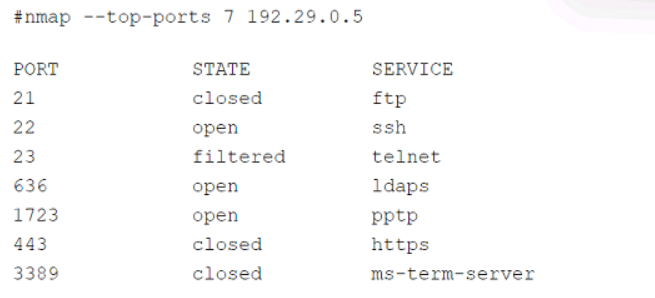
A security audit for unsecured network services was conducted, and the following output was generated:


Which of the following services should the security team investigate further? (Select two).
Show answerHide answer

Correct answer: C, D 23636

Explanation

Explanation:

The security team should investigate services running on port 23 (Telnet) and port 3389 (RDP) further, as these are commonly associated with unsecured or high-risk network services:

Port 23 (Telnet):Telnet transmits data, including credentials, in plaintext, making it highly vulnerable to interception and unauthorized access. It’s considered insecure and should be replaced with secure alternatives like SSH.

Port 3389 (RDP): Remote Desktop Protocol is a frequent target for attacks (e.g., brute force, exploits like BlueKeep). If improperly configured or unpatched, it poses a significant risk, especially on externally facing systems.

Port 21 (FTP): While FTP can be insecure (plaintext credentials), it’s less critical than Telnet and RDP unless explicitly misconfigured.

Port 22 (SSH): SSH is generally secure when properly configured, so it’s lower priority unless vulnerabilities are detected.

Port 636 (LDAPS): This is the secure version of LDAP (using SSL/TLS), making it less concerning unless misconfigure.

Port 1723 (PPTP): PPTP is outdated and has known vulnerabilities, but it’s less commonly targeted than Telnet or RDP in modern environments.

Reference:

CompTIA CySA+ Study Guide (CS0-003), Chapter 3: Vulnerability Management

NIST SP 800-41: Guidelines on Firewalls and Firewall Policy (identifying insecure services)

OWASP: Unsecure Communication (Telnet risks)
Question 60 Choose 1
A laptop that is company owned and managed is suspected to have malware. The company implemented centralized security logging. Which of the following log sources will confirm the malware infection?
Show answerHide answer

Correct answer: A XDR logs

Explanation

Explanation:

XDR (Extended Detection and Response) logs are the best source to confirm a malware infection on a company-owned laptop. XDR provides comprehensive endpoint monitoring, including behavioral analysis, file integrity checks, and threat detection, which can identify malware indicators like suspicious processes or network activity. Firewall logs track network traffic but may not confirm endpoint malware. IDS logs detect network-based intrusions but lack endpoint context. MFA logs record authentication events, not malware activity.

Reference:

CompTIA CySA+ Study Guide (CS0-003), Chapter 2: Security Operations

NIST SP 800-83: Guide to Malware Incident Prevention and Handling CySA+ Objective: 2.1 – Analyze logs to confirm indicators of compromise 3.5s How can Grok help?
Full mock exam

Sit the CS0-003 exam before exam day

Full-length mocks with the same number of questions and the same time limit as the real CS0-003 exam. Every attempt draws a new set of questions from the full bank, so you can keep going until you pass comfortably.

Get full CS0-003 mock exam
  • 85questions per mock
  • 165 mintime limit
  • 506questions in the bank
  • Newmock on every attempt