You are evaluating model-selection claims used by a peer team.
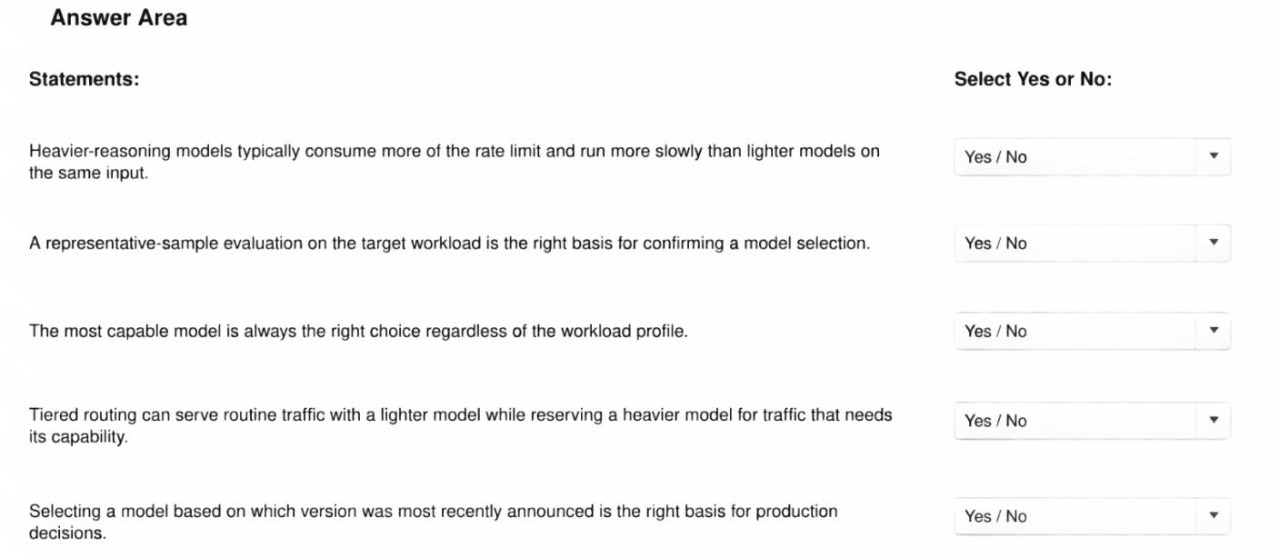
For each statement, select yes if the statement is generally true. Otherwise, select no.
Show answerHide answer
Explanation
Explanation:
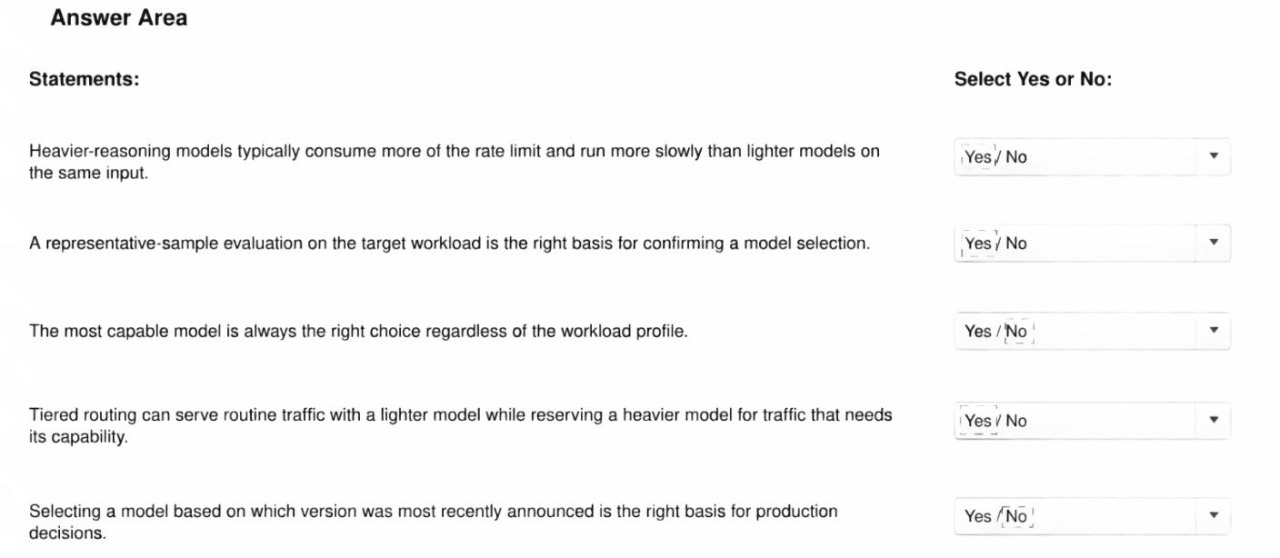
- Heavier-reasoning models consume more rate limit and run slower (Yes): Larger models require more compute per token, which translates to higher latency and greater token consumption against rate limits. Anthropic's guidance explicitly notes that Opus uses "meaningfully more of your quota" than Sonnet, and Sonnet more than Haiku .
- Representative-sample evaluation is the right basis for confirming model selection (Yes): Anthropic recommends testing candidate models against "20-30 examples from your actual workload" rather than relying on general benchmarks, because public benchmarks rarely reflect specific use-case requirements .
- Most capable model is always the right choice (No): Model selection is a trade-off between capability, speed, and cost. Anthropic explicitly recommends starting with a smaller model and scaling up only if quality falls short, to avoid "overpaying for capability you don't need" .
- Tiered routing serves routine traffic with a lighter model (Yes): Anthropic documents this pattern: a common approach is to "plan with Opus and execute with Sonnet," and Haiku is recommended for "quick lookups, simple edits, or high-volume scripted runs" .
- Newest announced version is the right basis for production decisions (No): Model selection must be driven by empirical evaluation against the workload's requirements profile (quality, latency, cost), not by recency of announcement. Anthropic's guidance consistently emphasizes testing against actual use cases before committing to a model .
Why the other options are not correct:
The "most capable always" and "newest announced" statements fail because they ignore the fundamental trade-off between capability, latency, and cost. A model that is more capable but slower and more expensive may be the wrong architectural choice for high-volume, latency-sensitive tasks .
References:
- Anthropic model selection: establish criteria (capabilities, speed, cost, effort) first; start efficiency-first or capability-first based on workload profile .