Anthropic certification · Exam CCAR-P

CCAR-P Mock Exam

Claude Certified Architect - Professional

Free CCAR-P questions on Governance, Safety and Risk Management, each with the answer and an explanation.

20 questions · 39 minutes · free, no sign-up

Governance, Safety and Risk Management questions

1–10 of 10 free
Question 1 Choose 1
You are assessing data-exfiltration risk in a Claude-based assistant that has tools for both internal-document retrieval and outbound HTTP calls.
Which scenario most directly indicates a data-exfiltration risk?
Show answerHide answer

Correct answer: C Adversarial content in a retrieved document instructs the model to call the outbound HTTP tool and send sensitive content to an attacker-controlled URL.

Explanation

Explanation:

The scenario in Option C directly describes the classic path of indirect prompt injection leading to data exfiltration: adversarial instructions are embedded in the retrieved document (untrusted data), inducing the model to call an outbound HTTP tool and send sensitive content to an attacker-controlled URL. This simultaneously satisfies two conditions: untrusted content influences tool invocation and the existence of a network-capable exfiltration channel. In an agent architecture, the context window does not distinguish between "data" and "instructions"—system prompts, user messages, and tool outputs are all in the same token stream. An attacker only needs to hide instructions in a document, and the model may treat them as legitimate commands and execute them. The retrieved document itself is untrusted data; its embedded instructions should not be treated as authorized commands. Once such instructions cause the assistant to include sensitive internal information in an outbound HTTP request, information crosses a trust boundary and is disclosed to an external party without proper authorization.

Why the other options are incorrect:

A describes a normal business call to an allow-listed domain to fulfill a user request, which is a legitimate use of the outbound tool, not exfiltration.

B is a routine question-and-answer interaction with no involvement of sensitive data or outbound tools.

D describes a user retrieving a document they are authorized to view, which is normal access behavior with no outbound transmission link.

References:

- Indirect prompt injection mechanism: tool output and system instructions share the same context window, with no structural signal distinguishing data from instructions; a trust boundary must be enforced at the application layer.
Question 2 Choose 1
You are reviewing a peer’s Claude Code permission rules for an enterprise rollout. The rules grant unrestricted Bash access to all projects across all developers. Which response is most appropriate?
Show answerHide answer

Correct answer: C Replace unrestricted Bash with narrowly scoped tool patterns that allow only the specific commands the workflows require, and add explicit deny rules for sensitive operations.

Explanation

Explanation:

The core issue is that granting unrestricted Bash access to all developers across all projects violates the principle of least privilege and creates an enormous attack surface. Unrestricted Bash exposes filesystem, credential, process, network, package-management, and potentially infrastructure-administration capabilities across every repository. A single prompt injection, compromised repository, or accidental command could have catastrophic consequences.

Option C (replacing unrestricted Bash with narrowly scoped tool patterns and adding explicit deny rules) directly applies the principle of least privilege. Anthropic's permission system supports allow, ask, and deny rules, with deny evaluated before ask and allow. Explicit deny rules should protect destructive commands, sensitive files, credential stores, and deployment systems. Enterprise configuration should combine managed baseline restrictions with project-specific permissions where necessary, and high-impact commands should remain subject to confirmation.

Why the other options are incorrect:

A deliberately expands the attack surface further by adding unrestricted access to more tool categories, moving in the opposite direction of security hardening.

B treats configuration simplicity as more important than enterprise security, failing to account for prompt injection, accidental commands, compromised repositories, or excessive human approval burden.

D disables all permission rules entirely, which is the most dangerous option—it eliminates every safeguard and guarantees that any malicious or accidental action runs unchecked across all projects.

References:

- Claude Code permissions documentation: deny rules are evaluated before ask and allow; a narrower allow cannot carve an exception out of a broad deny.

Question 3 Choose 1
You are supporting an EU-based deployment with GDPR obligations.
Which combination of measures best supports the deployment’s GDPR posture?
Show answerHide answer

Correct answer: A enterprise-tier deployment with a signed Data Processing Addendum, defined data-retention configuration, redaction of personal data not needed for the task, and documented data-subject-rights handling

Explanation

Explanation:

The core requirement for GDPR deployment is to establish a compliant data processing chain, rather than simply hoping the model "will not leak data." Option A covers all key elements required by GDPR: enterprise-tier deployment and a signed Data Processing Addendum (DPA) establish the legal basis for controller-processor relationships; Anthropic officially provides DPA to customers, and Enterprise plans explicitly support GDPR compliance, including EU/EEA regional processing, data subject rights support, and retention policies . Defined data retention configuration controls the lifecycle of data within the system; Anthropic's commercial API defaults to a 30-day retention period, with zero data retention (ZDR) available through agreement for sensitive data . Redaction of personal data not required for the task embodies the GDPR's data minimization principle (Article 5), reducing the risk exposure of personal data entering the model . Documented data subject rights handling process corresponds to GDPR Articles 15–20 (access, rectification, erasure, portability), and is an obligation that controllers must fulfill .

Why the other options are incorrect:

B (disabling retention configuration, redaction, and data subject rights handling) directly violates GDPR's data minimization, storage limitation, and accountability principles, and constitutes active non-compliance.

C (using a personal account to process large-scale EU personal data, with no DPA and no data subject rights process) lacks the legal basis for processing—the personal account terms are not suitable for business processing of personal data and provide no DPA protection .

D (pasting complete EU personal data into every prompt) violates the data minimization and purpose limitation principles; GDPR requires that only personal data necessary for the purpose be processed, not "the more the better" .

References:

- Anthropic official: DPA available to potential customers; Enterprise plans support GDPR compliance including EU/EEA regional processing and data subject rights .

Question 4 Choose 2
A security audit uncovers two issues: (1) all end users share a single API key, and (2) tool calls are executed without logging the initiating user. Which two mitigations directly address these specific findings? (Select two.)
Show answerHide answer

Correct answer: D, E Add actor attribution to tool-call logs so each call records the initiating user identity. Replace the shared API key with per-user OAuth tokens carrying scope-restricted permissions.

Explanation

Explanation:

The audit found two specific issues: (1) all end users share a single API key, and (2) tool calls are not logged with the initiating user. The two mitigation measures must directly correspond to these two findings.

Option E (replacing the shared API key with per-user OAuth tokens carrying scope-restricted permissions) directly addresses the first finding. A shared API key means all requests execute under the same identity—once the key is leaked, the blast radius covers all users, and logs cannot distinguish who performed which operation. The Claude platform documentation explicitly states that "shared personal keys act as one person," and recommends using identity-backed keys or per-user authentication for shared workloads . The CCAR-P Domain 2 (Tool Design & MCP Integration) explicitly tests per-user OAuth architecture: when tools require per-user authentication across multiple tenants, the correct approach is to centralize the auth flow, token storage, and audit trail in one place, rather than embedding tokens in prompts or scattering them across each agent . Replacing the shared key with per-user OAuth tokens ensures each request carries a distinguishable user identity and constrains the scope of operations available to each user through scope restrictions.

Option D (adding actor attribution to tool-call logs) directly addresses the second finding. "Tool calls executed without logging the initiating user" means that once an incident occurs, it is impossible to trace who triggered the call. The CCAR-P blueprint explicitly lists "audit logging" as a core content area of Domain 4 (Governance, Safety & Risk Management) . Adding actor attribution to tool-call logs enables each call record to carry the initiating user identity, satisfying traceability requirements.

Why the other options are incorrect:

A (validating structured outputs against a schema) addresses output format correctness, not credential management or audit logging.

B (enforcing RBAC at the retrieval layer) is a reasonable security control, but the audit findings focus on API key sharing and tool-call logging, not retrieval-layer authorization.

C (moving credentials from prompts to a server-side secret store) addresses the risk of credential leakage within prompts, but the finding is "shared API key," not "API key in prompts"; moreover, this option does not address the issue of tool-call log attribution.

References:

- Claude Platform authentication documentation: shared keys act as a single identity; per-user identity-backed credentials are recommended .

Question 5 Choose 1
You are reviewing a customer-support agent’s configuration. Each candidate tool falls into one of four categories: (1) required to complete defined tasks, (2) frequently used and reduces hand-offs, (3) occasionally useful for unrelated work, (4) speculative future utility. Which categories should typically remain in the agent configuration?
Show answerHide answer

Correct answer: C Categories 1 and 2 only, because they map to defined tasks and the agent’s regular hand-offs.

Explanation

Explanation:

The core principle of tool configuration is least privilege and necessity: tools should directly map to the agent's defined tasks and regular workflows, rather than accumulating based on "might be useful someday" or "broader is better."

Categories 1 and 2 should be retained. Category 1 (tools required to complete defined tasks) is self-evidently necessary—these tools are the foundation for the agent to fulfill its responsibilities. Category 2 (frequently used and reduces handoffs) directly improves workflow efficiency and reduces unnecessary human intervention. CCAR-P Domain 3 explicitly distinguishes between "required" and "frequent": an emergency escalation tool may only be invoked 0.1% of the time but is still necessary, whereas a frequently used tool naturally has justification for retention because it maps to actual task flows. The practical rule is: start from the smallest tool set that covers the role's tasks and only add tools when test runs demonstrate a real gap.

Why the other options are incorrect:

- A (retaining only category 3) completely inverts the priority order—tools "occasionally useful for unrelated work" neither map to defined tasks nor serve regular workflows, and retaining them introduces selection ambiguity and unnecessary attack surface.

- B(retaining only category 4) is the most dangerous choice—"speculative future utility" means no validated use case currently exists, and configuring tools in advance based on speculation is a typical anti-pattern of capability bloat.

- D (retaining all four categories) confuses "broader tool access" with "better performance." Research shows that when a single agent has 18 or more tools, selection reliability begins to decline significantly, while the ideal range is 4–5 tools. Unused tools increase context consumption and introduce distractors, and sensitive tools being "configured but instructed not to use" constitutes weak governance.

References:

- CCAR-P Domain 3 capability bloat analysis: assess the necessity of each tool using "required, not merely frequent" as the criterion.

Question 6 Choose 1
You are responding to an adversarial input pattern in which users include text claiming admin authority and instructing the model to bypass safety restrictions. Which combination of controls most effectively mitigates this attack pattern?
Show answerHide answer

Correct answer: B Prompt-level instructions that treat user content as untrusted data, runtime classifiers that detect override attempts, scoped tool permissions that cannot be elevated by user content, and audit logging of attempts.

Explanation

Explanation:

The attack pattern described in the question is: users claim to have admin privileges within the input text and instruct the model to bypass security restrictions. This is a typical direct prompt injection/jailbreak attack, where the attacker is the user themselves, attempting to manipulate the application through crafted input to produce content or take actions that should not occur .

Option B's combination of four controls precisely targets this threat model from multiple layers. Prompt-level instructions treat user content as untrusted data, establishing a clear boundary between "data" and "instructions" at the system prompt layer, preventing user text from being mistaken for authoritative commands . Runtime classifiers detect override attempts, Anthropic officially recommends using lightweight models (such as Claude Haiku) to screen user input before it reaches the primary conversation, with structured output limiting responses to simple classifications ; Anthropic's Constitutional Classifiers are also deployed in production to block jailbreak attempts . Scoped tool permissions ensure that even if the model is manipulated, the operations it can perform are strictly limited, and user input cannot elevate privileges—the core principle of agent containment best practices is "limit what the model can do" . Audit logging records all attempts, providing evidence for post-incident analysis and repeated offender handling; Anthropic recommends throttling or blocking users who repeatedly trigger refusals , and NCSC guidance also emphasizes that monitoring and logging user activity is fundamental to identifying and preventing attacks .

Why the other options are incorrect:

- A completely abandons all defenses, trusting that the model will "naturally" recognize and reject all bypass attempts. Although Claude has some resistance to such attacks, Anthropic's official documentation clearly states that additional measures are needed to strengthen protection, especially against usage that violates terms of service . Relying solely on the model's intrinsic resistance lacks defense in depth.

- C removing all security restrictions to "eliminate the attack surface" is logically absurd—it directly makes the assistant unrestricted for all inputs, precisely fulfilling the attacker's goal.

- D granting any privilege level claimed by users is equivalent to handing over access control to the attacker. Self-declared authority in user input is never trustworthy; access control must be independently verified outside the model.

References:

- Claude Platform documentation: best practices for mitigating jailbreaks and prompt injection, including input screening, prompt engineering, repeated offender handling, and audit logging .

Question 7 Choose 2
A loan pre-qualification assistant shows 94 percent approval recommendations that match the human underwriter decision. The fairness team has reviewed approval rate parity across protected groups and reported no significant difference. A board member has asked whether this evidence is sufficient to declare the assistant fair.
Which two Discernment-competency findings should you report? (Select two.)
Each correct answer presents part of the solution.
Show answerHide answer

Correct answer: A, B Approval rate parity does not by itself assess error rate parity across protected groups. Match with human underwriters does not establish freedom from underwriter-introduced bias.

Explanation

Explanation:

The core of this question is that the fairness team's review only covered approval rate parity (demographic parity), but a board member is asking whether this evidence is sufficient to declare the assistant fair. Discernment competency requires critically evaluating whether evaluation evidence truly supports the conclusion drawn.

Option A (Approval rate parity does not by itself assess error rate parity across protected groups) directly identifies the core gap. Approval rate parity only measures whether the proportion of positive decisions is equal across groups, but it does not measure equal opportunity (whether qualified applicants have equal true positive rates across groups) or equalized odds (whether error rates are balanced). Research in machine learning systems explicitly demonstrates that these fairness criteria are mathematically incompatible and can disagree in the same confusion matrix—a model can achieve demographic parity while having a 30-percentage-point true positive rate disparity . Therefore, "no significant difference in approval rates" cannot rule out the possibility that qualified applicants in protected groups are disproportionately rejected.

Option B (Match with human underwriters does not establish freedom from underwriter-introduced bias) directly challenges the validity of the 94% match rate. If the human underwriter decisions themselves contain bias, then the model replicating those decisions at a high rate simply perpetuates that bias. The Massachusetts Attorney General's investigation found that underwriters "frequently bypassed the models without clear standards or documentation, and often favored applicants based on assumptions"—human overrides themselves can become a source of bias . ASU field experiments also confirm that human review does not necessarily improve fairness; only when human overrides are based on clear logic rather than subjective intuition can decision quality improve . Therefore, matching human decisions does not equal fairness.

Why the other options are incorrect:

- C declares that a 94% match rate is sufficient evidence of fairness, which is precisely the erroneous conclusion this question is testing—Discernment requires identifying the limitations of evidence, not equating a single metric with a conclusion.

- D speculates that the fairness team "likely missed some protected groups," but the question does not provide any evidence about the review process; this is speculation about an unknown fact and does not constitute a substantive finding.

- E claims that a larger sample is needed before any meaningful fairness claim can be made, but this is a statistical power issue, not the core Discernment finding—the problem is that the types of metrics are insufficient, not that the sample size is too small.

References:

- CCAR-P Domain 5: handling AI ethics issues (bias, fairness, transparency) .

- Fairness metric incompatibility: demographic parity, equal opportunity, and equalized odds can disagree in the same model .

Question 8 Choose 2
The compliance team at a firm has approved a Claude Skill that generates client-facing investment summaries. The Skill includes the firm’s required disclaimers and prohibited-language list. A product manager has asked whether additional guardrails are needed at the application layer or whether the Skill alone is sufficient. Which two guardrail responsibilities should remain at the application layer rather than the Skill? (Select two.) Each correct answer presents part of the solution.
Show answerHide answer

Correct answer: A, B Log every generated summary to the firm’s compliance audit trail for retention. Verify the requesting user is authorized to generate investment summaries at all.

Explanation

Explanation:

The core of this question is which guardrail responsibilities must reside at the application layer rather than being delegated to the Skill. The Skill (containing disclaimer templates and prohibited-language lists) is essentially a bundle of instructions and content that can be loaded and invoked by the model. Its power comes from the tools and permissions granted by the surrounding environment, not from the instructions themselves . Therefore, responsibilities involving identity authentication, permission checks, and persistent audit records must be implemented in application code and cannot be reliably guaranteed by the Skill.

Option A (logging every generated summary to the firm's compliance audit trail) must remain at the application layer. Audit logs are a governance requirement, not a debugging convenience . The CCAR-P blueprint explicitly lists "audit logging" as a core competency under Domain 4 (Governance, Safety & Risk Management) . The Skill itself cannot guarantee that every invocation produces a persistent record—Anthropic's official documentation also states that usage analytics for Skills are not currently available through the Skills API, and that application-level logging must be implemented to track which Skills are included in requests .

Option B (verifying the requesting user is authorized to generate investment summaries) must remain at the application layer. Authorization checks must be enforced in deterministic code at tool boundaries, not in prompts . The Skill is model-invoked; it cannot reliably verify the identity and permissions of the calling user. Security best practices explicitly require that "authorization checks against the calling user be performed in code at tool boundaries" and that role-based access control be implemented at the application layer . Delegating authorization decisions to the Skill is equivalent to letting the model decide who has permission to perform what operations—this is an architectural anti-pattern.

Why the other options are incorrect:

C (formatting output according to the firm's house style guidelines), D (applying the standard disclaimer template), and E (applying the prohibited-language list) are all content-layer responsibilities that can be properly handled by the Skill. The Skill is precisely designed to encapsulate reusable specialized instructions and content , and these three items are static content or formatting rules that can be reliably applied by the Skill. The compliance team has already approved the Skill containing disclaimers and prohibited-language lists, indicating that this content is suitable for management within the Skill.

References:

- Anthropic official documentation: Skills API does not provide usage analytics; application-level logging must be implemented .

Question 9 Choose 1
You are configuring tool permissions for a Claude-based assistant. The assistant’s defined responsibilities require read access to a knowledge base and write access to a draft queue, and nothing else. Which scoping design best applies least privilege?
Show answerHide answer

Correct answer: B Per-role allow-list of exactly the read-knowledge-base and write-draft-queue tools, enforced at the orchestration layer.

Explanation

Explanation:

The core of the principle of least privilege is: grant only the minimum permissions necessary to complete defined tasks, and enforce restrictions at the enforcement layer rather than relying on the model's self-restraint. This assistant's defined responsibilities are clear: read the knowledge base and write to the draft queue, nothing else.

Option B (a per-role allowlist containing exactly these two tools, enforced at the orchestration layer) precisely satisfies this requirement. Industry guidance explicitly states that agent tool access should follow a "default deny, allowlist only what each agent needs" approach, treating tool restrictions as security boundaries rather than mere capability descriptions . Microsoft's guidance for AI agent least privilege also emphasizes: "Allowlist only retrieval tools and actions; block unvetted tools, plugins, and integrations by default" . Enforcing at the orchestration layer is critical—authorization checks must be completed in deterministic code, and cannot rely on the model's judgment . Research shows that when an agent's role allowlist is properly configured, "the LLM never sees unauthorized tools to call," which is a correctness guarantee by construction .

Why the other options are incorrect:

A (global read permission plus write-only limit to draft queue) grants read access to all tools, far exceeding the defined scope of "read knowledge base"—violating least privilege.

C (allow all tools, rely on the model to decline) is the typical "flexibility" anti-pattern; industry practice explicitly warns that this is "the fastest path to unsafe autonomy" . The model may be induced by prompt injection to invoke tools it should not use.

D (disable all tools) overcorrects; the assistant can no longer perform its designed tasks, rendering least privilege meaningless—the goal of least privilege is to enable secure task completion, not to paralyze functionality.

References:

- Microsoft Learn: AI agent least privilege guidance, default blocking of unvetted tools, authorization checks at downstream systems .

Question 10
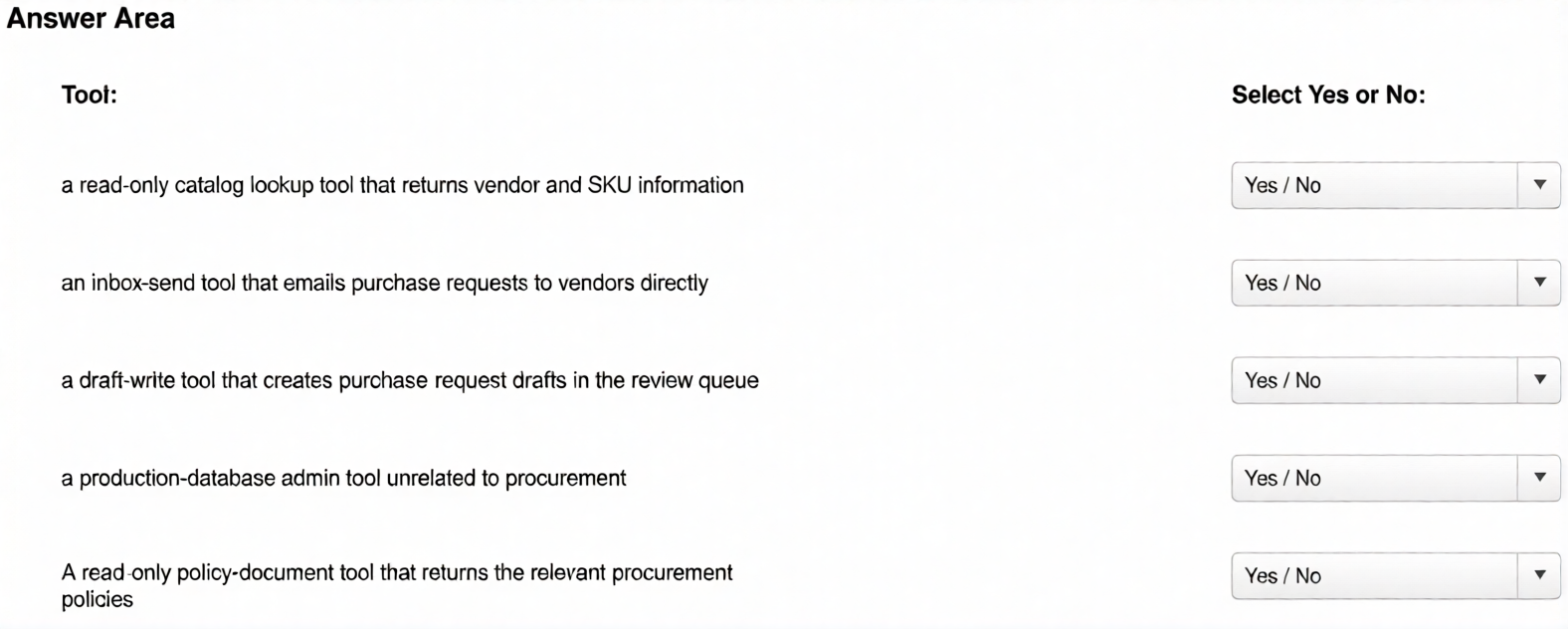
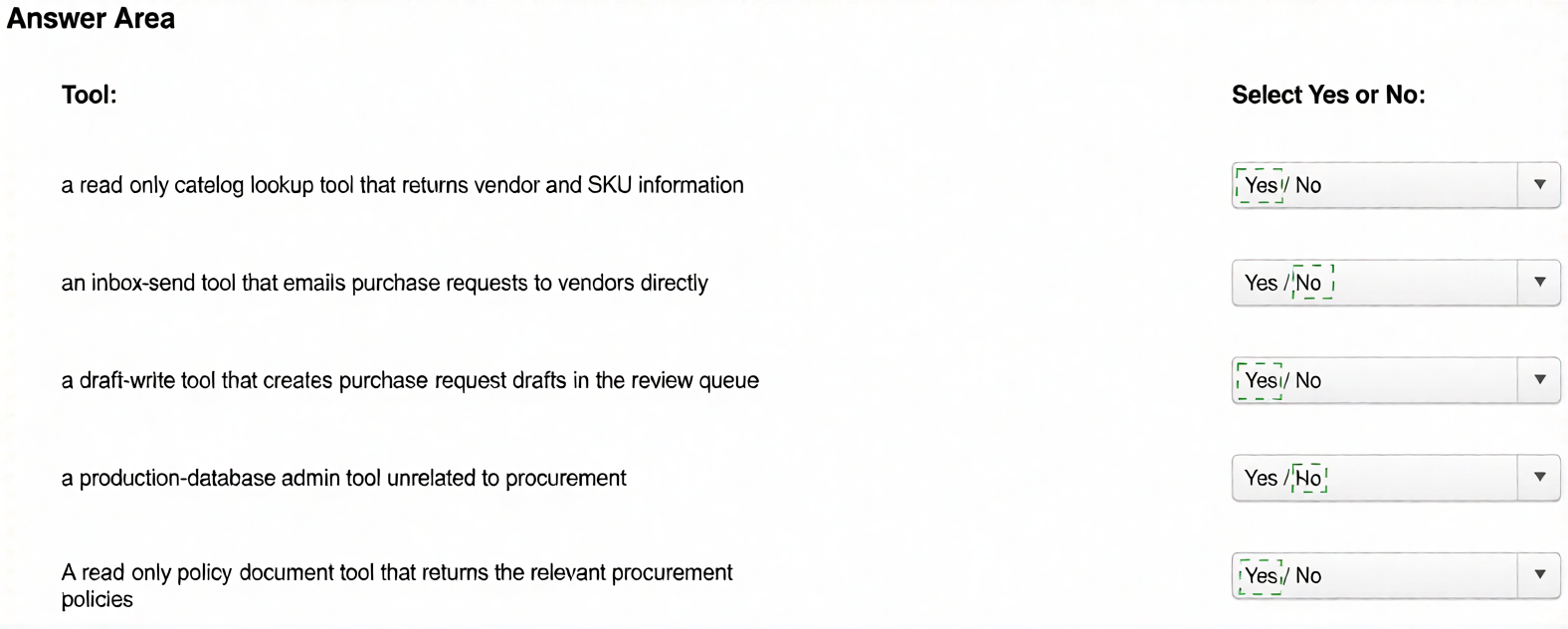
You are auditing a procurement-assistant agent whose defined responsibility is to draft purchase requests for review. For each tool currently configured on the agent, select yes if the tool should remain after a least-privilege audit. Otherwise, select no if it should be removed
Show answerHide answer

Explanation


Explanation:

The agent's defined responsibility is strictly to draft purchase requests for review, so every retained tool must be necessary for this task and limited to the minimum action level required.

- Yes for the read-only catalog lookup and read-only policy-document tools: the agent needs vendor/SKU data and procurement rules to prepare an accurate, compliant draft .

- Yes for the draft-write tool: it writes only into the review queue, preserving the required human approval boundary .

- No for the inbox-send tool: sending directly to vendors converts a drafting assistant into an externally acting purchasing agent and bypasses review .

- No for the production-database admin tool: it is unrelated to procurement and introduces unnecessary destructive capability and privilege-escalation exposure .

Why the other options are not correct:

The inbox-send tool exceeds the stated responsibility because it performs execution rather than drafting. The production-database admin tool violates least privilege because it is unrelated to the defined task and carries destructive capability. Anthropic's prompt-injection guidance likewise recommends limiting sensitive actions and applying least privilege so that a compromised agent can cause minimal damage .

References:

- CCAR-P Domain 4: human-in-the-loop design for high-stakes actions and least-privilege tool scoping .

That's the last free question in Governance, Safety and Risk Management

You've seen the free 30% (10 of 36 questions). Full access unlocks every question and full-length CCAR-P mock exams (63 questions, 120 minutes), a different mock on every attempt.

Unlock full mock exam
Full mock exam

Sit the CCAR-P exam before exam day

Full-length mocks with the same number of questions and the same time limit as the real CCAR-P exam. Every attempt draws a new set of questions from the full bank, so you can keep going until you pass comfortably.

Get full CCAR-P mock exam
  • 63questions per mock
  • 120 mintime limit
  • 129questions in the bank
  • Newmock on every attempt