Anthropic certification · Exam CCAR-P

CCAR-P Mock Exam

Claude Certified Architect - Professional

Free CCAR-P questions on Claude Models, Prompting and Context Engineering, each with the answer and an explanation.

20 questions · 39 minutes · free, no sign-up

Claude Models, Prompting and Context Engineering questions

1–3 of 3 free
Question 1 Choose 1
You are designing the prompt for a ticket-triage classifier with thirty well-defined categories and clear category descriptions in the prompt. Which technique is most appropriate as the starting point?
Show answerHide answer

Correct answer: B A zero-shot prompt that specifies the categories with their descriptions and the required output format.

Explanation

Explanation:

The scenario describes a classification task with thirty well-defined categories and clear category descriptions. This is an ideal case for a zero-shot prompt.

When the categories and their definitions are explicitly provided in the prompt, the model has all the necessary context to perform the classification without needing examples (few-shot prompting) or complex reasoning steps. Anthropic's prompt engineering guidance recommends starting with the simplest approach: clearly define the task, provide the category descriptions, and specify the desired output format (e.g., strict JSON or a single category label). This minimizes token usage and latency while maximizing consistency.

Why the other options are incorrect:

A (Chain-of-thought) is unnecessary here. Routing a ticket into one of thirty defined categories is a direct classification task, not a multi-step logic puzzle. CoT would add latency and token cost without improving accuracy.

C (Inventing new categories) violates the constraint of a defined taxonomy. A classifier must map to the provided set, not hallucinate new labels.

D (No category descriptions) would force the model to guess the meaning of the categories, inevitably leading to misclassifications and inconsistent outputs.

References:

- Anthropic prompt engineering guidance: Start with clear instructions, explicit definitions, and desired output formats; use zero-shot when the task and categories are well-defined.
Question 2 Choose 2
You are selecting a model for a new production workload and must complete the upstream steps before testing candidate models empirically. Which two steps must be completed BEFORE running a representative sample on a candidate model? (Select two.) Each correct answer presents part of the solution.
Show answerHide answer

Correct answer: C, D Choose a candidate model based on the requirements profile and known capabilities. Define the quality bar, latency tolerance, and expected volume for the workload.

Explanation

Explanation:

The question asks for the two steps that must be completed before running a representative sample on a candidate model. This corresponds to the upstream requirements-definition and candidate-selection phases of model selection, which must precede empirical testing.

Option D (Define the quality bar, latency tolerance, and expected volume for the workload) is the foundational prerequisite. You cannot meaningfully test a candidate model without first knowing what "good enough" means. Anthropic's model selection guidance explicitly recommends establishing key criteria first: capability, speed, cost, and effort . Without defined thresholds for quality, latency, and volume, test results have no interpretive context—you cannot determine whether a model passed or failed.

Option C (Choose a candidate model based on the requirements profile and known capabilities) is the direct next step after requirements are defined. Anthropic offers two directional approaches: efficiency-first (start with the cheapest model that might work) or capability-first (start with the strongest model and optimize downward) . Either way, the candidate model must be selected based on the requirements profile before empirical testing begins. Testing a randomly chosen model without this alignment wastes evaluation effort.

Why the other options are incorrect:

- A (Select the lightest model that consistently meets the quality bar) is a downstream outcome of empirical testing, not a prerequisite. You only know which model "consistently meets the bar" after running the representative sample.

- B (Retest when a new model version becomes available) is a post-deployment lifecycle activity, not a pre-testing step. Model version tracking and retesting occur after the initial selection is made and production is running .

- E (Sign off the production rollout plan) is a governance step that occurs after evaluation confirms the model meets requirements, not before testing.

References:

- Anthropic model selection: establish capability, speed, cost, and effort criteria first; then choose a starting model via efficiency-first or capability-first approach .

Question 3
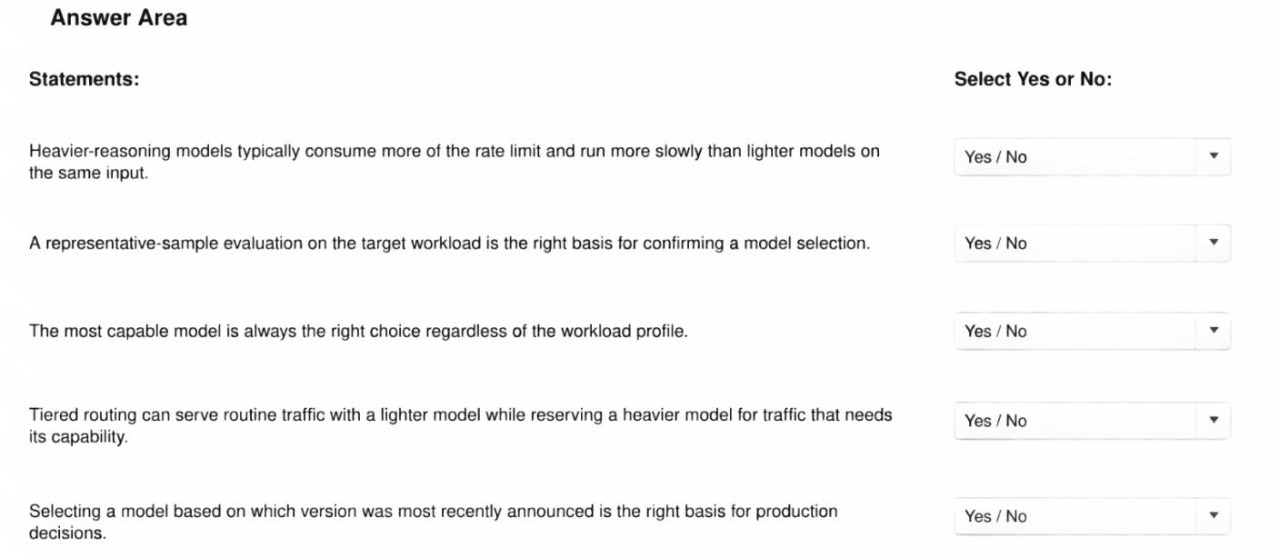
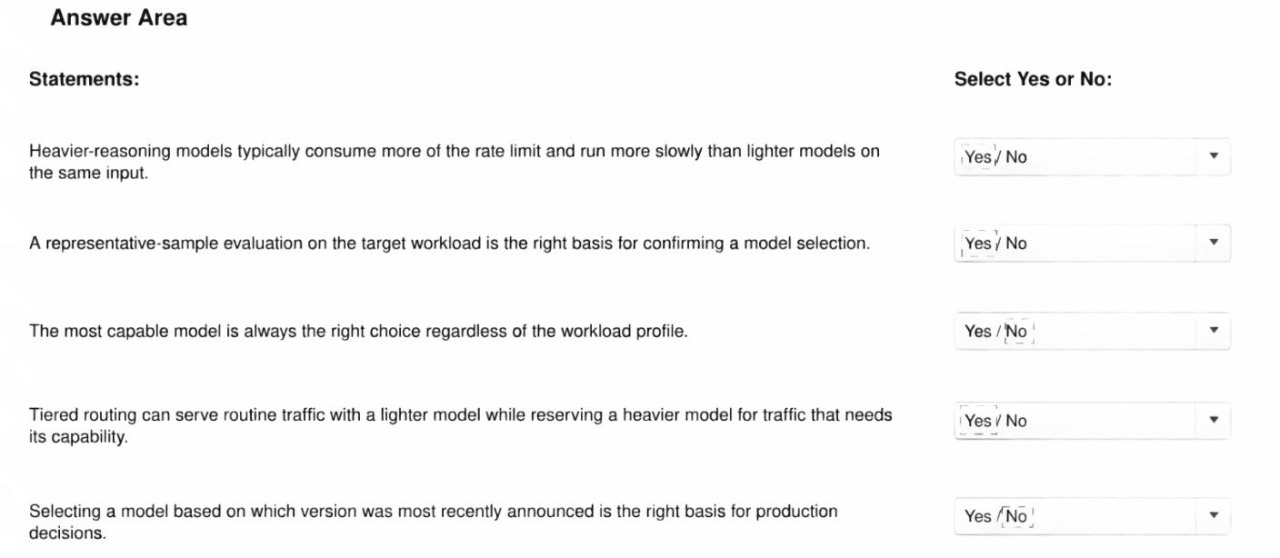
You are evaluating model-selection claims used by a peer team. For each statement, select yes if the statement is generally true. Otherwise, select no.
Show answerHide answer

Explanation


Explanation:

- Heavier-reasoning models consume more rate limit and run slower (Yes): Larger models require more compute per token, which translates to higher latency and greater token consumption against rate limits. Anthropic's guidance explicitly notes that Opus uses "meaningfully more of your quota" than Sonnet, and Sonnet more than Haiku .

- Representative-sample evaluation is the right basis for confirming model selection (Yes): Anthropic recommends testing candidate models against "20-30 examples from your actual workload" rather than relying on general benchmarks, because public benchmarks rarely reflect specific use-case requirements .

- Most capable model is always the right choice (No): Model selection is a trade-off between capability, speed, and cost. Anthropic explicitly recommends starting with a smaller model and scaling up only if quality falls short, to avoid "overpaying for capability you don't need" .

- Tiered routing serves routine traffic with a lighter model (Yes): Anthropic documents this pattern: a common approach is to "plan with Opus and execute with Sonnet," and Haiku is recommended for "quick lookups, simple edits, or high-volume scripted runs" .

- Newest announced version is the right basis for production decisions (No): Model selection must be driven by empirical evaluation against the workload's requirements profile (quality, latency, cost), not by recency of announcement. Anthropic's guidance consistently emphasizes testing against actual use cases before committing to a model .

Why the other options are not correct:

The "most capable always" and "newest announced" statements fail because they ignore the fundamental trade-off between capability, latency, and cost. A model that is more capable but slower and more expensive may be the wrong architectural choice for high-volume, latency-sensitive tasks .

References:

- Anthropic model selection: establish criteria (capabilities, speed, cost, effort) first; start efficiency-first or capability-first based on workload profile .

That's the last free question in Claude Models, Prompting and Context Engineering

You've seen the free 30% (3 of 11 questions). Full access unlocks every question and full-length CCAR-P mock exams (63 questions, 120 minutes), a different mock on every attempt.

Unlock full mock exam
Full mock exam

Sit the CCAR-P exam before exam day

Full-length mocks with the same number of questions and the same time limit as the real CCAR-P exam. Every attempt draws a new set of questions from the full bank, so you can keep going until you pass comfortably.

Get full CCAR-P mock exam
  • 63questions per mock
  • 120 mintime limit
  • 129questions in the bank
  • Newmock on every attempt