Antibodies in the Rh system typically exhibit which one of the following characteristics?
Show answerHide answer
Correct answer: AReacts best at 37ºC and AHG
Question 32Choose 1
The correct answer which best fits the characteristics in this question is Mycobacterium
kansasii.
The remaining Mycobacterium strains can be elimated as:
Mycobacterium marinum is considered a fast-grower.
Mycobacterium scrofulaceum produce deep-yellow to orange pigmented colonies when
grown in the either the light or dark.
Mycobacterium avium grows colonies which are nonpigmented in the light and dark which
do not intensify after light exposure.
What is the MOST likely identification of an acid-fast bacillus that demonstrates the
following characteristics?
Slow growth cream to tan colored colonies when grown in the dark
development of yellow pigment upon exposure to light.
Show answerHide answer
Correct answer: AMycobacterium kansasii
Question 33Choose 1
Allergen-specific IgE, synthesized in response to allergens, becomes fixed to receptors on
cellular membranes, especially those of basophils. If these receptor-bound IgE molecules
are aggregated on re-exposure to specific allergen, both mast cells and basophils produce
mediators that result in the allergic response. IgE-antigen interaction at the cell surface
causes degranulation of cells and release of substances including: histamine, SRS-A,
platelet activator, a kallikrein, and an eosinophil chemotactic factor. Basophils are the
principal cells that bind IgE antibody while their number of receptor sites is proportional to
serum IgE levels. Eosinophils are drawn to the site by the basophil chemotaxis mechanism,
but are not the main cell which binds the IgE antibody.
Immunology
The mediator cells that bind MOST to IgE antibodies are:
Show answerHide answer
Correct answer: ABasophils
Question 34Choose 4
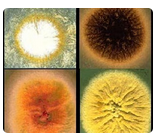
Micro - Matching
1. Upper left image
Multi-celled, rough walled macroconidia with a tapered terminal cell
2. Upper right image
Dense aggregates of echinulate, brown-black conidia
3. Lower left image
Loose clusters of elliptical conidia arranged in a "diphtheroid" pattern
4. Lower right image
Chains of large, lemon-shaped annelloconidia
Show answerHide answer
Correct answer: A, B, C, DAspergillus niger
Microsporum canis
Scopulariopsis species
Acremonium species
Question 35Choose 1
In DIC, or disseminated intravascular coagulation, the prothrombin time is increased due to
the consumption of the coagulation factors due to the tiny clots forming throughout the
vasculature. This is also the reason that the fibrinogen levels and platelet levels are
decreased. Finally FDP, or fibrin degredation products, are increased due to the formation
and subsequent dissolving of many tiny clots in the vasculature. The FDPs are the pieces
of fibrin that are left after the fibrinolytic processes take place.
Which of the following laboratory results would be seen in a patient with acute
Disseminated Intravascular Coagulation (DIC)?
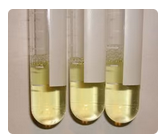
The term that is used to describe the color in these tubes of CSF is "xanthochromia."
Xanthochromia is an abnormal color, usually yellow, orange, or pink, in the supernatant of
the CSF sample. It may indicate that a subarachnoid hemorrhage (SAH) has occurred.
Jaundice and icterus both describe a yellowing of the skin, mucous membranes, and eyes.
Blood plasma/serum that is deep yellow is also described as icteric.
What term is used to describe the color in these tubes of cerebrospinal fluid (CSF)?
Show answerHide answer
Correct answer: BXanthochromia
Question 37Choose 1
The combination of complement C4, C2 and C3 that binds to the antigen-antibody complex
in the initial reaction step in the classical pathway of complement activation is called the
activation unit.
Which of the following is the "activation unit" in the classical complement pathway?
Show answerHide answer
Correct answer: CC4, C2, C3
Question 38Choose 3
Certain recipients have increased risk for developing TA-GVHD. They are:
Neonates less than 4 months of age
Fetuses
Recipients with a congenital or acquired immunodeficiency, such as bone marrow or stem
cell recipients, and patients receiving chemotherapy
recipients of donor units from a blood relative.
Which of the following patients are at risk for transfusion-associated graft versus host
disease (TA-GVHD) and require irradiated cellular blood products? (Choose all that apply)
Show answerHide answer
Correct answer: A, B, DNeonates less than 4 months of age
Recipients of donor units known to be from a blood relative.
Patient receiving chemotherapy who are immunocompromised.
Question 39Choose 1
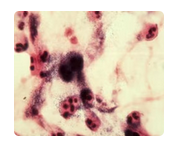
This Gram stain is under-decolorized.
This microscopic field is representative of other fields that were observed on a Gramstained
smear. Which of the following describes the quality of the smear?
Show answerHide answer
Correct answer: AUnder-decolorized
Question 40Choose 1
21 CFR 606.65 states, "Supplies and reagents shall be used in a manner consistent with
instructions provided by the manufacturer."
The correct answer is A. The reagents must be used according to the manufacturer's
instructions for use. If the instructions say one or two drops may be used and the facility
procedures also allow one or two drops, then there is no problem with the staff members
choosing to use two drops.
While equipment must be calibrated, it does not generally influence the number of drops
used.
Staff members often ask co-workers and colleagues from other facilities how to perform
tasks, but it is the manufacturer's instructions for the operation of equipment and the use of
reagents that must be followed.
A laboratory employee who is performing an internal audit of routine ABO and Rh typing
procedures notes that a technologist places two drops of Anti-D in a tube, centrifuges the
tube for 20 seconds, and reads the reaction using a magnifying mirror. When questioned
about the procedure, the technologist indicates that most staff use two drops of Anti-D
reagent because the reactions are stronger with two drops. In addition to reviewing the
facility procedure manual, what should be done to ensure regulatory compliance?
Show answerHide answer
Correct answer: AReview the anti-D manufacturer's current instructions for use.
Full mock exam
Sit the ASCP-MLT exam before exam day
Full-length mocks with the same number of questions and the same time limit as the real ASCP-MLT exam. Every attempt draws a new set of questions from the full bank, so you can keep going until you pass comfortably.