Confirmed cases of H1N1 virus have been reported more often in children and younger
adults than in any other age group.
Micro
The age groups that have been most affected by the H1N1 virus are children and younger
adults.
Show answerHide answer
Correct answer: Atrue
Question 62Choose 1
One agency that accredits education programs for clinical laboratory personnel is the:
Show answerHide answer
Correct answer: CNational Accrediting Agency for Clinical Laboratory Sciences (NAACLS)
Question 63Choose 1
Donor and recipient blood samples (samples utilized for pre-transfusion compatibility
testing) must be kept for at least 7 days after transfusion. Blood samples must be available
to investigate a transfusion reaction, if necessary.
Donor and recipient blood samples must be kept for at least how long after transfusion?
Show answerHide answer
Correct answer: B7 days
Question 64Choose 1
Refrigerated temperatures, those close to 4 ºC, are recommended for the preservation of enzyme activity in a patient sample.
Chemistry
The recommended storage temperature for the preservation of activity for MOST enzymes
is:
Show answerHide answer
Correct answer: B4 ºC
Question 65Choose 1
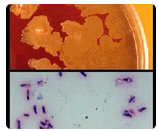
The clue to the identification of the colony seen in the upper frame is the gram stain in the
lower frame, in which are seen short, rounded, gram positive bacilli, many of which
possess distinct spores. As the colonies grew aerobically, the presence of spores indicates
Bacillus species. The colonies are spreading, smooth, yellow-white and non-hemolytic. The
lack of hemolysis and the small size of the bacterial cells suggests a species other than
Bacillus cereus, the species causing most human infections. The isolate was identified as
Bacillus circulans, which is consistent with the gram stain morphology. Clostridium
septicum also produces spores; however, this species is an anaerobe and would grow
poorly if at all and not produce spores aerobically. Listeria monocytogenes and
Lactobacillus species are gram positive bacilli; however, neither of these produce spores.
The colonies seen in the upper frame, grown after 48 hours incubation aerobically at 35°C,
and the accompanying gram stain in the lower frame are uncommonly associated with
human disease, but have been associated with septicemia, bronchopneumonia,
osteomyelitis and other infections, particularly in intravenous drug users. The most likely
identification is:
Show answerHide answer
Correct answer: BBacillus circulans
Question 66Choose 1
"Universal donor", (a misnomer) is usually applied to group O, Rh negative blood. Although
it may be necessary to use group O, Rh negative blood in an extreme emergency, it is
preferable to use type specific blood for emergencies.
In an extreme emergency , if the ABO and Rh type are unknown which of the following
should be given to the patient?
Show answerHide answer
Correct answer: CGroup O, Rh negative blood
Question 67Choose 1
hs-CRP is a recent marker of chronic inflammation. New measurements of CRP in lower
levels (hs-CRP) are now measured to monitor risk of cardiovascular disease.
Select the statement that best describes hs-CRP?
Show answerHide answer
Correct answer: Chs-CRP is a marker of chronic inflammation and measured to predict the risk of
cardiovascular disease
Question 68Choose 4
Measures Light scatter by particles - Nephelometer
Measures change in vapor pressure - Osmometer
Measures amount of electricity passing between two electrodes - Coulometry
Measures absorbance of light at a specific wavelength - Spectrophotometer
Lab operations
Matching
1. Measures Light scatter by particles
2. Measures change in vapor pressure
3. Measures amount of electricity passing between two electrodes
4. Measures absorbance of light at a specific wavelength
Show answerHide answer
Correct answer: A, B, C, DCoulometry
Nephelometer
Spectrophotometer
Osmometer
Question 69Choose 1
Unconjugated bilirubin is a byproduct of RBC breakdown, or hemolysis. It would be
expected to see an increase in unconjugated bilirubin when hemolysis is occuring at an
increased rate. The liver enzymes would not remain at normal levels if there were a viral
infection of the liver, chemical damage to the liver, or obstruction of bile ducts.
Chemistry
A patient presents with an elevation of unconjugated bilirubin, normal serum alkaline
phosphatase, normal liver enzymes, and no bilirubin in the urine. This combination would
suggest:
Show answerHide answer
Correct answer: CIncreased rate of hemolysis
Question 70Choose 1
HLA-DR is a class II MHC.
HLA-A, HLA-B, and HLA-C are all class I MHC.
Which of the following antigens is classified as a Major Histocompatibility Complex
Class II antigen (MHCII)?
Show answerHide answer
Correct answer: DHLA-DR
Full mock exam
Sit the ASCP-MLT exam before exam day
Full-length mocks with the same number of questions and the same time limit as the real ASCP-MLT exam. Every attempt draws a new set of questions from the full bank, so you can keep going until you pass comfortably.