Microsoft certification · Exam AB-620

AB-620 Mock Exam Page 3

Designing and Building Integrated AI Agent Solutions in Copilot Studio

Free AB-620 questions on Topic 3, Mix Questions, each with the answer and an explanation.

20 questions · 30 minutes · free, no sign-up

Topic 3, Mix Questions questions

21–22 of 22 free
Question 21
A team has deployed an agent in Copilot Studio and needs to evaluate whether the agent is meeting its intended goals before expanding usage to a broader audience. The team must evaluate agent performance using a structured and repeatable approach that produces actionable insights. You need to select and apply an appropriate evaluation method by performing the required actions in the correct order. In which order should you perform the actions? To answer, move all actions from the list of actions to the answer area and arrange them in the correct order.
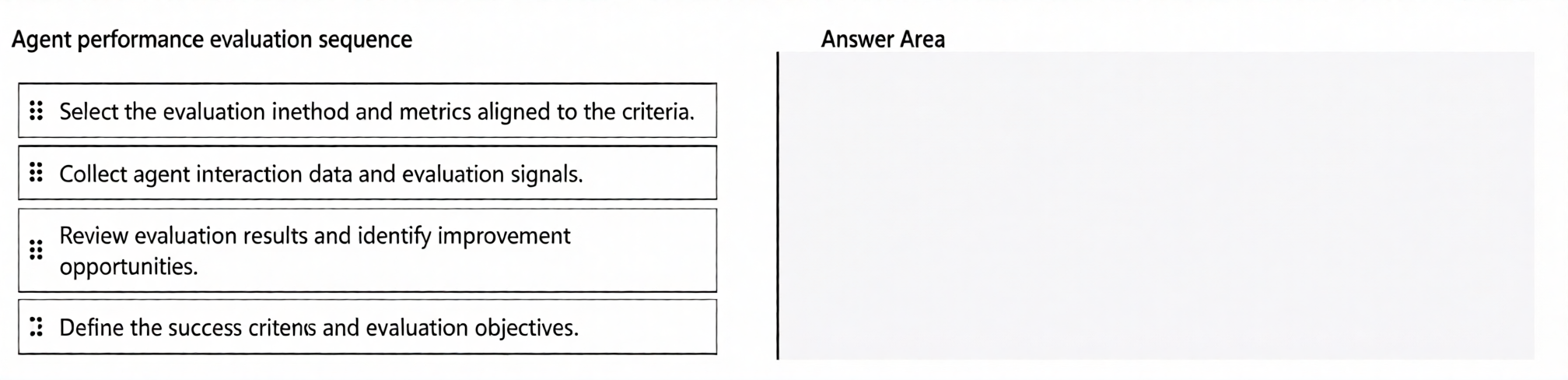
Show answerHide answer

Explanation
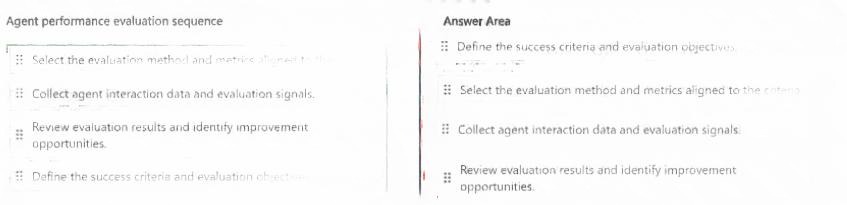


Explanation:

The correct order follows the standard evaluation lifecycle: define goals, choose methods, collect data, and analyze results.

1. Define the success criteria and evaluation objectives – Before evaluating anything, you must establish what "success" means for the agent. This includes defining the intended goals, target behaviors, and the objectives of the evaluation (e.g., accuracy, grounding, task completion, user satisfaction). Without clear criteria, evaluation lacks direction and measurable outcomes.

2. Select the evaluation method and metrics aligned to the criteria – Once success criteria are defined, you choose the appropriate evaluation method (e.g., test sets, comparative scoring, qualitative review) and the metrics that align with those criteria (e.g., groundedness, relevance, intent match rate, fallback rate). This ensures the evaluation measures what matters.

3. Collect agent interaction data and evaluation signals – With the method and metrics in place, you run the evaluation to collect data. This includes executing predefined test sets, capturing agent responses, recording evaluation signals (scores, citations, grounding status), and gathering any relevant telemetry or analytics.

4. Review evaluation results and identify improvement opportunities – Finally, you analyze the collected data to identify strengths, weaknesses, regressions, and areas for improvement. This step produces actionable insights that drive iterative enhancements to the agent before expanding usage.

❌ Why Other Orders Are Incorrect:

* Placing Select the evaluation method before Define the success criteria would mean choosing metrics without knowing what you are measuring against, leading to misaligned or irrelevant evaluation.
* Placing Collect agent interaction data before Select the evaluation method would result in unstructured data collection with no framework for scoring or comparison.
* Placing Review evaluation results before Collect agent interaction data is impossible because there would be no data to review.
* Defining criteria after collecting data would make the evaluation retrospective and unfocused, violating the requirement for a structured, repeatable approach.

📚 References:

* Microsoft Learn – Evaluate agents in Copilot Studio – Describes the evaluation lifecycle: define objectives, select methods, collect data, and review results.

Question 22
A company uses an agent in Copilot Studio to answer questions based on enterprise content The content is indexed in Azure AI Search. Responses must be generated by a Microsoft Foundry model. To meet the business needs, the solution must meet the following requirements: Users must be able to trace each answer back to its source. The agent must retrieve information from a centralized data index. Responses must be generated by an enterprise-approved foundation model. You need to configure generative answers for the agent. What should you configure for each requirement? To answer, move the appropriate configurations to the correct requirements. You may use each configuration once, more than once, or not at all. NOTE: Each correct selection is worth one point.
Show answerHide answer

Explanation


Explanation:

Each requirement maps to a specific configuration in Copilot Studio for generative answers grounded in enterprise content.

Users must be able to trace each answer back to its source → Instruct the agent to cite sources in knowledge settings – Enabling source citations in the knowledge settings ensures that each generated answer includes references to the source documents or data used. This provides traceability, allowing users to verify the origin of the information and trust the response.

The agent must retrieve information from a centralized data index → Configure Azure AI Search as the grounding data source – Azure AI Search provides a centralized, indexed repository of enterprise content. By configuring it as the grounding data source, the agent queries this index to retrieve relevant information for generating responses. This ensures responses are based on the organization's curated and indexed knowledge.

Responses must be generated by an enterprise-approved foundation model → Deploy a model in Foundry to an agent and connect to Copilot Studio – To ensure responses are generated by an approved foundation model, you deploy the model in Microsoft Foundry and connect it to Copilot Studio. This allows the agent to use the Foundry-hosted model for generative answers, meeting the enterprise governance requirement for model approval.

❌ Why Other Configuration Is Incorrect:

Upload documents directly into the agent – Uploading documents directly does not use a centralized index (Azure AI Search) and does not leverage an enterprise-approved Foundry model. It is a simpler approach suitable for small-scale, ad-hoc knowledge but does not meet the stated enterprise requirements for centralized indexing, traceability, or model governance.

📚 References:

Microsoft Learn – Use Azure AI Search as a knowledge source – Explains configuring Azure AI Search for centralized retrieval.

That's the last free question in Topic 3, Mix Questions

You've seen the free 30% (22 of 75 questions). Full access unlocks every question and full-length AB-620 mock exams, a different mock on every attempt.

Unlock full mock exam
Full mock exam

Sit the AB-620 exam before exam day

Full-length mocks with the same number of questions and the same time limit as the real AB-620 exam. Every attempt draws a new set of questions from the full bank, so you can keep going until you pass comfortably.

Get full AB-620 mock exam
  • —questions per mock
  • —time limit
  • 93questions in the bank
  • Newmock on every attempt
