Microsoft certification · Exam AB-620

AB-620 Mock Exam Page 2

Designing and Building Integrated AI Agent Solutions in Copilot Studio

Free AB-620 questions on Topic 3, Mix Questions, each with the answer and an explanation.

20 questions · 30 minutes · free, no sign-up

Topic 3, Mix Questions questions

11–20 of 22 free
Question 11
A company is building an agent topic in Copilot Studio. The agent topic uses a generative answers node to respond to user questions based on authorized knowledge sources.
To meet the business needs, the generative answers node must meet the following requirements:
Use the user ' s message in the generative answers node.
Scope the topic node to query only designated data.
Restrict responses to approved enterprise data.
Show answerHide answer

Explanation



Explanation:

Each requirement maps to a specific configuration within the generative answers node settings.

Use the user's message in the generative answers node → Select Activity.Text in the Input field – The Input field in the generative answers node defines what text is used as the query for knowledge retrieval. Selecting Activity.Text ensures that the user's message (their typed input) is used as the query, allowing the agent to respond directly to what the user asked.

Scope the topic node to query only designated data → Select Search only selected sources – The "Search only selected sources" option restricts the generative answers node to query only the knowledge sources explicitly selected for that node. This ensures the node does not pull from all available sources but only from the designated, authorized data sets.

Restrict responses to approved enterprise data → Clear Allow the AI to use its own general knowledge – By default, generative answers may use the AI model's general knowledge to supplement responses. Clearing "Allow the AI to use its own general knowledge" ensures that responses are grounded exclusively in the configured enterprise knowledge sources, preventing the AI from generating answers based on unapproved or external information.

❌ Why Other Configuration Is Incorrect:

Enable generative orchestration for the agent – Generative orchestration is an agent-level setting that allows the agent to dynamically select tools and knowledge sources. It is not a node-level configuration for controlling input, source scoping, or restricting responses to enterprise data. It does not directly address any of the three requirements.

📚 References:

* Microsoft Learn – Generative answers node in Copilot Studio – Explains the Input field, source selection, and general knowledge settings.
Question 12 Choose 1
A company is configuring an agent in Copilot Studio that uses a generative answers node inside multiple topics.
The company requires responses to meet the following requirements.
• Must use an executive summary format
• Must apply only within a specific topic.
• Must continue using configured knowledge sources.
• Must comply with connector security controls.

You need to configure a custom prompt to meet the formatting requirements
Solution: Create a custom prompt tool in the specific topic that instructs the model to respond using anexecutive-summary structure. Does the solution meet the goal?
Show answerHide answer

Correct answer: B No

Explanation

Explanation:

The proposed solution does not meet the goal because creating a custom prompt tool in the topic does not replace or integrate with the generative answers node's knowledge grounding and connector security controls.

The requirements state that the agent must:

1. Use an executive summary format.
2. Apply the formatting only within a specific topic.
3. Continue using configured knowledge sources.
4. Comply with connector security controls.

A custom prompt tool is a separate AI action that generates text based on the prompt. While it can enforce an executive summary format, it does not:

* Retrieve or ground responses in the configured knowledge sources.
* Honor the connector security controls that govern knowledge source access.
* Integrate with the generative answers node's grounding logic.

By using a custom prompt tool instead of modifying the generative answers node's prompt, the agent would generate responses without grounding in enterprise knowledge, violating the requirement to continue using configured knowledge sources. The correct approach is to add a prompt modification directly in the generative answers node settings for the specific topic. This preserves knowledge grounding, enforces the executive summary format, scopes the change to the topic, and maintains connector security controls.

❌ Why Option A Is Incorrect:

A. Yes – The solution does not meet the goal. A custom prompt tool cannot replace the generative answers node's knowledge grounding and connector security enforcement. Without these, responses would not comply with the company's requirements.

📚 References:

* Microsoft Learn – Prompt modifications in Copilot Studio – Explains how to add custom prompt instructions to generative answers nodes while preserving knowledge grounding and connector security.
Question 13 Choose 2
An agent in Copilot Studio must retrieve real-time data from an external system. The external system exposes a REST API. The API returns structured JSON data and requires authentication. The agent must: Call the API during conversations to fulfil user requests. Retrieve real-time data from the external system by calling an authenticated REST API during a conversation. The solution must use a supported mechanism that executes the REST API call, and the call must be explicitly configured to run at runtime. You need to determine which approaches add the REST API to the agent. Which two solutions meet the goal? Each correct answer presents a complete solution. NOTE: Each correct selection is worth one point.
Show answerHide answer

Correct answer: B, D Add the REST API as a tool and call it by using a topic or agent instruction. Configure an HTTP action and invoke it from a topic during the conversation.

Explanation

Explanation:

To retrieve real-time data from an external system via an authenticated REST API during conversations, you must use a mechanism that explicitly executes the API call at runtime. Copilot Studio supports two primary approaches for this:

B. Add the REST API as a tool and call it by using a topic or agent instruction – Copilot Studio allows you to add external APIs as tools (via custom connectors, Power Platform connectors, or MCP servers). Once added, the tool can be invoked from a topic (using a tool node) or through agent instructions (with generative orchestration). This explicitly configures the REST API call to run at runtime and supports authentication through the connector configuration.

D. Configure an HTTP action and invoke it from a topic during the conversation – The HTTP action (or "Call an HTTP endpoint" action) in Power Automate or Copilot Studio allows you to make authenticated REST API calls. By invoking it from a topic, you explicitly control when the API is called during the conversation. The HTTP action supports headers, authentication, request bodies, and parsing of structured JSON responses.

❌ Why Other Options Are Incorrect:

A. Create a global variable to store the API URL and call it by using a Redirect node – A Redirect node is used to redirect the conversation to another topic or URL; it does not execute API calls. Storing the URL in a variable does not invoke the API.

C. Enable generative answers and rely on the model to fetch the REST API data automatically – Generative answers nodes retrieve from configured knowledge sources (documents, indexed content), not from live REST APIs. The model cannot dynamically call an authenticated REST API on its own. This does not meet the requirement for real-time, authenticated data retrieval.

E. Add the REST API as a knowledge source so the agent can query it during conversations – Knowledge sources are used for grounding responses in static or indexed content. They do not support real-time, authenticated API calls. This approach would not return live data.

F. Create a topic variable and use a formula to parse the API endpoint string – Variables and formulas are used for data manipulation within the agent, not for executing API calls. This does not invoke the REST API or retrieve real-time data.

📚 References:

* Microsoft Learn – Add tools to an agent in Copilot Studio – Explains how to add REST APIs as tools and invoke them from topics.
Question 14
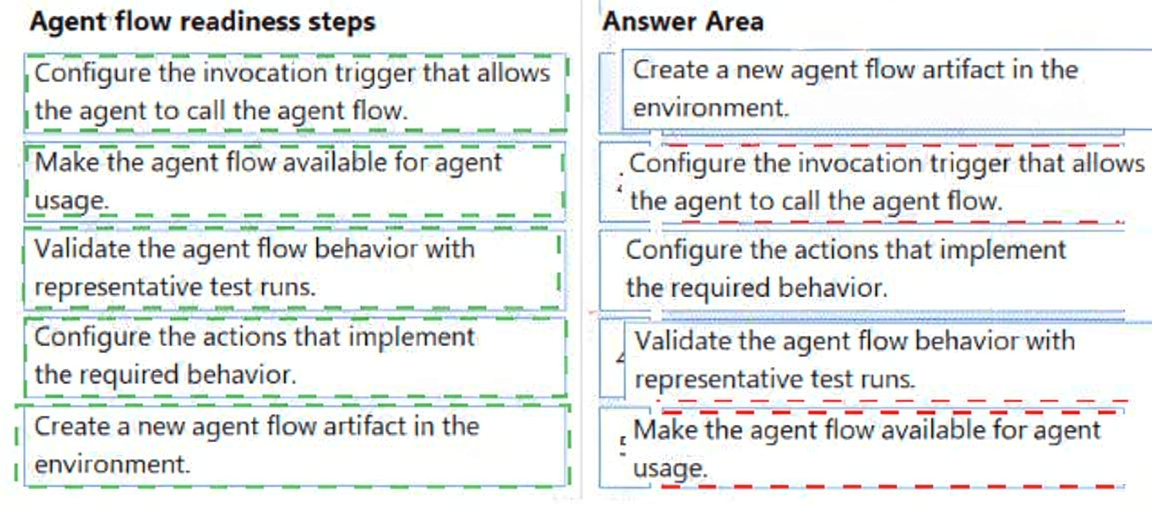
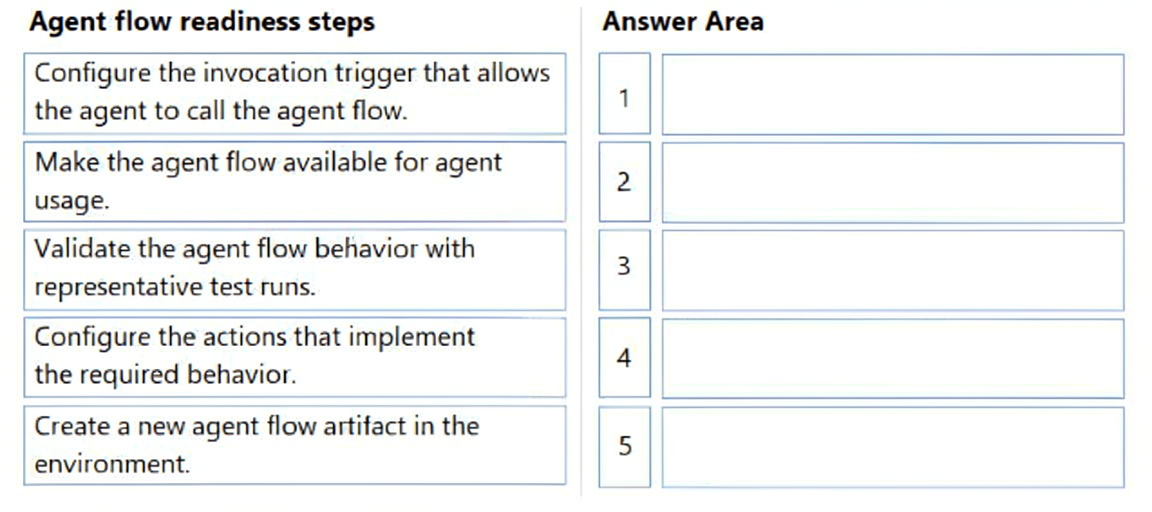
A company is preparing an agent flow so that it can be invoked by an agent during conversations. The agent flow must meet the following requirements:
The agent must be able to trigger the flow.
The agent flow must be verified.
You need to prepare an agent flow so that it can be used by the agent.
In which order should you perform the actions to prepare the agent flow? To answer, move all actions from
the list of actions to the answer area and arrange them in the correct order.
Show answerHide answer

Explanation


Explanation:

The correct order follows the standard development lifecycle for building and deploying an agent flow: create, configure trigger, build logic, test, and publish.

1. Create a new agent flow artifact in the environment – The first step is to create the agent flow artifact. This establishes the flow container in the Power Platform environment where all subsequent configuration will occur. Without creating the flow first, no other actions can be performed.

2. Configure the invocation trigger that allows the agent to call the agent flow – The invocation trigger defines how the agent will call the flow during a conversation. This must be configured before the flow's internal logic, because it establishes the contract (inputs and invocation method) that the agent will use to trigger the flow.

3. Configure the actions that implement the required behavior – Once the trigger is defined, you add the actions that implement the flow's business logic (e.g., API calls, data operations, conditional branches). This step builds the actual functionality that the flow will execute when invoked.

4. Validate the agent flow behavior with representative test runs – Before making the flow available to the agent, you must test it with representative inputs to verify that it behaves as expected. This ensures correctness and catches errors before the flow is exposed to users.

5. Make the agent flow available for agent usage – The final step is to publish or enable the flow so the agent can invoke it during conversations. Until this step, the flow is not accessible to the agent, even if it is fully configured and tested.

❌ Why Other Orders Are Incorrect:

Placing validation before configuration would be impossible—there is nothing to test until the actions are configured. Placing make available before validation would expose an untested flow to users, violating the requirement that the flow must be verified. Placing configure trigger after configure actions would define the flow logic without knowing how it will be invoked, making it difficult to design inputs and outputs correctly.

📚 References:

* Microsoft Learn – Create and configure agent flows – Describes the lifecycle for building agent flows.
Question 15
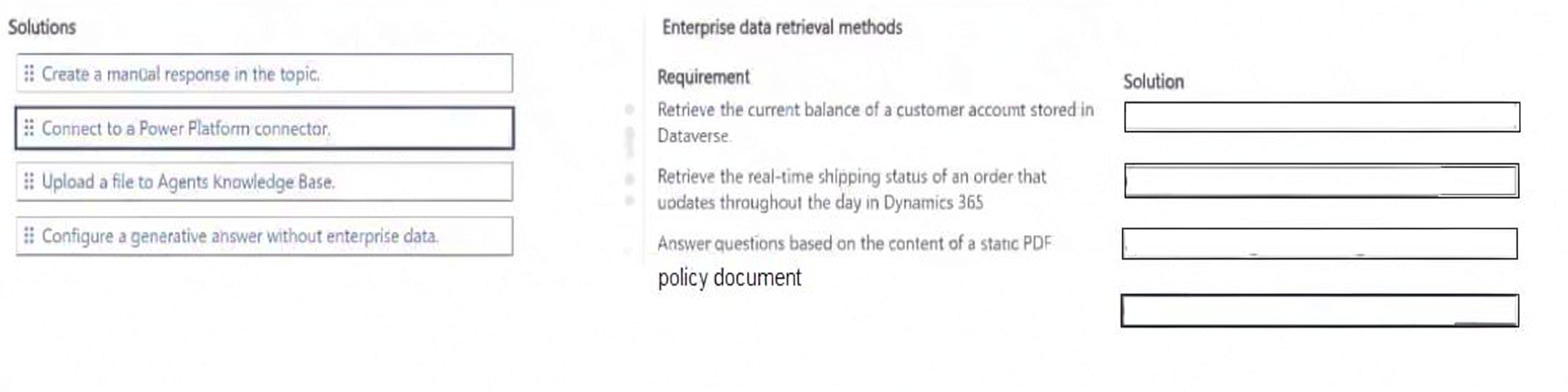
You are configuring an agent in Copilot Studio for an organization. The organization uses Microsoft Dataverse, Dynamics 365, and SharePoint Online. The agent must retrieve information from enterprise systems and internal documents. The agent must meet the following requirements:
* Must retrieve the current balance of a customer account stored in Dataverse.
* Must retrieve the real-time shipping status of an order that updates throughout the day in Dynamics 365.
* Must answer questions based on the content of a static PDF policy document.
* Must provide a welcome message that does NOT depend on enterprise data.
Explanation
Show answerHide answer

Explanation


Explanation:

Each requirement maps to the appropriate data retrieval method based on whether the data is dynamic (real-time), static (document-based), or conversational (no data dependency).

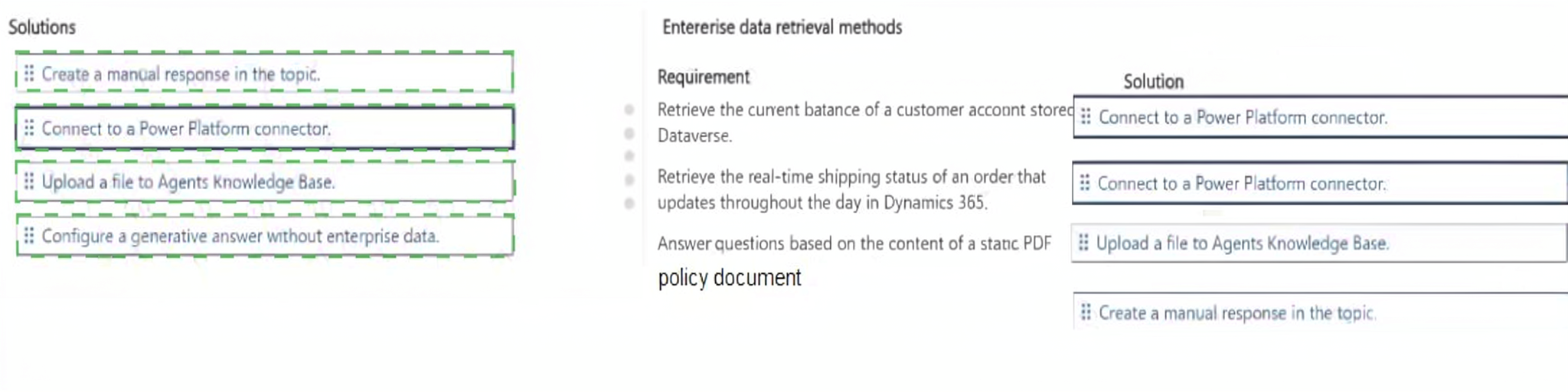
Retrieve the current balance of a customer account stored in Dataverse → Connect to a Power Platform connector – Dataverse stores structured, transactional data. To retrieve a customer's current balance, the agent must query Dataverse in real time. This is achieved by connecting to a  Power Platform connector (such as the Dataverse connector) and invoking an action to fetch the account balance. Connectors provide authenticated, real-time access to structured data.

Retrieve the real-time shipping status of an order that updates throughout the day in Dynamics 365 → Connect to a Power Platform connector – Dynamics 365 stores live operational data that changes frequently. To retrieve real-time shipping status, the agent must query Dynamics 365 in real time. The  Dynamics 365 connector (a Power Platform connector) enables authenticated, real-time retrieval of order status, ensuring the agent always returns current data.

Answer questions based on the content of a static PDF policy document → Upload a file to Agents Knowledge Base – Static documents such as PDFs are best handled by uploading them to the Agents Knowledge Base (knowledge source). The agent indexes the document content and uses generative answers to respond to questions grounded in the document. This is the correct approach for static, document-based knowledge.

Provide a welcome message that does NOT depend on enterprise data → Create a manual response in the topic – A welcome message is a fixed, pre-authored response that does not require data retrieval. Creating a  manual response (e.g., a Message node) in the topic ensures the greeting is delivered consistently without calling any enterprise systems.

❌ Why Other Solutions Are Incorrect:

Configure a generative answer without enterprise data – This option is not a valid solution for any requirement. Generative answers without enterprise data would not retrieve Dataverse balances, Dynamics 365 shipping statuses, or PDF content. It is a distractor option.

📚 References:

* Microsoft Learn – Use Power Platform connectors in Copilot Studio – Explains how to connect to Dataverse and Dynamics 365 for real-time data retrieval.
Question 16 Choose 1
A company is configuring generative answers for an agent in Copilot Studio. The agent must use Azure AI Search to retrieve enterprise content, and all responses must be generated by a Microsoft Foundry model. The agent sometimes generates answers that are not grounded in Azure AI Search content. The company requires that the agent only generate responses when relevant indexed content is retrieved. You need to configure the agent so that its generative answer behavior meets the organization ' s requirements. What should you do?
Show answerHide answer

Correct answer: C Require grounding for generative answers and use Azure AI Search as the retrieval source.

Explanation

Explanation:

The issue is that the agent sometimes generates answers that are not grounded in Azure AI Search content. The requirement is that the agent must only generate responses when relevant indexed content is retrieved.

C. Require grounding for generative answers and use Azure AI Search as the retrieval source – This is the correct solution. In Copilot Studio, the generative answers node includes a setting called "Require grounding" (or similar). When enabled, the agent will only generate a response if it can retrieve relevant content from the configured knowledge source. If no relevant content is found, the agent will not generate an answer (or will return a fallback message). By combining this with Azure AI Search as the retrieval source, you ensure that all responses are grounded in the indexed enterprise content, eliminating ungrounded AI-generated answers.

❌ Why Other Options Are Incorrect:

A. Use Azure AI Search as a fallback source and enable answer expansion – A fallback source is used when the primary source fails. Enabling answer expansion allows the model to elaborate beyond retrieved content, which would increase ungrounded responses, opposite to the requirement.

B. Upload documents into the agent and disable fallback responses – Uploading documents does not leverage Azure AI Search, which is a stated requirement. Disabling fallback responses alone does not enforce grounding; it only controls what happens when no answer is found. It does not prevent ungrounded generation when partial content is retrieved.

D. Enable citations and configure a public model endpoint – Citations improve transparency by showing sources, but they do not prevent ungrounded responses. A public model endpoint may violate the requirement to use a Microsoft Foundry model and does not enforce grounding.

E. Enable conversational boosting and select a Foundry-approved model – Conversational boosting helps improve relevance by considering conversation context, but it does not enforce grounding. Selecting a Foundry model meets the model requirement but does not address the ungrounded response issue.

📚 References:

* Microsoft Learn – Require grounding for generative answers – Explains how to enforce grounding so responses are only generated when relevant content is retrieved.
Question 17 Choose 1
A team is developing an agent in Copilot Studio and wants to evaluate its behavior before expanding access. The team needs a repeatable, consistent method to test the agent by using predefined interactions. You need to ensure that agent responses can be evaluated consistently across multiple test runs. What should you do?
Show answerHide answer

Correct answer: A Define test sets of prompts and expectations.

Explanation

Explanation:

To evaluate an agent's behavior in a repeatable and consistent way before expanding access, you need a structured, repeatable testing method. In Copilot Studio, this is achieved by defining  test sets—predefined groups of prompts (user inputs) paired with expected responses or outcomes. These test sets can be run multiple times, allowing the team to compare results across runs, track regressions, and measure improvements objectively.

A. Define test sets of prompts and expectations – Test sets provide a standardized, repeatable evaluation method. Each test set contains interactions (prompts) and the expected answers or behaviors. Running the same test set multiple times ensures consistency, enables scoring, and allows the team to evaluate the agent's behavior systematically before broader deployment.

❌ Why Other Options Are Incorrect:

B. Change the evaluation method to a qualitative approach – Qualitative evaluation relies on subjective human judgment, which is not repeatable or consistent across multiple test runs. The requirement specifically asks for a repeatable, consistent method.

C. Review evaluation scores from previous production sessions – Production session data reflects real user interactions, not predefined, repeatable test scenarios. It cannot be used to consistently evaluate the agent against a fixed set of expectations.

D. Publish the agent to additional channels for broader usage – Publishing to more channels increases exposure but does not provide a testing method. It also exposes the agent to users before it has been properly validated.

E. Enable telemetry and analytics to monitor intent matches, fallback usage, and response frequency – Telemetry and analytics are useful for monitoring live usage and identifying trends, but they are not a structured, repeatable testing method. They do not allow the team to compare consistent, predefined interactions across runs.

📚 References:

Microsoft Learn – Test sets in Copilot Studio – Explains how to define test sets with prompts and expected responses for repeatable evaluation.
Question 18 Choose 1
A solution architect is implementing a governance process for an agent developed in Copilot Studio. Before the agent is moved to production, the organization requires a standardized validation process to ensure that updates to the underlying knowledge base do not cause regressions in response accuracy. The validation process must satisfy the following technical criteria: Consistency: Execute a fixed library of test cases containing specific user prompts. Grounding: Measure the quality of the generated output against a verified " golden " response. Comparison: Provide a performance delta between the current version and previous test runs. You need to choose an evaluation method that meets the requirements. What should you use?
Show answerHide answer

Correct answer: D Use a predefined test set and compare results against expected outcomes across runs.

Explanation

Explanation:

The requirements specify a standardized validation process with three technical criteria: consistency (fixed library of test cases), grounding (comparison to a verified "golden" response), and comparison (performance delta between runs). In Copilot Studio, this is achieved by using predefined test sets and comparing results against expected outcomes across multiple runs.

D. Use a predefined test set and compare results against expected outcomes across runs – Test sets in Copilot Studio allow you to define a fixed library of test cases (user prompts) with expected outcomes (golden responses). You can run these test sets multiple times, and the system provides scoring, comparison, and performance deltas between runs. This directly satisfies all three criteria:

* Consistency: The same test set is executed each time.
* Grounding: Each response is scored against the expected "golden" answer.
* Comparison: The evaluation dashboard shows performance deltas between the current run and previous runs.

❌ Why Other Options Are Incorrect:

A. Use the Test your agent pane to manually enter questions and verify that the correct topic or action triggers for each turn – The Test pane is for ad-hoc, manual testing. It does not provide a fixed library of test cases, scored grounding against golden responses, or performance deltas across runs. It is not a standardized validation process.

B. Publish the agent and use channel usage metrics as the primary evaluation method – Channel usage metrics measure adoption and engagement (e.g., number of sessions, users), not response accuracy or regressions. This does not satisfy the consistency, grounding, or comparison criteria.

C. Enable Conversation Transcripts in Analytics and perform a keyword search to identify if the agent uses the correct knowledge sources – Reviewing transcripts is a manual, qualitative process. It does not provide a fixed test library, golden response comparison, or performance deltas. It is not repeatable or standardized.

📚 References:

* Microsoft Learn – Test sets in Copilot Studio – Explains how to define test sets with prompts and expected responses for consistent evaluation.
Question 19
A solution containing an agent in Copilot Studio is deployed to multiple environments that require different configuration values.
Configuration values must vary by environment without modifying the solution contents.
Configuration values must meet the following requirements:
Allow values to be set during import.
Exclude values from the agent definition.
Run a dedicated agent instance for each individual environment.
You need to configure the application lifecycle management solution.
What should you configure for each requirement? To answer, move the appropriate configurations to the correct requirements. You may use each configuration once, more than once, or not at all. NOTE: Each correct selection is worth one point.
Show answerHide answer

Explanation


Explanation:

Application Lifecycle Management (ALM) in Power Platform and Copilot Studio relies on environment variables and distinct agent versions to manage configuration across environments.

Allow values to be set during import → Define environment variables in the solution – Environment variables allow you to parameterize values that differ per environment (e.g., API URLs, connection strings). When importing a solution, Power Platform prompts you to provide values for these variables. This enables environment-specific configuration without modifying the solution contents.

Exclude values from the agent definition → Define environment variables in the solution – By using environment variables, the actual values are stored in the environment (not in the solution's agent definition). The solution contains only the reference to the variable, not the value itself. This ensures that sensitive or environment-specific values are excluded from the agent definition and managed separately per environment.

Run a dedicated agent instance for each individual environment → Publish distinct agent versions for each environment – Each environment (development, test, production) should have its own published agent instance. Publishing distinct agent versions ensures that each environment operates independently, with its own configuration, knowledge sources, and behaviors. This prevents cross-environment interference and supports proper ALM separation.

❌ Why Other Configurations Are Incorrect:

Use channel specific settings – Channel-specific settings control how the agent behaves on different channels (e.g., Teams, web, voice). They do not manage environment-specific configuration values or agent instance separation.

Hardcode the configuration values in the agent configuration – Hardcoding values embeds them directly in the agent definition. This violates the requirement to exclude values from the agent definition and prevents values from being set during import. It also makes the solution inflexible across environments.

📚 References:

* Microsoft Learn – Environment variables in solutions – Explains how to define environment variables for ALM and set values during import.
Question 20
A company configures an agent flow that interacts with multiple systems to complete user requests. The company must integrate external services, retrieve data, and notify users as part of the same automated flow run. To support this scenario, the agent flow must be able to do the following:
Call an external API.
Retrieve stored data from a supported internal data source.
Send a Teams message.
You need to select a connector or action type for each requirement.
What should you use? To answer, move the appropriate connectors or actions to the correct requirements.
You may use each connector or action once, more than once, or not at all. You may need to move the split bar
between panes or scroll to view content.
NOTE: Each correct selection is worth one point.
Show answerHide answer

Explanation


Explanation:

Each requirement maps to a specific connector or action type based on the nature of the operation.

Call an external API → Make an HTTPS request – The HTTPS request action allows the flow to send HTTP requests (GET, POST, PUT, DELETE) to external APIs. It supports headers, authentication, request bodies, and parsing of JSON responses. This is the correct action for calling any external REST API.

Retrieve stored data from a supported internal data source → Add a standard connector – Standard connectors (Power Platform connectors) provide pre-built, authenticated access to internal data sources such as SharePoint, Dataverse, SQL Server, Dynamics 365, and Office 365. Adding a standard connector enables the flow to retrieve stored data from these supported internal systems.

Send a Teams message → Trigger a notification – The notification action (or "Post message in a chat" / "Send a notification") is used to send messages to Microsoft Teams. This can be a direct message to a user or a message to a channel. It is the correct action for notifying users via Teams during the flow run.

❌ Why Other Connectors or Actions Are Incorrect:

* Make an HTTPS request is not used for retrieving stored data from internal data sources (standard connectors are) or for sending Teams messages (notification actions are).
* Add a standard connector is not used for calling arbitrary external APIs (HTTPS request is) or for sending Teams messages (notification action is).
* Trigger a notification is not used for calling external APIs or retrieving stored data. It is specifically for sending messages or alerts.

📚 References:

* Microsoft Learn – Use HTTP requests in Power Automate – Explains how to call external APIs.
Full mock exam

Sit the AB-620 exam before exam day

Full-length mocks with the same number of questions and the same time limit as the real AB-620 exam. Every attempt draws a new set of questions from the full bank, so you can keep going until you pass comfortably.

Get full AB-620 mock exam
  • —questions per mock
  • —time limit
  • 93questions in the bank
  • Newmock on every attempt