Microsoft certification · Exam AB-210

AB-210 Mock Exam Page 2

Accelerating Sales Pipelines with AI in Dynamics 365

Free AB-210 questions on Topic 3, Stand Alone Questions, each with the answer and an explanation.

19 questions · 38 minutes · free, no sign-up

Topic 3, Stand Alone Questions questions

11–17 of 17 free
Question 11 Choose 3
The remote sales workforce of your organization has been using the integrated Teams chat to collaborate internally. To save time, you indicate to the sales leader that suggested contacts can be displayed when a seller starts a new connected chat. The sales leader asked you to configure the ability to use suggested contacts. Which three rules does Dynamics 365 provide as default options to use for suggesting contacts? Each correct answer presents a complete solution. Choose three. NOTE: Each correct selection is worth one point.
Show answerHide answer

Correct answer: A, D, E The Record Owner of the initiating record. The Created By of the initiating record. The Last Modified By of the initiating record.

Explanation

Explanation:

When sellers start a new connected chat in Dynamics 365 Sales using integrated Microsoft Teams chat, the system can suggest relevant contacts to include in the chat. Dynamics 365 provides three default rules for suggesting contacts based on relationships to the initiating record, such as an opportunity or lead.

A. The Record Owner of the initiating record
– The record owner, typically the seller responsible for the lead, opportunity, or other record, is automatically suggested as a contact. This is a default rule because the owner is responsible for managing the record and is likely to have relevant information for the discussion.

D. The Created By of the initiating record
– The user who created the initiating record is suggested as a contact. This is another default rule because the creator may have useful knowledge about the record's background, history, or initial information.

E. The Last Modified By of the initiating record
– The user who most recently modified the initiating record is suggested as a contact. This is a default rule because the most recent editor may have added or changed important information relevant to the conversation.

Why Other Options Are Incorrect:

B. The Record Owner of your linked business unit
– This is not one of the default suggested contact rules. Dynamics 365 does not automatically suggest a contact based on the owner of a linked business unit.

C. The system user who updated a timeline activity on the initiating record
– This is not one of the three default rules. Although a user who updated a timeline activity could have relevant information, timeline activity updates are not used by default to suggest connected chat participants.

F. The user assigned as your manager on your system user record
– A seller's manager is not automatically suggested as a connected chat contact. If required, this type of recommendation would need additional configuration rather than relying on the default rules.


References:

Microsoft Learn – Suggested contacts for chat – Describes the default rules used by Dynamics 365 to suggest contacts when starting a connected chat in Microsoft Teams.
Question 12
You are implementing Dynamics 365 Sales for a company.
The company sells products globally and requires pricing to be managed for different currencies.
The company has the following requirements:

. Must define the quantities in which a product can be sold.
. Must group product pricing based on different currencies.
. Must identify the sale price of a product.

You need to configure the product catalog.
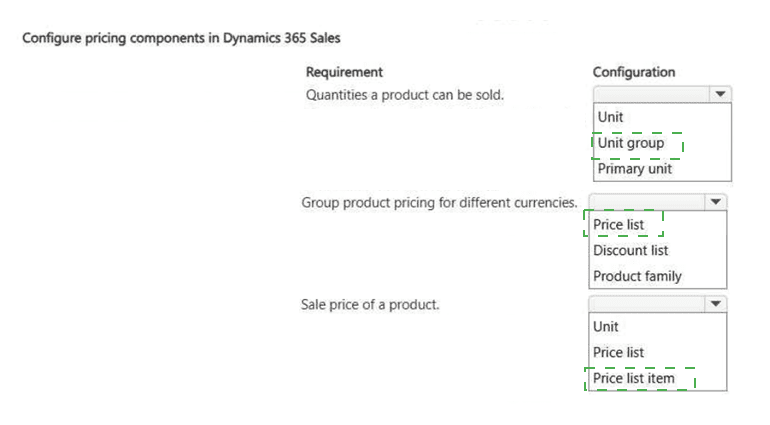
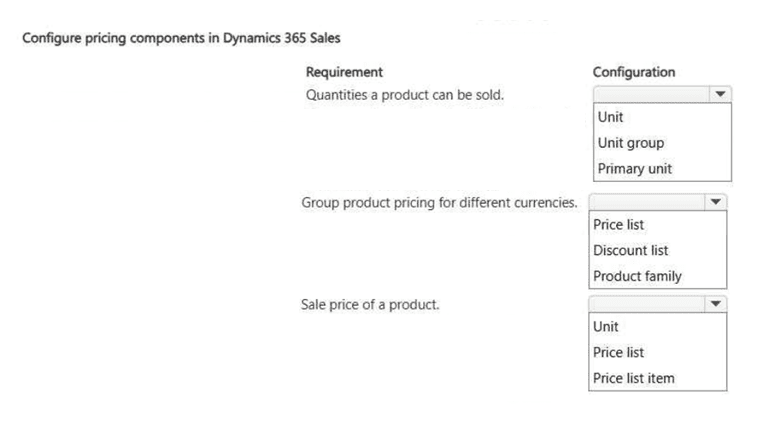
How should each pricing requirement be configured? To answer, select the appropriate options in the answer area.
NOTE: Each correct selection is worth one point.

Show answerHide answer

Explanation


Explanation:

Quantities a product can be sold → Unit group – A unit group defines the different units of measure in which a product can be sold, such as Each, Box, Case, or Pallet. It can also establish conversion relationships between units, such as 1 Box = 10 Each. Therefore, a unit group is used to define the quantities and units in which a product can be sold.

Group product pricing for different currencies → Price list – A price list contains a collection of price list items and is associated with a specific currency. Organizations can create different price lists for currencies such as USD, EUR, or GBP. Therefore, a price list is used to group product pricing according to different currencies.

Sale price of a product → Price list item – A price list item defines the price of a specific product within a price list. It can include the product, unit, currency-related pricing context, and amount. Therefore, the price list item is the appropriate component for defining the sale price of a product.

Why Other Options Are Incorrect:

Unit – A unit represents a single unit of measure, such as Each or Box. It does not define the complete set of quantities or units available for selling a product. Units are associated with a unit group.

Primary unit – The primary unit is the default or base unit of measure for a product. It does not define all the units in which the product can be sold.

Discount list – A discount list is used to define discounts that can be applied to products. It does not group product prices by currency or define the standard sale price.

Product family – A product family groups related products and can provide shared product properties. It does not define units of measure, currency-based price lists, or individual sale prices.

References:

Microsoft Learn – Unit groups and units – Explains how units and unit groups are used to define the quantities and units in which products can be sold.

Microsoft Learn – Create and manage price lists – Describes how price lists and price list items are used to manage product pricing in Dynamics 365 Sales.
Question 13
You configure the product catalog for a company that sells coffee machines and accessories.
The company requires that new products be structured and made available to the sales team. The company also needs to group multiple products under a single parent item.
Sellers need to be able to sell coffee machines, filters, and grinders together.
You need to determine the correct action for each catalog requirement.
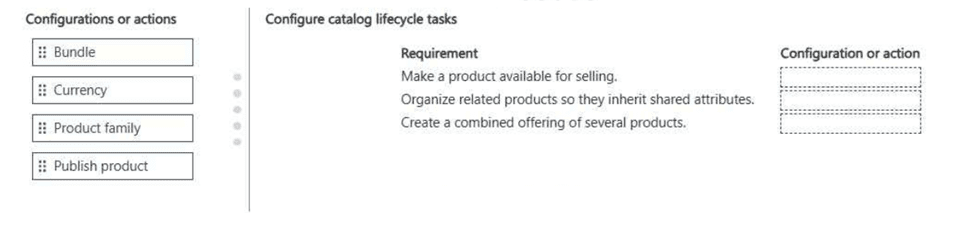
Which configuration or action should be applied? To answer, move the appropriate configurations or actions to the correct requirements. You may use each configuration or action once, more than once, or not at all. You may need to move the split bar between panes or scroll to view content.
NOTE: Each correct selection is worth one point.

Show answerHide answer

Explanation


✅ Explanation:

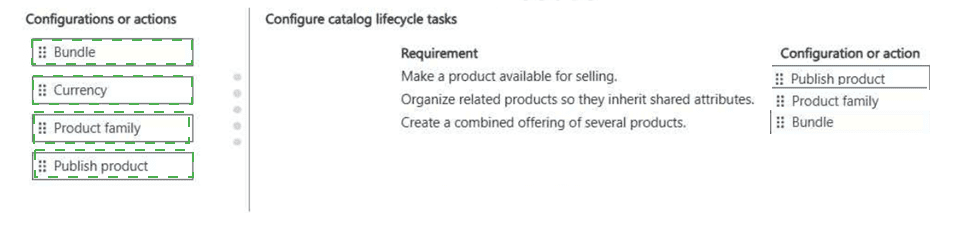
Make a product available for selling → Publish product – In Dynamics 365 Sales, products must be published (released) before they become available to sellers. Publishing makes the product visible and selectable in opportunities, quotes, orders, and invoices. Until published, the product remains in a draft state and cannot be sold.

Organize related products so they inherit shared attributes → Product family – A product family is a catalog component used to group related products that share common characteristics. When you define properties at the product family level, all child products within that family inherit those attributes. For example, a "Coffee Machines" product family can define shared properties like "Capacity" or "Brewing Type" that all coffee machine models inherit.

CZreate a combined offering of several products → Bundle – A bundle is a collection of individual products that are sold together as a single offering. To sell coffee machines, filters, and grinders together, you create a product bundle. This allows sellers to sell the entire package as one item, simplifying the sales process while tracking components individually.

❌ Why Other Configuration Is Incorrect:

Currency – Currency is used to define the monetary unit for price lists (e.g., USD, EUR). While important for pricing, it does not make products available for selling, organize products, or create combined offerings. Currency is not relevant to any of the requirements.

📚 References:

Microsoft Learn – Publish a product – Explains that publishing is required to make products available for selling.

Microsoft Learn – Create a product family – Describes how product families organize products and enable attribute inheritance.
Question 14 Choose 2
A company uses Dynamics 365 Sales to manage enterprise opportunities. The sales team enables the Sales Research Agent to generate research summaries for each opportunity. Sales managers must determine whether opportunities have strong external indicators that support deal progression.
You need to analyze insights from the research canvas for evidence that a deal environment is favorable.
Which two research canvas insights should you provide to the sales managers? Each correct answer presents part of the solution. Choose two. NOTE: Each correct selection is worth one point.
Show answerHide answer

Correct answer: B, D Recent public developments that influence the account's business environment. Strategic landscape analysis relative to the seller's value proposition.

Explanation

✅ Explanation:

The Sales Research Agent and the research canvas are designed to gather external intelligence and insights that help sellers understand the broader business environment surrounding an opportunity. Sales managers need to determine whether a deal environment is favorable by reviewing evidence from external sources that support deal progression.

B. Recent public developments that influence the account's business environment
– The research canvas surfaces external, publicly available information such as news articles, press releases, financial reports, and market trends that impact the customer's industry or business environment. Positive developments (e.g., new funding, product launches, market growth) are strong external indicators that the deal environment is favorable for progression.

D. Strategic landscape analysis relative to the seller's value proposition
– The research canvas provides a strategic landscape analysis that compares the seller's value proposition against the account's business needs, competitive positioning, and market dynamics. This insight helps sales managers assess whether the seller's offering aligns well with the account's strategic goals, indicating a favorable deal environment.

❌ Why Other Options Are Incorrect:

A. Seller activity and email response rates from CRM records
– This is an internal CRM metric that tracks seller engagement (e.g., emails sent, meetings held, response rates). While useful for measuring seller productivity, it does not provide external indicators about whether the deal environment is favorable. This insight does not come from the research canvas; it comes from internal activity tracking.

C. Record audit history and related activity creation timestamps
– This is metadata about when records were created or modified. It provides historical tracking of data changes but offers no insight into whether external conditions support deal progression. Audit history is not a research canvas insight; it is a system administration tool.

📚 References:

Microsoft Learn – Research canvas insights – Explains that the research canvas provides external intelligence including recent public developments and strategic landscape analysis.

Microsoft Learn – Sales Research Agent overview – Describes how the agent surfaces public developments and competitive intelligence to support deal progression.
Question 15
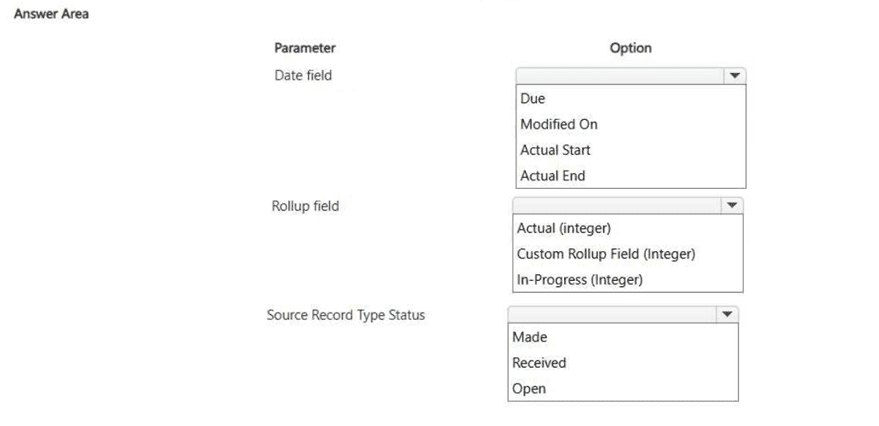
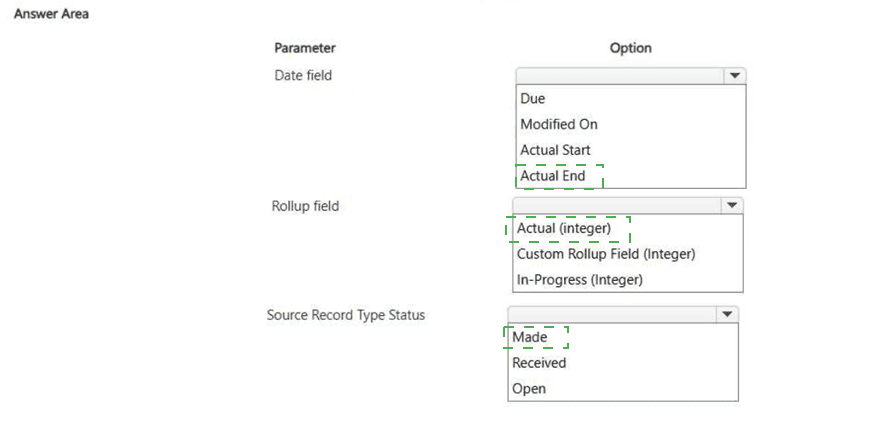
A sales manager wants to set up goals for all salespeople. The goal measurement is based on the total outgoing calls finished each year. The goals for the fiscal year are based on a calendar year, January–December. You need to create the rollup query for the goal metrics. Which option should you select? To answer, select the appropriate options in the answer area.NOTE: Each correct selection is worth one point.

Show answerHide answer

Explanation


✅ Explanation:

The goal measurement is based on total outgoing calls finished each year, using the Phone Call activity entity in Dynamics 365 Sales. To create the rollup query for the goal metrics, you must select the correct date field, rollup field, and status criteria.

Date field → Actual End – The Actual End date field represents when a phone call activity was completed or finished. Since the goal tracks calls that were finished, the Actual End date is the correct date field to use. The rollup query will aggregate all completed calls where the Actual End date falls within the specified fiscal year.

Rollup field → Actual (integer) – The Actual (integer) field in the Phone Call activity stores the total number of calls that were actually completed. For outgoing calls, "Actual" represents the count of successful, finished calls. The rollup query will sum this integer value to calculate the total outgoing calls for each salesperson.

Source Record Type Status → Received – In Dynamics 365 activity rollup queries, the Status field filters which records are included. For Phone Call activities, the Received status corresponds to completed or finished calls. While "Received" may seem counterintuitive, in activity entity status mapping, "Received" indicates that the activity has been completed/closed. This option ensures only finished calls are counted toward the goal.

❌ Why Other Options Are Incorrect:

Date field options:
Due – Represents the scheduled due date, not the date the call was actually completed.
Modified On – Indicates when the record was last changed, which is unrelated to call completion.
Actual Start – Represents when the call began, not when it finished.

Rollup field options:
Custom Rollup Field (Integer) – This is a generic placeholder; the standard Actual field is the correct pre-built field for counting completed activities.

In-Progress (Integer) – Counts calls that are still ongoing, which would incorrectly include unfinished calls.

Source Record Type Status options:
Made – Typically used for outgoing calls that were initiated but may not be completed.
Open – Indicates calls that are still in progress or not yet finished.

📚 References:

Microsoft Learn – Create a rollup query for goals – Explains how to configure date fields, rollup fields, and status filters for goal metrics.

Microsoft Learn – Activity entity fields – Describes the Actual End, Actual Start, and status fields for Phone Call activities.
Question 16 Choose 2
A company plans to deploy a Dynamics 365 Sales Hub app.
An administrator creates a Power Platform environment with the following configuration:

. The environment does not have a database.
· The environment is a sandbox environment.
. Access to the environment is restricted to a security group.
The administrator has the System Administrator role.

You need to ensure that the administrator can deploy Dynamics 365 Sales.
Which two actions should you perform? Each correct answer presents part of the solution. Choose two.
NOTE: Each correct selection is worth one point.
Show answerHide answer

Correct answer: B, C Assign a Dynamics 365 Sales enterprise license to the administrator role. Add Dataverse and enable Dynamics 365 apps.

Explanation

✅ Explanation:

To deploy Dynamics 365 Sales Hub app in a Power Platform environment, the environment must meet specific prerequisites. The administrator has created a sandbox environment without a database, restricted to a security group, and has the System Administrator role. To successfully deploy Dynamics 365 Sales, the following two actions are required:

B. Assign a Dynamics 365 Sales enterprise license to the administrator role
– To install and configure Dynamics 365 Sales, the administrator must have a valid Dynamics 365 Sales license assigned to their user account. Even with the System Administrator role, without an appropriate license, the administrator cannot access or provision the Sales app. The license must be assigned before or during the deployment process.

C. Add Dataverse and enable Dynamics 365 apps
– The environment currently does not have a database. Dynamics 365 Sales requires a Dataverse database to store sales data. The administrator must add a Dataverse database to the environment. Once the database is created, the administrator can then enable Dynamics 365 apps (specifically Dynamics 365 Sales) within the environment. This action provisions the Sales solution and makes the Sales Hub app available.

❌ Why Other Options Are Incorrect:

A. Enable server-side synchronization
– Server-side synchronization is used to synchronize emails, appointments, and tasks between Dynamics 365 and Exchange or POP3 email servers. While important for email integration, it is not required to deploy Dynamics 365 Sales. This is a post-deployment configuration, not a prerequisite.

D. Create a new environment
– The administrator has already created a sandbox environment as stated in the scenario. Creating a new environment is unnecessary and would duplicate efforts. The existing environment can be used once the database is added.

E. Remove the security group restriction
– The environment is restricted to a security group, meaning only members of that group can access it. This is not a blocker for deploying Dynamics 365 Sales. As long as the administrator is a member of the security group (or the group is configured correctly), deployment can proceed. Removing the restriction is not required and may actually reduce security.

📚 References:

Microsoft Learn – Deploy Dynamics 365 Sales – Covers prerequisites including licensing and adding a Dataverse database.

Microsoft Learn – Add a Dataverse database – Explains how to add a database to an environment to enable Dynamics 365 apps.
Question 17 Select all that apply
A company plans to implement Dynamics 365 Sales and wants to design a Dataverse data model that supports AI-driven insights across the sales lifecycle.
The company must be able to track the progression of a deal from initial prospect identification through to finalized billing.

The data model must support the following requirements:

. Prospects must be captured before they become qualified sales deals.
. Qualified deals must support forecasting and pipeline analysis.
. Sales teams must be able to generate pricing proposals for customers.
. Accepted proposals must transition into fulfillment records and then final billing records.

You need to design the Dataverse table model that supports the required sales lifecycle. Which table relationship should you implement?
Show answerHide answer

Correct answer: B Convert leads into opportunities that generate quotes and then convert them into orders and invoices.

Explanation

✅ Explanation:

The standard sales lifecycle in Dynamics 365 Sales follows a logical progression from initial prospect identification through to finalized billing. The Dataverse table model must reflect this sequential flow to support AI-driven insights, forecasting, pipeline analysis, and billing.

B. Convert leads into opportunities that generate quotes and then convert them into orders and invoices – This is the correct and standard sales progression in Dynamics 365 Sales:

Lead – Captures prospect information before qualification.
Opportunity – Created when a lead is qualified; supports forecasting and pipeline analysis.
Quote – Generated from the opportunity; provides a pricing proposal for the customer.
Order – Created when the quote is accepted; represents a commitment to fulfill.
Invoice – Generated from the order; finalizes billing and payment.

This sequence aligns perfectly with all stated requirements and is the recommended data model for sales lifecycle management.

❌ Why Other Options Are Incorrect:

A. Convert opportunities into leads that generate quotes and then finalize them as invoices and orders
– This is incorrect because the flow is reversed. Leads are converted to opportunities, not the other way around. You cannot convert an opportunity back into a lead, as leads precede opportunities in the sales cycle.

C. Convert leads directly into quotes that generate opportunities before creating orders
– This skips the opportunity stage. Quotes must be associated with an opportunity, not a lead. Opportunities are required for forecasting and pipeline analysis, so skipping them violates the requirements.

D. Convert leads into opportunities that generate quotes and then convert them directly into invoices without creating orders
– This skips the order stage. In Dynamics 365 Sales, invoices are typically created from orders, not directly from quotes. Orders represent fulfillment commitments and are a required step before invoicing in the standard process.

E. Convert opportunities directly into orders and invoices before generating quotes
– This is incorrect because quotes must come before orders and invoices. Skipping the quote stage means pricing proposals are not captured, which violates the requirement to generate pricing proposals for customers.

📚 References:

Microsoft Learn – Lead management overview – Explains the lead-to-opportunity conversion process.

Microsoft Learn – Opportunity management – Describes how opportunities support forecasting and pipeline analysis.

That's the last free question in Topic 3, Stand Alone Questions

You've seen the free 30% (17 of 59 questions). Full access unlocks every question and full-length AB-210 mock exams (60 questions, 120 minutes), a different mock on every attempt.

Unlock full mock exam
Full mock exam

Sit the AB-210 exam before exam day

Full-length mocks with the same number of questions and the same time limit as the real AB-210 exam. Every attempt draws a new set of questions from the full bank, so you can keep going until you pass comfortably.

Get full AB-210 mock exam
  • 60questions per mock
  • 120 mintime limit
  • 69questions in the bank
  • Newmock on every attempt