Microsoft certification · Exam AB-100

AB-100 Mock Exam Page 3

Agentic AI Business Solutions Architect

Free AB-100 mock exam questions 21–28, each with the answer and an explanation.

20 questions · 30 minutes · free, no sign-up

Free AB-100 questions

21–28 of 28 free
Question 21 Choose 1
A retail company plans to deploy Microsoft Copilot Studio agents to support:

Microsoft Dynamics 365 Commerce scenarios.

A Microsoft Power Apps inventory management solution.

You need to recommend a solution to organize product catalog data as a consistent source for multiple AI systems.

What should you recommend?
Show answerHide answer

Correct answer: D Centralize the product catalog data in Microsoft Dataverse and expose the data to both agents.

Explanation

Explanation:
The requirement is a consistent source of product catalog data for multiple AI systems (Dynamics 365 Commerce and Power Apps inventory). Centralizing in Microsoft Dataverse provides a single, governed, real-time data layer that both Copilot Studio agents can query via connectors or Power Platform integration. Decentralized approaches (separate tables, scraping, PDFs) create inconsistency, duplication, and maintenance overhead.

Correct Option:

D. Centralize the product catalog data in Microsoft Dataverse and expose the data to both agents.
Dataverse is the native data platform for Power Platform and Dynamics 365, ensuring consistency and security.
Both Copilot Studio agents can connect to the same Dataverse table via Power Platform connectors or custom APIs.
Centralization eliminates data silos and ensures all agents see the same up-to-date product catalog.

Incorrect Options:

A. Let each agent scrape product details from Microsoft SharePoint Online libraries.
Scraping is unreliable, non-real-time, and creates duplication of effort.
SharePoint is not designed as a structured, queryable source for AI agents, leading to inconsistency.

B. Store the product catalog data in a separate custom table for each agent.
Separate tables cause data fragmentation and synchronization problems.
When product details change, each table must be updated individually, risking inconsistency.

C. Configure prompts to pull product details from the PDFs of external vendors.
PDFs are unstructured, difficult to parse reliably, and not a real-time data source.
This approach is error-prone, slow, and unsuitable for consistent multi-agent access.

Reference:
Microsoft Learn – “Microsoft Dataverse as a data source for Copilot Studio” – Centralized, real-time, governed data for AI agents.
Microsoft Learn – “Best practices for multi-agent data consistency” – Avoid siloed tables or unstructured sources like PDFs or SharePoint scraping.
Question 22 Choose 1
A company has a Microsoft Power Platform environment that contains Microsoft Dataverse data. You create a Microsoft Copilot Studio agent named Agent1 that processes the Dataverse data. You discover that Agent1 fails to return relevant or accurate results. You need to improve the quality and reliability of data grounding. What should you do?
Show answerHide answer

Correct answer: C Verify and cleanse the Dataverse data.

Explanation

Explanation:
Agent1 processes Dataverse data but returns inaccurate or irrelevant results. The root cause is likely poor data quality (missing values, duplicates, outdated records, inconsistent formats) in the grounding source itself. Grounding quality depends directly on source data quality. Cleansing Dataverse data (validation, deduplication, standardization) improves reliability before any agent retraining or configuration changes.

Correct Option:

C. Verify and cleanse the Dataverse data.
Grounding provides factual context; if source data is dirty, results will be wrong regardless of prompt design.
Cleansing includes removing duplicates, filling missing fields, standardizing formats, and validating relationships.
This directly addresses data quality and reliability at the source, not just agent behavior.

Incorrect Options:

A. Use an adaptive card in Agent1.
Adaptive cards control how responses are visually presented (buttons, images, forms).
They do not improve the accuracy or relevance of underlying grounded data.

B. Add example user inputs to the training data of Agent1.
Example user inputs help with intent recognition but cannot fix incorrect or missing grounding data.
If Dataverse data is wrong, the agent will confidently return wrong answers regardless of training examples.

D. Retrain Agent1.
Retraining improves topic matching and dialogue flow, but does not cleanse or correct the data source.
Garbage in, garbage out: retraining on dirty data will not improve result quality.

Reference:
Microsoft Learn – “Data grounding best practices in Copilot Studio” – Grounding quality is directly tied to source data cleanliness.
Microsoft Learn – “Troubleshoot inaccurate agent responses” – First verify and cleanse Dataverse data before retraining or reconfiguring.
Question 23 Choose 1
A company has a portfolio of AI initiatives at different stages of development.

You need to recommend a structured approach to evaluating the return on AI investment (ROAI) across all the initiatives. The solution must balance immediate results with longterm values and strategic innovations.

What should you include in the recommendation?
Show answerHide answer

Correct answer: B a horizon-based framework

Explanation

Explanation:
The requirement is to evaluate ROAI across initiatives at different stages, balancing immediate results (short-term), long-term value, and strategic innovations. A horizon-based framework (e.g., McKinsey Three Horizons) categorizes initiatives into Horizon 1 (incremental/current), Horizon 2 (growth/medium-term), and Horizon 3 (transformative/long-term). This allows tailored metrics for each stage rather than forcing a one-size-fits-all financial calculation.

Correct Option:

B. a horizon-based framework
Horizons separate efficiency gains (short-term ROAI) from strategic bets (long-term innovation).
Enables different KPIs: cost savings (H1), revenue growth (H2), optionality value (H3).
Balances immediate results with future value without underfunding transformative AI.

Incorrect Options:

A. a simple cost and benefit analysis
Too simplistic for initiatives at different stages; Horizon 3 AI may have high costs with intangible long-term benefits.
Fails to capture strategic value like learning, positioning, or option value.

C. the internal rate of return (IRR) function
IRR works for predictable cash flow projects, not for exploratory or strategic AI initiatives.

Early-stage AI often has no reliable revenue forecast, making IRR misleading or impossible to calculate.

D. a prioritization grid
Useful for comparing initiatives against two criteria (e.g., impact vs. effort) but does not inherently balance short-term and long-term value.
Lacks the temporal structure needed to evaluate different maturity stages together.

Reference:
McKinsey Three Horizons model – Adapted for AI investment: Horizon 1 (AI-assisted efficiency), Horizon 2 (AI growth enablers), Horizon 3 (disruptive AI innovations). Microsoft Learn – “Measuring ROAI across AI lifecycle” – Recommends horizon-based frameworks over single-metric financial analyses.
Question 24
A company plans to implement an AI solution that will contain a Microsoft Copilot Studio agent and a Microsoft Foundry agent. The solution will be stored in a source code repository.

You need to recommend a deployment method for each agent. The solution must meet the following requirements:

A test environment must be used before a deployment to production.

Production must be isolated from development and testing.

The deployment must be repeatable and fully automated.

The solution must NOT require manual intervention.

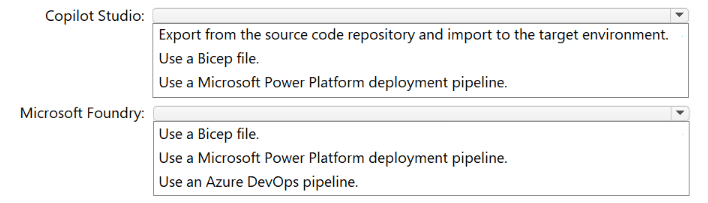
Which deployment method should you recommend for each agent? To answer, select the appropriate options in the answer area.

NOTE: Each correct selection is worth one point.

Show answerHide answer

Explanation


Explanation:
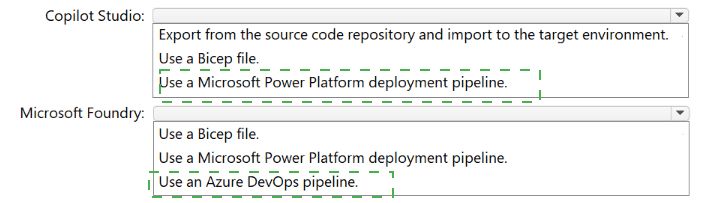
Both agents require repeatable, fully automated deployment with environment isolation (test → production) and no manual intervention. For Copilot Studio, native Power Platform deployment pipelines provide automated ALM (Application Lifecycle Management) with environment mapping. For Microsoft Foundry (Azure AI Foundry) , Azure DevOps pipelines offer full automation, infrastructure-as-code optionality, and integration with source control, while Bicep alone lacks the orchestration and test/production promotion logic.

Correct Options:

Copilot Studio:
Use a Microsoft Power Platform deployment pipeline
Native ALM solution for Copilot Studio agents.
Supports automated promotion from test to production with environment variables.
No manual export/import required; fully repeatable.

Microsoft Foundry:

Use an Azure DevOps pipeline
Supports fully automated deployment of Azure AI Foundry agents (models, prompts, data connections).
Integrates with source code repository for version control.
Enables test → production gates without manual steps.

Incorrect Options (excluded per requirements):

For Copilot Studio:
Export from source code repository and import to target environment → Requires manual export/import, violates “no manual intervention.”
Use a Bicep file → Bicep is infrastructure-as-code but does not handle Copilot Studio agent logic deployment natively.

For Microsoft Foundry:
Use a Bicep file → Bicep alone deploys infrastructure (e.g., AI Hub, compute), but not the full agent logic/prompts with automated promotion; requires manual pipeline orchestration.

Use a Microsoft Power Platform deployment pipeline → Not designed for Azure AI Foundry agents; these pipelines work only for Power Platform/Copilot Studio artifacts.

Reference:
Microsoft Learn – “Power Platform ALM with deployment pipelines” – For Copilot Studio.
Microsoft Learn – “Azure DevOps pipelines for Azure AI Foundry” – For automated, repeatable deployment with environment isolation.
Question 25 Choose 1
A company uses Microsoft Dynamics 365 Finance to manage accounts payable.

You are designing an AI invoice processing solution.

You need to recommend the prerequisites to configure a prebuilt copilot for accounts payable.

What should you recommend?
Show answerHide answer

Correct answer: D From the Power Platform admin center, assign the Finance and Operations AI security role to users.

Explanation

Explanation:
To configure a prebuilt copilot for accounts payable in Dynamics 365 Finance, users need specific security roles to access AI features. The Finance and Operations AI security role (or equivalent) must be assigned from the Power Platform admin center because Dynamics 365 Finance AI capabilities are governed through Power Platform security. Creating a new agent from scratch or building custom AI tools bypasses the prebuilt copilot configuration requirement.

Correct Option:

D. From the Power Platform admin center, assign the Finance and Operations AI security role to users.
Prebuilt copilots in Dynamics 365 Finance require specific AI security roles.
The Power Platform admin center manages these roles across environments.
This is a documented prerequisite before any accounts payable AI feature can be used.

Incorrect Options:

A. From Microsoft Copilot Studio, create an accounts payable agent.
Creating a custom agent is not a prerequisite for configuring a prebuilt copilot.
Prebuilt copilots are provided out-of-the-box; custom agents are optional and require more work.

B. Extend Microsoft 365 Copilot for Sales to an accounts payable agent.
Copilot for Sales is designed for CRM scenarios, not accounts payable in Dynamics 365 Finance.
Extending it to finance is not supported and not a prerequisite.

C. Build an AI tool in Microsoft Foundry.
Building a custom AI tool is a development project, not a prerequisite.
Prebuilt copilots do not require custom building; they require configuration and permissions.

Reference:
Microsoft Learn – “Prerequisites for accounts payable copilot in Dynamics 365 Finance” – Assign Finance and Operations AI role via Power Platform admin center.
Microsoft Learn – “Prebuilt copilots in Dynamics 365” – Security role assignment is mandatory before configuration.
Question 26
A company has a Microsoft Copilot Studio agent for customer support. You are reviewing and validating the following prompts:

• A prompt that has instructions to "help the customer as best you can"

• A prompt that helps retrieve product information from a knowledge base

You need to ensure that the agent delivers consistent and accurate responses.

What should you do for each prompt? To answer, select the appropriate options in the answer area.

NOTE: Each correct selection is worth one point.

Show answerHide answer

Explanation


Explanation:
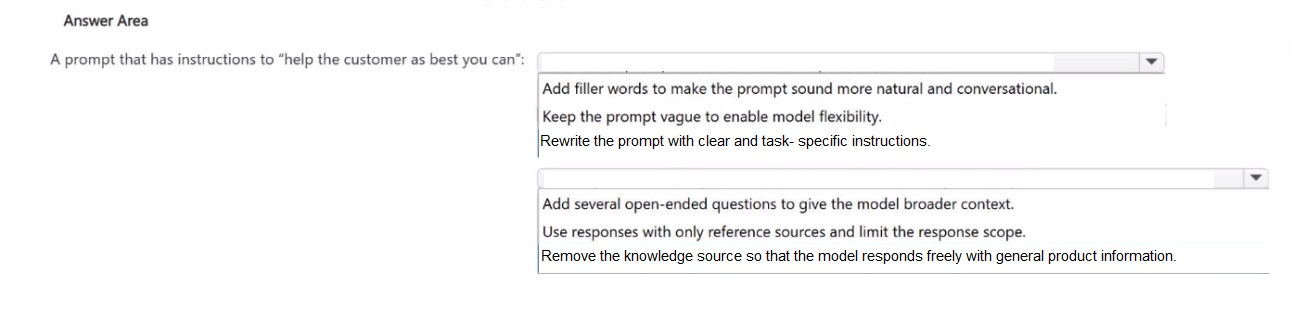
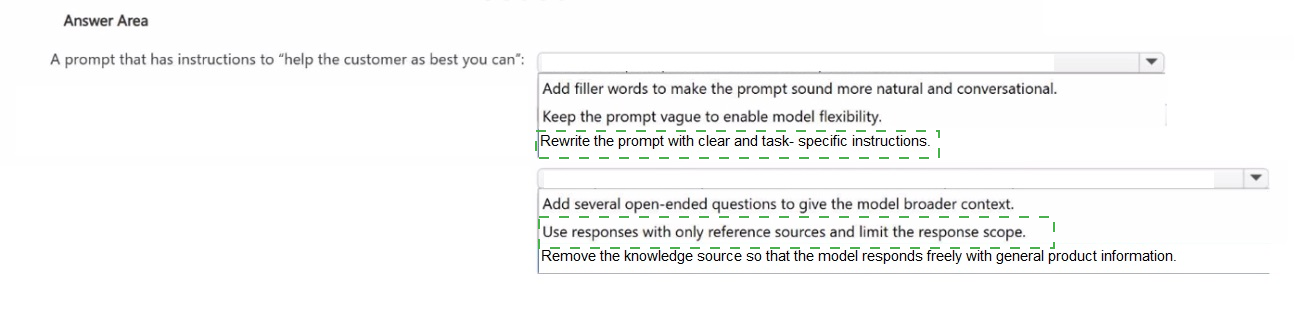
A vague prompt like “help the customer as best you can” leads to inconsistent, unpredictable responses. It must be rewritten with clear, task-specific instructions. For a prompt retrieving product information from a knowledge base, accuracy requires using responses with only reference sources and limiting scope to avoid hallucinations or free-form general knowledge.

Correct Options:

For the prompt “help the customer as best you can”:
Rewrite the prompt with clear and task-specific instructions
Vague instructions allow the model to guess intent, causing inconsistent answers.
Clear instructions (e.g., “List refund policy steps for electronics under warranty”) ensure reliability.
Best practice for Copilot Studio prompt engineering.

For the prompt that helps retrieve product information from a knowledge base:
Use responses with only reference sources and limit the response scope
Grounding the prompt strictly to the knowledge base prevents the model from inventing product details.
Limiting scope ensures responses are factual, traceable, and consistent.
This is critical for customer support accuracy and compliance.

Incorrect Options (excluded):
Add filler words → Reduces clarity, worsens consistency.
Keep the prompt vague → Directly causes the problem described.
Add several open-ended questions → Increases ambiguity, not helpful for retrieval.
Remove the knowledge source → Causes hallucinations; model would respond with general (often wrong) product info.

Reference:
Microsoft Learn – “Prompt best practices in Copilot Studio” – Use specific instructions, ground to knowledge sources, limit scope to reference-only responses for consistent accuracy.
Question 27 Choose 1
A company has a Microsoft Foundry generative Al model.

You need to evaluate the model's output to measure the overall quality and coherence of generated responses. The evaluation must use GPT-4o as a judge and return a numeric score for each output.

Which type of metric should you use?
Show answerHide answer

Correct answer: D Al quality (Al assisted)

Explanation

Explanation:
The requirement is to evaluate coherence and overall quality of generated responses using GPT-4o as a judge with a numeric score per output. This is an AI-assisted quality metric (also called LLM-as-a-judge), where a powerful model evaluates another model’s outputs on dimensions like fluency, relevance, and coherence. Groundedness measures factual alignment with sources, not general quality. NLP metrics (e.g., BLEU) require reference texts.

Correct Option:

D. AI quality (AI assisted)
Uses GPT-4o as an evaluator to score outputs on quality and coherence.
Returns a numeric score (e.g., 1–5) per response without needing human-labeled references.
Specifically designed for generative AI output evaluation in Azure AI Foundry.

Incorrect Options:

A. Groundedness
Measures whether the model’s response is factually supported by provided source documents.
Does not evaluate coherence or overall quality; focused only on hallucination detection.

B. AI quality (NLP)
Refers to traditional NLP metrics (BLEU, ROUGE, METEOR) that compare output to reference texts.
Requires ground-truth references; not suitable for open-ended generative evaluation without references.

C. Risk and safety
Evaluates harmful content (hate speech, violence, self-harm).
Does not measure coherence or general response quality.

Reference:
Microsoft Learn – “Evaluate generative AI models in Azure AI Foundry” – AI-assisted quality metrics use GPT-4o as a judge for coherence and quality.
Microsoft Learn – “Groundedness vs. AI-assisted metrics” – Groundedness is for fact-checking; AI-assisted is for quality scoring without references.
Question 28 Choose 1
A company has a customer order system that creates sales orders manually.

You need to design an Ai solution to automate the following tasks as part of the system:

• Save the order details to a database.

• Update the order status m the database.

• Extract the order details from an order file

• Prepare and send a confirmation email to customers.

The solution must minimize development effort and support intelligent automation and solution integration.

What should you include m the design?
Show answerHide answer

Correct answer: A a Microsoft Copilot Studio agent that uses Microsoft Power Automate workflows

Explanation

Explanation: The tasks require intelligent automation (extracting order details, sending emails) and integration (saving/updating database). A Copilot Studio agent combined with Power Automate workflows minimizes development effort because Copilot Studio handles natural language interaction and decision logic, while Power Automate provides prebuilt connectors (database, email) with low-code/ no-code orchestration.

Correct Option:

A. a Microsoft Copilot Studio agent that uses Microsoft Power Automate workflows
Copilot Studio provides AI-driven conversation and decisioning for order processing.
Power Automate workflows offer 500+ prebuilt connectors (SQL, Outlook, file systems) with minimal code.
Together they enable intelligent automation and seamless integration, reducing development time.

Incorrect Options:

B. a multi-agent solution that uses Microsoft Foundry Agent Service
Requires custom coding and orchestration, increasing development effort.
Over-engineered for manual order automation; Foundry is better for complex multi-step research or reasoning tasks.

C. a multi-agent solution that uses the Semantic Kernel SDK
Requires professional development (C#/Python) and manual connector building.
High effort compared to low-code Copilot Studio + Power Automate.

D. a workflow in Azure Logic Apps
Logic Apps can orchestrate (database, email) but lacks intelligent automation (AI-driven extraction and decision-making).
No built-in language model for extracting order details from unstructured order files.

Reference:
Microsoft Learn – “Copilot Studio with Power Automate” – Best combination for low-code AI + automation.
Microsoft Learn – “When to use Logic Apps vs. Power Automate” – Power Automate is lower-code for business automation; Logic Apps is more infrastructure-focused.

That's the last free question

You've seen the free 30% (28 of 95 questions). Full access unlocks every question and full-length AB-100 mock exams, a different mock on every attempt.

Unlock full mock exam
Full mock exam

Sit the AB-100 exam before exam day

Full-length mocks with the same number of questions and the same time limit as the real AB-100 exam. Every attempt draws a new set of questions from the full bank, so you can keep going until you pass comfortably.

Get full AB-100 mock exam
  • —questions per mock
  • —time limit
  • 95questions in the bank
  • Newmock on every attempt