Microsoft certification · Exam AB-100

AB-100 Mock Exam

Agentic AI Business Solutions Architect

Free AB-100 questions on Multiple Choice Questions, each with the answer and an explanation.

20 questions · 30 minutes · free, no sign-up

Multiple Choice Questions questions

1–10 of 25 free
Question 1 Choose 2
A company has a Microsoft Copilot Studio agent that provides answers based on a knowledge base for customer support.

Users report that, occasionally, the agent provides inaccurate answers.

You need to use metrics from the Analytics tab in Copilot Studio to identify the cause of the inaccuracies.

Which two options should you use? Each correct answer presents part of the solution.

NOTE: Each correct selection is worth one point.
Show answerHide answer

Correct answer: B, E session information and session outcomesquality of generated answers

Explanation

Explanation:
This AB-100 question focuses on identifying root causes of inaccurate answers from a Copilot Studio agent using a knowledge base. The Analytics tab provides various metrics. Session information and outcomes help analyze conversation flow and success/failure patterns, while quality of generated answers specifically evaluates the accuracy and grounding of AI responses from the knowledge base.

Correct Option:

B. session information and session outcomes
Session information and outcomes show detailed conversation transcripts, engagement levels, resolution status, and where the agent failed to deliver expected results. By reviewing sessions with poor outcomes, you can identify patterns leading to inaccurate answers, such as unhandled queries or fallback triggers.

Correct Option:

E. quality of generated answers
The Quality of generated answers metric uses AI to score responses on relevance, completeness, and groundedness to the knowledge base. It directly highlights inaccurate or low-quality answers, allowing you to pinpoint problematic queries and improve knowledge sources or instructions.

Incorrect Option:

A. survey results
Survey results (CSAT or thumbs up/down) indicate user perception but are subjective and post-response. They do not provide detailed technical diagnostics on why the agent generated inaccurate answers from the knowledge base.

Incorrect Option:

C. topic usage and topics with low resolution
Topic usage and low resolution metrics are useful for classic topic-based flows but less relevant for generative answers relying on a knowledge base, where inaccuracies stem more from content quality than topic triggers.

Incorrect Option:

D. engagement, resolution, and escalation rates
These high-level KPIs show overall performance trends but lack the granular insight needed to diagnose the specific cause of inaccurate knowledge-base responses.

Reference:
Microsoft Learn: Analyze conversational agents - Copilot Studio
Microsoft Learn: FAQ for analytics - Copilot Studio
Question 2 Choose 1
A company has Microsoft Foundry agents that generate responses by using Azure OpenAI resources. The agents are deployed to both the United States and Europe.

A company mandate states that the agents and their grounding data must adhere to data residency and movement regulations.

You need to recommend a governance solution for the agents.

What should you include in the recommendation?
Show answerHide answer

Correct answer: B Azure Policy

Explanation

Explanation:
This AB-100 question tests governance recommendations for Microsoft Foundry agents using Azure OpenAI across regions (US and Europe). The key requirement is enforcing data residency and movement regulations for agents and grounding data. Azure Policy is the primary service for implementing preventive controls and compliance at scale in Azure environments.

Correct Option:

B. Azure Policy
Azure Policy allows you to create and enforce rules that restrict resource deployments to approved geographic regions, deny non-compliant configurations, and ensure data residency requirements are met automatically. It supports governance at scale across subscriptions, preventing data movement violations for Foundry agents and associated Azure OpenAI resources.

Incorrect Option:

A. Microsoft Defender for Cloud
Microsoft Defender for Cloud provides security posture management, threat protection, and compliance recommendations. While useful for visibility, it does not enforce preventive governance policies for data residency and resource location restrictions.

Incorrect Option:

C. Azure Monitor
Azure Monitor is designed for collecting metrics, logs, and setting up alerts for operational monitoring. It helps observe activity but cannot enforce governance rules or prevent violations of data residency regulations.

Incorrect Option:

D. Microsoft Purview
Microsoft Purview excels at data discovery, classification, lineage, and compliance management. It is valuable for data governance but does not provide the policy enforcement mechanism needed to control resource deployment locations for residency requirements.

Reference:
Microsoft Learn: Azure Policy overview
Microsoft Learn: Data residency in Azure
Question 3
You are designing an AI strategy for Microsoft Dynamics 365 finance and operations apps.

You are evaluating the use of Microsoft Copilot Studio to provide in-app help and guidance based on generative AI general knowledge.

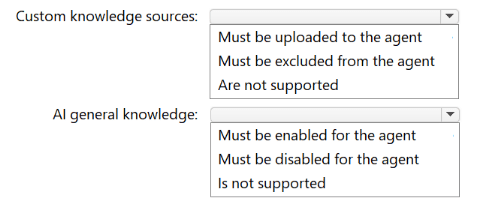
You need to recommend which knowledge sources to include in the generative help and guidance agent. The solution must minimize the risk of generating inaccurate responses.

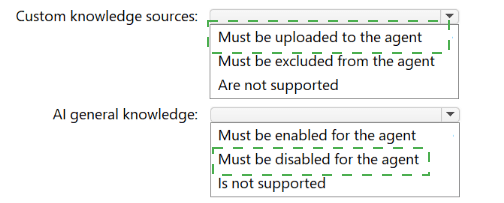
What should you recommend? To answer, select the appropriate options in the answer area.

NOTE: Each correct selection is worth one point.

Show answerHide answer

Explanation


Explanation:
This AB-100 question is about designing a generative help and guidance agent in Copilot Studio for Dynamics 365 Finance and Operations apps. The goal is to use generative AI while minimizing the risk of inaccurate (hallucinated) responses. Best practice is to ground the agent with reliable custom data and restrict broad, unverified general knowledge.

Correct Option:

Custom knowledge sources: Must be uploaded to the agent
Uploading approved documents (PDF, Word, etc.) to the agent as knowledge sources allows the generative AI to retrieve and ground responses in trusted, organization-specific content. This significantly reduces inaccuracies compared to relying solely on the model’s parametric knowledge.

Correct Option:

AI general knowledge: Must be disabled for the agent
AI general knowledge (the model’s broad pre-trained knowledge) is disabled by default for in-app help agents. Enabling it increases the risk of hallucinations and inaccurate answers. Disabling it ensures responses stay grounded in uploaded custom knowledge sources only.

Incorrect Option:

Custom knowledge sources: Must be excluded from the agent
Excluding custom knowledge sources would force the agent to rely only on general knowledge, which directly contradicts the goal of minimizing inaccurate responses.

Incorrect Option:

Custom knowledge sources: Are not supported
Custom knowledge sources are fully supported in Copilot Studio for Dynamics 365 F&O generative help agents.

Incorrect Option:

AI general knowledge: Must be enabled for the agent
Enabling general knowledge increases hallucination risk, which violates the requirement to minimize inaccurate responses.

Incorrect Option:

AI general knowledge: Is not supported
AI general knowledge is supported but should be intentionally disabled in this scenario.

Reference:
Microsoft Learn: Add knowledge to generative help and guidance with Copilot (Dynamics 365)
Microsoft Learn: Knowledge sources in Copilot Studio
Question 4 Choose 1
A company uses Microsoft Foundry agents.

You need to ensure that an agent can dynamically use external tools at runtime without updating the agent. What should you include in the solution?
Show answerHide answer

Correct answer: A a Model Context Protocol (MCP) server

Explanation

Explanation:
This AB-100 question focuses on advanced capabilities of Microsoft Foundry agents for dynamic tool usage. The key requirement is enabling agents to discover and use external tools at runtime without redeploying or updating the agent definition. Model Context Protocol (MCP) is the standard that supports this dynamic, real-time tool integration.

Correct Option:

A. a Model Context Protocol (MCP) server
A Model Context Protocol (MCP) server allows Foundry agents to dynamically discover, connect to, and utilize external tools and data sources at runtime. This decouples tool integration from the agent itself, enabling seamless updates to tools without modifying or redeploying the agent.

Incorrect Option:

B. a Microsoft Foundry hub
Microsoft Foundry Hub is used for centralized management, discovery, and governance of agents. It does not provide the runtime dynamic tool-calling capability required in this scenario.

Incorrect Option:

C. Microsoft Copilot Studio
Copilot Studio is excellent for building conversational agents with topics and generative AI, but it does not natively support the advanced dynamic runtime tool integration via MCP for Foundry agents.

Incorrect Option:

D. Azure AI Search
Azure AI Search provides powerful semantic search and retrieval capabilities for grounding data. It is useful for knowledge retrieval but does not enable dynamic external tool execution at runtime without agent updates.

Reference:
Microsoft Learn: Microsoft Foundry agents documentation
Microsoft Learn: Model Context Protocol (MCP) overview
Question 5 Choose 1
A company has an Al agent that automates the review of customer feedback stored in a cloud database.

You plan to generate monthly reports from the agent's output to provide insights into customer sentiment and guide product development and marketing.

You need to ensure that the data ingested by the agent is clean and suitable for the intended use.

What should you do to prepare the data?
Show answerHide answer

Correct answer: C Identify and address biased data.

Explanation

Explanation:
This AB-100 question evaluates data preparation best practices before ingesting customer feedback into an AI agent for sentiment analysis. When generating business-critical reports for product development and marketing, ensuring data quality is essential. The most important step among the options is addressing bias to prevent skewed insights and unreliable recommendations.

Correct Option:

C. Identify and address biased data.
Identifying and mitigating biased data (such as over-representation of certain demographics, regions, or negative/positive skew) is critical for responsible AI. This ensures the agent produces fair, accurate sentiment insights that can be trusted for strategic decisions in product development and marketing.

Incorrect Option:

A. Ensure that the size of the database does not exceed 100 GB.
Database size limits are related to technical capacity and cost, not data quality or suitability for AI processing. Modern AI services can handle much larger datasets, so size restriction is not the primary data preparation concern.

Incorrect Option:

B. Translate the data into a single language.
While multilingual support can sometimes help, it is not always required. Many modern AI models handle multiple languages effectively. Translation may also introduce errors and is not the core requirement for making data “clean and suitable.”

Incorrect Option:

D. Sort the database by customer last name.
Sorting data by last name has no impact on data quality, cleanliness, or the AI agent’s ability to analyze sentiment. It is an irrelevant organizational step for this use case.

Reference:
Microsoft Learn: Data preparation for AI agents
Microsoft Responsible AI principles
Question 6 Select all that apply
A company has an AI solution built by using Microsoft Copilot Studio and Power Platform.

The solution is used by the company's sales, marketing, and customer service teams.

You are performing a return on AI investment (ROAI) analysis to evaluate the impact of the solution.

You need to identify which measurable business drivers to include in the analysis.

Which two business drivers should you identify? Each correct answer presents part of the solution.

NOTE: Each correct selection is worth one point.
Show answerHide answer

Correct answer: A the reduced average case resolution time

Explanation

Explanation:
This AB-100 question focuses on measuring Return on AI Investment (ROAI) for a Copilot Studio and Power Platform solution used across sales, marketing, and customer service. ROAI analysis requires selecting direct, quantifiable business outcomes that clearly demonstrate the AI solution’s impact on operational efficiency and productivity.

Correct Option:

A. the reduced average case resolution time
Reduced average case resolution time is a key measurable driver in customer service. AI agents can automate responses, suggest solutions, and handle routine queries, directly shortening handling time per case. This leads to cost savings, improved customer satisfaction, and clear ROI calculation.

Correct Option:

D. increased employee productivity
Increased employee productivity is a core ROAI metric. By using AI agents for drafting emails, generating insights, summarizing data, and handling repetitive tasks, sales, marketing, and service teams can focus on higher-value activities, resulting in more output per employee and measurable efficiency gains.

Incorrect Option:

B. market capitalization
Market capitalization is influenced by many external market factors and is too broad and indirect to attribute meaningfully to an internal AI solution in a ROAI analysis.

Incorrect Option:

C. economic market predictability
Economic market predictability is an external macroeconomic factor and cannot be directly influenced or measured as a result of deploying a Copilot Studio solution.

Incorrect Option:

E. brand awareness
Brand awareness is a marketing outcome that is difficult to directly and accurately measure as a result of the AI solution. It is not a primary, quantifiable driver for ROAI in this context.

Reference:
Microsoft Learn: Measure return on AI investment (ROAI)
Microsoft Learn: Copilot Studio business value and ROI
Question 7 Choose 1
You are designing an Al business solution that contains the following components:

• A Microsoft Power Automate workflow

• A Microsoft Copilot Studio agent

• A Microsoft Dataverse database

• A Microsoft Power Apps app

As part of the application lifecycle management (ALM) process, you plan to package the components, so that they can be deployed to other environments as a group. You need to recommend a solution that supports versioning, dependencies, and deployments. What should you include m the recommendation?
Show answerHide answer

Correct answer: C Microsoft Power Platform solutions

Explanation

Explanation:
This AB-100 question tests understanding of Application Lifecycle Management (ALM) for a composite AI business solution built on Power Platform components. The goal is to package multiple components (Power Apps, Power Automate flows, Dataverse tables, and Copilot Studio agent) for consistent deployment across environments with support for versioning, dependency tracking, and transport.

Correct Option:

C. Microsoft Power Platform solutions
Microsoft Power Platform solutions are the native packaging mechanism designed specifically for this purpose. They allow you to group Power Apps, flows, Dataverse artifacts, and Copilot Studio agents into a single artifact that supports versioning, dependency management, solution layers, and seamless export/import or pipeline-based deployment between development, test, and production environments.

Incorrect Option:

A. Azure DevOps
Azure DevOps is an excellent tool for implementing CI/CD pipelines and source control (often used together with Power Platform Build Tools). However, it is not the packaging mechanism itself. It orchestrates the movement of solutions but does not replace the need for a Power Platform solution.

Incorrect Option:

B. GitHub Actions
GitHub Actions can automate ALM workflows (similar to Azure DevOps), but like Azure DevOps, it serves as a pipeline tool and does not provide the actual packaging, versioning, and dependency capabilities required for Power Platform components.

Reference:
Microsoft Learn: Application lifecycle management (ALM) with Microsoft Power Platform
Microsoft Learn: ALM for Copilot Studio agents
Question 8
You are designing a testing solution for a Microsoft Copilot Studio agent that integrates with Microsoft Dynamics 365 Customer Service and Dynamics 365 Sales.

You need to design end-to-end scenarios to test the agent's ability to perform the following actions:

Coordinate tasks and data interactions across both Dynamics 365 apps.

Interpret user input and provide contextually relevant outputs.

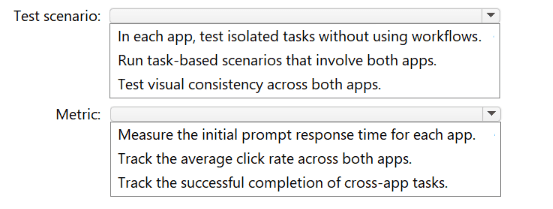
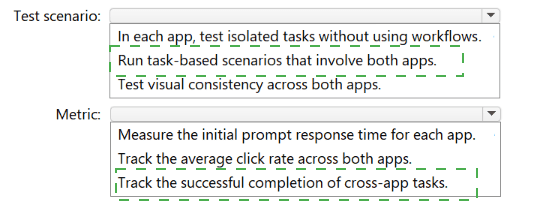
Which test scenario and metric should you include in the design? To answer, select the appropriate options in the answer area.

NOTE: Each correct selection is worth one point.

Show answerHide answer

Explanation


Explanation:
This AB-100 question evaluates testing strategy for a Copilot Studio agent integrated with multiple Dynamics 365 applications (Customer Service and Sales). The focus is on end-to-end capabilities, specifically the agent’s ability to coordinate tasks and data across apps while providing relevant responses. Proper testing must validate cross-application functionality rather than isolated or superficial checks.

Correct Option:

Test scenario: Run task-based scenarios that involve both apps.
End-to-end testing requires creating realistic business scenarios where the agent must interact with both Dynamics 365 Customer Service and Sales simultaneously (e.g., creating a case from a sales opportunity or updating customer data across modules). This validates the agent’s coordination and data interaction capabilities.

Correct Option:

Metric: Track the successful completion of cross-app tasks.
This metric directly measures whether the agent successfully completes workflows that span both applications, including correct data flow, context retention, and accurate outcomes. It confirms the agent’s effectiveness in real business processes involving multiple Dynamics 365 apps.

Incorrect Option:

Test scenario: In each app, test isolated tasks without using workflows.
Isolated testing per app does not validate the required cross-app coordination and integration, making it insufficient for end-to-end scenario testing.

Incorrect Option:

Test scenario: Test visual consistency across both apps.
Visual consistency is a UI/UX concern and does not address the functional requirements of task coordination and contextual response generation across applications.

Incorrect Option:

Metric: Measure the initial prompt response time for each app.
Response time is a performance metric but does not evaluate the quality or success of cross-app task coordination and data interactions.

Incorrect Option:

Metric: Track the average click rate across both apps.
Click rate is more relevant to web analytics or user engagement and is not meaningful for measuring AI agent task completion success in Dynamics 365 integrations.

Reference:
Microsoft Learn: Test and validate agents in Copilot Studio
Microsoft Learn: ALM and testing for Power Platform + Dynamics 365 solutions
Question 9 Choose 1
You need to design an application lifecycle management (ALM) process for a Microsoft Power Platform environment that contains a solution named Solution1.

Solution1 must include a custom connector for Copilot in Microsoft Dynamics 365 Customer Service. Solution1 must meet the following requirements:

• Ensure that the custom connector can be deployed consistently across environments as part of the ALM process.

• Allow the custom connector to be edited only in the development environment.

What should you include in the design?
Show answerHide answer

Correct answer: B Add the custom connector to Solution1.

Explanation

Explanation:
This AB-100 question tests best practices for managing custom connectors within Application Lifecycle Management (ALM) in Microsoft Power Platform. Custom connectors used by Copilot agents must be included in a managed solution to ensure consistent deployment across environments while maintaining editability only in the development environment.

Correct Option:

B. Add the custom connector to Solution1.
Adding the custom connector directly to Solution1 (as a solution component) ensures it is properly packaged, versioned, and exported/imported as part of the ALM process. This allows consistent deployment to other environments (test, production) while keeping the source editable only in the development environment through solution layers and managed solutions.

Incorrect Option:

A. Share the custom connector.
Sharing a custom connector only grants usage permissions to other users or environments. It does not support proper ALM practices such as versioning, dependency management, or consistent deployment as part of a solution.

Incorrect Option:

C. Create the custom connector in the default solution.
Creating components in the default solution is not recommended for ALM. Default solution components are difficult to export, version, and promote cleanly across environments, violating the consistency requirement.

Incorrect Option:

D. Add the custom connector to GitHub.
GitHub can be used for source control of certain assets, but custom connectors in Power Platform are not stored as code files. They must be managed as solution components for proper deployment and ALM.

Reference:
Microsoft Learn: Application lifecycle management (ALM) with Microsoft Power Platform
Microsoft Learn: Custom connectors in solutions - Power Platform
Question 10
A company has a Microsoft 365 E5 subscription and uses Microsoft Copilot Studio.

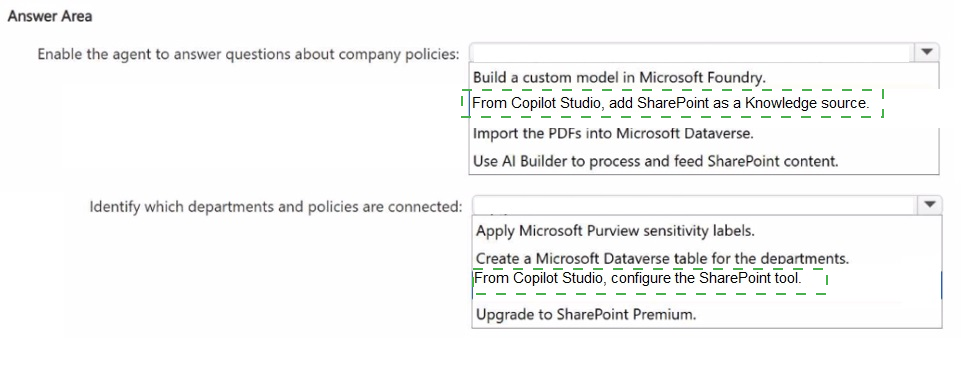
The company has a Microsoft SharePoint Online library that contains 10,000 policy PDFs from various departments. The library contains a populated column named Department for each PDF.

You need to design a Copilot Studio agent that will use the SharePoint library as a knowledge source. The solution must meet the following requirements:

• Enable the agent to answer user questions about company policies.

• Ensure that the agent can identify which departments and policies are connected.

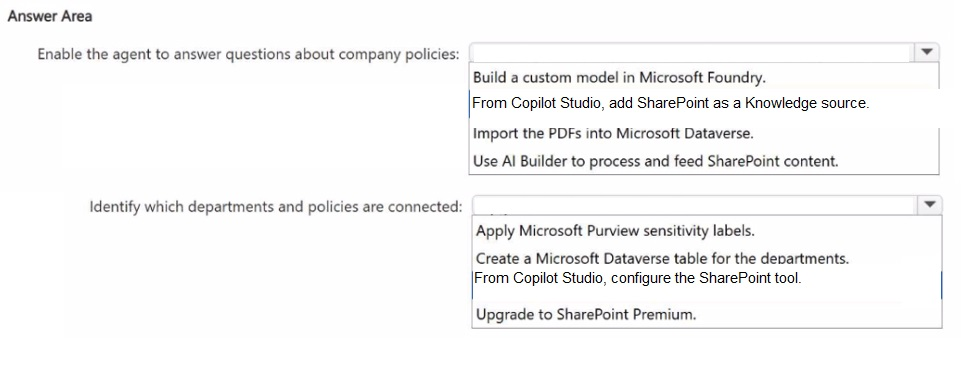
What should you include in the design for each requirement? To answer, select the appropriate options in the answer area.

NOTE: Each correct selection is worth one point.

Show answerHide answer

Explanation


Explanation:
This AB-100 question tests knowledge of integrating SharePoint document libraries as knowledge sources in Copilot Studio agents, especially when metadata (Department column) is available. The design must enable effective grounding for policy questions while leveraging structured metadata for better context and filtering.

Correct Option:

Enable the agent to answer questions about company policies: From Copilot Studio, add SharePoint as a Knowledge source.
Adding the SharePoint Online library directly as a knowledge source in Copilot Studio allows the generative AI agent to retrieve and ground responses in the 10,000 policy PDFs. This is the recommended, low-code approach for document-based knowledge grounding without complex data migration.

Correct Option:

Identify which departments and policies are connected: From Copilot Studio, configure the SharePoint tool.
Configuring the SharePoint tool (or data source) in Copilot Studio enables the agent to access and utilize metadata columns such as “Department.” This allows the agent to understand relationships between policies and departments, support filtered queries, and provide more precise, context-aware answers.

Incorrect Option:

Build a custom model in Microsoft Foundry.
Building a custom model is overkill, more expensive, and unnecessary when SharePoint integration is natively supported in Copilot Studio.

Incorrect Option:

Import the PDFs into Microsoft Dataverse.
Importing 10,000 PDFs into Dataverse is not practical or recommended due to storage limits, performance issues, and loss of native SharePoint document management features.

Incorrect Option:

Use AI Builder to process and feed SharePoint content.
AI Builder is useful for document processing (e.g., extraction), but it adds unnecessary complexity when Copilot Studio can directly consume SharePoint as a knowledge source.

Incorrect Option:

Apply Microsoft Purview sensitivity labels.
Sensitivity labels are for data protection and compliance, not for enabling the agent to identify department-policy relationships.

Incorrect Option:

Create a Microsoft Dataverse table for the departments.
Creating additional Dataverse tables is not required when the Department metadata already exists in SharePoint.

Incorrect Option:

Upgrade to SharePoint Premium.
SharePoint Premium is not a requirement for basic knowledge source integration or metadata usage in Copilot Studio.

Reference:
Microsoft Learn: Add knowledge sources to agents in Copilot Studio
Microsoft Learn: SharePoint as a knowledge source in Copilot Studio
Full mock exam

Sit the AB-100 exam before exam day

Full-length mocks with the same number of questions and the same time limit as the real AB-100 exam. Every attempt draws a new set of questions from the full bank, so you can keep going until you pass comfortably.

Get full AB-100 mock exam
  • —questions per mock
  • —time limit
  • 95questions in the bank
  • Newmock on every attempt