Cisco certification · Exam 350-801

350-801 Mock Exam Page 5

Implementing Cisco Collaboration Core Technologies (350-801 CLCOR)

Free 350-801 mock exam questions 41–50, each with the answer and an explanation.

20 questions · 27 minutes · free, no sign-up

Free 350-801 questions

41–50 of 162 free
Question 41 Choose 1

Which action prevent toll fraud in Cisco Unified Communications Manager?

Show answerHide answer

Correct answer: A

Configure ad hoc conference restriction

Explanation

Explanation:
Toll fraud occurs when unauthorized callers place expensive external (off-net) calls through the CUCM system. One common vector is an ad-hoc conference that is left open after the legitimate parties disconnect, allowing an external caller to stay connected and dial further off-net numbers. Configuring ad-hoc conference restriction forces the conference to drop when the only remaining participant is an off-net party, thereby closing this fraud path.

Correct Option:

A. Configure ad hoc conference restriction
In CUCM Service Parameters (or the Conference Bridge configuration) enable the “Drop Ad Hoc Conference” / “Restrict Ad Hoc Conferences” setting. When the last on-net participant leaves, the conference is automatically torn down, preventing an external caller from remaining in the conference and placing fraudulent long-distance calls.

Incorrect Option:

B. Implement toll fraud restriction in the Cisco IOS router
Router-level class-of-restriction or translation rules can help, but the question asks specifically for an action inside Cisco Unified Communications Manager.

C. Allow off-net to off-net transfers
Explicitly permitting off-net-to-off-net transfers opens, rather than closes, a toll-fraud vector.

D. Implement route patterns in Cisco Unified CM
Route patterns are required for normal call routing; they do not by themselves prevent the conference-based toll-fraud scenario addressed by the restriction setting.

Reference:
Cisco Unified Communications Manager System Guide / Security Guide – “Preventing Toll Fraud”: configure the Drop Ad Hoc Conference parameter to ensure conferences are released when only off-net parties remain.
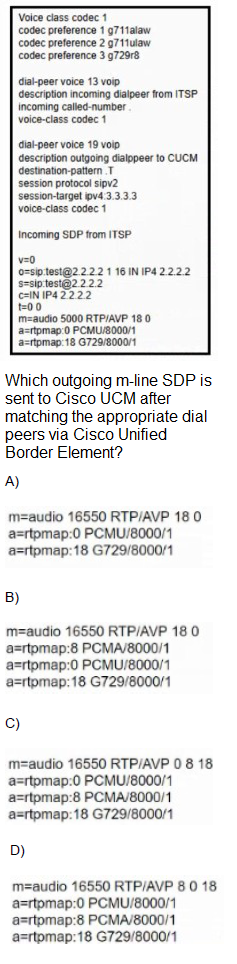
Question 42 Choose 2

An engineer is designing a load balancing solution for two Cisco Unified Border routers.
The first router (cube1.abc.com) takes 60% of the calls and the second router
(cute2.abc.com) takes 40% of the calls, Assume all DNS A records have been created.
Which two SRV records are needed for a load balanced solution? (Choose two.)

Show answerHide answer

Correct answer: A, E

sip_udp.abc.com 60 IN SRV 1 40 5060 cube2.abc.com

sip_udp.abc.com 60 IN SRV 1 60 5060 cube1.abc.com

Explanation

Explanation:
DNS SRV records distribute SIP traffic according to priority and weight. Records that share the same (lowest) priority are load-balanced by their relative weights. To give cube1 60 % of the calls and cube2 40 % of the calls, both records must use the same priority value and the weights must be set to 60 and 40 respectively. The two correct SRV records therefore use priority 1 with the matching weights.

Correct Option:

A. sip_udp.abc.com 60 IN SRV 1 40 5060 cube2.abc.com
Priority 1, weight 40 → cube2 receives 40 % of the traffic.

E. sip_udp.abc.com 60 IN SRV 1 60 5060 cube1.abc.com
Priority 1, weight 60 → cube1 receives 60 % of the traffic.

Because both records have identical priority, the DNS resolver distributes queries proportionally to the weights (60 : 40).

Incorrect Option:

B. sip_udp.abc.com 60 IN SRV 3 60 5060 cube2.abc.com
Higher priority number (3) means this record is used only if lower-priority records fail; it does not participate in the 60/40 load share.

C. sip_udp.abc.com 60 IN SRV 60 1 5060 cube1.abc.com
Priority and weight values are swapped; priority 60 is very low preference and weight 1 produces almost no traffic share.

D. sip_udp.abc.com 60 IN SRV 2 60 5060 cube1.abc.com
Priority 2 is lower preference than priority 1, so this record is not used while the priority-1 records are available.

Reference:
RFC 2782 (DNS SRV) and Cisco Unified Border Element / CUCM DNS SRV design guides: equal-priority records are load-balanced by weight; the weight ratio determines the percentage of calls each target receives.
Question 43 Choose 1

Which description of the Mobile and Remote Access feature is true?

Show answerHide answer

Correct answer: C

Collaboration Edge feature that enables remote individuals to access enterprise
collaboration services via Jabber without the use of a VPN connection

Explanation

Explanation:
Mobile and Remote Access (MRA) is a Collaboration Edge feature that allows remote users to register their Cisco Jabber clients (and other endpoints) to the on-premises Unified Communications infrastructure. Registration, presence, instant messaging, voice, video and other collaboration services are provided securely over the Internet without requiring a VPN tunnel into the corporate network.

Correct Option:

C. Collaboration Edge feature that enables remote individuals to access enterprise collaboration services via Jabber without the use of a VPN connection
MRA terminates the external SIP/HTTPS connections on the Expressway-E/C pair and proxies them into the internal CUCM/IM&P cluster. Remote Jabber users therefore obtain full enterprise services while remaining outside the corporate firewall and without a VPN.

Incorrect Option:

A.
MRA is not limited to international calling; it provides the full set of collaboration services, and a VPN is not required.

B.
The defining characteristic of MRA is that a VPN is not needed; the option incorrectly states that a VPN is used.

D.
MRA is specifically for remote (off-premises) users; it is not an access method for PCs that are already inside the corporate environment.

Reference:
Cisco Expressway / Mobile and Remote Access Deployment Guide: “Mobile and Remote Access allows endpoints such as Cisco Jabber to have registration, call control, provisioning, messaging and presence services provided by Cisco Unified Communications Manager when the endpoint is not within the enterprise network \ldots without the need for a separate VPN client.”
Question 44 Choose 1

Which DHCP option must be set up for new phones to obtain the TFTP server IP address?

Show answerHide answer

Correct answer: A

Option 66

Explanation

Explanation:
When a Cisco IP phone boots it uses DHCP to obtain its IP address, subnet mask, default gateway and the address of the TFTP server that holds its configuration files. DHCP Option 66 is the standard option defined for this purpose; it carries the IP address or hostname of the TFTP server. The phone reads Option 66 and then contacts that TFTP server to download its device configuration.

Correct Option:

A. Option 66
Configure the DHCP scope with Option 66 set to the IP address (or hostname) of the TFTP/CUCM server. New phones automatically receive this value and proceed with the TFTP download of their configuration.

Incorrect Option:

B. Option 15
Option 15 supplies the DNS domain name; it is not used for TFTP.

C. Option 120
Option 120 is used for SIP server addresses, not for the TFTP server.

D. Option 6
Option 6 provides DNS server IP addresses; it does not convey the TFTP server location.

Reference:
Cisco IP Phone Administration Guide and CUCM documentation: “DHCP Option 66 (TFTP Server Name) must be configured so that the phone can locate the TFTP server and download its configuration files.”
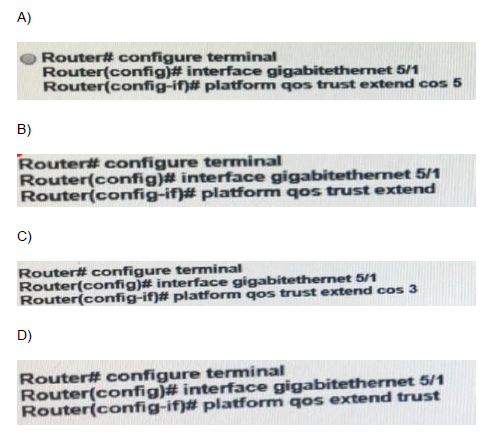
Question 45 Choose 1

Which configuration tells a switch port to send Cisco Discovery protocol packets that
configure an attached Cisco IP phone to trust tagged traffic that is received from a device that is connected to the access port on the Cisco IP phone?


Show answerHide answer

Correct answer: B

Option B

Explanation

Explanation

The question relates to QoS trust settings for Cisco IP phones in the Cisco 350-801 (CCNP Collaboration) exam.

When a Cisco IP phone connects to a switch port, a computer can connect through the phone’s access port. To allow the phone to trust the Class of Service (CoS) markings on tagged traffic received from that computer, the switch must advertise the appropriate trust configuration through Cisco Discovery Protocol (CDP).

The relevant configuration is switchport priority extend trust, which instructs the phone to trust the priority markings of traffic received from the attached PC.

Correct Option: B

The correct command is:

Switch(config)# interface GigabitEthernet1/0/2
Switch(config-if)# switchport priority extend trust

This interface-level command instructs the Cisco IP phone to trust the IEEE 802.1p priority (CoS) markings received from a PC or another device connected to the phone’s access port. The phone preserves the received priority instead of overwriting it with a configured CoS value. Cisco documents this behavior in its switch command reference.

Incorrect Options

- A. Incorrect if it configures a fixed CoS value rather than trusting the priority markings received from the attached device.

- C. Incorrect if it configures a voice VLAN or another unrelated port feature; those settings do not enable the phone to trust the attached PC’s priority markings.

- D. Incorrect if it configures a different QoS or switching behavior rather than the trust keyword of switchport priority extend.

Note: The supplied image’s option text is not visible in the question, so these incorrect-option explanations are conditional rather than verified against the exact commands shown.

Reference

Cisco official documentation:

- Catalyst 2960-XR Switch Command Reference — QoS Commands.
Question 46 Choose 1

What is set when using CoS to mark an Ethernet frame?

Show answerHide answer

Correct answer: B

802.1p User Priority bits

Explanation

Explanation
Class of Service (CoS) is a Layer 2 Quality of Service (QoS) marking mechanism used to prioritize Ethernet frames based on their importance. CoS uses the 3-bit Priority Code Point (PCP) field in the IEEE 802.1Q VLAN tag, commonly called the 802.1p User Priority field. These three bits provide eight priority values, from 0 to 7, which network devices can use to classify and prioritize traffic.

Correct Option:

B. 802.1p User Priority bits
The IEEE 802.1p User Priority field contains three bits within the 802.1Q Ethernet VLAN tag. These bits encode the CoS value, ranging from 0 (lowest priority) to 7 (highest priority). Switches use these markings to determine how frames should be queued and forwarded during congestion. For example, voice traffic may receive a higher priority than ordinary data traffic to reduce latency and jitter.

Incorrect Options

- A. IPP bits:
IP Precedence (IPP) uses the first three bits of the IP Differentiated Services field in the IP header. It is a Layer 3 marking mechanism, not the field used by CoS to mark Ethernet frames.

- C. IP ECN bits:
Explicit Congestion Notification (ECN) uses two bits in the IP Differentiated Services field to indicate congestion-related information. It does not represent the Ethernet CoS priority value.

- D. DSCP bits:
Differentiated Services Code Point (DSCP) uses six bits in the IP header to classify Layer 3 traffic for QoS treatment. DSCP is not the field used to mark Ethernet frames with CoS.

Reference
- IEEE 802.1Q — defines VLAN tagging and the three-bit Priority Code Point (PCP) field.
Question 47 Choose 1

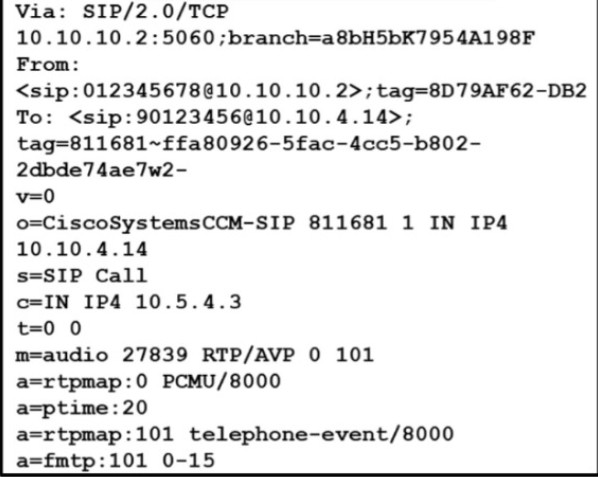
Refer to the exhibit.

Which Codec is negotiated?

Show answerHide answer

Correct answer: C

G.711ulaw

Explanation

Explanation
In Cisco Collaboration, codec negotiation determines which audio compression algorithm two endpoints will use for a voice call. The exhibit typically contains Session Description Protocol (SDP) information, including RTP payload types that identify the codecs offered during call setup.

The supplied answer is C. G.711ulaw. This matches the published version of this 350-801 practice question.

Correct Option:

C. G.711ulaw
G.711 μ-law (G.711ulaw) is an audio codec that provides uncompressed PCM voice at 64 kbps. It is widely used in North American telephony and generally delivers high voice quality with low processing requirements.

In SDP, the static RTP payload type 0 identifies G.711 μ-law. If the exhibit shows payload type 0 as the negotiated codec, the answer is G.711ulaw.

Incorrect Options

- A. G.729:
Compresses voice to approximately 8 kbps, reducing bandwidth usage compared with G.711.

- B. iLBC:
The Internet Low Bitrate Codec is designed to provide reasonable voice quality under packet-loss conditions. It commonly uses dynamic RTP payload type assignments.

- D. G.728:

Uses low-delay code-excited linear prediction (LD-CELP) and operates at 16 kbps.

These codecs are incorrect because the expected negotiated codec in this question is G.711ulaw.

Reference
- Cisco IOS Voice Command Reference — Codec Definitions
Question 48 Choose 1

An engineer is notified that the Cisco TelePresence MX800 that is registered in Cisco
Unified communications Manager shows an empty panel, and the Touch 10 shows a
corresponding icon with no action when pressed. Where does the engineer go to remove the inactive custom panel?

Show answerHide answer

Correct answer: D

The In-Room control Editor on the webpage of the MX800

Explanation

Explanation
The Cisco TelePresence MX800 supports custom in-room control panels displayed on the Cisco Touch 10 controller. These panels can control room peripherals such as lights, blinds, and other equipment.

An empty panel can still appear on the Touch 10 with its corresponding icon, even when it contains no functional controls. To remove the inactive panel and its icon, the engineer must delete it from the device's In-Room Control Editor.

Correct Option:

D. The In-Room Control Editor on the webpage of the MX800

The engineer should:

1. Open the MX800's web interface.

2. Navigate to Integration → In-Room Control.

3. Launch the In-Room Control Editor.

4. Select the inactive custom panel.

5. Click the Delete panel (trash/bin) icon.

6. Push the updated configuration to the video system, if required.

The empty panel and its associated icon will then be removed from the Touch 10 interface.

Incorrect Options

- A. Phone configuration page in CUCM Administration:
Used to configure registered phones and their settings, not to delete custom in-room control panels stored on the MX800.

- B. SIP Trunk security profile page in CUCM Administration:
Controls SIP trunk security settings, such as transport and authentication-related parameters. It does not manage Touch 10 custom panels.

- C. Software Upgrades page in CUCM OS Administration:
Used for software upgrade and installation tasks, not for editing or deleting custom control panels.

Reference
- Cisco TelePresence MX and SX Series In-Room Control Guide
Question 49 Choose 1

An engineer is setting up a system with voice and video endpoints using auto-QoS policy
on the switches. Which DSCP values are expected for interactive voice and video?

Show answerHide answer

Correct answer: A

EF AND AF41

Explanation

Explanation
Cisco Auto-QoS uses Differentiated Services Code Point (DSCP) markings to classify voice and video traffic so that switches can apply appropriate queuing and forwarding policies. For interactive voice, Cisco uses Expedited Forwarding (EF), while interactive video uses Assured Forwarding 41 (AF41). These markings help minimize delay and packet loss for real-time communications. Cisco's AutoQoS documentation explicitly identifies EF for interactive voice and AF41 for interactive video.

Correct Option:

A. EF AND AF41

- EF (DSCP 46): Used for interactive voice traffic. It receives priority treatment to minimize latency, jitter, and packet loss.

- AF41 (DSCP 34): Used for interactive video, including video conferencing. It receives preferential forwarding treatment while allowing bandwidth to be shared with other traffic classes.

Both values are standard Cisco QoS markings for these traffic types.

Incorrect Options

- B. EF AND AF21:
EF is correct for voice, but AF21 is generally associated with transactional or interactive data traffic, not interactive video.

- C. EF AND CS3:
EF is correct for voice, but CS3 is commonly used for telephony signaling rather than interactive video.

- D. EF AND CS6:
EF is correct for voice, but CS6 is associated with network control and routing traffic, not interactive video.

Reference
- Cisco AutoQoS Configuration Guide — identifies the DSCP values used for interactive voice and video.
Question 50 Choose 1

Refer to the exhibit.


Show answerHide answer

Correct answer: A

Option A

Explanation

Explanation
This question refers to DNS SRV records and how their Priority and Weight fields determine which server a client contacts first. The exhibit is needed to compare the existing SRV records for the three servers.

The matching version of this Cisco 350-801 practice question asks how to ensure that server1.sample.com is always contacted first. Its published answer is D (Priority = 5, Weight = 70), rather than A.

Correct Option:

A — as provided in your question
You have marked A as the answer, but I cannot verify that it is correct without seeing the actual exhibit and its current SRV record values.

The key DNS SRV rules are:

- Priority: Lower numerical values are preferred. A client tries servers with the lowest priority value first.

- Weight: When multiple records have the same priority, weight influences the probability of selecting each server. A higher weight gives that server a greater share of selections; it does not guarantee that it is always contacted first.

Therefore, to guarantee that server1.sample.com is preferred over the other two servers, configure it with a lower priority value than both alternatives.

Incorrect Options

- B. Priority = 10, Weight = 5:
Does not guarantee first contact if another server has a lower priority.

- C. Priority = 10, Weight = 10:
Equal priority and weight do not guarantee that this server is contacted first.

- D. Priority = 5, Weight = 70:
Would be preferred over servers with priority 10, assuming those are the other records. This is the published answer to the matching question, but the exhibit should be checked to confirm.

Reference
- RFC 2782 — A DNS RR for specifying the location of services (DNS SRV)
Full mock exam

Sit the 350-801 exam before exam day

Full-length mocks with the same number of questions and the same time limit as the real 350-801 exam. Every attempt draws a new set of questions from the full bank, so you can keep going until you pass comfortably.

Get full 350-801 mock exam
  • 90questions per mock
  • 120 mintime limit
  • 541questions in the bank
  • Newmock on every attempt