Cisco certification · Exam 350-801

350-801 Mock Exam Page 3

Implementing Cisco Collaboration Core Technologies (350-801 CLCOR)

Free 350-801 mock exam questions 21–30, each with the answer and an explanation.

20 questions · 27 minutes · free, no sign-up

Free 350-801 questions

21–30 of 162 free
Question 21 Choose 1

Which protocol does prime collaboration Assurance use to poll the health status of different
systems in the collaboration environment?

Show answerHide answer

Correct answer: D

SNMP

Explanation

Explanation:
Cisco Prime Collaboration Assurance monitors the health and operational status of devices and services across a Cisco collaboration environment. It uses Simple Network Management Protocol (SNMP) to collect monitoring information from supported network devices, including routers, switches, and collaboration infrastructure. SNMP enables the management system to retrieve operational data and monitor device health, helping administrators identify faults, assess performance, and troubleshoot network issues.

Correct Option:

D. SNMP (Simple Network Management Protocol)
SNMP is the correct answer because Cisco Prime Collaboration Assurance uses it to monitor supported devices and collect operational and health information. Through SNMP queries and responses, the management application can retrieve information exposed by devices through Management Information Bases (MIBs). Depending on the device and configuration, SNMP traps or notifications can also report events. This information supports centralized monitoring, fault detection, and performance management.

Incorrect Option:

A. SIP (Session Initiation Protocol)
SIP is a signaling protocol used to establish, manage, and terminate multimedia communication sessions, including voice and video calls. It supports call control functions such as registration and session negotiation. Although SIP-related information may help monitor collaboration services, SIP is not the protocol identified for polling device health status in this question.

B. SMTP (Simple Mail Transfer Protocol)
SMTP is used to send and relay email messages between mail clients and servers. In network management systems, email may be used to deliver alerts or notifications to administrators. However, SMTP does not provide the standard mechanism used by Cisco Prime Collaboration Assurance to poll supported devices for operational health and status information.

C. SCCP (Skinny Client Control Protocol)
SCCP is a Cisco signaling protocol used primarily for communication between Cisco Unified Communications Manager and supported Cisco IP phones. It supports phone registration and call-control operations. Although SCCP plays an important role in Cisco collaboration environments, it is not the protocol used by Prime Collaboration Assurance for general device-health polling.

Reference:
1. Cisco — Hosted Collaboration Mediation Fulfillment Planning Guide: Describes how Prime Collaboration Assurance uses SNMP and HTTP to remotely poll information from devices in an IP communications deployment. Official Cisco documentation
Question 22 Choose 1

What is a characteristic of video traffic that governs QoS requirements for video?

Show answerHide answer

Correct answer: D

Video is typically variable bit rate.

Explanation

Explanation:
Video traffic has specific Quality of Service (QoS) requirements because its bandwidth consumption can change depending on factors such as video resolution, frame rate, motion, and encoding efficiency. Most real-time video codecs use variable bit rate (VBR), meaning the amount of data transmitted fluctuates over time. QoS mechanisms must account for these bandwidth variations while controlling delay, jitter, and packet loss to maintain acceptable video quality and a smooth viewing experience.

Correct Option:

D. Video is typically variable bit rate.
Video traffic is typically variable bit rate because the bandwidth required changes with the complexity of the video content. Scenes with rapid motion or intricate details generally require more data than static scenes. Consequently, video traffic can experience significant bandwidth fluctuations. Network administrators must provision sufficient capacity and configure QoS policies to manage congestion, prioritize real-time media, and minimize packet loss, delay, and jitter.

Incorrect Option:

A. Video is typically constant bit rate.
This option is incorrect because video traffic is generally variable bit rate (VBR), not constant bit rate (CBR). Video codecs produce different amounts of data depending on frame complexity and motion. Although some video systems can operate at a constant bit rate, this is not the typical traffic characteristic emphasized in Cisco collaboration QoS design. CBR is more commonly associated with traditional real-time voice traffic.

B. Voice and video are the same, so they have the same QoS requirements.
This option is incorrect because voice and video have different traffic characteristics and bandwidth requirements. Both are sensitive to delay, jitter, and packet loss, but video typically consumes more bandwidth and generates burstier traffic. QoS policies must account for these differences to maintain call quality, synchronize audio and video, and allocate sufficient network resources for both media types.

C. Voice and video traffic are different, but they have the same QoS requirements.
This option is misleading because, although voice and video share some QoS objectives, their traffic profiles and bandwidth-management requirements differ. Voice generally produces a relatively steady bit rate, whereas video is typically bursty and variable bit rate. Network administrators must consider these distinctions when configuring bandwidth allocation, queuing, and prioritization to maintain a reliable collaboration experience.

Reference:
1. Cisco — Video Quality of Service (QoS) Tutorial: Explains that video traffic is typically bursty and variable bit rate, unlike constant-bit-rate voice traffic.
Question 23 Choose 1

After an engineer runs the ntils ntp status command on the Cisco Unified Communications
manager publisher, the stratum value is 16. Which issue can the cisco Unified CM cluster
experience?

Show answerHide answer

Correct answer: D

Database replication is not synchronized on the Unified CM nodes

Explanation

Explanation:
In a Cisco Unified Communications Manager (Unified CM) cluster, Network Time Protocol (NTP) synchronizes the system clocks across cluster nodes. The utils ntp status command displays the NTP synchronization status and stratum value. A stratum value of 16 indicates that the clock is unsynchronized or considered unreliable. If the publisher's time is not properly synchronized, time discrepancies between nodes can affect cluster operations, including database replication and synchronization.

Correct Option:

D. Database replication is not synchronized on the Unified CM nodes
A stratum value of 16 indicates that the publisher is not synchronized with a reliable NTP time source. Unified CM cluster nodes depend on consistent system time for reliable operation. NTP misconfiguration or synchronization failures can contribute to database replication problems and other cluster issues. The engineer should verify NTP reachability and configuration on the publisher and subscribers, then check NTP status and database replication health.

Incorrect Option:

A. The date/time group on all phones defaults to the time zone of the engineer.
This option is incorrect because phone time zones are determined by the configured date/time groups and device pool settings in Unified CM, not by the engineer running the command. An NTP synchronization problem affects accurate system time, but it does not automatically change all phones to the engineer's time zone.

B. The cluster loses access to port 124 at the firewall.
This option is incorrect because Unified CM uses UDP port 123 for NTP communication, not port 124. If a firewall blocks NTP traffic, the publisher may fail to synchronize with its configured time source, resulting in an unsynchronized stratum value of 16 and potentially affecting database replication.

C. Unified CM sends an NTPv4 packet.
This option is incorrect because sending an NTPv4 packet is not itself a fault. Cisco Unified CM supports NTPv4 for communication with its configured external time server. The issue in this question is the stratum value of 16, which indicates an unreliable or unsynchronized time source rather than simply identifying the NTP packet version.

Reference:
1. Cisco — Troubleshoot NTP on Unified Communications Manager: Explains stratum 16, NTP synchronization requirements, and troubleshooting steps. Official Cisco NTP troubleshooting guide
Question 24 Choose 2

A user forwards a corporate number to an international number. What are two methods to
prevent this forwarded call? (Choose two.)

Show answerHide answer

Correct answer: C, E

Configure a Forced Authorization Code on the international route pattern.

Set call forward All CSS to restrict international dial patterns.

Explanation

Explanation:
In Cisco Unified Communications Manager (Unified CM), call forwarding can create a toll-fraud risk when a user forwards a corporate directory number to an unauthorized international destination. Administrators can prevent these calls by applying appropriate calling privileges and authorization controls. Forced Authorization Codes (FACs) require users to enter an authorized code before completing restricted calls, while the Call Forward All Calling Search Space (CFACSS) controls which destinations are reachable when a call is forwarded.

Correct Option:

C. Configure a Forced Authorization Code on the international route pattern.
A Forced Authorization Code (FAC) can require callers to enter a valid authorization code before completing calls through a restricted route pattern. When FAC enforcement is configured on the international route pattern, it helps prevent unauthorized international calls. This control can reduce toll-fraud risk, although its effectiveness depends on the call scenario and the applicable authorization configuration.

E. Set Call Forward All CSS to restrict international dial patterns.
The Call Forward All Calling Search Space (CFACSS) determines the destinations that Unified CM permits when a user forwards calls using Call Forward All. Assigning a restricted CSS that does not include international route patterns prevents the forwarded call from reaching international numbers. This is an effective way to limit toll-fraud exposure while allowing permitted forwarded calls to continue normally.

Incorrect Option:

A. Configure all forced code on all router.
This option is incorrect because configuring authorization codes on all routers is not the appropriate Unified CM control for restricting forwarded international calls. FACs are configured in Unified CM and associated with route patterns or other supported call-routing configurations. Applying security controls indiscriminately to routers does not directly enforce the forwarding privileges controlled by Unified CM's Calling Search Spaces.

B. Block international dial patterns in the SIP trunk CSS.
This option is incorrect because the SIP trunk's Calling Search Space controls which partitions are available for calls routed through that trunk. It does not replace the forwarding-specific CSS controls that determine which destinations a user's forwarded call can reach. The more direct solution is to restrict the Call Forward All CSS so international route patterns are unavailable.

D. Set the call Classification to OnNet for the international route pattern.
This option is incorrect because call classification identifies a call as OnNet or OffNet; it does not independently restrict access to international destinations. Changing the classification does not replace authorization controls or Calling Search Space restrictions. To prevent unauthorized international forwarding, administrators should use FAC enforcement where appropriate and restrict the forwarding CSS to permitted destinations.

Reference:
1. Cisco — Client Matter Codes and Forced Authorization Codes, Unified CM Release 14. Explains how to configure FAC on route patterns and documents the limitation that forwarded calls to FAC-enabled patterns fail because no user is available to enter the code. Official Cisco feature configuration guide
Question 25 Choose 2

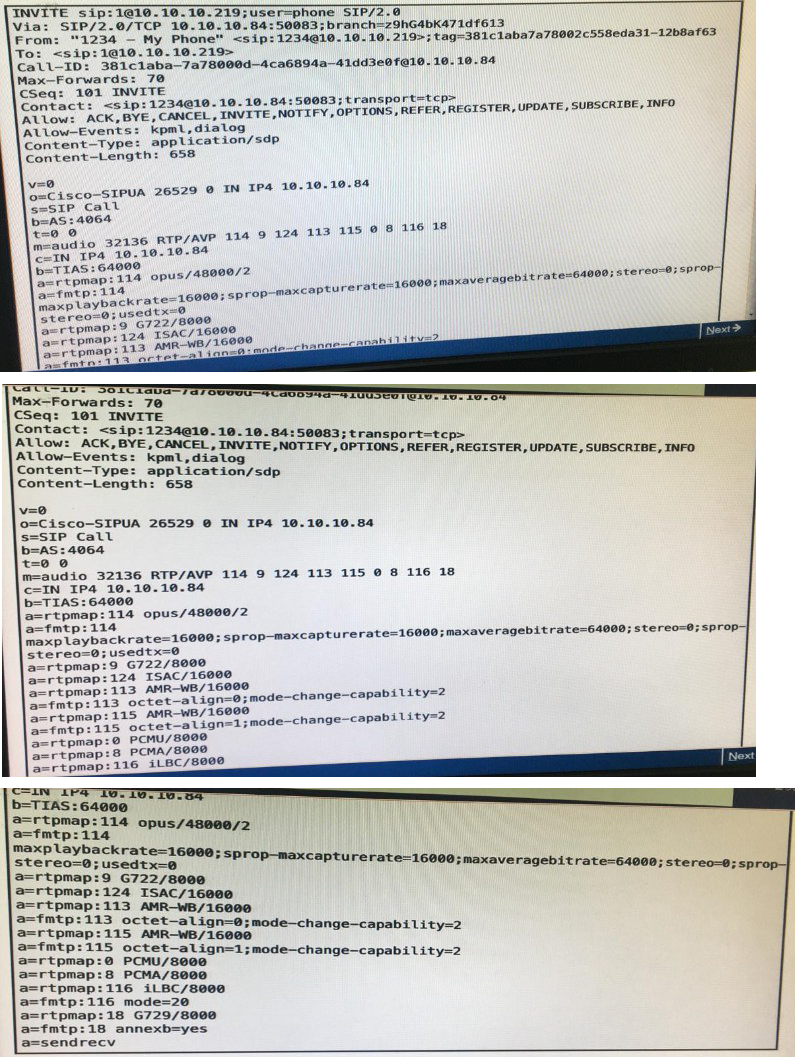
Refer to the exhibit.

When a UC Administrator is troubleshooting DTMF negotiated by this SIP INVITE, which two messages should be examined next to further troubleshoot the issue? (Choose two.)

Show answerHide answer

Correct answer: C, D

SUBSCRIBE

NOTIFY

Explanation

Explanation:
When troubleshooting Dual-Tone Multi-Frequency (DTMF) negotiation in a SIP call, the administrator must identify how the endpoints negotiate and transport keypad digits. Some Cisco collaboration devices support Key Press Markup Language (KPML), which uses SIP event subscriptions to communicate DTMF events outside the audio stream. The SIP SUBSCRIBE and NOTIFY messages are therefore important when investigating whether this DTMF signaling method is negotiated and functioning correctly.

Correct Option:

C. SUBSCRIBE
The SIP SUBSCRIBE method establishes a subscription to an event package, such as KPML for DTMF digit collection. In Cisco Unified Communications Manager environments, a device can subscribe to receive notifications about telephone keypad events. When troubleshooting DTMF, inspect the SUBSCRIBE message to verify the event package, request headers, and subscription details, and determine whether the subscription was accepted successfully.

D. NOTIFY
The SIP NOTIFY method delivers event information to a subscriber after a subscription has been established. For KPML-based DTMF signaling, the notifying device sends keypad-event information in NOTIFY messages. Examining these messages helps confirm whether DTMF digits are being reported correctly, whether the event payload is valid, and whether the subscription remains active during the call.

Incorrect Option:

A. PRACK
PRACK (Provisional Response Acknowledgment) acknowledges reliable provisional SIP responses, such as 183 Session Progress, when the reliable provisional response mechanism is used. It supports SIP call signaling but is not the primary message used to transport KPML-based DTMF digit events. For this troubleshooting scenario, SUBSCRIBE and NOTIFY are more relevant.

B. UPDATE
The SIP UPDATE method modifies session parameters during an early or established SIP dialog, such as updating session descriptions or media parameters. Although session changes can affect media behavior, UPDATE is not the message pair used for KPML event subscription and DTMF notification. Inspecting SUBSCRIBE and NOTIFY is the appropriate approach for this DTMF signaling method.

E. REGISTER
The SIP REGISTER method allows a user agent to register its address with a SIP registrar. Registration establishes or refreshes the device's registration binding, but it does not carry KPML keypad-event notifications. A device can be successfully registered and still experience DTMF signaling issues, so the relevant event messages must be examined separately.

Reference:
1. Cisco — SIP Configuration Guide: DTMF Events Through SIP Signaling. Explains how SIP SUBSCRIBE and NOTIFY messages support out-of-band DTMF signaling.
Question 26 Choose 1

An administrator is designing a new Cisco UCM for a company with many departments and
firm structure on their communications policies. The administrator must make sure that
these communication policies are reflected in the phone system setup. Certain
departments cannot be accessed directly, even if they have dedicated DID numbers. Some
phones, especially public phones, must not be able to dial international numbers Which
type of function is configured to control which device is allowed to call another device in
Cisco UCM?

Show answerHide answer

Correct answer: A

partitions and calling search spaces

Explanation

Explanation:
Cisco Unified Communications Manager (Unified CM) uses partitions and Calling Search Spaces (CSSs) to control call access and enforce an organization's communication policies. Partitions group directory numbers and route patterns into logical categories, while CSSs determine which partitions a phone or calling entity can access. By assigning appropriate CSSs to devices and restricting access to sensitive partitions or international route patterns, administrators can control which destinations different phones are permitted to call.

Correct Option:

A. Partitions and Calling Search Spaces
Partitions and CSSs work together to implement call-routing permissions in Cisco Unified CM. A partition contains directory numbers or route patterns, while a CSS specifies the partitions that a calling device can search. For example, a public phone can use a restricted CSS that excludes international route patterns, and departments with confidential numbers can be protected by limiting which devices have access to their partitions.

Incorrect Option:

B. Calling patterns and route patterns
Route patterns define how dialed numbers are matched and routed to destinations such as gateways or trunks. Although route patterns are essential to call routing, the term “calling patterns” does not identify the primary access-control mechanism in Unified CM. Partitions and CSSs determine whether a phone can access a particular route pattern or directory number.

C. Regions and device pools
Regions control codec selection and bandwidth usage for audio and video calls, while device pools group common device configuration settings, including locations, date/time groups, and regions. These features help manage system configuration and media resources, but they do not directly determine which phones are permitted to call specific directory numbers or international destinations.

D. Links and pipes
Links and pipes are not the standard Unified CM call-access control functions described in this question. Unified CM uses partitions and Calling Search Spaces to organize destinations and enforce calling privileges. These controls allow administrators to create different classes of service for departments, employees, management, and public phones.

Reference:
1. Cisco — System Configuration Guide for Unified CM, Release 14: Explains partitions, Calling Search Spaces, and how they restrict access to call destinations. Official Cisco documentation
Question 27 Choose 1

When a phone is registered over Mobile and Remote Access, where does it register?

Show answerHide answer

Correct answer: B

Cisco Unified Communications Manager

Explanation

Explanation:
Cisco Mobile and Remote Access (MRA) allows supported collaboration endpoints to securely access enterprise collaboration services from outside the corporate network without requiring a traditional VPN. The solution uses Expressway-C and Expressway-E to provide secure traversal through the organization's network perimeter. Although these Expressway servers facilitate discovery, signaling traversal, and connectivity, the phone's actual registration and call-control services remain hosted by Cisco Unified Communications Manager (Unified CM).

Correct Option:

B. Cisco Unified Communications Manager
When a phone connects through Mobile and Remote Access, it registers with Cisco Unified Communications Manager, which provides call control, device configuration, and telephony services. Expressway-E acts as the external access point, while Expressway-C provides the internal traversal and signaling connection toward Unified CM. These components allow the phone to register securely without being directly exposed to the public internet.

Incorrect Option:

A. Expressway-C
Expressway-C is the internal traversal server in an MRA deployment. It communicates with Expressway-E across the traversal zone and provides access toward internal collaboration services, including Unified CM. However, Expressway-C does not serve as the phone's call-control registration destination. The phone registers with Unified CM through the MRA infrastructure.

C. Cisco Unified Presence Server
Cisco Unified Presence Server provides presence and instant messaging capabilities in supported Cisco Unified Communications deployments. It can support features that display users' availability, but it is not the registration destination for MRA-enabled phones. Phone registration and call control are handled by Unified CM.

D. Expressway-E
Expressway-E is the externally facing server that enables remote endpoints to discover and securely access enterprise collaboration services. It provides the external side of the MRA connection and helps establish secure signaling traversal. However, it does not register the phone as its call-control server; registration occurs with Unified CM.

Reference:
1. Cisco — Mobile and Remote Access Through Cisco Expressway Deployment Guide: Explains the MRA architecture, Expressway traversal, and Unified CM registration.
Question 28 Choose 1

Which field of a Real-Time Transport Protocol packet allows receiving devices to detect lost
packets?

Show answerHide answer

Correct answer: C

Sequence number

Explanation

Explanation:
Real-Time Transport Protocol (RTP) carries real-time audio and video across IP networks. Its header contains several fields that help receiving devices process media correctly and identify transmission problems. The sequence number increases by one for each RTP packet sent, allowing the receiver to detect missing packets by identifying gaps in the sequence. This information is particularly important in Cisco collaboration environments, where packet loss can degrade voice quality, video playback, and synchronization.

Correct Option:

C. Sequence number
The RTP sequence number is a 16-bit field that increments for each packet transmitted. The receiving endpoint examines successive sequence numbers to identify gaps that indicate potentially lost or missing packets. For example, if packets numbered 100, 101, and 103 arrive, the receiver can infer that packet 102 is missing. Sequence numbers also help reorder packets that arrive out of order, supporting more reliable media processing.

Incorrect Option:

A. CSRC (Contributing Source ID)
The CSRC field identifies contributing sources in an RTP stream, particularly when a mixer combines media from multiple sources. It helps the receiver identify the sources contributing to the payload. However, it does not track packet ordering or detect packet loss. That function is performed by the RTP sequence number.

B. Timestamp
The RTP timestamp indicates the sampling instant of the media data in a packet. It helps the receiver reconstruct media timing, support synchronized playback, and manage variations in packet arrival times. Although timestamps are essential for smooth audio and video playback, they do not directly identify missing packets. The sequence number is used for that purpose.

D. SSRC (Synchronization Source Identifier)
The SSRC field identifies the synchronization source of an RTP stream. It allows receivers to distinguish between different media streams, such as audio streams from separate participants in a conference. Although SSRC is important for stream identification and synchronization, it does not indicate whether individual packets have been lost. The RTP sequence number provides that information.

Reference:
1. RFC 3550 — RTP: A Transport Protocol for Real-Time Applications. Section 5.1 defines the RTP sequence number and explains that it supports packet-loss detection and packet sequence reconstruction.
Question 29 Choose 1

Multiple route patterns match a number. How does Cisco Unified Communications
Manager determine which pattern to use?

Show answerHide answer

Correct answer: B

the one with the longest match

Explanation

Explanation:
Cisco Unified Communications Manager (CUCM) selects a route pattern based on the most specific match for the dialed digits. When multiple route patterns could match a number, CUCM uses digit-pattern specificity, favoring the pattern that matches the greatest number of dialed digits with the fewest wildcards or variable characters. This allows more specific routing rules to take precedence over broader patterns and helps administrators control call routing predictably.

Correct Option:

B. The one with the longest match
CUCM uses closest-match routing, selecting the pattern that matches the dialed number while matching the fewest other possible numbers. This generally favors the most specific pattern, often described in exam questions as the longest match. For example, if 8XXX, 89XX, and 8912 all match the dialed number 8912, the exact pattern 8912 is the closest match and is selected.

Incorrect Option:

A. The one that discards everything PreDot
The PreDot (.) character is a digit-manipulation instruction, not a route-pattern selection rule. It tells CUCM to discard the digits preceding the dot before sending the remaining digits to the next system. Although this setting can affect how a number is transmitted, it does not determine which pattern wins when multiple route patterns match the dialed number.

C. The one that comes first in numerical order
CUCM does not generally select a route pattern simply because it comes first numerically. Instead, it uses closest-match logic to select the most specific matching pattern. If equally matching patterns exist in different partitions, the calling search space determines which partition is searched first. Therefore, numerical ordering is not the general rule for selecting a route pattern.

D. The one with the closed match
“Closed match” is not the standard CUCM term for this routing behavior. Cisco describes the mechanism as closest-match routing. CUCM selects the matching pattern that encompasses the fewest other possible numbers, favoring a more specific match over a broader wildcard pattern. The correct technical concept is closest-match routing, making option B the intended answer among the choices.

Reference:
1. Cisco Unified Communications SRND — Dial Plan and Closest-Match Routing
Question 30 Choose 1

A presence redundancy group is deployed, and an engineer with ID012345678 initiates a
Manager fallback. Which statement about Cisco server Recovery Manager is true?

Show answerHide answer

Correct answer: D

disconnects all users that had been failed over, and the users must log in again

Explanation

Explanation:
Cisco Unified Communications Manager IM and Presence Service uses presence redundancy groups to maintain service availability when a node fails. A Manager fallback operation returns users from a secondary node to their designated primary node when the primary node is available again. Cisco Server Recovery Manager coordinates recovery actions during this process. The key distinction is that fallback can interrupt existing user sessions, requiring affected users to sign in again.

Correct Option:

D. Disconnects all users that had been failed over, and the users must log in again
During a manual fallback, Cisco Server Recovery Manager restarts critical services on the primary IM and Presence node. It then disconnects users who had previously failed over to the backup node. Those users must log in again to reconnect to their assigned node. This behavior is explicitly documented by Cisco for manual fallback in a presence redundancy group.

Incorrect Option:

A. Restart the Cisco Presence Engine
This is incorrect because restarting the Cisco Presence Engine alone does not describe the documented behavior of a manual fallback operation. Server Recovery Manager manages the transition between the primary and backup IM and Presence nodes, including restarting critical services on the primary node and disconnecting affected users. The option focuses on one service rather than the complete fallback behavior.

B. Disconnects all users that had been failed over
This is partially correct but incomplete. Cisco documents that manual fallback disconnects users who had failed over, but it also requires those users to log in again to their assigned node. Because option D includes both the disconnection and re-login requirement, it is the most accurate answer.

C. Restarts critical services on the secondary node
This is incorrect because, during manual fallback, Server Recovery Manager restarts critical services on the primary node, not the secondary node. The purpose is to restore normal operation on the recovered primary node and return users to their assigned node. Restarting services on the secondary node is not the action described in Cisco’s manual-fallback procedure.
Full mock exam

Sit the 350-801 exam before exam day

Full-length mocks with the same number of questions and the same time limit as the real 350-801 exam. Every attempt draws a new set of questions from the full bank, so you can keep going until you pass comfortably.

Get full 350-801 mock exam
  • 90questions per mock
  • 120 mintime limit
  • 541questions in the bank
  • Newmock on every attempt