Cisco certification · Exam 350-801

350-801 Mock Exam Page 4

Implementing Cisco Collaboration Core Technologies (350-801 CLCOR)

Free 350-801 mock exam questions 31–40, each with the answer and an explanation.

20 questions · 27 minutes · free, no sign-up

Free 350-801 questions

31–40 of 162 free
Question 31 Choose 1

An engineer must extend the corporate phone system to mobile users connecting through
the internet with their own devices. One requirement is to keep this as simple as possible
for end users. Which infrastructure element achieves these goals?

Show answerHide answer

Correct answer: A

Cisco Expressway-C and Expressway-E

Explanation

Explanation:
Organizations can extend Cisco Unified Communications to remote and mobile users through Mobile and Remote Access (MRA). MRA allows supported Cisco collaboration clients and devices to connect securely from outside the corporate network without requiring users to establish a traditional VPN connection. The Cisco Expressway-C and Expressway-E pair provides the traversal and secure access infrastructure for this capability, simplifying the connection process for users working over the internet.

Correct Option:

A. Cisco Expressway-C and Expressway-E
Cisco Expressway-C is deployed inside the enterprise network, while Expressway-E is placed at the network edge, typically in a DMZ. Together, they provide secure traversal for Mobile and Remote Access (MRA), allowing supported Cisco collaboration clients to access corporate calling, messaging, and presence services over the internet without a separate VPN client. This supports bring-your-own-device (BYOD) use while simplifying the end-user experience.

Incorrect Option:

B. Cisco Unified Instant Messaging and Presence
Cisco Unified IM and Presence provides instant messaging, presence information, and availability features. It does not, by itself, provide the secure edge traversal infrastructure needed for remote clients to access corporate collaboration services from the internet. IM and Presence can integrate with an Expressway MRA deployment, but Expressway-C and Expressway-E provide the remote-access path.

C. Cisco Unified Border Element
Cisco Unified Border Element (CUBE) is primarily a session border controller used to connect voice networks, such as an enterprise VoIP system and a service-provider SIP trunk. It provides functions such as SIP interworking, security, and media handling. Although CUBE is important in voice-network connectivity, it is not the standard solution for Cisco Jabber mobile and remote access without a VPN.

D. Cisco Express Mobility
Cisco Extension Mobility allows users to access their phone profiles on supported Cisco IP phones, typically by logging in to a device. It is not the infrastructure that securely connects internet-based mobile clients to corporate Unified Communications services. The question's requirements—remote access over the internet and a simple user experience—identify Cisco Expressway-C and Expressway-E for MRA.

Reference:
1. Cisco Expressway Series — Features and Benefits
Question 32 Choose 1

Why would we not include an end user’s PC device in a QoS trust boundary?

Show answerHide answer

Correct answer: C

The end user may incorrectly tag their traffic to be prioritized over other network traffic

Explanation

Explanation:
A QoS trust boundary defines where the network begins trusting packet markings, such as Differentiated Services Code Point (DSCP) or Layer 2 Class of Service (CoS), to determine traffic priority. End-user PCs are generally considered untrusted because users or applications may mark traffic with an unnecessarily high priority. If network switches trust these markings without validation, ordinary data traffic could receive preferential treatment over latency-sensitive voice and video traffic.

Correct Option:

C. The end user may incorrectly tag their traffic to be prioritized over other network traffic
An end user can configure a PC or application to mark packets with high-priority DSCP or CoS values, potentially causing ordinary data traffic to receive preferential network treatment. If the access switch trusts those markings, the user could consume priority queue resources intended for voice and video. Cisco therefore recommends treating unmanaged PCs as untrusted and validating or remarking their traffic at the network edge.

Incorrect Option:

A. The end user could incorrectly tag their traffic to bypass firewalls.
QoS markings identify traffic priority; they do not inherently bypass firewall rules. Firewalls enforce security policies based on factors such as addresses, ports, protocols, and configured inspection rules. While QoS and security policies can interact in network design, the primary reason for not trusting PC-generated markings is to prevent users from improperly claiming network priority, not to bypass firewalls.

B. There is no reason not to include an end user’s PC device in a QoS trust boundary.
This is incorrect because unmanaged PCs may generate arbitrary QoS markings, intentionally or accidentally. Trusting those markings without validation can allow non-real-time traffic to compete with latency-sensitive voice and video. Centrally managed and secured PCs may be trusted under an appropriate policy, but ordinary unmanaged endpoints should generally be treated as untrusted.

D. The end user could incorrectly tag their traffic to advertise their PC as a default gateway.
QoS markings do not advertise a device as a default gateway. Default gateway information is typically configured manually or learned through network mechanisms such as DHCP. DSCP and CoS markings influence how network devices classify and prioritize traffic; they do not establish gateway roles or routing advertisements. Therefore, this is unrelated to the QoS trust-boundary concern.

Reference:
1. Cisco — Borderless Campus Design Guide: QoS Classification and Marking
Question 33 Choose 1

What is the element of Cisco collaboration infrastructure that allows Jabber clients outside
of the network to register in Cisco Unified communications Manager and use its resources?

Show answerHide answer

Correct answer: A

Cisco Expressway

Explanation

Explanation:
Cisco Jabber clients located outside the corporate network need a secure method to access internal Cisco Unified Communications Manager (CUCM) services. Cisco Expressway Mobile and Remote Access (MRA) provides this connectivity by enabling supported Jabber clients to discover and connect to enterprise collaboration services over the internet, without requiring a traditional VPN. Expressway provides secure traversal between the external client and the internal collaboration infrastructure.

Correct Option:

A. Cisco Expressway
Cisco Expressway enables Jabber clients outside the corporate network to access CUCM for services such as call control and, when configured, other collaboration features. In an MRA deployment, Expressway-E provides the external-facing connection, while Expressway-C communicates with internal collaboration servers. This architecture simplifies remote access and helps protect internal systems without requiring users to establish a VPN connection.

Incorrect Option:

B. Cisco Prime Collaboration Provisioning Server
Cisco Prime Collaboration Provisioning is a management and provisioning solution used to automate and manage collaboration services, users, and devices. It does not provide the secure traversal path that remote Jabber clients require to access CUCM over the internet. Provisioning tools support administration; Expressway provides the remote-access infrastructure.

C. Cisco Unified Border Element
Cisco Unified Border Element (CUBE) is a session border controller primarily used to connect enterprise voice networks with service-provider SIP trunks or other SIP-based systems. It provides signaling and media interworking and security functions, but it is not the standard MRA component for allowing Jabber clients to connect remotely to CUCM.

D. Cisco IM and Presence node
The Cisco IM and Presence node provides instant messaging, availability, and presence services. It can participate in the services accessed by Jabber, but it does not independently provide the secure internet-facing traversal needed for remote clients. Expressway supplies the MRA connectivity, while IM and Presence provides its specific collaboration services.

Reference:
1. Cisco Expressway Series — Product Overview
Question 34 Choose 1

How is bandwidth allocated to traffic flows in a flow-based WFQ solution?

Show answerHide answer

Correct answer: A

Each type of traffic flow has equal bandwidth

Explanation

Explanation:
Flow-based Weighted Fair Queuing (WFQ) is a congestion-management mechanism that schedules packets from multiple flows fairly, rather than allowing one flow to consume all available bandwidth. In classic flow-based WFQ, flows are identified and given fair access to the available bandwidth, generally based on their classification and configured weights. Unlike strict priority queuing, WFQ does not inherently give voice traffic absolute priority over every other flow.

Correct Option:

A. Each type of traffic flow has equal bandwidth
Cisco's standard flow-based WFQ allocates an equal share of bandwidth to each active flow during congestion, rather than giving every application type a fixed allocation. A flow is identified using packet-header information, such as source and destination IP addresses and TCP/UDP ports. One important nuance: classic Cisco WFQ can account for IP precedence, so higher-precedence traffic may receive preferential scheduling; option A reflects the basic equal-flow principle.

Incorrect Option:

B. Bandwidth is divided among traffic flows. Voice has priority.
This is incorrect because flow-based WFQ does not inherently place all voice traffic into a strict-priority queue. Instead, it fairly schedules individual flows and can favor low-volume, interactive traffic. Strict priority for voice is typically achieved using Low Latency Queuing (LLQ), which adds a priority queue to class-based WFQ. This option confuses flow-based WFQ with a priority-queuing mechanism.

C. Voice has priority and the other types of traffic share the remaining bandwidth.
This describes a priority-queuing design more closely than standard flow-based WFQ. In a configuration using LLQ, voice traffic can receive strict-priority treatment while other classes share the remaining bandwidth according to their policies. Standard flow-based WFQ instead schedules flows fairly, with possible preferential treatment based on traffic characteristics and IP precedence. Therefore, this is not the best answer.

D. All the bandwidth is divided based on the QoS marking of the packets.
This is incorrect because standard flow-based WFQ does not allocate all bandwidth solely according to QoS markings. It primarily separates traffic into flows and shares bandwidth fairly. Cisco WFQ can consider IP precedence when determining scheduling weights, but that is different from dividing bandwidth exclusively according to QoS markings. Class-based WFQ allows administrators to define traffic classes and configure bandwidth allocations more explicitly.

Reference:
1. Cisco — Configuring Weighted Fair Queueing
Question 35 Choose 1

What is the most efficient way to configure a speed dial to number 1111 on multiple phones
using the Self-Provisioning feature in Cisco UCM?

Show answerHide answer

Correct answer: D

Configure a universal device template that has speed dials in the phone button
configuration field, then specify 1111 as a speed dial by editing the speed dial within the
universal device template.

Explanation

Explanation:
Cisco Unified Communications Manager (CUCM) Self-Provisioning allows users to provision supported phones using predefined configuration templates, reducing the need to configure each device individually. A Universal Device Template (UDT) can define common phone settings, including speed-dial button configuration and speed-dial entries. To apply the same speed dial across multiple phones efficiently, an administrator can configure the speed-dial entry in the template used for provisioning, rather than manually editing each phone.

Correct Option:

D. Configure a universal device template that has speed dials in the phone button configuration field, then specify 1111 by editing the speed dial within the universal device template
The Universal Device Template (UDT) is the appropriate place to define common device settings for phones provisioned through CUCM Self-Provisioning. Configure a phone button template that includes speed-dial buttons, then add 1111 as a speed-dial entry in the UDT. This applies the intended configuration consistently to phones provisioned using that template, reducing repetitive manual work.

Incorrect Option:

A. Configure each phone with the same DN and then configure a speed dial on one phone manually.
This is incorrect because configuring a speed dial on one phone does not automatically replicate that entry to other phones merely because they share the same directory number. Device-level speed-dial settings are not automatically synchronized across separate phone configurations. A shared provisioning template is more efficient when the same speed dial must be deployed to multiple phones.

B. Configure a phone button template and use BAT to specify 1111 after the phone is in CUCM.
Bulk Administration Tool (BAT) can add or update speed dials for multiple phones, provided their phone button template supports speed-dial buttons. However, this approach involves a separate bulk-update workflow after the phones are configured. The question specifically asks about using Self-Provisioning, for which configuring the UDT is the more direct template-based approach.

C. Configure a universal device template, then allow the user to specify 1111 through the Self Care Portal.
This is incorrect because the question asks for an administrator-controlled, consistent speed dial across multiple provisioned phones. Having each user specify the number through the Self Care Portal adds user interaction and does not centrally define the required entry in the provisioning template. Configuring the speed dial in the UDT is the intended method for standardizing the setting.

Reference:
1. Cisco — Configure Self-Provisioning Feature on CUCM
Question 36 Choose 1

A remote office has a less-than-optimal WAN connection end experiences packed loss,
delay, and jitter. Which VoIP codec should be used in this situation?

Show answerHide answer

Correct answer: D

G.729A

Explanation

Explanation:
When a remote office has a constrained or unreliable WAN connection with packet loss, delay, and jitter, selecting a codec with low bandwidth requirements is important. A codec that uses less bandwidth reduces congestion and leaves more capacity for other traffic. G.729A is a compressed voice codec that provides intelligible speech at a low bit rate, making it a common choice for bandwidth-constrained VoIP links. However, codec choice alone does not eliminate packet loss, delay, or jitter.

Correct Option:

D. G.729A — with an important technical caveat
G.729A compresses voice to an 8 kbps payload rate, compared with G.711’s 64 kbps, making it useful when WAN bandwidth is limited. This can reduce congestion-related packet drops. However, G.729A is not specifically the most resilient codec for packet loss: its speech coding can be affected by lost packets, while iLBC is designed to handle packet loss more robustly. If the question emphasizes packet loss, delay, and jitter, option C (iLBC) may be technically better; if it emphasizes low bandwidth, D is the usual choice.

Incorrect Option:

A. G.722.1
G.722.1 is a wideband audio codec designed to provide higher-quality audio at compressed bit rates. Although it can be efficient compared with G.711, it is not the typical answer for a constrained WAN where bandwidth conservation is the main priority. It also does not provide the same specific packet-loss resilience associated with iLBC.

B. G.711 A-law
G.711 A-law uses a 64 kbps voice payload, which consumes significantly more bandwidth than G.729A. On a constrained WAN, that higher bandwidth demand can worsen congestion and contribute to packet loss. G.711 can provide good voice quality when the network is well provisioned, but it is generally less suitable when bandwidth is scarce.

C. iLBC
iLBC is not necessarily incorrect for the conditions described. In fact, Cisco documentation notes that iLBC includes error-correction functionality and is designed to perform better in networks with higher packet loss. Its bit rate is approximately 13.33 or 15.2 kbps, higher than G.729A’s 8 kbps payload rate. Therefore, C is a strong technical choice when packet-loss resilience is the primary concern, even though D may be the intended answer if the exam is testing bandwidth conservation.

Reference:
1. Cisco — iLBC Support for SIP and H.323
Question 37 Choose 2

A customer asked to integrate Unity Connection with Cisco UCM using SIP protocol Which
two features must be enabled on SIP security profiles? (Choose two)

Show answerHide answer

Correct answer: D, E

Accept replaces header

Accept unsolicited notification

Explanation

Explanation:
For SIP integration between Cisco Unity Connection (CUC) and Cisco Unified Communications Manager (CUCM), the SIP trunk security profile must permit signaling needed for voicemail-related functions. Cisco's integration guide specifically identifies Accept Unsolicited Notification and Accept Replaces Header as required settings. The former allows unsolicited SIP NOTIFY messages, including those used for message-waiting indications (MWI); the latter supports SIP dialogs that replace existing dialogs, including supervised transfers.

Correct Options: D and E

D. Accept Replaces Header
This setting allows CUCM to accept new SIP dialogs that replace existing SIP dialogs. It supports call-transfer scenarios, including supervised transfers initiated through Cisco Unity Connection. When the SIP trunk security profile does not permit the Replaces header, certain transfer operations may fail. Cisco's Unity Connection SIP integration documentation explicitly instructs administrators to enable this option on the CUCM SIP trunk security profile.

E. Accept Unsolicited Notification
This setting allows CUCM to accept SIP NOTIFY messages that arrive without a prior subscription or solicitation. In a Unity Connection integration, these messages are used for message-waiting indication (MWI), which signals that a user has voicemail. If unsolicited notifications are not accepted, CUCM may reject the relevant SIP NOTIFY messages, preventing voicemail message-waiting indicators from updating correctly.

Incorrect Option:

A. Accept presence subscription
This setting controls whether CUCM accepts SIP presence-subscription requests through the trunk. Presence subscriptions are not the primary requirement for standard Unity Connection voicemail integration. The documented SIP integration settings instead include unsolicited notifications and Replaces-header support, along with out-of-dialog REFER. Therefore, this option is not one of the two expected answers for this question.

B. Enable application level authorization
This option enables application-level authorization for SIP trunk requests and requires corresponding permissions for application users. It is not a general requirement for standard Unity Connection SIP integration. Cisco's integration procedure focuses on enabling the specific SIP signaling features needed for voicemail functions and transfers. Application-level authorization should be enabled only when the deployment's security design specifically requires it.

C. Allow charging header
This option concerns handling the SIP charging header, which can carry charging-related information. It is not one of the standard settings Cisco identifies for basic Unity Connection SIP trunk integration. The relevant requirements for this question are support for SIP NOTIFY messages and Replaces-header processing, rather than charging information.

Reference:
1. Cisco Unity Connection 15 — Setting Up a CUCM SIP Trunk Integration
Question 38 Choose 1

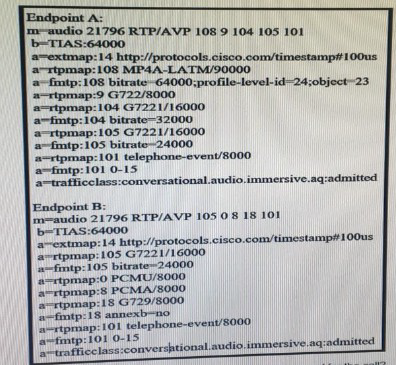
Refer to the exhibit.

Endpoint A calls endpoint B. What is the only audio codec that can be used for the call?

Show answerHide answer

Correct answer: D

G7221/16000

Explanation

Explanation:
To determine the only audio codec that Endpoint A and Endpoint B can use, compare the audio codecs listed in their SDP offers. A codec must be supported by both endpoints, including a compatible codec name and clock rate, to be selected for the call. The exhibit shows different codec lists for each endpoint, so the correct answer is the codec whose advertised format matches on both sides.

Correct Option:

D. G7221/16000
Endpoint A advertises G.722.1 at a 16 kHz clock rate with payload type 105 and a bitrate of 24,000 bps. Endpoint B advertises the same codec, clock rate, payload type, and bitrate. This is the matching audio codec that both endpoints support. Therefore, G.722.1/16000 at 24 kbps is the only common audio codec available for this call.

Incorrect Options

A. G722/8000
Endpoint A advertises G.722/8000 using payload type 9, but Endpoint B does not include payload type 9 or G.722/8000 in its SDP media description. Although G.722 is a valid wideband audio codec, it cannot be negotiated for this call because Endpoint B does not advertise support for it.

B. PCMA/8000
PCMA/8000, also known as G.711 A-law, is advertised by Endpoint B using payload type 8. However, Endpoint A does not advertise PCMA/8000 in its SDP offer. Because the endpoints do not share this codec, it cannot be selected for their media session.

C. Telephone-event/8000
Both endpoints advertise telephone-event/8000, but this is used for RTP-based DTMF signaling, not for encoding the call's voice audio. It carries telephone keypad events rather than speech. Although it appears in both codec lists, it is not the audio codec requested by the question.

Reference
1. RFC 4566 — SDP: Session Description Protocol — Defines how media formats and payload types are advertised in SDP.
Question 39 Choose 1

An employee of company ABC just quit. The IT administrator deleted the employee’s userid
from the active directory at 10 a m. on March 4th The nightly sync occurs at 10 p.m daily.
The IT administrator wants to troubleshoot and find a way to delete the userid as soon as
possible How is this issue resolved?

Show answerHide answer

Correct answer: C

Wait until 3:15 a.m. on March 6th for garbage collection to remove the user from Cisco
UCM.

Explanation

Explanation:
When Cisco Unified Communications Manager (CUCM) synchronizes end users from Microsoft Active Directory, deleting an account in Active Directory does not necessarily remove the corresponding user from CUCM immediately. The configured synchronization schedule determines when CUCM detects the directory change. After synchronization identifies a deleted user, CUCM's database cleanup processes may take additional time to remove the user record completely. Therefore, the answer depends on both the nightly synchronization time and the garbage-collection schedule.

Correct Option:

C. Wait until 3:15 a.m. on March 6th for garbage collection to remove the user from Cisco UCM
At 10 p.m. on March 4, the nightly LDAP synchronization detects that the account was deleted from Active Directory and marks the corresponding CUCM user record inactive. CUCM's garbage-collection process runs daily at 3:15 a.m., but it permanently removes accounts only after they have been inactive for more than 24 hours. The March 5 run is too early; the March 6 run removes the account.

Incorrect Options

A. Wait until 10 p.m. on March 4th when the user is automatically removed from Cisco UCM
This is incorrect because the 10 p.m. synchronization does not immediately delete the CUCM user record. Instead, it identifies the missing Active Directory account and marks the synchronized user as inactive. The user record remains in the CUCM database until the garbage-collection process removes it after the required inactive period.

B. Wait until 10 p.m. on March 5th when the user is automatically removed from Cisco UCM
This is incorrect because the March 5 synchronization is not the final deletion step. The account is marked inactive during synchronization, and garbage collection performs the permanent removal. The scheduled synchronization and the garbage-collection process serve different purposes, so waiting for another nightly sync is not the correct explanation.

D. Wait until 3:15 a.m. on March 5th for garbage collection to remove the user from Cisco UCM
This is incorrect because the account will have been marked inactive for only about 5 hours and 15 minutes when garbage collection runs on March 5. CUCM requires the record to remain inactive for more than 24 hours before permanent deletion. The next garbage-collection run, at 3:15 a.m. on March 6, satisfies this requirement.

Reference
1. Cisco Collaboration System SRND — Account Synchronization with Active Directory
Question 40 Choose 1

Which user group is targeted by MRA services?

Show answerHide answer

Correct answer: D

On-the-go mobile workforce who connect to corporate phone services using their own
mobile device

Full mock exam

Sit the 350-801 exam before exam day

Full-length mocks with the same number of questions and the same time limit as the real 350-801 exam. Every attempt draws a new set of questions from the full bank, so you can keep going until you pass comfortably.

Get full 350-801 mock exam
  • 90questions per mock
  • 120 mintime limit
  • 541questions in the bank
  • Newmock on every attempt