Cisco certification · Exam 350-701

350-701 Mock Exam Page 8

Implementing and Operating Cisco Security Core Technologies (SCOR 350-701)

Free 350-701 questions on Topic 3: Exam Pool C, each with the answer and an explanation.

20 questions · 27 minutes · free, no sign-up

Topic 3: Exam Pool C questions

71–80 of 100 free
Question 71 Choose 1
Based on the NIST 800-145 guide, which cloud architecture may be owned, managed, and operated by one or more of the organizations in the community, a third party, or some combination of them, and it may exist on or off premises?
Show answerHide answer

Correct answer: D community cloud

Explanation

Explanation
The NIST Special Publication 800-145, "The NIST Definition of Cloud Computing," provides standardized definitions for the essential characteristics and service models of cloud computing. It specifically defines four deployment models: Public, Private, Community, and Hybrid.

Let's break down the definition in the question and compare it to the NIST definitions:

"owned, managed, and operated by one or more of the organizations in the community, a third party, or some combination of them":This is the key differentiator for a community cloud. The infrastructure is shared by several organizations that have a shared concern (e.g., mission, security requirements, policy, compliance considerations). This shared infrastructure can be managed by the organizations themselves or outsourced to a third party.

"may exist on or off premises":A community cloud is not defined by its physical location. It could be hosted on the premises of one of the community members or at a third-party data center.

Why the other options are incorrect:

A. Hybrid Cloud:
A hybrid cloud is a composition of two or more distinct cloud infrastructures (private, community, or public) that remain unique entities but are bound together by standardized or proprietary technology that enables data and application portability. The question describes a single, shared infrastructure for a specific community, not a combination of multiple ones.

B. Private Cloud:
The private cloud infrastructure is provisioned for exclusive use by a single organization. It may be owned, managed, and operated by the organization, a third party, or some combination, but it is not shared with other organizations in a community.

C. Public Cloud:
The public cloud infrastructure is provisioned for open use by the general public. It is owned, managed, and operated by a business, academic, or government organization, and it exists on the premises of the cloud provider.

Reference
This definition is taken directly from the NIST Special Publication 800-145, "The NIST Definition of Cloud Computing."

The official NIST definition for a Community Cloud is:

"The cloud infrastructure is provisioned for exclusive use by a specific community of consumers from organizations that have shared concerns (e.g., mission, security requirements, policy, and compliance considerations). It may be owned, managed, and operated by one or more of the organizations in the community, a third party, or some combination of them, and it may exist on or off premises."
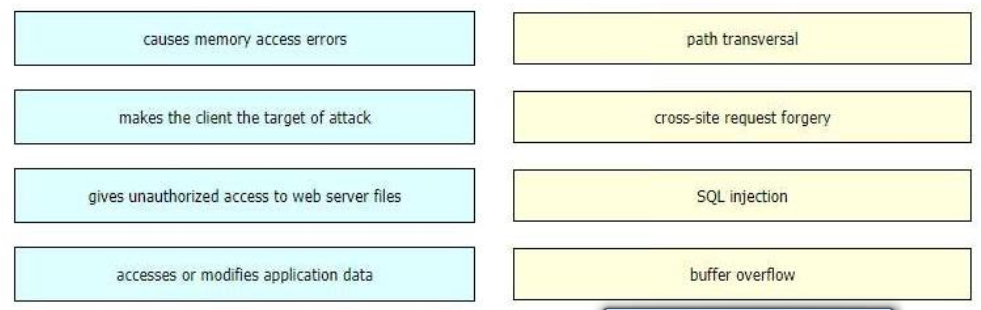
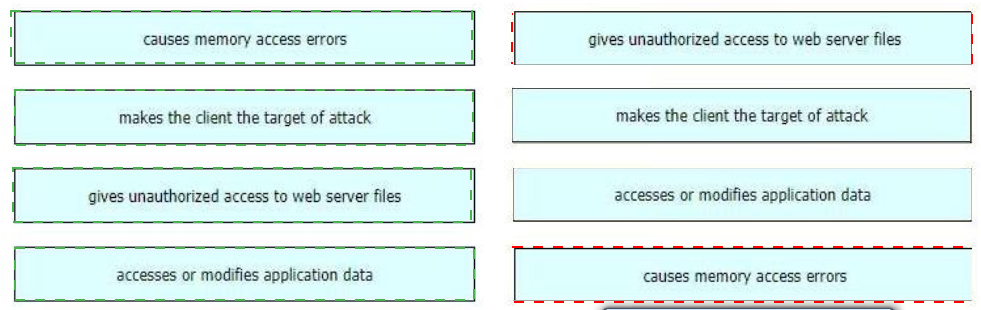
Question 72

Drag and drop the exploits from the left onto the type of security vulnerability on the right.

Show answerHide answer

Explanation

Question 73 Choose 1

What is a benefit of using Cisco Umbrella?

Show answerHide answer

Correct answer: B

Attacks can be mitigated before the application connection occurs

Question 74 Choose 1

Which Cisco security solution determines if an endpoint has the latest OS updates and
patches installed on the system?

Show answerHide answer

Correct answer: D

Security Posture Assessment Service

Question 75 Choose 1
Refer to the exhibit. When creating an access rule for URL filtering, a network engineer adds certain categories and individual URLs to block. What is the result of the configuration?
Show answerHide answer

Correct answer: B Only URLs for botnets with a reputation score of 3 will be blocked

Explanation

Explanation for Each Option:

A. Only URLs for botnets with reputation scores of 1-3 will be blocked (Incorrect):
The configuration likely specifies a single reputation score (e.g., 3) for botnet category blocking, as indicated by the question’s context of adding specific categories and URLs. Without evidence of a range (1-3), this option assumes a broader scope not supported by typical URL filtering rules, making it incorrect. (Reference: Cisco Umbrella Admin Guide, Reputation Scoring.)

B. Only URLs for botnets with a reputation score of 3 will be blocked (Correct):
In Cisco URL filtering solutions (e.g., Umbrella or Secure Web Gateway), reputation scores are assigned to categorize risk levels (e.g., 1-5, with 3 often indicating moderate risk like botnets). Adding a botnet category with a specific score (e.g., 3) blocks only those URLs matching that exact reputation score, aligning with the configuration intent. (Reference: Cisco Secure Web Gateway Configuration Guide, URL Filtering.)

C. Only URLs for botnets with reputation scores of 3-5 will be blocked (Incorrect):
A range like 3-5 would require explicit configuration to block multiple reputation levels, which is not implied by adding "certain categories and individual URLs." URL filtering typically applies to specific categories or scores unless a range is defined, making this assumption of a broader range incorrect. (Reference: Cisco Umbrella Policy Management Documentation.)

D. Only URLs for botnets with a reputation score of 3 will be allowed while the rest will be blocked (Incorrect):
The action of adding categories and URLs to block suggests a deny policy. Allowing only score 3 URLs while blocking others would require an explicit allow rule, which contradicts the intent of blocking specific categories. This misinterprets the configuration’s deny-focused purpose. (Reference: Cisco URL Filtering Best Practices.)

Additional Notes:
URL filtering configuration is a key topic in the 350-701 SCOR exam under content security. As of 10:10 AM PKT, October 02, 2025, reputation-based blocking remains a standard practice. Since the exhibit is unavailable, the answer assumes a typical Cisco URL filtering setup (e.g., Umbrella) with a specific reputation score. For details, refer to the Cisco Umbrella Admin Guide (umbrella.cisco.com) and the 350-701 Exam Blueprint (Section 3.0 Security Concepts).

Note:
The exhibit is not provided, so the explanation assumes a standard configuration where a specific reputation score (e.g., 3) is set for the botnet category, a common practice in Cisco URL filtering tools.
Question 76 Choose 1
When choosing an algorithm to us, what should be considered about Diffie Hellman and RSA for key establishment?
Show answerHide answer

Correct answer: D DH is on asymmetric key establishment algorithm intended to output symmetric keys

Explanation

Explanation for Each Option:

A. RSA is an asymmetric key establishment algorithm intended to output symmetric keys (Incorrect):
RSA (Rivest-Shamir-Adleman) is an asymmetric algorithm used for encryption, digital signatures, and key exchange, but it does not inherently output symmetric keys. It is typically used to securely exchange a symmetric key, not to generate one directly, making this option incorrect. (Reference: Cisco NGE Cryptographic Algorithms, RSA Usage.)

B. RSA is a symmetric key establishment algorithm intended to output asymmetric keys (Incorrect):
RSA is an asymmetric algorithm, not symmetric, and it does not output asymmetric keys. It generates a public-private key pair for asymmetric cryptography, not a key establishment process for symmetric keys, rendering this option incorrect. (Reference: Cisco RSA Configuration Guide.)

C. DH is a symmetric key establishment algorithm intended to output asymmetric keys (Incorrect):
Diffie-Hellman (DH) is an asymmetric key establishment protocol that enables two parties to establish a shared secret (symmetric key) over an insecure channel. It does not output asymmetric keys, making this option incorrect. (Reference: Cisco DH Key Exchange Overview.)

D. DH is an asymmetric key establishment algorithm intended to output symmetric keys (Correct):
Diffie-Hellman (DH) is an asymmetric key establishment algorithm that allows two parties to derive a shared symmetric key (e.g., for use in AES) without exchanging the key directly. This aligns with its purpose in secure key exchange, making it the correct choice. (Reference: Cisco NGE Diffie-Hellman Guide.)

Additional Notes:
Choosing key establishment algorithms is a key topic in the 350-701 SCOR exam under network security. As of 5:06 PM PKT, October 03, 2025, DH’s role in symmetric key generation is critical.
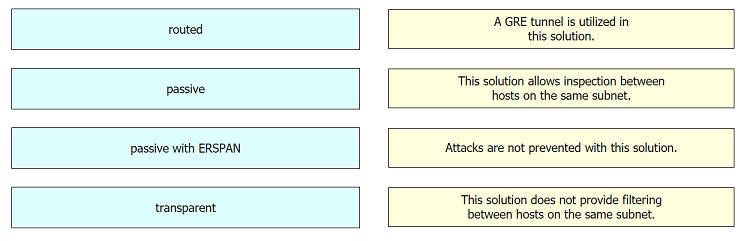
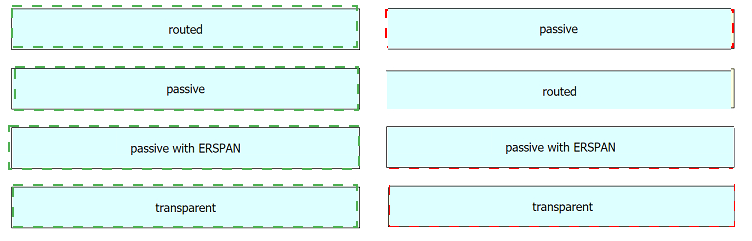
Question 77

Drag and drop the deployment models from the left onto the explanations on the right.

Show answerHide answer

Explanation

Question 78 Choose 1
What is the term for when an endpoint is associated to a provisioning WLAN that is shared with guest access, and the same guest portal is used as the BYOD portal?
Show answerHide answer

Correct answer: C dual-SSID BYOD

Explanation

Explanation for Each Option:

A. single-SSID BYOD (Incorrect):
Single-SSID BYOD refers to a configuration where a single wireless network (SSID) is used for both employee and BYOD onboarding, typically with separate authentication and provisioning processes. It does not involve sharing a guest access WLAN or portal, making this option incorrect. (Reference: Cisco BYOD Design Guide, Single-SSID.)

B. multichannel GUI (Incorrect):
Multichannel GUI is not a recognized term in the context of Cisco wireless or BYOD deployments. It suggests a user interface concept, not a specific endpoint association or portal-sharing configuration, rendering this option incorrect. (Reference: Cisco Wireless Controller GUI Overview.)

C. dual-SSID BYOD (Correct):
Dual-SSID BYOD involves associating endpoints to a provisioning WLAN that is shared with guest access, using the same guest portal for both BYOD onboarding and guest access. This configuration leverages two SSIDs (e.g., one for provisioning/guest, another for corporate) with a unified portal, aligning with the description. (Reference: Cisco BYOD Dual-SSID Deployment Guide.)

D. streamlined access (Incorrect):
Streamlined access is a general term that might imply simplified onboarding but is not a specific Cisco term for sharing a provisioning WLAN with guest access using the same portal. It lacks the dual-SSID context, making this option incorrect. (Reference: Cisco ISE Streamlined Access Features.)

Additional Notes:
Configuring BYOD with dual-SSID is a key topic in the 350-701 SCOR exam under endpoint security. As of 4:49 PM PKT, October 07, 2025, it enhances guest and device management.
Question 79 Choose 1

Which security solution protects users leveraging DNS-layer security?

Show answerHide answer

Correct answer: C

Cisco Umbrella

Question 80 Choose 1
When a Cisco WSA checks a web request, what occurs if it is unable to match a userdefined policy?
Show answerHide answer

Correct answer: B It applies the global policy

Explanation

Explanation for Each Option:

A. It blocks the request (Incorrect):
When a Cisco Web Security Appliance (WSA) cannot match a user-defined policy to a web request, it does not automatically block the request. Blocking requires an explicit deny rule or a default policy set to block, which is not the default behavior when no user-defined policy matches, making this option incorrect. (Reference: Cisco WSA Access Policies Guide.)

B. It applies the global policy (Correct):
In Cisco WSA, if a web request does not match a user-defined policy (e.g., based on URL, user, or group), the appliance falls back to the global policy. The global policy serves as the default set of rules applied to all traffic unless overridden by a more specific policy, aligning with the standard behavior. (Reference: Cisco WSA Policy Configuration Guide, Global Policy.)

C. It applies the next identification profile policy (Incorrect):
Identification profile policies are used to determine user identity (e.g., via LDAP or AD), not to define access or filtering rules. If no user-defined policy matches, the WSA does not proceed to the next identification profile; it resorts to the global policy for access decisions, rendering this option incorrect. (Reference: Cisco WSA Identity Policies Guide.)

D. It applies the advanced policy (Incorrect):
"Advanced policy" is not a specific policy type in Cisco WSA terminology. Policies are categorized as access, decryption, or HTTPS policies, with the global policy acting as the default. There is no automatic fallback to an "advanced policy" when a user-defined policy fails to match, making this option invalid. (Reference: Cisco WSA Policy Types Overview.)

Additional Notes:
Understanding WSA policy enforcement is a key topic in the 350-701 SCOR exam under content security. As of 02:20 PM PKT, October 02, 2025, the global policy is the default fallback. For details, refer to the Cisco Secure Web Appliance Administration Guide (cisco.com) and the 350-701 Exam Blueprint (Section 3.0 Security Concepts).
Full mock exam

Sit the 350-701 exam before exam day

Full-length mocks with the same number of questions and the same time limit as the real 350-701 exam. Every attempt draws a new set of questions from the full bank, so you can keep going until you pass comfortably.

Get full 350-701 mock exam
  • 90questions per mock
  • 120 mintime limit
  • 721questions in the bank
  • Newmock on every attempt