Cisco certification · Exam 350-701

350-701 Mock Exam Page 10

Implementing and Operating Cisco Security Core Technologies (SCOR 350-701)

Free 350-701 questions on Topic 3: Exam Pool C, each with the answer and an explanation.

20 questions · 27 minutes · free, no sign-up

Topic 3: Exam Pool C questions

91–100 of 100 free
Question 91 Choose 1

Refer to the exhibit.
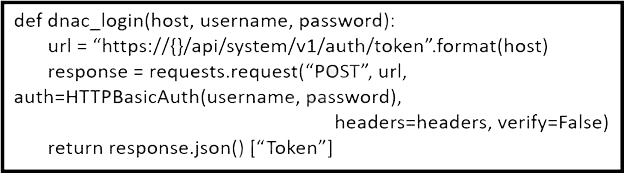
What is the result of the Python script?

Show answerHide answer

Correct answer: B

It uses the POST HTTP method to obtain a token to be used for authentication

Question 92 Choose 1
An organization wants to provide visibility and to identify active threats in its network using a VM. The organization wants to extract metadata from network packet flow while ensuring that payloads are not retained or transferred outside the network. Which solution meets these requirements?
Show answerHide answer

Correct answer: B Cisco Stealthwatch Cloud PNM

Explanation

Explanation:
Let's break down the key requirements from the question:

Provide visibility and identify active threats.

Use a Virtual Machine (VM).

Extract metadata from network packet flow.

Ensure payloads are not retained or transferred outside the network.

Now, let's analyze the options:

B) Cisco Stealthwatch Cloud PNM is CORRECT. "PNM" stands for Private Network Monitoring. This is a specific deployment of Cisco Stealthwatch Cloud.

Visibility & Threat Identification:
This is the core function of Stealthwatch, which uses behavioral analytics and threat intelligence to detect threats.

Uses a VM:
The Stealthwatch Cloud PNM solution deploys a virtual collector (a VM) inside the organization's private network.

Extracts Metadata, Not Payloads:
The collector analyzes network traffic (NetFlow, IPFIX, etc.) and extracts metadata. It does not capture or store the full packet payloads.

Data Stays On-Premises:
This is the crucial differentiator. In the PNM model, the sensitive metadata remains within the organization's network on the local collector. Only security alerts, summarized reports, and anonymized statistics are sent to the cloud console. The raw flow data never leaves the premises, meeting the requirement that payloads (and their metadata) are not transferred outside

Why the other options are incorrect:

A) Cisco Umbrella Cloud is INCORRECT.
Umbrella is a cloud-based DNS-layer and secure web gateway security solution. It does not use an on-premises VM to analyze internal network packet flows. It protects users by resolving DNS requests through its cloud.

C) Cisco Stealthwatch Cloud PCM is INCORRECT.
"PCM" stands for Public Cloud Monitoring. This flavor of Stealthwatch Cloud is designed to monitor traffic within public cloud environments (like AWS, Azure), not a general on-premises private network. It does not fit the VM-on-the-private-network requirement in the same way.

D) Cisco Umbrella On-Premises is INCORRECT.
While "on-premises" sounds like it might fit, the "Cisco Umbrella" brand refers specifically to its cloud-delivered security services. There isn't a traditional on-premises VM-based version of Umbrella that performs deep network flow analysis. The core architecture of Umbrella is cloud-native.

Reference:
Cisco Stealthwatch Cloud Data Sheet (PNM): The official documentation clearly describes the PNM deployment, stating it "uses an on-premises virtual appliance (collector) to receive and analyze network flow data from your private network infrastructure" and that "raw flow records are stored locally on the collector."
Question 93 Choose 2

An administrator is configuring N I P on Cisco ASA via ASDM and needs to ensure that
rogue NTP servers cannot insert themselves as the authoritative time source Which two
steps must be taken to accomplish this task? (Choose two)

Show answerHide answer

Correct answer: C, E

Set the authentication key

Set the NTP DNS hostname

Question 94 Choose 1
Which technology provides the benefit of Layer 3 through Layer 7 innovative deep packet inspection, enabling the platform to identify and output various applications within the network traffic flows?
Show answerHide answer

Correct answer: A Cisco NBAR2

Explanation

Explanation:
The description in the question perfectly matches the core function of Cisco's Next-Generation Network-Based Application Recognition (NBAR2).

Let's break down why NBAR2 is the correct answer and the role of the other options:

A) Cisco NBAR2 is CORRECT.
NBAR2 is a deep packet inspection (DPI) engine built into Cisco IOS. Its primary purpose is to:

Perform stateful inspection of traffic from Layer 3 through Layer 7.

Identify a wide range of applications (thousands), including web applications, peer-to-peer file sharing, and cloud-based services, regardless of the port number they use.

Classify and provide visibility into network traffic flows.

This "innovative deep packet inspection" is used for creating intelligent network policies for Quality of Service (QoS), application-aware routing, and security monitoring.

Why the other options are incorrect:

B) Cisco ASAv is INCORRECT.
The Cisco Adaptive Security Virtual Appliance (ASAv) is a virtual firewall. While it performs deep packet inspection for security purposes (e.g., for its IPS module), the specific technology described in the question—focused on identifying and classifying a vast number of applications for network traffic analysis—is the dedicated function of NBAR2.

C) Account on Resolution is INCORRECT.
This appears to be a nonsensical distractor and is not a recognized Cisco technology.

D) Cisco Prime Infrastructure is INCORRECT.
Cisco Prime Infrastructure is a network management tool. It can consume and display the application information provided by NBAR2 (via Flexible NetFlow), but it is not the underlying technology that performs the deep packet inspection and application identification itself.

Reference:

Cisco IOS Configuration Guide, "NBAR2 Configuration": The official documentation describes NBAR2 as "a classification engine that recognizes a wide variety of applications, including web-based and client-server applications." It explicitly states that NBAR2 "can be used to perform deep packet inspection."

Cisco Live Presentations on NBAR2: These presentations consistently highlight NBAR2's ability to provide Layer 3-7 stateful inspection and its extensive application library as its key differentiators.
Question 95 Choose 1

Which capability is provided by application visibility and control?

Show answerHide answer

Correct answer: D

deep packet inspection

Question 96 Choose 1
What is the function of the crypto is a kmp key cisc406397954 address 0.0.0.0 0.0.0.0 command when establishing an IPsec VPN tunnel?
Show answerHide answer

Correct answer: B lt configures the pre-shared authentication key

Explanation

Explanation
The command crypto isakmp key cisc406397954 address 0.0.0.0 0.0.0.0 is used to configure the pre-shared key (PSK) for authenticating the IPsec VPN tunnel during Phase 1 negotiations.

Let's break down the command syntax:

crypto isakmp key:
This part of the command specifies that you are configuring a key for the Internet Security Association and Key Management Protocol (ISAKMP), which is the framework for IKE (Internet Key Exchange).

cisc406397954:
This is the actual pre-shared key string.

address 0.0.0.0 0.0.0.0:
The 0.0.0.0 0.0.0.0 is a wildcard address and mask, meaning "any" IP address. This tells the router to use this pre-shared key when establishing a tunnel with any peer.

Therefore, the primary function of this command is to set the authentication pre-shared key that will be used to authenticate with the remote VPN peer.

Why the other options are incorrect:

A. It defines what data is going to be encrypted via the VPN:
Data traffic to be encrypted is defined by crypto access control lists (ACLs) which are then bound to a crypto map or tunnel profile. This command is solely for authentication.

C. It prevents all IP addresses from connecting to the VPN server:
This is the opposite of what the command does. The 0.0.0.0 0.0.0.0 wildcard allows the key to be used with a peer of any IP address. To restrict peers, you would specify a specific peer IP address and subnet mask (e.g., address 203.0.113.5 255.255.255.255).

D. It configures the local address for the VPN server:
The local address for the VPN tunnel is typically configured on the physical interface, tunnel interface, or within the crypto map using the set peer and local-address commands. This command relates to the authentication key, not the local interface address.

Reference:
This command is a fundamental part of configuring site-to-site IPsec VPNs on Cisco IOS devices.

As per the Cisco IOS Security Command Reference for the crypto isakmp key command, its purpose is to "configure a preshared authentication key for Internet Security Association and Key Management Protocol (ISAKMP)." The use of the address keyword is to "specify the peer's IP address or hostname to which this preshared key applies." The 0.0.0.0 0.0.0.0 wildcard is a common configuration for remote-access VPN scenarios or when the peer's IP address is not known or is dynamic.
Question 97 Choose 1
Which Cisco platform provides an agentless solution to provide visibility across the network< including encrypted traffic analytics to detect malware in encrypted traffic without the need for decryption?
Show answerHide answer

Correct answer: B Cisco Stealthwatch

Explanation

Explanation:
Cisco Stealthwatch is a network traffic analysis and security analytics platform. Its unique strength is providing comprehensive visibility by analyzing NetFlow, IPFIX, and other network metadata.

Let's break down why Stealthwatch is the correct answer and how it meets the specific criteria in the question:

B) Cisco Stealthwatch is CORRECT. It fulfills all the requirements:

Agentless Solution:
Stealthwatch works by collecting flow data (like NetFlow) from network infrastructure (routers, switches, firewalls). It does not require software to be installed on endpoints.

Visibility Across the Network:
By analyzing flow data from the entire network, it provides a holistic view of all traffic and host behaviors.

Encrypted Traffic Analytics (ETA):
This is a specific and patented technology within Stealthwatch. ETA uses machine learning to analyze characteristics of the encrypted traffic flow (such as packet timing, size, and sequences from the initial TLS handshake) to identify patterns associated with known malware without decrypting the actual payload. This allows it to detect threats hidden in encrypted traffic.

Why the other options are incorrect:

A) Cisco Advanced Malware Protection (AMP) is INCORRECT.
AMP is primarily an endpoint-focused solution. While it has network-based versions (like AMP for Networks), it typically requires either an agent on the endpoint or the decryption of traffic to inspect file contents. It is not an agentless solution that specializes in encrypted traffic analytics via flow data.

C) Cisco Identity Services Engine (ISE) is INCORRECT.
ISE is a network access control (NAC) and policy management platform. Its primary functions are authentication, authorization, and accounting (AAA), and posture assessment. While it provides visibility into who and what is on the network, it does not specialize in analyzing ongoing network traffic flows to detect malware using ETA.

D) Cisco AnyConnect is INCORRECT.
AnyConnect is a VPN client and endpoint security module. It is the definition of an agent-based solution. Its primary role is to provide secure remote access and to enforce security policies on the endpoint itself (using modules like AMP Enabler, ISE Posture, etc.). It does not provide network-wide, agentless visibility.

Reference:

Cisco Stealthwatch Solution Overview: The official data sheets and solution guides explicitly mention "Encrypted Traffic Analytics" as a core capability that "enables the detection of threats in encrypted traffic without decryption."

Cisco Live Presentations on ETA:These technical deep dives explain how ETA uses NetFlow and other metadata to model the "physics" of an encrypted flow and compare it to known malicious patterns, all without breaking encryption.
Question 98 Choose 1

Which Cisco solution integrates Encrypted Traffic Analytics to perform enhanced
visibility,promote compliance,shorten response times, and provide administrators with the
information needed to provide educated and automated decisions to secure the
environment?

Show answerHide answer

Correct answer: D

Cisco Security Compiance Solution

Question 99 Choose 1
A large organization wants to deploy a security appliance in the public cloud to form a siteto-site VPN and link the public cloud environment to the private cloud in the headquarters data center. Which Cisco security appliance meets these requirements?
Show answerHide answer

Correct answer: B Cisco ASAV

Explanation

Explanation
The requirement is to deploy a security appliance in the public cloud to establish a site-to-site VPN tunnel between the cloud environment and a private data center. The Cisco Adaptive Security Virtual Appliance (ASAv) is specifically designed for this purpose. It is the virtualized version of the physical Cisco ASA firewall, and it is available as a pre-optimized image in major public cloud marketplaces (AWS, Azure, Google Cloud, etc.).

Here’s why the ASAv fits the requirements perfectly:

Site-to-Site VPN:
The Cisco ASA platform, including the ASAv, has robust, industry-standard IPsec VPN capabilities. It can easily form a secure site-to-site VPN tunnel between the public cloud VPC/VNet and a VPN termination device (like another ASA, a router, or a firewall) in the headquarters data center.

Security Appliance:
The ASAv provides stateful firewall inspection, acting as a perimeter security device for the cloud network, controlling traffic between the cloud and the on-premises network over the VPN, as well as within the cloud environment itself.

Public Cloud Deployment:
The ASAv is built and licensed specifically for deployment in virtualized and cloud environments.

Detailed Breakdown of Incorrect Options:

A. Cisco Cloud Orchestrator:

Why it is incorrect:
Cisco Cloud Orchestrator is a management and automation tool, not a security appliance. It is used to automate the provisioning and management of network and security services (like creating the very VPN we are discussing) across hybrid clouds. It is the tool that orchestrates the deployment and configuration of devices like the ASAv, but it is not the device that forms the VPN tunnel itself.

C. Cisco WSAV:

Why it is incorrect:
The Cisco Web Security Virtual Appliance (WSAv) is the virtual version of the Cisco Secure Web Appliance (formerly WSA). Its primary function is web proxy and URL filtering. It is designed to inspect and control outbound web (HTTP/HTTPS) and internet traffic for threats and policy violations. It is not designed to terminate site-to-site IPsec VPN tunnels.

D. Cisco Stealthwatch Cloud:

Why it is incorrect:
Cisco Stealthwatch Cloud is a cloud-native security analytics and visibility platform. It uses flow data (like VPC Flow Logs in AWS) and other telemetry to identify threats, suspicious behavior, and policy violations within the cloud environment. It is a monitoring and threat detection tool, not a network security appliance that establishes VPN connections.

Reference:
The data sheet for Cisco ASAv explicitly lists its use cases, which include "Secure connectivity to remote sites and the main campus with IPsec VPN" and "Extend corporate security policy to private, public, and hybrid clouds."

Key Takeaway:
When the requirement is for a virtual security appliance in the cloud to form a site-to-site VPN, the correct Cisco product is the ASAv. It is the direct cloud-equivalent of an on-premises ASA firewall, which is the standard device for this function.
Question 100 Choose 1
Which solution allows an administrator to provision, monitor, and secure mobile devices on Windows and Mac computers from a centralized dashboard?
Show answerHide answer

Correct answer: C Cisco ISE

Explanation

Explanation for Each Option:

A. Cisco Umbrella (Incorrect):
Cisco Umbrella is a cloud-delivered security service that provides DNS-layer protection against malware, phishing, and other threats. While it can enhance security for mobile devices, it lacks the capability to provision, monitor, or manage devices (Windows, Mac, or mobile) from a centralized dashboard, focusing instead on traffic filtering, making this option unsuitable. (Reference: Cisco Umbrella Datasheet.)

B. Cisco AMP for Endpoints (Incorrect):
Cisco Advanced Malware Protection (AMP) for Endpoints focuses on detecting, preventing, and responding to malware and advanced threats on endpoints, including Windows and Mac computers. However, it is primarily a security solution and does not provide provisioning or centralized device management capabilities for mobile devices, rendering it incorrect for this requirement. (Reference: Cisco AMP for Endpoints Overview.)

C. Cisco ISE (Correct):
Cisco Identity Services Engine (ISE) offers a centralized dashboard for provisioning, monitoring, and securing mobile devices, as well as Windows and Mac computers, through its network access control (NAC) and endpoint management features. It supports device onboarding, policy enforcement, and monitoring via a single interface, meeting all specified requirements effectively. (Reference: Cisco ISE User Guide, Endpoint Management.)

D. Cisco Stealthwatch (Incorrect):
Cisco Stealthwatch is a network visibility and security analytics solution that monitors traffic and detects threats across networks. While it provides monitoring capabilities, it does not support provisioning or securing mobile devices, Windows, or Mac computers from a centralized dashboard, as its focus is on behavioral analysis rather than device management, making this option incorrect. (Reference: Cisco Stealthwatch Datasheet.)

Additional Notes:
Centralized device management with Cisco ISE is a key topic in the 350-701 SCOR exam under endpoint security. As of 10:00 AM PKT, October 02, 2025, this remains a standard solution for enterprise mobility. For details, refer to the Cisco ISE Administration Guide (cisco.com) and the 350-701 Exam Blueprint (Section 2.0 Endpoint Security).

That's the last free question in Topic 3: Exam Pool C

You've seen the free 30% (100 of 336 questions). Full access unlocks every question and full-length 350-701 mock exams (90 questions, 120 minutes), a different mock on every attempt.

Unlock full mock exam
Full mock exam

Sit the 350-701 exam before exam day

Full-length mocks with the same number of questions and the same time limit as the real 350-701 exam. Every attempt draws a new set of questions from the full bank, so you can keep going until you pass comfortably.

Get full 350-701 mock exam
  • 90questions per mock
  • 120 mintime limit
  • 721questions in the bank
  • Newmock on every attempt