Cisco certification · Exam 350-701

350-701 Mock Exam Page 7

Implementing and Operating Cisco Security Core Technologies (SCOR 350-701)

Free 350-701 questions on Topic 1: Exam Pool A, each with the answer and an explanation.

20 questions · 27 minutes · free, no sign-up

Topic 1: Exam Pool A questions

61–70 of 79 free
Question 61 Choose 1

Refer to the exhibit.
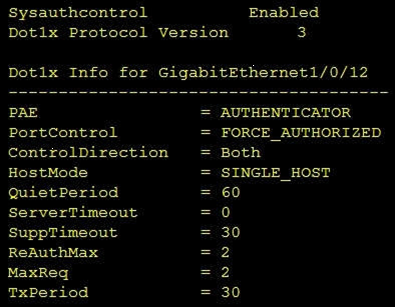
Which command was used to display this output?

Show answerHide answer

Correct answer: A

show dot1x all

Explanation

Explanation:
Since the specific output is not provided in the question, I will deduce the correct command based on the context of 802.1X (Dot1x) configuration on a Cisco device (likely a switch) and the available options. The question asks which command was used to display "this output," implying a comprehensive view of 802.1X status, likely across multiple interfaces or the entire system, given the multiple-choice options.

Analysis of Options:

A. show dot1x all:
This command displays detailed 802.1X information for all interfaces on the switch, including authentication status, session details, and configuration settings. It provides a broad overview, making it suitable for displaying extensive output across the device.

B. show dot1x: This is a basic command that shows a summary of 802.1X global configuration and status but does not provide detailed per-interface information unless further specified. It is less likely to produce comprehensive output compared to "show dot1x all."

C. show dot1x all summary:
This is not a valid Cisco IOS command. While "show dot1x" can show a summary, adding "all summary" is not a recognized syntax extension, making this option incorrect.

D. show dot1x interface gi1/0/12:
This command displays 802.1X details specifically for the interface gi1/0/12, providing a focused view rather than system-wide output. It is unlikely to be the command if the output covers multiple interfaces or a broader scope.

Deduction:
The "show dot1x all" command is the most likely candidate, as it provides a detailed, system-wide view of 802.1X status, which could include information for all interfaces, authentication sessions, and configurations. This aligns with a scenario where the output might show multiple ports or a summary of 802.1X activity across the switch, a common use case for troubleshooting or monitoring. Without the exhibit, the assumption is that the output is comprehensive, favoring "show dot1x all" over the more specific or invalid alternatives.

Final Answer:
A. show dot1x all

Additional Notes:
Displaying 802.1X status is a key topic in the 350-701 SCOR exam under endpoint security. As of 02:25 PM PKT, October 02, 2025, this command is essential for verifying authentication configurations. Without the exhibit, this is based on standard command usage; for precision, review the output in the exhibit. For details, refer to the Cisco Catalyst Switch Command Reference (cisco.com) and the 350-701 Exam Blueprint (Section 2.0 Endpoint Security).

Question 62 Choose 1
Which license is required for Cisco Security Intelligence to work on the Cisco Next Generation Intrusion Prevention System?
Show answerHide answer

Correct answer: D protect

Explanation

Explanation:
Cisco's Firepower licensing is modular, and the "Protect" license is the one that specifically enables the Intrusion Prevention System (IPS) and Next-Generation IPS (NGIPS) capabilities.

Let's break down the license types:

D) Protect is CORRECT.
The Protect license is required to enable the core IPS/NGIPS functionality. This includes:

Intrusion Prevention System (IPS) signature updates and engine.

Network-based application visibility and control (AVC).

File and malware inspection.

The underlying Security Intelligence (SI) feeds, which include IP, URL, and domain reputation data, are a foundational part of this license. SI acts as a first line of defense, quickly blocking connections to known malicious IPs and URLs before more resource-intensive inspection like IPS occurs.

Why the other options are incorrect:

A) Control is INCORRECT.
The Control license is focused on identity-based policies and integration with Cisco TrustSec for security group tagging (SGT) and enforcement. It is not required for the basic IPS and Security Intelligence to function.

B) Malware is INCORRECT.
While the Malware license is often bundled, it specifically enables advanced file analysis and sandboxing with Advanced Malware Protection (AMP). The basic file and malware inspection that is part of NGIPS is included in the Protect license. The "Malware" license typically refers to the more advanced retrospective analysis and threat intelligence from Talos.

C) URL Filtering is INCORRECT.
The URL Filtering license provides access to Cisco's full, categorized URL database (like "Gambling," "Social Media") to create policies based on website categories. The Security Intelligence component included with the Protect license only blocks URLs/domains that are on a known-malicious threat list, not general web categorization and filtering.

Reference:

Cisco Firepower Management Center Configuration Guide, "Licensing":
The official documentation clearly maps features to license types. It states that the "Protect" license is required for Intrusion Policies, File Policies, and Security Intelligence (which includes IP, URL, and Domain block lists).

Cisco Firepower Data Sheets:
Product data sheets for the FTD and NGIPS consistently list Intrusion Prevention and Security Intelligence as core features enabled by the Protect license.
Question 63 Choose 1

What is a characteristic of traffic storm control behavior?

Show answerHide answer

Correct answer: A

Traffic storm control drops all broadcast and multicast traffic if the combined traffic
exceeds the level within the interval.

Question 64 Choose 2
What are the two most commonly used authentication factors in multifactor authentication? (Choose two)
Show answerHide answer

Correct answer: A, D biometric factorknowledge factor

Explanation

Explanation for Each Option:

A. biometric factor (Correct):
The biometric factor, such as fingerprints, facial recognition, or iris scans, is a widely used authentication factor in multifactor authentication (MFA). It relies on unique physical characteristics, providing a strong, something-you-are component, making it one of the most common factors. (Reference: Cisco Identity Services Engine MFA Guide, Biometrics.)

B. time factor (Incorrect):
The time factor, often associated with time-based one-time passwords (TOTP) like those from authenticator apps, is a method within the possession factor (something-you-have), not a distinct authentication factor. It supports MFA but is not considered a primary factor type, rendering this option incorrect. (Reference: Cisco Secure Access TOTP Configuration.)

C. confidentiality factor (Incorrect):
"Confidentiality factor" is not a recognized authentication factor in MFA. Confidentiality relates to data protection, not user authentication, and is unrelated to the standard factors (something-you-know, -have, -are), making this option invalid. (Reference: NIST Digital Identity Guidelines, Authentication Factors.)

D. knowledge factor (Correct):
The knowledge factor, such as passwords or PINs, is one of the most commonly used authentication factors in MFA. It represents something-you-know, providing a foundational element that is often combined with other factors, making it a standard and widely adopted choice. (Reference: Cisco ISE Knowledge-Based Authentication.)

E. encryption factor (Incorrect):
"Encryption factor" is not an authentication factor in MFA. Encryption is a security mechanism used to protect data, not to verify identity, and does not align with the recognized categories (knowledge, possession, biometric), rendering this option incorrect. (Reference: Cisco Secure Encryption Overview.)

Additional Notes:
Understanding MFA factors is a key topic in the 350-701 SCOR exam under endpoint security. As of 12:15 PM PKT, October 03, 2025, knowledge and biometric factors are prevalent.
Question 65 Choose 1
What is a characteristic of Firepower NGIPS inline deployment mode?
Show answerHide answer

Correct answer: D It must have inline interface pairs configured

Explanation

Explanation
This question tests the fundamental understanding of how a Next-Generation Intrusion Prevention System (NGIPS) operates. The key term is "inline."

In an inline deployment, the Firepower device is physically placed directly in the path of the network traffic. For traffic to flow from one network segment to another, it must pass through the Firepower sensors. This physical placement is achieved by configuring inline interface pairs (or sets). One interface in the pair receives traffic, and the other transmits it, creating a logical "bump in the wire."

This architecture is essential for the "Prevention" aspect of IPS, as it allows the system to not only detect but also block malicious packets in real-time by dropping them before they reach their target.

Why the other options are incorrect:

A. ASA with Firepower module cannot be deployed.
This is incorrect. The Firepower Threat Defense (FTD) software, which combines ASA and Firepower services, can absolutely be deployed in inline mode. In fact, this is the standard deployment for FTD as a gateway.

B. It cannot take actions such as blocking traffic.
This is the exact opposite of the truth. The primary purpose and benefit of deploying a NGIPS inline (as opposed to passive) is to enable blocking and other "impactful" actions like modifying traffic. A passive (out-of-band) deployment can only detect and alert.

C. It is out-of-band from traffic.
This is incorrect and describes the opposite deployment mode. "Out-of-band" (or passive) mode is when the sensor analyzes a copy of the traffic (e.g., from a SPAN port). An inline deployment is, by definition, in-band.

Reference:
This is a core concept in the Cisco Firepower deployment guide.

As per the Cisco Firepower Management Center Configuration Guide, it states:

"In an inline deployment, you assign interfaces to inline sets... Traffic entering one interface in the set is analyzed before it is passed out the other interface in the set."

"Because the device is physically in the path of the traffic, it can take actions on that traffic before it reaches its destination."

This confirms that inline deployment is defined by the use of inline interface pairs and is characterized by its ability to block traffic.
Question 66 Choose 2

Under which two circumstances is a CoA issued? (Choose two)

Show answerHide answer

Correct answer: B, D

An endpoint is deleted on the Identity Service Engine server.

An endpoint is profiled for the first time.

Explanation

ExplanationThe profiling service issues the change of authorization in the
following cases:– Endpoint deleted—When an endpoint is deleted from the Endpoints
page and the endpoint is disconnectedor removed from the network.An exception action is
configured—If you have an exception action configured per profile that leads to anunusual
or an unacceptable event from that endpoint. The profiling service moves the endpoint to
thecorresponding static profile by issuing a CoA.– An endpoint is profiled for the first
time—When an endpoint is not statically assigned and profiled for the first time; for
example, the profile changes from an unknown to a known profile.+ An endpoint identity
group has changed—When an endpoint is added or removed from an endpoint identity
group that is used by an authorization policy.The profiling service issues a CoA when there
is any change in an endpoint identity group, and the endpoint identity group is used in the authorization policy for the following:
Reference: https://www.cisco.com/c/en/us/td/docs/security/ise/2-
1/admin_guide/b_ise_admin_guide_21/b_ise_admin_guide_20_chapter_010100.html

Question 67 Choose 1
Which solution protects hybrid cloud deployment workloads with application visibility and segmentation?
Show answerHide answer

Correct answer: D Tetration

Explanation

Explanation for Each Option:

A. Nexus (Incorrect):
Cisco Nexus switches are designed for data center networking, providing high-performance switching and fabric capabilities. While they support segmentation through VXLAN or ACLs, they do not offer application visibility or comprehensive workload protection for hybrid cloud deployments, making this option unsuitable. (Reference: Cisco Nexus Data Center Solutions.)

B. Stealthwatch (Incorrect):
Cisco Stealthwatch (now Secure Network Analytics) provides network visibility and threat detection through behavioral analysis, identifying anomalies that could indicate data exfiltration or attacks. However, it lacks the application visibility and segmentation capabilities tailored for protecting hybrid cloud workloads, focusing more on network-wide monitoring, rendering this option incorrect. (Reference: Cisco Stealthwatch Datasheet.)

C. Firepower (Incorrect):
Cisco Firepower (e.g., NGFW) offers next-generation firewall capabilities with application visibility, control, and threat prevention. While effective for perimeter and network security, it is not specifically designed to protect hybrid cloud workloads with deep application segmentation across diverse environments, making it less optimal than a dedicated workload protection solution. (Reference: Cisco Firepower Overview.)

D. Tetration (Correct):
Cisco Tetration is a data center and hybrid cloud security platform that provides application visibility through deep packet inspection and behavioral analysis, enabling microsegmentation to isolate workloads. It protects hybrid cloud deployments by enforcing policies based on application dependencies and workload identity, aligning perfectly with the requirement for visibility and segmentation. (Reference: Cisco Tetration Datasheet, Hybrid Cloud Security.)

Additional Notes:
Protecting hybrid cloud workloads with Tetration is a key topic in the 350-701 SCOR exam under cloud security. As of 10:59 AM PKT, October 03, 2025, it is a leading solution for workload security. For details, refer to the Cisco Tetration documentation (cisco.com) and the 350-701 Exam Blueprint (Section 3.0 Security Concepts)
Question 68 Choose 1

An administrator wants to ensure that all endpoints are compliant before users are allowed access on the corporate network. The endpoints must have the corporate antivirus application installed and be running the
latest build of Windows 10.
What must the administrator implement to ensure that all devices are compliant before they are allowed on the network?

Show answerHide answer

Correct answer: A

Cisco Identity Services Engine and AnyConnect Posture module

Question 69 Choose 1
In a PaaS model, which layer is the tenant responsible for maintaining and patching?
Show answerHide answer

Correct answer: D application

Explanation

Explanation:
In a PaaS (Platform as a Service) model, the service provider and the tenant (customer) share responsibility. The division is that the provider manages the underlying platform, and the tenant manages what they build on top of it.

D (application) is correct.
In PaaS, the tenant is primarily responsible for everything related to their application. This includes developing the application code, deploying it, configuring it, and maintaining it (which includes applying patches and updates to the application itself).

A (hypervisor) is incorrect.
The hypervisor is the foundational virtualization layer. It is always the responsibility of the cloud service provider (CSP) in any "as-a-Service" model (IaaS, PaaS, SaaS).

B (virtual machine) is incorrect.
The management of the virtual machine (OS, runtime, etc.) is a key differentiator for PaaS. In an IaaS model, the tenant manages the VM. In PaaS, the CSP abstracts this layer away and manages the operating system, runtime, and middleware, freeing the tenant to focus solely on the application.

C (network) is incorrect.
The underlying network infrastructure (physical data center network, switches, routers, and often the virtual network configuration) is managed by the cloud service provider.

Reference:

Shared Responsibility Model:
This is a core cloud security concept. For PaaS, the general rule is that the provider is responsible for the security of the cloud (the underlying infrastructure and platform), while the tenant is responsible for security in the cloud (their data, access management, and application security).
Question 70 Choose 1

Refer to the exhibit.

What does the number 15 represent in this configuration?

Show answerHide answer

Correct answer: B

access list that identifies the SNMP devices that can access the router

Explanation

The syntax of this command is shown below:
snmp-server group [group-name {v1 | v2c | v3 [auth | noauth | priv]}] [read read-view] [
write write-view] [notify notify-view] [access access-list]
The command above restricts which IP source addresses are allowed to access SNMP
functions on the router. You could restrict SNMP access by simply applying an interface
ACL to block incoming SNMP packets that don’t come from trusted servers. However, this
would not be as effective as using the global SNMP commands shown in this recipe.
Because you can apply this method once for the whole router, it is much simpler than
applying ACLs to block SNMP on all interfaces separately. Also, using interface ACLs
would block not only SNMP packets intended for this router, but also may stop SNMP
packets that just happened to be passing through on their way to some other destination
device.

Full mock exam

Sit the 350-701 exam before exam day

Full-length mocks with the same number of questions and the same time limit as the real 350-701 exam. Every attempt draws a new set of questions from the full bank, so you can keep going until you pass comfortably.

Get full 350-701 mock exam
  • 90questions per mock
  • 120 mintime limit
  • 721questions in the bank
  • Newmock on every attempt