Cisco certification · Exam 350-701

350-701 Mock Exam Page 6

Implementing and Operating Cisco Security Core Technologies (SCOR 350-701)

Free 350-701 questions on Topic 1: Exam Pool A, each with the answer and an explanation.

20 questions · 27 minutes · free, no sign-up

Topic 1: Exam Pool A questions

51–60 of 79 free
Question 51 Choose 1

The main function of northbound APIs in the SDN architecture is to enable communication between which two areas of a network?

Show answerHide answer

Correct answer: D

SDN controller and the management solution

Question 52 Choose 1
Which policy is used to capture host information on the Cisco Firepower Next Generation Intrusion Prevention System?
Show answerHide answer

Correct answer: D Network Discovery

Explanation

Explanation:
The Cisco Firepower NGIPS does more than just block threats; it is also a powerful network visibility and discovery tool. The policy specifically designed to gather and catalog information about hosts on the network is the Network Discovery policy.

Let's break down the role of each policy:

D) Network Discovery is CORRECT.
The Network Discovery policy is used to passively and actively discover hosts, operating systems, applications, and open services on your network. It uses various methods to capture host information, including:

Analyzing NetFlow data.

Performing passive OS fingerprinting.

Sending out active probes (if configured).

Listening to network traffic to identify hosts and the services they are running.

This collected host data populates the Hosts table in the FMC and is used for creating more targeted and effective intrusion and access control policies.

Why the other options are incorrect:

A) Correlation is INCORRECT.
Correlation policies are used to define automated responses to specific event patterns. For example, you can create a correlation rule that triggers an alert if a single host triggers ten different critical intrusions within one minute. It is an event-based analysis and response tool, not a host information gathering tool.

B) Intrusion is INCORRECT.
The Intrusion Policy is the core of the NGIPS. It is where you manage Snort rules to detect and prevent known vulnerability exploits, malware activity, and other malicious traffic. It uses the information gathered by the Network Discovery policy to be more effective, but its primary function is threat detection/prevention, not host discovery.

C) Access Control is INCORRECT.
The Access Control Policy is the main policy applied to traffic. It contains the ordered list of rules that determine whether to allow, block, or inspect traffic. It is the master policy that can invoke Intrusion, Network Discovery, and other policies, but it does not itself capture the host information.

Reference:

Cisco Firepower Management Center Configuration Guide, "Network Discovery Policies": The official documentation states, "Use network discovery policies to discover the hosts, operating systems, applications, and open services on your network."

Firepower System Overview: The architecture clearly separates the functions: Network Discovery handles host and application visibility, which then informs the enforcement actions taken by the Access Control and Intrusion policies.
Question 53 Choose 1
Which CLI command is used to register a Cisco FirePower sensor to Firepower Management Center?
Show answerHide answer

Correct answer: D configure manager add

Explanation

Explanation
This command is the exact syntax used on a Cisco Firepower Threat Defense (FTD) sensor, or any Firepower module, to initiate the registration process with a Firepower Management Center (FMC).

configure manager:
This is the base command that enters the configuration mode for managing the connection to the FMC.

add:
This sub-command specifies that you are adding a new manager.

:
This is a placeholder for the IP address or hostname of the FMC to which you want to register the sensor.

:
This is a placeholder for the unique registration key that must be pre-configured on the FMC. This key acts as a shared secret to authenticate the sensor during the registration process. It ensures that only authorized devices can register to the management center.

The Process Flow:
An administrator generates a unique registration key on the FMC for a specific sensor.
The administrator logs into the CLI of the Firepower sensor (FTD device).
The command configure manager add is executed.
The sensor uses this information to contact the FMC, authenticate itself using the key, and establish a secure communication channel.
The sensor then appears in the FMC web interface as a pending device, ready to be deployed with policies.

Detailed Breakdown of Incorrect Options:

A. configure system add

Why it is incorrect:
This command uses an invalid syntax and context. The configure system command family is typically used for basic system configurations like setting the hostname, timezone, or DNS servers, not for manager registration. The keyword manager is crucial and missing here. The Firepower OS does not recognize configure system add as a valid command for this purpose.

B. configure manager add host:

Why it is incorrect:
This command has the correct verb (configure manager) but the order of the parameters is wrong. The syntax is very specific: the add keyword must come immediately after configure manager, followed by the host, and then the key. Placing the before the add command is syntactically invalid and would result in an error. The CLI parser would not understand this structure.

C. configure manager delete

Why it is incorrect:
This command is a valid command, but it performs the exact opposite action. It is used to unregister the sensor from its current FMC, not to register it. If you run this command on a managed sensor, it will sever its connection with the management center. While it is a real command, its function is the reverse of what the question asks.

Reference:

Cisco Official Documentation:
The command is documented in the Cisco Firepower Threat Defense Command Reference guide. Searching for "configure manager add" will lead you to the exact syntax and usage.

Cisco FMC Configuration Guide:
The process of registering devices using the CLI is a standard procedure outlined in the "Add Devices" section of the Firepower Management Center configuration guide.

Key Takeaway:
The correct command is a logical sequence: configure the manager, add it, specify where (), and finally, provide the secret how (). Memorizing this structure is essential for the exam.
Question 54 Choose 1
How does Cisco Umbrella archive logs to an enterprise owned storage?
Show answerHide answer

Correct answer: D by being configured to send logs to a self-managed AWS S3 bucket

Explanation

Explanation
Cisco Umbrella provides several methods for exporting log data for long-term storage, archiving, and integration with on-premises SIEM systems. The key phrase in the question is "archive logs to an enterprise owned storage."

D. by being configured to send logs to a self-managed AWS S3 bucket:
This is the correct and most direct method for archiving to enterprise-owned storage. In the Umbrella dashboard, you can configure a setting called "Log Destinations" where you specify the details of your own (self-managed) Amazon S3 bucket. Once configured, Umbrella will automatically and continuously stream logs directly to your S3 bucket, which you fully control and own. This meets the requirement for enterprise-owned storage, even though it resides in a public cloud.

Why the other options are incorrect:

A. by using the Application Programming Interface to fetch the logs:
While Umbrella does have a Reporting API that can be used to query and retrieve data, this is not the primary or recommended method for archiving large volumes of raw logs. The API is better suited for pulling specific, aggregated data for custom dashboards or applications, not for the continuous, bulk transfer required for archiving.

B. by sending logs via syslog to an on-premises or cloud-based syslog server:
This is a valid and common method for sending logs to a SIEM (like Splunk or ArcSight) for real-time analysis and correlation. However, it is generally not considered the best practice for pure archiving. Syslog can be susceptible to network interruptions, and the storage behind the syslog server is managed separately. The question specifically asks for the method to archive to enterprise-owned storage, and while this could be used, the S3 method (Option D) is the more direct, scalable, and recommended solution for this specific purpose.

C. by the system administrator downloading the logs from the Cisco Umbrella web portal:
This is a manual process. The web portal only allows for downloading logs for a limited, recent time window (e.g., the last 7-30 days depending on the license). This is useful for ad-hoc investigations but is completely impractical for automated, continuous archiving of all log data, which is the goal of an archiving solution.

Reference:
This functionality is documented in the Cisco Umbrella administrator guide under log management and configuration.

Cisco Umbrella Documentation: "Add S3 Bucket as Log Destination": This section provides step-by-step instructions on how to configure Umbrella to send logs to a customer-owned Amazon S3 bucket. This is explicitly the service's built-in mechanism for long-term log archiving to a location controlled by the enterprise.

In summary, while other methods exist for log export or forwarding, the configured, automatic delivery to a self-managed S3 bucket is the standard and recommended way to archive Cisco Umbrella logs to enterprise-owned storage.
Question 55 Choose 1
A network administrator configures Dynamic ARP Inspection on a switch. After Dynamic ARP Inspection is applied, all users on that switch are unable to communicate with any destination. The network administrator checks the interface status of all interfaces, and there is no err-disabled interface. What is causing this problem?
Show answerHide answer

Correct answer: D The no ip arp inspection trust command is applied on all user host interfaces

Explanation

Explanation:
Dynamic ARP Inspection (DAI) is a security feature that validates ARP packets in a network. It relies on the DHCP Snooping binding database to distinguish between legitimate and malicious ARP packets.

The key to this scenario is the trust state of the switch interfaces.

Trusted Interfaces:
DAI forwards all ARP packets received on these interfaces without inspection. These are typically interfaces connected to other switches, routers, or reliable infrastructure.

Untrusted Interfaces:
DAI intercepts and validates all ARP packets received on these interfaces. The validation checks if the ARP packet's IP-to-MAC binding matches an entry in the DHCP Snooping binding database. If there is no match, the ARP packet is dropped.

Let's analyze the options:

Why Option D is Correct:
If the no ip arp inspection trust command is applied to all interfaces connecting to user hosts, it means all user-facing ports are untrusted. When a user's computer sends a gratuitous ARP or an ARP request/reply, DAI will check it against the DHCP Snooping binding table. If the binding isn't found (which is highly likely in this universal failure scenario), the ARP packet is dropped. Without successful ARP, a device cannot resolve an IP address to a MAC address, making all IP communication impossible. The problem is not err-disabled interfaces; it's that the legitimate ARP packets necessary for communication are being silently discarded.

Why Option A is Incorrect:
While DAI does require DHCP Snooping to build its binding table, if DHCP Snooping were not enabled, DAI would not have a database to validate against. However, the typical behavior in this case is that DAI would either not function or would log violations, but it often will not cause a complete communication blackout for all users unless it's explicitly configured to be very strict. The most direct and common cause for a total outage is the misconfiguration of trust on all user ports.

Why Option B is Incorrect:
The ip arp inspection limit command is used to limit the rate of ARP packets to prevent DoS attacks. If this rate limit were too low and being exceeded, the interface would typically be placed into an err-disabled state. The problem explicitly states "there is no err-disabled interface," so this cannot be the cause.

Why Option C is Incorrect:
If Dynamic ARP Inspection is not enabled on a VLAN, it simply does not run on that VLAN. Traffic would flow normally, not be blocked. The problem states that DAI has been applied and is causing a blockage, so this option is illogical.

Reference:
This falls under the Network Security domain of the 350-701 SCOR exam, specifically covering Layer 2 security features like Dynamic ARP Inspection. Understanding the dependency on DHCP Snooping and the critical role of the trust/untrust interface configuration is fundamental to implementing DAI correctly.
Question 56 Choose 2

Which two risks is a company vulnerable to if it does not have a well-established patching solution for endpoints? (Choose two)

Show answerHide answer

Correct answer: A, D

exploits

malware

Explanation

Malware means “malicious software”, is any software
intentionally designed to cause damage to a computer, server, client, or computer network.
The most popular types of malware includes viruses, ransomware and spyware. Virus
Possibly the most common type of malware, viruses attach their malicious code to clean
code and wait to be run.
Ransomware is malicious software that infects your computer and displays messages
demanding a fee to be paid in order for your system to work again.Spyware is spying
software that can secretly record everything you enter, upload, download, and store on
your computers or mobile devices. Spyware always tries to keep itself hidden.An exploit is
a code that takes advantage of a software vulnerability or security flaw.Exploits and
malware are two risks for endpoints that are not up to date. ARP spoofing and
eavesdropping are attacks against the network while denial-of-service attack is based on
the flooding of IP packets.

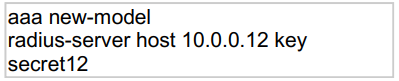
Question 57 Choose 1

Refer to the exhibit.

Which statement about the authentication protocol used in the configuration is true?

Show answerHide answer

Correct answer: C

The authentication and authorization requests are grouped in a single packet

Explanation

ExplanationThis command uses RADIUS which combines authentication
and authorization in one function (packet).

Question 58 Choose 1
In which cloud services model is the tenant responsible for virtual machine OS patching?
Show answerHide answer

Correct answer: A IaaS

Explanation

Explanation
This question tests the understanding of the shared responsibility model in cloud computing. The key is knowing which layers of the stack are managed by the cloud provider and which are managed by the tenant (customer).

IaaS (Infrastructure as a Service):
In this model, the cloud provider is responsible for the core infrastructure: the physical data center, network, storage, and servers. The tenant is responsible for everything on top of that, including the operating system, runtime, data, and applications. Therefore, patching the guest operating system of a virtual machine is the tenant's responsibility.

Why the other options are incorrect:

B. UCaaS (Unified Communications as a Service):
This is a specific type of SaaS for communication tools (e.g., Webex). The provider manages the entire application and its underlying platform and infrastructure. The tenant has no responsibility for OS patching.

C. PaaS (Platform as a Service):
In this model, the cloud provider manages the underlying infrastructure (servers, storage, network) and the operating system, middleware, and runtime environment. The tenant is only responsible for their application and data. The tenant does not have access to or responsibility for the OS.

D. SaaS (Software as a Service):
In this model, the cloud provider manages the entire application stack, from the infrastructure all the way up to the application itself. The tenant is only responsible for their use of the application and their data. The tenant has zero responsibility for any OS patching.

Reference:
The shared responsibility model is a fundamental concept for cloud security.

A common analogy used in Cisco and other cloud training is:

IaaS: The cloud provider is the landlord; you are responsible for everything inside your rented unit (the VM), including maintenance (patching).

PaaS: The cloud provider manages the building and utilities; you are only responsible for your business operations inside (the application).

SaaS: You are just a customer using a service; the provider manages everything.
Question 59 Choose 2

Which two deployment model configurations are supported for Cisco FTDv in AWS?
(Choose two)

Show answerHide answer

Correct answer: A, C

Cisco FTDv configured in routed mode and managed by an FMCv installed in AWS

Cisco FTDv configured in routed mode and managed by a physical FMC appliance on premises

Question 60 Choose 1
What is the result of running the crypto isakmp key ciscXXXXXXXX address 172.16.0.0 command?
Show answerHide answer

Correct answer: C authenticates the IKEv1 peers in the 172.16.0.0/16 range by using the key ciscXXXXXXXX

Explanation

Explanation for Each Option:
A. authenticates the IKEv2 peers in the 172.16.0.0/16 range by using the key ciscXXXXXXXX (Incorrect):
The crypto isakmp key command is specific to IKEv1 (Internet Key Exchange version 1) on Cisco IOS devices, not IKEv2. While IKEv2 uses a similar pre-shared key mechanism, this command syntax is tied to IKEv1 configuration. Thus, it does not authenticate IKEv2 peers, making this option incorrect. (Reference: Cisco IOS Security Configuration Guide, IKEv1 vs. IKEv2.)

B. authenticates the IP address of the 172.16.0.0/32 peer by using the key ciscXXXXXXXX (Incorrect):
The command specifies address 172.16.0.0 without a mask, which defaults to a /32 (single IP) in some contexts, but when followed by a subnet (implied /16 from 172.16.0.0 range), it applies to the 172.16.0.0/16 network. It authenticates a range of peers, not just 172.16.0.0/32, making this option inaccurate. (Reference: Cisco IOS IPsec Configuration Guide, ISAKMP Key Syntax.)

C. authenticates the IKEv1 peers in the 172.16.0.0/16 range by using the key ciscXXXXXXXX (Correct):
The crypto isakmp key ciscXXXXXXXX address 172.16.0.0 command configures a pre-shared key (ciscXXXXXXXX) for IKEv1 Phase 1 authentication. The IP address 172.16.0.0 without a mask implies a /16 range (172.16.0.0 - 172.16.255.255), authenticating all peers in this subnet, aligning with standard IKEv1 behavior on Cisco routers. (Reference: Cisco IOS ISAKMP Configuration Guide, Pre-Shared Keys.)

D. secures all the certificates in the IKE exchange by using the key ciscXXXXXXXX (Incorrect):
This command configures a pre-shared key for IKEv1 authentication, not certificate-based security. Certificate-based authentication uses crypto ca commands and relies on digital certificates, not pre-shared keys. The key here authenticates peers, not certificates, making this option a misinterpretation of the command’s purpose. (Reference: Cisco IOS PKI Configuration Guide, Certificate Authentication.)

Additional Notes:
The crypto isakmp key command is a key topic in the 350-701 SCOR exam under VPN technologies, configuring IKEv1 pre-shared keys. As of 09:12 AM PKT, October 02, 2025, this remains a standard configuration for site-to-site VPNs. For details, refer to the Cisco IOS Security Configuration Guide (cisco.com) and the 350-701 Exam Blueprint (Section 3.0 Security Concepts). More questions?

Note:
The key "ciscXXXXXXXX" appears to be a placeholder with truncated characters; I treated it as a valid pre-shared key for explanation purposes.
Full mock exam

Sit the 350-701 exam before exam day

Full-length mocks with the same number of questions and the same time limit as the real 350-701 exam. Every attempt draws a new set of questions from the full bank, so you can keep going until you pass comfortably.

Get full 350-701 mock exam
  • 90questions per mock
  • 120 mintime limit
  • 721questions in the bank
  • Newmock on every attempt