Show answerHide answer
Correct answer: D Option D
Explanation
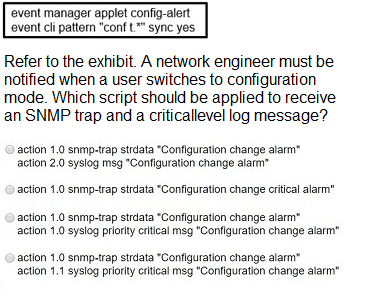
Explanation:The Cisco Embedded Event Manager (EEM) applet is triggered when a user enters configuration mode via the conf t command. The requirement is to generate both an SNMP trap and a critically level log message. For the log message to be sent at critical level, the syslog action must include the priority critical keyword. Additionally, the order of action labels (e.g., 1.0 and 1.1) is irrelevant as EEM executes actions sequentially based on the label numbering. Option D correctly configures two separate actions:
action 1.0 snmp-trap strdata "Configuration change alarm" – sends an SNMP trap with the specified string.
action 1.1 syslog priority critical msg "Configuration change alarm" – generates a syslog message at critical severity.
This meets the requirement of receiving both an SNMP trap and a critical-level log message.
Why other options are incorrect:
A. Option A – This is missing the priority critical keyword, so the syslog message would be sent at the default severity (usually informational), not at critical level. This violates the requirement.
B. Option B – This only generates an SNMP trap and does not produce any syslog message. Without the syslog action, the critical-level log requirement is not fulfilled.
C. Option C– While this uses the priority critical keyword, it incorrectly applies it to the snmp-trap action. The priority critical parameter is only valid for the syslog action, not for snmp-trap. This would cause a syntax error and the applet would fail to execute properly.
References:
Cisco IOS Embedded Event Manager Command Reference: "syslog priority critical – Specifies the severity level of the syslog message"
Cisco EEM Configuration Guide: "The snmp-trap action generates an SNMP trap; the syslog action generates a syslog message with optional priority"