Refer to the exhibit.
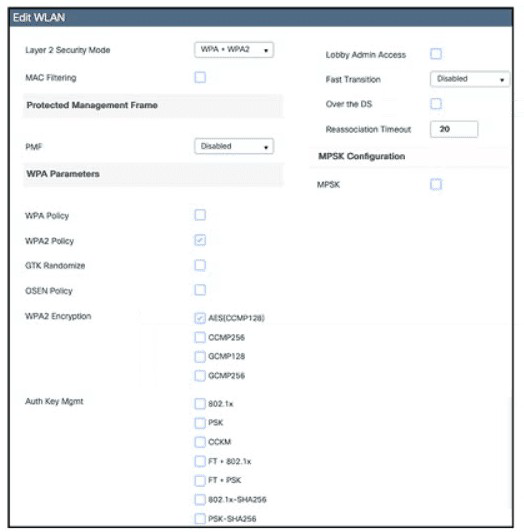
Which action must be taken to configure a WLAN for WPA2-AES with PSK and allow only 802.11r-capable clients to connect?
Which action must be taken to configure a WLAN for WPA2-AES with PSK and allow only 802.11r-capable clients to connect?
Show answerHide answer
Correct answer: B Enable Fast Transition and FT + PSK.
Explanation
✅ Explanation:To configure a WLAN for WPA2-AES with PSK and allow only 802.11r-capable clients to connect, the engineer must enable both the Fast Transition feature and the FT + PSK Authentication Key Management (AKM) setting. Here's why:
Fast Transition (802.11r) must be enabled globally on the WLAN to activate the feature.
FT + PSK is the specific AKM method that provides both the necessary security for a PSK-based network and the fast roaming capability. By selecting only this option and deselecting the standard PSK AKM, the WLC ensures that only clients that support 802.11r can authenticate.
This configuration ensures that legacy clients which do not support 802.11r and would attempt to use the standard PSK method are effectively blocked from connecting.
Why other options are incorrect:
A. Enable PSK and FT + PSK.
This would allow both 802.11r-capable clients (using FT+PSK) and non-802.11r clients (using standard PSK) to connect, which violates the requirement to allow only 802.11r-capable clients to connect.
C. Enable Fast Transition and PSK.
This enables the Fast Transition feature globally but would still allow non-802.11r clients (using standard PSK) to connect. Additionally, to use Fast Transition, the FT + PSK AKM must be selected, not just the standard PSK method.
D. Change Fast Transition to Adaptive Enabled and enable FT + PSK.
"Adaptive" Fast Transition allows both 802.11r and non-802.11r clients to connect, which contradicts the requirement to allow only 802.11r-capable clients.
🔗 References
Cisco Wireless Configuration Guide: Selecting only the FT + PSK AKM restricts the WLAN to 802.11r-capable clients only, while non-802.11r clients are rejected.
Cisco Community Best Practices: Enabling Fast Transition with FT + PSK is the correct approach to ensure only 802.11r-capable clients can connect.