Salesforce certification · Exam Salesforce-MuleSoft-Developer

Salesforce-MuleSoft-Developer Mock Exam

Salesforce MuleSoft Developer - Mule-Dev-201

Free Salesforce-MuleSoft-Developer questions on DataWeave Transformations, each with the answer and an explanation.

20 questions · 33 minutes · free, no sign-up

DataWeave Transformations questions

1–6 of 6 free
Question 1 Choose 1
A Mule project contains a DataWeave module like WebStore.dwl that defines a function named loginUser. The module file is located in the project's src/main/resources/libs/etl folder. What is correct DataWeave code to import all of the WebStore.dwl file's functions and then call the loginUser function for the login "Todd.Pal@mulesoft.com"?
Show answerHide answer

Correct answer: D 1. 1. import * from libs::etl::WebStore 2. 2. --- 3. 3. loginUser("Todd.Pal@mulesoft.com")

Explanation

Explanation:

In DataWeave 2.0, to import functions from a module file, you use the import directive. The path is constructed using double colons :: to represent directory separators, and the file extension (.dwl) is omitted.

Breaking down the correct import:
Module location: src/main/resources/libs/etl/WebStore.dwl

The src/main/resources directory is the root for DataWeave modules.
Therefore, the module path is: libs::etl::WebStore

import * from libs::etl::WebStore imports all functions from that module into the current namespace, allowing you to call loginUser() directly.

Why the other options are incorrect:
A) import libs.etl – This is invalid syntax. DataWeave uses :: separators, not dots. Also, you must specify the filename (WebStore), not just the folder.

B) import * from libs::etl – This tries to import from a directory (etl), not a module file (WebStore). You must import from the specific .dwl file.

C) import libs.etl.WebStore – Uses dot notation (.) instead of the correct double colon (::) syntax.

Key DataWeave Module Import Rules:
- Path separators are ::, not . or /.
- Omit the .dwl extension in the import statement.
- The path is relative to src/main/resources.
- import * from imports all functions so they can be called directly by name.

Reference:
This follows DataWeave 2.0 documentation on module imports, specifically the syntax for importing from custom modules in the resources folder. The pattern import * from some::path::ModuleName is standard.
Question 2 Choose 1
Which keyword do you use to create a new function in DataWeave?
Show answerHide answer

Correct answer: B fun

Explanation

Explanation:

✅ Correct Option:

B. fun
In DataWeave, the keyword fun is used to define a new function. This is the official and syntactically correct declarative keyword for creating anonymous functions, which can be assigned to variables or used inline. For example: var myFunction = fun(x) -> x * 2.

❌ Incorrect Options:

A. function
This is incorrect. While function is a common keyword in many other programming languages like JavaScript, it is not the keyword used for function definition in the DataWeave language. Using function will result in a syntax error.

C. func
This is incorrect. func is an abbreviation sometimes used in other languages but is not valid syntax in DataWeave. The language specification requires the use of fun to declare a function.

D. map
This is incorrect. map is a higher-order function in DataWeave used to apply a transformation to every element of an array. It is not a keyword for creating a new function but rather a function that consumes another function as an argument.

📋 Summary:
DataWeave has its own specific syntax for function definition. To create an anonymous function, the correct and required keyword is fun, followed by the parameters and the function body. This is a fundamental part of the language's syntax for defining reusable transformation logic.

🔗 Reference:
MuleSoft Documentation: DataWeave - Functions (The documentation shows examples using the fun keyword).
Question 3 Choose 1
An API instance of type API endpoint with API proxy is created in API manager using an API specification from Anypoint Exchange. The API instance is also configured with an API proxy that is deployed and running in CloudHub.

An SLA- based policy is enabled in API manager for this API instance.

Where can an external API consumer obtain a valid client ID and client secret to successfully send requests to the API proxy?
Show answerHide answer

Correct answer: A In the organization's public API portal in Anypoint Exchange, from an approved client application for the API proxy

Explanation

Explanation:

✅ Correct Option

A. In the organization's public API portal in Anypoint Exchange, from an approved client application for the API proxy 🟢
When an SLA-based policy (like Rate Limiting or Throttling) is applied, MuleSoft enforces client ID and client secret validation. These credentials are issued when an external API consumer registers their client application through the API portal in Anypoint Exchange. Once the application is approved, the client gets a valid client ID and client secret to access the API proxy successfully.

❌ Incorrect Options

B. In Anypoint Studio, from components generated by APIkit for the API specification 🔴
APIkit scaffolds flows in Anypoint Studio based on the API specification, but it does not provide client credentials for consumers. It is a developer tool for building APIs, not a distribution point for consumer authentication details.

C. In Anypoint Studio, from components generated by Rest Connect for API specification 🔴
Rest Connect helps generate reusable connectors from REST APIs but does not issue client IDs or secrets. Like APIkit, it is focused on simplifying integration, not consumer identity management.

D. In Runtime Manager, from the properties tab of the deployed approved API proxy 🔴
Runtime Manager shows deployment properties, logs, and monitoring details, but it does not provide client credentials. Only Anypoint Exchange, via the API portal, manages client applications and their credentials.

📘 Summary
In this case, the API proxy is deployed in CloudHub and protected by an SLA-based policy. API consumers must obtain valid client credentials. These credentials are created when the consumer registers and gets approval for their client application in the organization’s API portal in Anypoint Exchange. This ensures controlled and secure access to the API proxy.

🔗 Reference
MuleSoft Documentation – Managing Client Applications
Question 4 Choose 1
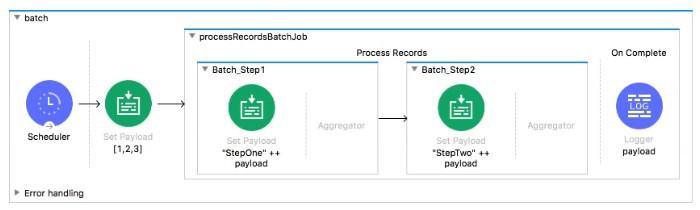
Refer to the exhibit.


What is the output payload in the On Complete phase
Show answerHide answer

Correct answer: A summary statistics with NO record data

Explanation

Explanation:

Let's break down the Batch Job behavior:

Batch Job Phases:
Process Records: Processes individual records through Batch Steps (Batch_Step1, Batch_Step2)
On Complete: Runs once after all records have been processed, providing summary statistics about the batch execution (e.g., total records, successful records, failed records)

Key Behavior:
The On Complete phase does not receive the processed record data as payload.
Its payload contains batch job summary information (metadata about the batch execution), not the actual records.
Record data flows only within the Process Records phase through Batch Steps.

What Happens in This Flow:
Scheduler sets payload to [1, 2, 3]
Batch Job starts

Process Records phase:
Each record (1, 2, 3) goes through Batch_Step1 → transforms to "StepOne" ++ payload
Then through Batch_Step2 → transforms to "StepTwo" ++ "StepOne" ++ original

Output would be ["StepTwoStepOne1", "StepTwoStepOne2", "StepTwoStepOne3"]

On Complete phase:
Receives batch summary, NOT the processed records
Contains stats like total records processed, successful count, failed count

Key Concepts Tested:
Batch Job phases (Process Records vs. On Complete)
Data flow in Batch Jobs
Understanding that On Complete receives summary metadata, not record data

Reference:
MuleSoft Documentation: Batch Job On Complete phase provides statistics about batch execution, not the processed records.

Analysis of Other Options:

B. The records processed by the last batch step: Incorrect. This would be the output of the Process Records phase, not the On Complete phase.

C. The records processed by all batch steps: Incorrect. This is also Process Records phase data, not On Complete phase data.

D. The original payload: Incorrect. Neither phase receives the original payload; Process Records receives individual records, On Complete receives summary stats.
Question 5 Choose 1
Which of the below functionality is provided by zip operator in DataWeave?
Show answerHide answer

Correct answer: A Merges elements of two lists (arrays) into a single list

Explanation

Explanation:

The zip operator (or function: dw::Core::zip()) in DataWeave is a fundamental array operation:

1. Functionality: It takes two arrays as input and combines them element-by-element, based on their position (index), into a single new array.
2. Output Structure: The resulting array contains sub-arrays (or pairs), where the $i$-th sub-array contains the $i$-th element of the first input array and the $i$-th element of the second input array.
3. Example: If you zip the array ["a", "b"] with the array [1, 2], the result is [["a", 1], ["b", 2]].
4. Size: The resulting array's size is equal to the size of the smallest input array; any trailing elements in the longer array are ignored.

This perfectly matches the description in Option A.

❌ Incorrect Answers
B. Used for sending attachments: This functionality is handled by specialized connectors, such as the Email Connector, or by processing multipart/form-data MIME types, which is entirely separate from DataWeave's core transformation logic.

C. Minimize the size of long text using encoding: This describes compression (like GZIP) or encoding (like Base64). Mule applications use the Compression Module for creating compressed files (like .zip files), which is a component/module, not the DataWeave zip operator.

D. All of the above: Incorrect since options B and C are false.

📚 References
DataWeave zip Function: The official MuleSoft documentation for the dw::Core module states that the zip function "Merges elements from two arrays into an array of arrays. The first sub-array in the output array contains the first indices of the input sub-arrays... and so on".
Question 6 Choose 1
A web client sends a request to http;//localhost:8081?dept=sales. What is the correct DataWeave expression to access the value of dept?
Show answerHide answer

Correct answer: A attributes.queryParams.dept

Explanation

Explanation:

In Mule 4, query parameters from an HTTP request are accessed through the message attributes in the queryParams map:

attributes contains all message metadata (headers, query params, URI params)

queryParams is a map within attributes containing all query parameters

dept is the specific query parameter name

So the correct DataWeave expression is: attributes.queryParams.dept

Key Concepts Tested:
Mule 4 message structure and attributes
Accessing HTTP query parameters
Difference between attributes, payload, and vars

Reference:
MuleSoft Documentation: Query parameters are accessed via attributes.queryParams.paramName.

Analysis of Other Options:

B. attributes.dept: Incorrect. Query parameters are not directly under attributes; they're in the queryParams map.

C. message.queryParams.dept: Incorrect. message scope doesn't exist in Mule 4 DataWeave expressions.

D. vars.dept: Incorrect. vars contains flow variables, not automatically populated query parameters. You would need to explicitly set a variable first using Set Variable.

That's the last free question in DataWeave Transformations

You've seen the free 30% (6 of 22 questions). Full access unlocks every question and full-length Salesforce-MuleSoft-Developer mock exams (65 questions, 105 minutes), a different mock on every attempt.

Unlock full mock exam
Full mock exam

Sit the Salesforce-MuleSoft-Developer exam before exam day

Full-length mocks with the same number of questions and the same time limit as the real Salesforce-MuleSoft-Developer exam. Every attempt draws a new set of questions from the full bank, so you can keep going until you pass comfortably.

Get full Salesforce-MuleSoft-Developer mock exam
  • 65questions per mock
  • 105 mintime limit
  • 234questions in the bank
  • Newmock on every attempt