Splunk certification · Exam SPLK-3003

SPLK-3003 Mock Exam Page 3

Splunk Core Certified Consultant

Free SPLK-3003 mock exam questions 21–25, each with the answer and an explanation.

20 questions · 33 minutes · free, no sign-up

Free SPLK-3003 questions

21–25 of 25 free
Question 21 Choose 1
What is required to setup the HTTP Event Collector (HEC)?
Show answerHide answer

Correct answer: A Each HEC input requires a unique name but token values can be shared.
Explanation

Explanation: Each HEC input requires a unique name but token values can be shared. The name is a human-readable identifier for the input that appears in Splunk Web. The name must be unique among all HEC inputs on the same Splunk platform instance. The token value is a string of alphanumeric characters that acts as an identifier and an authentication code for the input. You can use the same token value for multiple inputs, but it is recommended to use different tokens for different data sources or applications.
Question 22 Choose 1
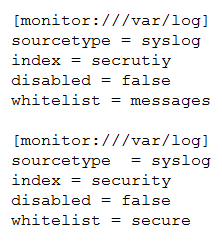
Consider the scenario where the /var/log directory contains the files secure, messages, cron, audit. A customer has created the following inputs.conf stanzas in the same Splunk app in order to attempt to monitor the files secure and messages:

Which file(s) will actually be actively monitored?
Show answerHide answer

Correct answer: D /var/log/secure, /var/log/messages

Explanation

Explanation: The inputs.conf stanzas in the image are attempting to monitor the files secure and messages in the /var/log directory. However, the whitelist attribute is set to “messages” and “secure” respectively, which means that only those files will be actively monitored. Therefore, the correct answer is D. /var/log/secure, /var/log/messages.
Question 23 Choose 1
As a best practice which of the following should be used to ingest data on clustered indexers?
Show answerHide answer

Correct answer: D splunktcp, splunktcp-ssl, HTTP Event Collector (HEC)
Explanation

Explanation: As a best practice, the following should be used to ingest data on clustered indexers: splunktcp, splunktcp-ssl, HTTP Event Collector (HEC). These are the methods that allow data to be sent to the indexers by forwarders or other data sources, without requiring any configuration on the indexers themselves. The indexers can receive the data on specific ports and index it according to the cluster settings. These methods also support load balancing and encryption of the data. Therefore, the correct answer is D. splunktcp, splunktcp-ssl, HTTP Event Collector (HEC).
Question 24 Choose 1
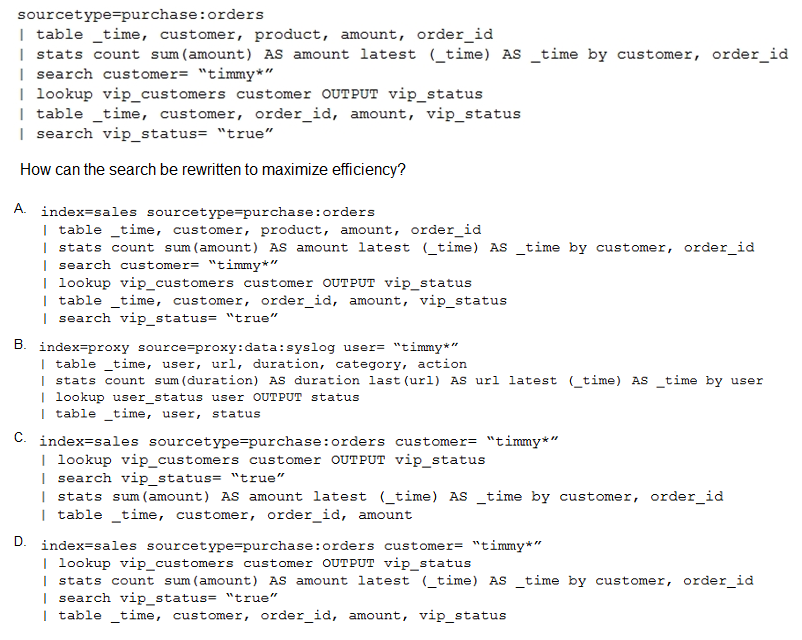
A customer has written the following search:
Show answerHide answer

Correct answer: C Option C

Explanation

Explanation: The search can be rewritten to maximize efficiency by using the index option. The index option is used to specify the index to search. This option is useful when you have multiple indexes and want to search only one of them. The index option is also useful when you want to search a specific index that is not the default index. The index option can reduce the search time and resource consumption by limiting the scope of the search.
Question 25 Choose 1
When monitoring and forwarding events collected from a file containing unstructured textual events, what is the difference in the Splunk2Splunk payload traffic sent between a universal forwarder (UF) and indexer compared to the Splunk2Splunk payload sent between a heavy forwarder (HF) and the indexer layer? (Assume that the file is being monitored locally on the forwarder.)
Show answerHide answer

Correct answer: B The UF sends a stream of data containing one set of medata fields to represent the entire stream, whereas the HF sends individual events, each with their own metadata fields attached, resulting in a lager payload.

Explanation

Explanation: The difference in the Splunk2Splunk payload traffic sent between a universal forwarder (UF) and indexer compared to the payload sent between a heavy forwarder (HF) and the indexer layer is that the UF sends a stream of data containing one set of metadata fields to represent the entire stream, whereas the HF sends individual events, each with their own metadata fields attached, resulting in a larger payload. This is because the UF does not parse or index the data before forwarding it, but rather sends it as raw data in 64K TCP chunks. The metadata fields, such as host, source, sourcetype, etc., are applied to the entire stream based on the inputs.conf configuration. The HF, on the other hand, parses and indexes the data before forwarding it, which means that it breaks the data into individual events and assigns metadata fields to each event based on props.conf and transforms.conf configuration. This results in a larger payload size, but also allows for more granular control over event processing and routing.

That's the last free question

You've seen the free 30% (25 of 85 questions). Full access unlocks every question and full-length SPLK-3003 mock exams (65 questions, 105 minutes), a different mock on every attempt.

Unlock full mock exam
Full mock exam

Sit the SPLK-3003 exam before exam day

Full-length mocks with the same number of questions and the same time limit as the real SPLK-3003 exam. Every attempt draws a new set of questions from the full bank, so you can keep going until you pass comfortably.

Get full SPLK-3003 mock exam
  • 65questions per mock
  • 105 mintime limit
  • 85questions in the bank
  • Newmock on every attempt