Splunk certification · Exam SPLK-3003

SPLK-3003 Mock Exam Page 2

Splunk Core Certified Consultant

Free SPLK-3003 mock exam questions 11–20, each with the answer and an explanation.

20 questions · 33 minutes · free, no sign-up

Free SPLK-3003 questions

11–20 of 25 free
Question 11 Choose 1
When can the Search Job Inspector be used to debug searches?
Show answerHide answer

Correct answer: A If the search has not expired.

Explanation

Explanation: The Search Job Inspector can be used to debug searches if the search has not expired. This means that the search artifact still exists on the search head and can be inspected for performance and error information. The Search Job Inspector can be accessed from the Job menu in Splunk Web, or by using the btool command with the job_inspector option. The search does not need to be running or queued to use the Search Job Inspector, as long as it has not expired. Therefore, the correct answer is A, if the search has not expired.
Question 12 Choose 1
A customer has the following Splunk instances within their environment: An indexer cluster consisting of a cluster master/master node and five clustered indexers, two search heads (no search head clustering), a deployment server, and a license master. The deployment server and license master are running on their own single-purpose instances. The customer would like to start using the Monitoring Console (MC) to monitor the whole environment. On the MC instance, which instances will need to be configured as distributed search peers by specifying them via the UI using the settings menu?
Show answerHide answer

Correct answer: C Search heads, deployment server, license master, cluster master/master node

Explanation

Explanation: The Monitoring Console (MC) is a Splunk app that provides a comprehensive view of the health and performance of a Splunk environment. The MC can be configured to monitor a single instance or a distributed deployment. To monitor a distributed deployment, the MC instance needs to be configured as a search head that can run distributed searches across the other instances in the environment. Therefore, the MC instance needs to have the other search heads, the deployment server, the license master, and the cluster master/master node as distributed search peers. The MC instance does not need to have the indexers as distributed search peers, because the cluster master/master node already provides access to the indexed data in the cluster. Therefore, the correct answer is C. Search heads, deployment server, license master, cluster master/master node.
Question 13 Choose 1
When using SAML, where does user authentication occur?
Show answerHide answer

Correct answer: C The Identity Provider (IDP) decodes the SAML request and authenticates the user.

Explanation

Explanation: When using SAML, user authentication occurs at the Identity Provider (IDP). The IDP is a system that verifies the user’s identity and provides a SAML assertion to the Service Provider (SP). The SP is a system that trusts the IDP and grants access to the user based on the SAML assertion. The SAML assertion contains information about the user’s identity, attributes, and authorization level.
Question 14 Choose 1
A customer has a multisite cluster (two sites, each site in its own data center) and users experiencing a slow response when searches are run on search heads located in either site. The Search Job Inspector shows the delay is being caused by search heads on either site waiting for results to be returned by indexers on the opposing site. The network team has confirmed that there is limited bandwidth available between the two data centers, which are in different geographic locations. Which of the following would be the least expensive and easiest way to improve search performance?
Show answerHide answer

Correct answer: A Configure site_search_factor to ensure a searchable copy exists in the local site for each search head.

Explanation

Explanation: The least expensive and easiest way to improve search performance for a multisite cluster with limited bandwidth between sites is to configure site_search_factor to ensure a searchable copy exists in the local site for each search head. This option allows the search heads to use search affinity, which means they will prefer to search the data on their local site, avoiding network traffic across sites. This option also preserves the disaster recovery benefit of multisite clustering, as each site still has a full copy of the data. Therefore, the correct answer is A, configure site_search_factor to ensure a searchable copy exists in the local site for each search head.
Question 15 Choose 1
Which of the following statements is true, as it pertains to search head clustering (SHC)?
Show answerHide answer

Correct answer: C SHC members must run on the same hardware specifications.
Explanation

Explanation: Splunk Data Model Acceleration (DMA) summaries are stored in summaryHomePath, which is an attribute in the indexes.conf file that specifies the location of the summary files for data model acceleration. By default, the summaryHomePath is set to $SPLUNK_DB//summary, where $SPLUNK_DB is the root directory for all index data. The summary files are CSV files that contain precomputed summary data relevant to the data model. Therefore, the correct answer is C, in summaryHomePath.
Question 16 Choose 1
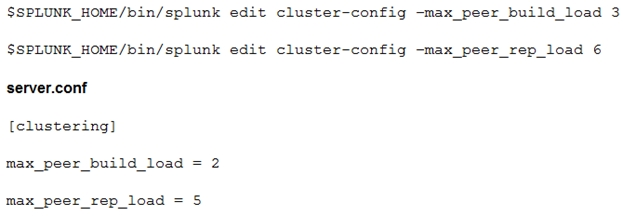
What should be considered when running the following CLI commands with a goal of accelerating an index cluster migration to new hardware?
Show answerHide answer

Correct answer: B Network latency and storage IOPS

Explanation

Explanation: Network latency is the time it takes for data to travel from one point to another, and storage IOPS is the number of input/output operations per second. These factors can affect the performance of the migration and should be taken into account when planning and executing the migration.

The CLI commands that you have shown in the image are used to adjust the maximum load that a peer node can handle during bucket replication and rebuilding. These settings can affect the performance and efficiency of an index cluster migration to new hardware. Therefore, some of the factors that you should consider when running these commands are:

Data ingestion rate: The higher the data ingestion rate, the more buckets will be created and need to be replicated or rebuilt across the cluster. This will increase the load on the peer nodes and the network bandwidth. You might want to lower the max_peer_build_load and max_peer_rep_load settings to avoid overloading the cluster during migration.

Network latency and storage IOPS: The network latency and storage IOPS are measures of how fast the data can be transferred and stored between the peer nodes. The lower these values are, the longer it will take for the cluster to replicate or rebuild buckets. You might want to increase the max_peer_build_load and max_peer_rep_load settings to speed up the migration process, but not too high that it causes errors or timeouts.

Distance and location: The distance and location of the peer nodes can also affect the network latency and bandwidth. If the peer nodes are located in different geographic regions or data centers, the data transfer might be slower and more expensive than if they are in the same location. You might want to consider using site replication factor and site search factor settings to optimize the cluster for multisite deployment.

SSL data encryption: If you enable SSL data encryption for your cluster, it will add an extra layer of security for your data, but it will also consume more CPU resources and network bandwidth. This might slow down the data transfer and increase the load on the peer nodes. You might want to balance the trade-off between security and performance when using SSL data encryption.
Question 17 Choose 1
A customer with a large distributed environment has blacklisted a large lookup from the search bundle to decrease the bundle size using distsearch.conf. After this change, when running searches utilizing the lookup that was blacklisted they see error messages in the Splunk Search UI stating the lookup file does not exist. What can the customer do to resolve the issue?
Show answerHide answer

Correct answer: B The blacklisted lookup definition stanza needs to be modified to specify setting allow_caching=true.

Explanation

Explanation: The customer can resolve the issue by modifying the blacklisted lookup definition stanza to specify setting allow_caching=true. This option allows the lookup to be cached on the search head and used for searches, without being included in the search bundle that is distributed to the indexers. This way, the customer can reduce the bundle size and avoid the error messages. Therefore, the correct answer is B, the blacklisted lookup definition stanza needs to be modified to specify setting allow_caching=true.
Question 18 Choose 1
Consider the search shown below.

What is this search’s intended function?
Show answerHide answer

Correct answer: C To return all the web_log events from the web index that occur two hours before and after all high severity, denied events found in the firewall index.
Question 19 Choose 1
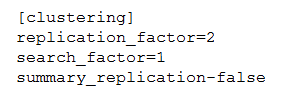
The customer has an indexer cluster supporting a wide variety of search needs, including scheduled search, data model acceleration, and summary indexing. Here is an excerpt from the cluster mater’s server.conf:

Which strategy represents the minimum and least disruptive change necessary to protect the searchability of the indexer cluster in case of indexer failure?
Show answerHide answer

Correct answer: D Increase replication_factor=3, search_factor=2 to protect the data, and allow there to always be a searchable copy.

Explanation

Explanation: This is the minimum and least disruptive change necessary to protect the searchability of the indexer cluster in case of indexer failure, because it ensures that there are always at least two copies of each bucket in the cluster, one of which is searchable. This way, if one indexer fails, the cluster can still serve search requests from the remaining copy. Increasing the replication factor and search factor also improves the cluster’s resiliency and availability. The other options are incorrect because they either do not protect the searchability of the cluster, or they require more changes and disruptions to the cluster.

Option A is incorrect because enabling maintenance mode on the CM does not prevent excessive fix-up, but rather delays it until maintenance mode is disabled. Maintenance mode also prevents searches from running on the cluster, which defeats the purpose of protecting searchability.

Option B is incorrect because leaving replication_factor=2 means that there is only one searchable copy of each bucket in the cluster, which is not enough to protect searchability in case of indexer failure. Enabling summary_replication does not help with this issue, as it only applies to summary indexes, not all indexes.

Option C is incorrect because converting the cluster to multi-site requires a lot of changes and disruptions to the cluster, such as reassigning site attributes to all nodes, reconfiguring network settings, and rebalancing buckets across sites. It also does not guarantee that there will always be a searchable copy of each bucket in each site, unless the site replication factor and site search factor are set accordingly.
Question 20 Choose 1
When setting up a multisite search head and indexer cluster, which nodes are required to declare site membership?
Show answerHide answer

Correct answer: A Search head cluster members, deployer, indexers, cluster master

Explanation

Explanation: The internal Splunk authentication will take precedence over any external schemes, such as LDAP. This means that if a username exists in both $SPLUNK_HOME/etc/passwd and LDAP, the Splunk platform will attempt to log in the user using the native authentication first. If the authentication fails, and the failure is not due to a nonexistent local account, then the platform will not attempt to use LDAP to log in. If the failure is due to a nonexistent local account, then the Splunk platform will attempt a login using the LDAP authentication scheme.
Full mock exam

Sit the SPLK-3003 exam before exam day

Full-length mocks with the same number of questions and the same time limit as the real SPLK-3003 exam. Every attempt draws a new set of questions from the full bank, so you can keep going until you pass comfortably.

Get full SPLK-3003 mock exam
  • 65questions per mock
  • 105 mintime limit
  • 85questions in the bank
  • Newmock on every attempt